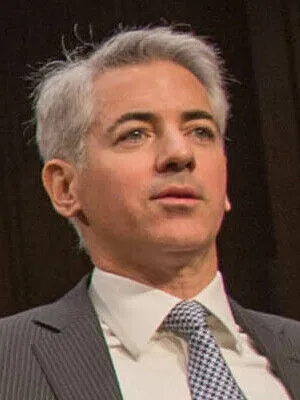
Bill Ackman
Human Design Chart
Biography
He received a Bachelor of Arts degree magna cum laude from Harvard College in 1988, and an MBA from Harvard Business School in 1992. In 1992, Ackman founded with a fellow Harvard graduate the investment firm Gotham Partners, which made small investments in public companies. In 1995, Ackman's reputation was enhanced when he partnered with the insurance and real estate firm Leucadia National to bid for Rockefeller Center. Although they did not win the deal, the high profile nature of the bid caused investors to flock to Gotham Partners growing it to $500 million in assets by 1998.
In 2004, with $54 million in funding from his personal funds and from his former business partner Leucadia National, Ackman started Pershing Square Capital Management. In 2005, Pershing bought a significant share in the fast food chain, Wendy's International and successfully pressured them to sell its Tim Hortons doughnut chain. Wendy's spun off Tim Horton through an IPO in 2006 and raised $670 million for Wendy's investors. After Ackman sold his shares at a substantial profit.
His funds have since bought large stakes in Target Corporation, Borders Group and Barnes & Noble.
Ackman has given to charitable causes such as the Center for Jewish History to preserve Jewish genealogy, and the Innocence Project in New York City and Centurion Ministries in Princeton, N.J. (both groups are dedicated to investigating the cases of people who have been wrongfully convicted). Ackman is a signatory of The Giving Pledge committing himself to give away at least 50% of his wealth to charitable causes.
He married Karen Ann Herskovitz, a landscape architect, on July 10, 1994. They have three children.
Human Design Analysis: Bill Ackman as Manifesting Generator 2/4
Manifesting Generator 2/4 — Design at a Glance
Bill Ackman's design tends towards lightning-fast implementation, which only proves sustainable when based on inner consent. As an Manifesting Generator, he had constant sacral energy combined with the ability to skip steps through linked Motor and Throat Centers. This configuration allowed him to quickly draw things into his life but also risked skipping important stages or starting too many projects simultaneously.
Without the strategy of Responding – waiting for impulses rather than initiating on a whim – this speed often led to frustration, which is the non-self theme of his type. The challenge was not just being fast but ensuring that his sacral center gave a clear 'yes' at every step. Only by reacting to life's impulses and regularly checking if his inner authority still approved of the current path could he maintain his creative drive.
With correct application, this potential overloading turned into a productive play mode. Parallel processing of various tasks was not an obstacle but a source of deep satisfaction as long as variety and fun were prioritized. The urge to finish one thing before starting another contradicted his nature; instead, his energy flourished in the dynamic interaction of several equally interesting fields, provided he remained true to the rhythm of his own reactions.
Emotional Authority
Bill Ackman's design tends towards not making decisions on a first impulse but subjecting them to emotional maturation. His inner authority resides in the defined Solar Plexus Center – the emotional authority. This mechanism holds regardless of all other defined centers in his chart; the emotional wave always takes precedence in decision-making.
Ackman was marked by constant ups and downs of emotions. The world appeared differently colored depending on his current mood: a topic could be enthusiastically embraced as highly relevant one moment, then dismissed or negatively assessed the next. This immediate emotional reaction was only a snapshot, not final truth. Decisions made from this fleeting feeling carried the risk of proving wrong later since they were based on transient waves.
His design's mechanics thus demanded patience and strategic hesitation. It was necessary to 'play it cool' and rethink decisions multiple times or even sleep on them. Only when initial emotional intensity subsided and calmness set in could clarity emerge. This process of emotional distancing allowed Ackman to recognize deeper connections beyond the first, often misleading impression. Long-term course corrections required this temporal distance to ensure that the choice was based on a stable inner truth rather than a passing mood.
The 2/4 Profile — Hermit / Opportunist
Bill Ackman's design tends towards a pendulum balance between deep withdrawal and social engagement. He showed himself as someone who needed constant switching between the need for solitude and the desire for community. This dynamic results from his Profile 2/4, the Natural Talent-Networker. Line 2 defends individuality with a clear stance: 'I know.' It protects the inner space from interference since preserving one's identity is paramount here. Simultaneously, Line 4 brings revolutionary principles and human rights into his network. It seeks support for these values externally.
For Bill Ackman, it was crucial to create a safe environment where he could clearly communicate his availability limits. He needed to signal: 'Now I want company' or 'Now I'm withdrawing.' During his alone time, he delved into internal processes to find peace and clarity. Once this need for withdrawal was satisfied, the social element of Line 4 became active again. He then sought targeted contact with his trusted network. This cycle allowed him to reflect on his network's knowledge in isolation, evaluate it, and develop precise ideas from it. The tension between protecting oneself and disseminating revolutionary content shaped how he interacted with his environment.
Split Definition — Defined & Open Centers
Bill Ackman's Human Design profile is characterized by an extraordinary inner stability: Seven of the nine centers are defined, creating a constant, autonomous presence in thinking, identity, and energy. This system does not rely on external validation for willpower or well-being but operates from a stable internal architecture.
The defined Head and Ajna Centers generate a persistent mental pressure to question things and understand concepts. This process is not a fleeting inspiration but a permanent mental function that generates ideas and theories. Combined with the defined G Center, Bill Ackman has a solid self-identity and a clear sense of direction in life. He knows who he is and where he's going without needing to prove it to others.
The energy foundation is established by the defined Sacral, Solar Plexus, and Root Centers. The Sacral Center provides a reliable source of vital energy based on reactions – not initiatives. The defined Solar Plexus ensures that emotional decisions are never made in the moment but only after waiting for the emotional wave to pass for clarity. The Root Center supplies constant pressure and stress resistance to push this life path forward.
Despite this strong structure, the Heart (willpower) and Spleen Centers (intuition/survival) remain open. This does not indicate weakness but a specific mechanism: Bill Ackman is not designed to generate willpower from himself or make spontaneous intuitive decisions. Instead, he takes on the pressure of his environment to be competitive or prove himself (open Heart), as well as fears about survival or lack of well-being (open Spleen). The challenge lies in not interpreting these conditioned impulses as his own truth. By relying on his defined emotional authority and sacral energy, he remains immune to the pressure to make promises or take spontaneous risks. His strength lies in patience, waiting for the emotional wave to pass before acting only when there is inner resonance – not out of fear or intellect.
Channels for powerful leadership, logic and emotional clarity.
Bill Ackman's Human Design profile tends towards constant, mutative impulses that initiate new directions through inner authenticity. This dynamic was primarily shaped by Channel 14-2 in his Personality Design. This channel connects the Sacral Center with the G Center: Gate 14 focuses on the availability of material resources to drive mutation, while Gate 2 provides higher knowledge to direct movement through space and time. As a 'key holder', Bill Ackman translated confident reactive living into innovative impulses that he transformed into material reality. His aura was supportive to others by helping them find their own direction as long as he remained open to life's responses.
In his design, Channel 34-20 supported this energy through the drive for manifestation guided by sacral reaction. Gate 34 provided raw physiological power, which Gate 20 in the Throat Center immediately expressed with potential. This created a powerful resource for creative life force and self-affirmation, but only sustained success if directed towards things that genuinely brought him joy.
Additionally, Channel of Logic 63-4 influenced his design with healthy skepticism. Gate 63 represented doubt while Gate 4 formulated patterns. This mind continuously filtered for consistency to ask questions and test answers, helping him serve the collective through well-thought-out predictions without mentally solving his own life.
Further influences came from Gates like Gate 8 (Contribution/Facilitation) and Gate 27 (Care/Self-preservation), emphasizing his ability for individual facilitation and caring warmth. Gates 15 (Collective Behavior) and 17 (Succession/Logic) rounded out the profile by promoting adaptation to natural rhythms and organization for the future. His design also included Gates 60 (Acceptance of Limitations) and 37 (Friendship/Community), highlighting his genetic role in care and support within group structures.
Individual Circuitry — Circuit Signature
Bill Ackman's Human Design profile tends towards pulsing, individual expression flanked by cool future logic and cyclical emotional reflection. As a Shared Definition, two separate energetic systems worked in parallel: The first connected Identity, Intellect, Voice, and Life Force; the second Emotion and Survival Instinct.
The Knowledge Circuit propelled his unique path forward. The structuring (Channel 43-23) formed new insights in the mind into a clear statement through speech. The Beat (Channel 2-14) gave this expression a rhythmic, emotional pulse from the Solar Plexus over identity. This created an acoustic transformative presence.
Parallel worked the Understanding Circuit with focused, emotionless logic. Channel 63-4 connected Head Center (inspirational intuition) directly to Ajna Center (rational mind). This allowed strategic thinking for the future free of emotional conditioning – a visual clear perspective on improvement.
The Sense Making Circuit processed past cyclically. Abstraction (Channel 64-47) and Recognition (Channel 30-41) linked Head, Mind, Emotion, and Root Center. Feelings from Solar Plexus were energized by the Root to allow collective learning from past experiences – a wave-like often inexplicable reflection.
The Integration secured survival in the present. Channel 20-34 connected Throat Center and Sacral Center: Power from reacting to life (Gate 34) was directly translated into voice (Gate 20). This allowed him to gain energy through immediate action and expression without delay.
Right Angle Cross of Explanation 2
Bill Ackmans Human Design shows a tendency towards strategic clarity and logical penetration. He is someone who unravels complex situations through rational analysis to create clear explanatory structures. This attitude stems from the configuration of the right cross in Explanation 2. In Human Design, this aspect describes the ability not only to recognize connections but also to formulate them so precisely and understandably that others can follow them. It's about the power of logic as a tool for ordering chaos.
The mechanics of this cross support a way of thinking based on facts and causal links. Bill Ackman used this energy to distill concrete insights from confusing information. His strength lay in distinguishing the essential from the non-essential and presenting it in a way that convinces and provides orientation. This is not mere intuition but a structured process of explanation that creates clarity where there was previously uncertainty. Through this rational approach, he could reduce complex issues to their core and thus establish a basis for informed decisions. The energy of this cross acts as a catalyst for understanding by translating abstract concepts into tangible logical argument chains.
Saturn Return · Uranus Opposition · Chiron Return · 2nd Saturn Return — Life Cycles
Bill Ackmans development is marked by three structural turning points: the establishment of his professional foundation, a radical new beginning, and later public confrontation. In 1992, at age 26, he completed his MBA at Harvard Business School and founded Gotham Partners. This first Saturn return cycle condensed years of groundwork into a solid career base.
Unique was the Uranus opposition in 2004: At 38, he broke with existing structures by founding Pershing Square Capital Management. This cycle often signals a necessary radical break or new beginning to fulfill one's potential.
The second Saturn return cycle occurred in 2024 when Ackman was 58 years old. He publicly expressed his resignation from Claudine Gay as President of Harvard University and tweeted about racism. This cycle often brings maturity tests or public crises where inner convictions must be brought to the fore. The sequence of these cycles illustrates a path from building a solid foundation through disruptive changes to a confrontational position in the public sphere, with each step fulfilling a specific structural function in his life journey.
Manifesting Generator · Emotional Authority — Synthesis
A central red thread runs through the design: the dynamic tension between internal pressure and external expression. The combination of manifesting generator type, defined Head and Ajna Centers, and numerous channels to the Throat Center points to someone constantly filled with ideas and impulses (Head, Ajna), but who can only correctly channel them through sacral reactions. This inner drive is evident in the Beat Channel (34/20) and the Structuring Channel (64/47), where energy and knowledge wait to be manifested – though only when strategy and authority (emotional wave) are involved. The repeated emphasis on 'reaction' rather than 'initiation' underscores this need for external stimuli to kick-start the inner motor to find authentic expression.
The central paradox lies in the connection between quick action and the need for deep emotional clarity. The design shows a person who can react swiftly to impulses (manifesting generator), but is simultaneously compelled by the emotional center to let decisions mature over time. This discrepancy between speed and thoroughness creates a tension field where it's necessary to align one's impulse with the necessity of emotional validation – an ongoing navigation between the urge for immediate manifestation and the inner wisdom that requires time to gain clarity.
6 Defined Channels
Incarnation Cross - Right Angle Cross of Explanation 2
Solar Return
The Solar Return shows the moment when the sun returns to its exact birth position - your personal solar year.
Life Cycles
Discover the life cycles with a detailed triple view (birth chart, cycle chart, composite).
Human Design Profile
- Strategy
- To respond - wait for something to respond to
- Authority
- Emotional Authority
- Profile
- 2/4 - Hermit / Opportunist
- Definition
- Split Definition
- Incarnation Cross
- Right Angle Cross of Explanation 2
- Date of Birth
- 11.05.1966 00:30
- Place of Birth
- Chappaqua, NY, United States
Frequently Asked Questions
What is Bill Ackman's Human Design type?
What Profile does Bill Ackman have in Human Design?
What authority does Bill Ackman possess?
What incarnation cross does Bill Ackman have?
When was Bill Ackman born?
Discover your own Human Design
Are you also a Manifesting Generator? Find out in a personal reading how to unfold your multi-talents and direct your energy wisely.
More Personalities
Back to overviewAldair

Alizée

Angeli

Arletty

Artus
Balthus