Photo: Wikimedia Commons
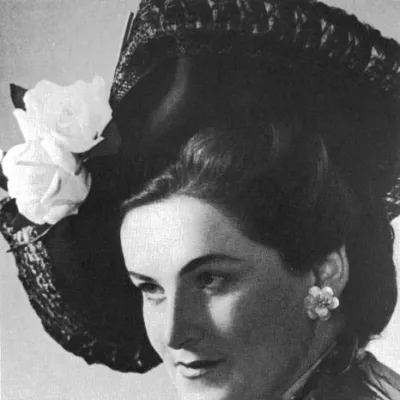
Birgit Nilsson
Human Design Chart
Biography
Her family needed her on the farm when she was young, but she broke away anyway to study in Stockholm. Her father objected, but her mother funded her with a legacy.
Nilsson married Swedish restaurateur Bertil Niklasson on 10 September 1949. She died on 25 December 2005 in Vastra Karup, Sweden, aged 87. Before she died she named Placido Domingo the recipient of the first prize in her name, to be awarded after her death, for "unrivaled contributions to the world of opera." Domingo was notified of the $1 million award in October 2009.
Human Design Analysis: Birgit Nilsson as Manifesting Generator 2/4
Manifesting Generator 2/4 — Design at a Glance
Birgit Nilsson was characterized by a hybrid energy configuration. Her design combined the constant power of the Generator with the ability to skip steps. She had a steady internal energy source that only became effective when reacting to external impulses rather than initiating on her own. This reaction allowed her to quickly draw new situations into her life.
However, this speed brought specific challenges. Often, she would skip necessary intermediate steps, leading to the need to return later and make up for missing foundations. This process could lead to frustration if the pace was not controlled. Additionally, she tended to pursue multiple projects simultaneously, driven by various internal signals. If her inner authority and strategy did not align, the joy of creation quickly turned to exhaustion.
The key to her satisfaction lay in constantly reviewing her impulses. Only when her inner energy gave a clear 'yes' to a task could she effectively use her strength. Under these conditions, she developed a playful approach to her work. Parallelism then became an advantage, as variety sustained her energy. She derived deep satisfaction from her work as long as she remained in the flow of reaction and did not work against her inner resonance.
Emotional Authority
Birgit Nilsson never made decisions in the heat of the moment. Her inner authority lay in the defined emotional center, meaning she was constantly under a wave of emotional ups and downs. The world appeared to her colored by her current mood: a moment of enthusiasm could turn into deep skepticism in the next. This design required a specific strategy: patience. Since her immediate feelings often were only snapshots and not the final truth, she risked grave errors with quick, spontaneous judgments. Instead, she let decisions mature. She took time, slept on it multiple times, and consciously sought distance from her initial impulses. Only when the intense emotions subsided and emotional distance was gained, did the necessary clarity and calmness set in. This process of emotional maturation was central to all long-term, life-defining steps. Only through this conscious waiting and overcoming the first impression did she succeed in recognizing the deeper, more comprehensive truth behind fleeting emotional reactions and making solid, sustainable decisions.
The 2/4 Profile — Hermit / Opportunist
Birgit Nilsson was characterized by the Profile 2/4, which was marked by a constant alternation between the need for withdrawal and the desire for community. She needed phases of isolation to gain inner clarity before re-engaging in her network. This dynamic required clear communication of her boundaries: signaling when she sought company and when she wanted to be left alone.
Line 2, embodied by Gate 8, focused on selflessness and contribution to the collective. Birgit Nilsson often acted as a role model, where her natural talent came into unusual play. However, her service to group goals was fraught with the risk of not being recognized, which could lead to crises if the individual contribution could not be fulfilled.
At the same time, Line 4, represented by Gate 30, known as the 'burnout' line, pushed her to be influential in the network and seize opportunities. For projectors, this carries the risk of getting stuck in the repetition of intense feelings. While analytical thinking promoted positive results, emotional overload could lead to breakdowns. Birgit Nilsson used her alone time to reflect on experiences from her social environment and develop new insights, thereby balancing the tension between seclusion and network work.
Split Definition — Defined & Open Centers
Birgit Nilsson revealed herself as someone who possessed a reliable, stable identity and a clear inner direction. Her defined G Center gave her a deep sense of self-worth and the ability to speak her own truth, supported by her defined Throat Center. This configuration created a consistent form of communication that was not dependent on external opinions but spoke from her Higher Self. This stability was complemented by her defined Heart Center, which gave her the willpower and strength to keep promises and determine her own resources. She had the energy to actively shape her life and take responsibility.
At the same time, her design was marked by a complex emotional and energetic dynamic. Her defined Solar Plexus served as an inner authority; decisions required patience to wait out the emotional wave until clarity emerged. This contrasted with her open mental centers. The open Head and Ajna Centers made her susceptible to external inspirations and mental confusion. She tended to identify with questions and concepts of others rather than trust her own emotional clarity. This could lead to an internal dialogue in which she questioned whether she had found the "right" answer or inspiration, which could distract her from the correct decision-making process.
Additionally, her open Spleen Center carried a fundamental survival fear and sensitivity to health and well-being. She was prone to clinging to people or situations that gave a false sense of security, or making spontaneous decisions to dispel fears. The wisdom of her design lay in not suppressing these fears but observing them without immediately following them, and instead waiting for confirmation from her Solar Plexus and the energy of her Sacral Center. Her defined Root Center provided the necessary pressure to move forward in the world, but required that this stress be channeled through her strategy to avoid degenerating into obsessive actions.
Channels for power, rhythm, presence, reflection, principles and determination.
Birgit Nilsson revealed herself as someone who, through persistent reaction to life, took a unique and innovative path. This attitude was rooted in her configuration: Beat 14-2 connected the generative energy of the Sacral Center with identity in the G Center. Gate 14 facilitated the handling of material resources for mutation, while Gate 2 as the driver directed movement through space and time. She possessed the keys to open new perspectives by trusting her inner reaction, even when the goal was unclear.
Her expression carried the quality of awakening. Channel Awakening 10-20 connected the G Center with the Throat Center. Here, individual knowledge transformed into proper action (Gate 20), tempered by a behavioral code that secured interactions (Gate 10). She spoke from the essence of being, lived in the now, and radiated a clarity that inspired others to be themselves, without her actively steering this process.
At the same time, Birgit Nilsson gathered experiences to distill deep truths from them. The Lost Son 13-33 connected listening and storing secrets (Gate 13) with withdrawal for reflection (Gate 33). She waited patiently until hidden connections beneath the surface revealed themselves before sharing her insights. This process of maturation gave continuity and stability to her contributions.
Emotionally, she was sensitive to her position within communities. The Synthesis 19-49 connected the pressure for belonging (Gate 19) with the rejection of the incompatible (Gate 49). She sought balance between feasibility and fairness to secure the cohesion of her "tribe."
On the material level, she mastered the Money Line 21-45. This channel connected the will for control and service (Gate 21) with the authoritative voice of possession (Gate 45). She worked hard but needed independence to follow her natural rhythm and take responsibility.
Her journey of discovery was marked by the Discovery Channel 29-46. Gate 29 offered the endurance of the Sacral Center through positive affirmation, while Gate 46 connected her to the right place at the right time. She had to let go of expectations to lose herself in the experience and ultimately gain significant insights.
Additionally, gates like Gate 8 (Contribution and Leadership), Gate 30 (Recognizing Feelings and Longings), and Gate 26 (Innovation in the Tribe) contributed to her complex dynamics. Gate 27 brought caring warmth, while Gate 52 called for concentration and pattern correction. Gate 15 established logical rhythms, and Gate 31 enabled the transmission of power.
Tribal Circuitry — Circuit Signature
Birgit Nilsson's Design featured a tendency towards rhythmic, pulsating expressive strength, drawing from the Knowledge Circuit. The active channel "The Beat" connected her Identity and Sacral Centers, creating a direct physical link between her essence and life force. This generated an inner stability that worked as a fundamental rhythm.
Parallel to this, the Meaning Circuit showed a strong emotional depth. The channels "The Lost Son" and "Discovery" linked her Throat, Identity, and Sacral Centers into a cohesive flow. This allowed her to not only reflect on past experiences and feelings but to directly translate them into her voice and actions. The energy flowed cyclically and wave-like, enabling her to share insights from the past and thus touch others.
In the Ego Circuit, there were two separate segments since there was no direct connection between them. On one hand, the channel "The Money Line" connected Throat and Heart Centers, suggesting a capacity for joint creation of resources through words and promises. On the other hand, the channel "Synthesis" linked Solar Plexus and Root Centers, connecting emotional waves with the need for pauses. This separation meant that her emotional processing and strategic resource acquisition worked as parallel, independent forces.
Finally, the channels of the Integration Circuit, specifically "Awakening," activated a connection between Throat and Identity Centers. This supported the ability to express intuitive impulses and reactions to life in the here and now clearly and self-determined. Overall, these shared but clearly structured energy fields shaped a personality that navigated between a deep inner rhythm, emotional reflection, and strategic communication.
Right Angle Cross of Contagion 2
Birgit Nilssons Human-Design profile indicated a tendency towards a deep, often painful identification with the suffering of others. She was someone who not only observed the fate of others but also carried it internally as her own. This attitude stemmed from the right side of the infection cross, a configuration that describes a high level of empathy and a nearly physical resonance with the emotional or physical distress of her surroundings. Instead of remaining detached, Birgit Nilsson absorbed these energies, which strongly influenced her perception and well-being. It was not about actively helping in a strategic sense, but rather about passively experiencing the states surrounding her. This mechanism meant that her inner world was heavily influenced by the feelings and pains of the people she encountered. The boundary between her own and others' experiences was permeable, leading to an intense but also burdensome internal processing. Birgit Nilsson lived this feeling by carrying the burdens of others, without always choosing to do so consciously. It was an inherent property of her system that made her vulnerable to the mood of her environment and challenged her own emotional stability.
Saturn Return · Uranus Opposition · Chiron Return · 2nd Saturn Return — Life Cycles
Birgit Nilsson was an artist whose life path was marked by clear cycles of maturation and public affirmation. Her Human-Design profile suggested a structure in which inner development condensed into concrete, visible milestones. In 1946, at the age of 28, her debut as Agathe in Weber's 'Freischütz' took place, marking the first Saturn Return, a time when years of hard work and discipline often lead to a solid, first major achievement. The energy of this cycle helped lay the foundations for a sustainable career.
Later, in 1959 at the age of 41, she conquered the Metropolitan Opera in New York as Isolde, corresponding to the Uranus Opposition, a moment of sudden expansion and breakthrough that breaks existing boundaries and opens up new, international horizons. Here, the ability to radically change and work in a new, larger arena was demonstrated.
The peak of this development occurred in 1968 when she was appointed an honorary member of the Vienna State Opera at the age of 50. This coincided with the Chiron Return, a fulfillment cycle of about two years. During this phase, one's own incarnation cross increasingly unfolds in life, provided one has lived according to their own strategy. Meaning and purpose become experiential, and long-term work finds its logical, worthy affirmation. Nilssons career thus demonstrated the sequential effect of these astrological influences on her human design.
Manifesting Generator · Emotional Authority — Synthesis
Birgit Nilsson lived a life characterized by a profound inner dynamism. As a Manifesting Generator with emotional authority and the Profile Natural Talent/Networker, she seemed to possess a constant energy source (Sacral Center) that was, however, always subject to the flow of her emotions. This emotional wave required time for decision maturation, while her design simultaneously brought the ability to quickly initiate things and effect change. The right side of the infection cross points to a natural ability to influence and carry others along, which was evident in documented career events.
A central paradox in her design lay in the tension between the need for inner peace and the desire for connection. The profile suggests a pendulum swing between withdrawing into her own world (Line 2) and exchanging with a chosen circle (Line 4). This was reinforced by the combination of the Knowledge Circuit, which promotes individuality and transformation, and the sacral energy, which reacts to external impulses. This interaction between the drive for uniqueness and the ability to connect with others shaped her personality.
6 Defined Channels
Incarnation Cross - Right Angle Cross of Contagion 2
Solar Return
The Solar Return shows the moment when the sun returns to its exact birth position - your personal solar year.
Life Cycles
Discover the life cycles with a detailed triple view (birth chart, cycle chart, composite).
Human Design Profile
- Strategy
- To respond - wait for something to respond to
- Authority
- Emotional Authority
- Profile
- 2/4 - Hermit / Opportunist
- Definition
- Split Definition
- Incarnation Cross
- Right Angle Cross of Contagion 2
- Date of Birth
- 17.05.1918 14:45
- Place of Birth
- Torekov, SWED
Frequently Asked Questions
What was Birgit Nilsson's Human Design type?
What Profile did Birgit Nilsson have in Human Design?
What Authority guided Birgit Nilsson?
What incarnation cross did Birgit Nilsson have?
When was Birgit Nilsson born?
Discover your own Human Design
Are you also a Manifesting Generator? Find out in a personal reading how to unfold your multi-talents and direct your energy wisely.
More Personalities
Back to overviewAaliyah

Aldair
Alexia

Alizée

Angèle

Angeli