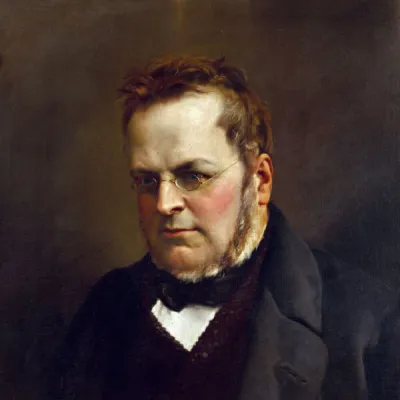
Camillo Cavour
Human Design Chart
Biography
Cavour put forth several economic reforms in his native region of Piedmont in his earlier years, and founded the political newspaper Il Risorgimento. After being elected to the Chamber of Deputies, he quickly rose in rank through the Piedmontese government, coming to dominate the Chamber of Deputies through a union of left-center and right-center politicians. After a large rail system expansion program, Cavour became prime minister in 1852. As prime minister, Cavour successfully negotiated Piedmont's way through the Crimean War, Second Italian War of Independence, and Garibaldi's expeditions, managing to maneuver Piedmont diplomatically to become a new great powerin Europe, controlling a nearly united Italy that was five times as large as Piedmont had been before he came to power.
He died 6 June 1861.
Human Design Analysis: Camillo Cavour as Projector 5/1
Projector 5/1 — Design at a Glance
Camillo Cavour was someone who immediately spotted weaknesses in systems. As a Projector, he had a dense, focused aura that shone like a bright light beam directly onto areas of his environment that were still dark or not functioning properly. This ability to instantly recognize flaws in the system was his natural tool for bringing 'light into darkness' and illuminating paths for others.
However, this direct perception required sensitivity. If he had addressed his observations bluntly right away, it would often have been perceived as unpleasant by others – similar to shining a flashlight directly into someone's face. The more elegant expression of his nature was to attract people through his own harmony, so that they approached him automatically and asked for his insights. His strategy therefore lay in waiting for genuinely appreciative invitations from others before taking on a leadership role.
Since his sacral center was undefined, Camillo Cavour did not have a constant, intrinsic source of life energy. Instead, he experienced phases of high activity and fast work speed that had to be accompanied by rest periods to prevent burnout. Living according to this design rewarded him with success; deviating from it sooner or later led to the non-self theme of bitterness.
Splenic Authority
Camillo Cavour demonstrated decision-making based on an immediate physical alarm feeling. His inner authority lay in his defined Spleen Center, which presupposed that both his Emotional and Sacral Centers were open – a characteristic only Projectors or Manifestors exhibit. The Spleen served as his health and alert system with pronounced survival intelligence. It provided spontaneous internal knowledge about whether a situation, environment, or society was right for him. His instinct and physical well-being acted as reliable indicators; the first, spontaneous impulse was considered correct and protected him directly from harmful influences. However, this Spleen impulse was very subtle and occurred only once in the moment. It could easily be drowned out or ignored by other voices, making high vigilance necessary. Since Camillo Cavour knew what was right for him only at that moment, his plans often changed last-minute. Long-term commitments were difficult; he needed a lot of space and flexibility to avoid unnecessary binding. A temporary retreat supported the clarity of decision-making, as this allowed the subtle impulse of the Spleen Center to be perceived without being overlaid by external expectations.
The 5/1 Profile — Heretic / Investigator
Camillo Cavour was someone who used deep, independent knowledge to offer solutions for complex problems to others. His design as a 5/1er – Hero/Researcher – gave him almost magnetic appeal: Others actively sought his expertise and expected answers to their pressing questions. This dynamic created tension; without clear boundaries, he risked being exhausted by the constant demands of others, similar to a scientist confronted with an overflowing inbox at the end of a long day.
His profile combined the introspective depth of Line 1 with the authoritative projection of Line 5. In crisis situations, he was seen as a potential 'General' or temporary sole ruler who should exercise absolute authority to solve the problem and then withdraw. This role carried the risk of becoming a scapegoat if high expectations were not met. Moreover, his powerful expression of new insights could undermine established values and have negative consequences when these ideas were introduced into existing structures. Cavour had to learn to say no in order to maintain a beneficial balance between his own research work for himself and problem-solving for the collective. Only then could he optimally utilize his gifts without being drained by endless demands from others.
Split Definition — Defined & Open Centers
Camillo Cavour was characterized by a design that combined mental clarity with strong willpower. His defined Head and Ajna centers created a constant internal pressure to question and form concepts; he thought permanently in specific patterns. However, this inspiration did not have to be implemented immediately as there was no direct energy available to bring thoughts into the world solely through intellect. Instead, he used his defined Throat center to carry these mental processes outward as clear communication and action.
His defined Heart Center gave him reliable willpower. He could make promises and keep them, which strengthened his self-esteem and helped him control resources autonomously. This was complemented by a defined G Center, giving him a firm identity and a clear sense of direction, along with a defined Spleen Center that allowed spontaneous intuitive judgments in the moment.
At the same time, Cavour was vulnerable to external influences in his open centers. His open Sacral center had no constant energy flow; it absorbed the vital energy of others and amplified it, which could lead to overexertion if he did not listen to his inner authority. Similarly, his open Solar Plexus absorbed emotional waves from the environment, putting him at risk of personalizing foreign feelings or avoiding confrontation out of fear of rejection. Additionally, his open Root center took on adrenalized stress from his surroundings, causing him to often rush unnecessarily or put himself under pressure to escape this feeling. His strength lay in using his defined mental and willful structure without being overwhelmed by the conditioning energy of his open centers.
Channels for logic, reflection, structure and devotion.
Camillo Cavour was characterized by a mind that used skepticism as a tool. The Logic channel 63-4 connected Head with Ajna center; it filtered patterns and asked questions until logical evidence was present. Unfounded belief found no space. Parallel to this, the Structuring channel 23-43 between Ajna and Throat assimilated spontaneous insights and clearly expressed them to increase efficiency. This innovative thinking required patience until it was accepted by the collective.
His strategic intelligence came from the Devotion channel 26-44 that connected Spleen with Heart center. Instinctive awareness identified tribal needs before they became conscious. Cavour used willpower and intuition to convincingly sell improvements – a typical stance of a capitalist or politician who generates resources.
Reflection and memory were shaped by the Lost Son channel 13-33 between G and Throat centers. He listened, gathered experiences, and withdrew to sort lessons before sharing them. This created continuity through patient observation rather than hasty action.
Additionally, gates like 7 (Leadership), 18 (Correction of political processes) and 48 (Pattern recognition) contributed to his ability to navigate hierarchies and analyze deeper connections. His design promoted a stance of serving leadership: he served the common good through logical organization and instinctive selling of ideas that strengthened the tribe.
Collective Circuitry — Circuit Signature
Camillo Cavours design laid a tendency towards structured, logical analysis that showed in separate energetic blocks. As someone with Split Definition, he did not have an uninterrupted connection between all defined centers; instead, two parallel power fields existed: one for cognitive processing and communication (Head, Ajna, Throat, and Identity center) and another for resource management (Heart and Spleen center). This separation meant that rational strategies did not automatically flow into tangible material results.
The Understanding Circuit connected the Head with the Ajna center through the Logic channel. This gave him the ability to filter visual future aspects through cool ratio and strategically plan. Parallel to this, the Knowledge Circuit structured the Ajna with Throat center via the Structuring channel. Here abstract knowledge was translated into clear verbal formulations, enabling precise articulation of his innovative ideas.
In the realm of meaning-making, the circuit connected the Throat with the Identity center through the Lost Son channel. This promoted a cyclical reflection on past experiences to gain emotional insights for personal identity. Finally, the Ego Circuit via the Devotion channel provided a connection between Heart and Spleen centers. This supported cooperative action and the joint creation of resources but required regular rest periods due to lack of Sacral energy.
Left Angle Cross of Masks 2
Camillo Cavours Human-Design shows the imprint of the left cross of masks. This configuration described a fundamental stance where one's own self often remained hidden behind a facade. Nothing was as it appeared on the surface; the true intention or identity lay beneath and eluded quick judgment by others.
This structure created an inner conflict between what was shown outwardly and what was actually felt or thought internally. It wasn't about malicious deception, but rather a deeply rooted necessity to protect the core of oneself by hiding behind roles or masks. As a result, one's own truth remained elusive and often misunderstood for the environment.
Camillo Cavour lived with this tension: He had to learn that his authenticity did not lie in immediate transparency, but in the ability to penetrate these layers or at least accept that others could only see him fragmentarily. The left cross of masks shaped his existence as someone constantly navigating between visibility and invisibility, where the true nature of his character often remained hidden from public expectations or superficial impressions.
Saturn Return · Uranus Opposition · Chiron Return — Life Cycles
Camillo Cavour emerged as a person who adopted a clear, action-oriented stance during times of crisis. His design indicated a tendency towards strategic approach, especially when external circumstances challenged him. This fundamental attitude became visible in 1850 at the age of 40 when he was appointed Minister for Agriculture and Trade. This career move fell into the phase of Uranus opposition, a time when new structures often assert themselves or existing roles need to be redefined. For his design, this was a moment where inner clarity met external demands and required a concrete positioning.
Ten years later in 1859 at the age of 49, the Chiron Return occurred. This cycle marks the bloom period of one's incarnation purpose if they have lived according to their strategy beforehand. In that year, Austria declared war on Sardinia – a crisis which for Cavour was not only a threat but also an opportunity to realize his life theme in reality. The Chiron Return is not a traditional healing process but rather a fulfillment cycle where meaning and purpose become tangible. For Cavour, this period showed how his long-term preparation met a decisive historical turning point that profoundly shaped his life.
Projector · Splenic Authority — Synthesis
Camillo Cavour was a Projector whose life seemed marked by a deep need to recognize patterns and make them accessible to others. The defined Mental Center (Head-Ajna) in conjunction with the Profile of Hero/Researcher points to someone constantly asking questions and seeking answers – an unending process of inspiration and understanding (Channel 63-4). However, this ability to clarify the unclear went hand-in-hand with a pronounced sensitivity for imbalances as he immediately recognized errors in the system.
This recognition of problems led to a central paradox: Cavour possessed the inner authority of the Spleen Center, a fine impulse towards self-preservation and delineation. Simultaneously, his knowledge circuitry was driven by the urge to share new insights and initiate transformation. The combination of instinctive self-care and the need to inspire others created tension between protecting one's own energy and pointing out improvement potentials in their environment.
4 Defined Channels
Incarnation Cross - Left Angle Cross of Masks 2
Solar Return
The Solar Return shows the moment when the sun returns to its exact birth position - your personal solar year.
Life Cycles
Discover the life cycles with a detailed triple view (birth chart, cycle chart, composite).
Human Design Profile
- Type
- Projector
- Strategy
- Wait for the respectful invitation
- Authority
- Splenic Authority
- Profile
- 5/1 - Heretic / Investigator
- Definition
- Split Definition
- Incarnation Cross
- Left Angle Cross of Masks 2
- Date of Birth
- 10.08.1810 17:45
- Place of Birth
- Turin, Italy
Frequently Asked Questions
What is Camillo Cavour's Human Design type?
Which Profile did Camillo Cavour have in Human Design?
What authority determined Camillo Cavour's decisions?
What incarnation cross was assigned to Camillo Cavour?
When was Camillo Cavour born?
Discover your own Human Design
Are you also a Projector? Find out in a personal reading how to unfold your leadership qualities and recognize the right invitations.
More Personalities
Back to overviewSissy Spacek
Alain-Fournier
Anémone
Ann-Margret

Bourvil
Hergé