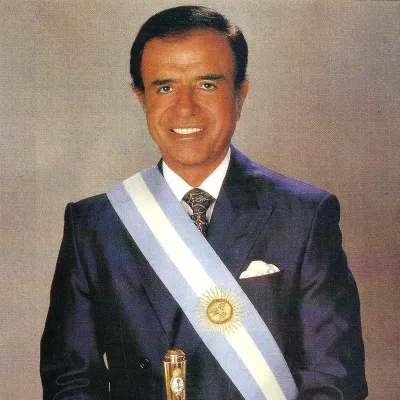
Carlos Menem
Human Design Chart
Biography
Born to a Syrian family, Menem was raised as a Muslim, but later converted to Roman Catholicism to pursue a political career.
He was investigated on various criminal and corruption charges, including illegal arms trafficking, (he was sentenced to seven years in prison), embezzlement of public funds (he was sentenced four and half years to prison), extortion and bribery (in both he was declared innocent). His position as senator earned him immunity from incarceration.
Carlos Menem married twice and had four children. When he died from urinary tract infection in Buenos Aires on 14 February 2021 at age 90, he was the oldest living former Argentine president.
Carlos Menem as a Generator 1/3 in Human Design
Generator 1/3 — Design at a Glance
Carlos Menem was someone with immense endurance who used his strength most effectively when he responded to impulses from his environment. As a Generator, he had abundant sacral energy that made him extremely strong and resilient – provided this energy was put towards tasks that resonated internally with him. His motto wasn't initiating but responding: He waited for signals from life until his inner self gave a clear 'yes', then acted in response.
This mechanism protected him from the typical pitfalls of his type. If he did things that didn't suit him or went against his internal resonance, he risked wasting energy and burning out. Equally frustrating was being held back from his heart project when he still had plenty of power to keep working on it. When Carlos Menem lived in harmony with this design – by responding purely from the gut – he rewarded himself with a deep sense of fulfillment and satisfaction. If, however, he constantly initiated independently against his inner compass, that led sooner or later to persistent frustration and energy loss. His strength lay in finding the right answers to life's questions rather than posing them.
Sacral Authority
Carlos Menem lived as a Generator whose decision-making was shaped by sacral authority. This internal guidance came from his defined Sacral Center and manifested in physical reactions to external stimuli: a gut feeling or a noticeable surge of energy. His design required him to listen to these signals – often audible as grunts, hums, or simple 'mmms' – to know if something gave him energy or not.
With his open Emotional Center, the sacral authority could fully unfold its clarity; it wasn't overlaid by fluctuating emotional waves. This configuration simplified his process: He didn't need long analysis but reacted in the moment of contact. When his sacral motor kicked in, he felt vital and alive, with inexhaustible energy for the task at hand.
Additionally, the activated Spleen Center acted as a supportive instance. It gave him quick, instinctive access to his physical well-being. This connection enabled spontaneous reactions and decisions that came directly from the gut. Carlos Menem was born to immerse himself in tasks with great enthusiasm without needing to search for a higher purpose. The joy of work itself was his motivation, guided by this reliable, bodily perception.
The 1/3 Profile — Investigator / Martyr
Carlos Menem's design inclined towards empirical learning: He showed himself as someone who didn't just collect knowledge theoretically but validated it through direct practice and enduring setbacks. As a 1/3 Profile – Researcher and Experimenter – his life was marked by a dual dynamic. Line 1 demanded study and security; it drove him to analyze obstacles and selectively sort out negative influences before acting. But this planning energy alone wasn't enough. It had to connect with Line 3, which took the path of trial and error.
This configuration meant that Carlos Menem learned through confrontation with superior forces. Experiences of helplessness or futile efforts weren't final defeats but necessary steps to avoid dependencies and find his own way. When he made a decision or formed an opinion, it was based on double testing: theoretical preparation by Line 1 and practical verification by Line 3. His design challenged him to venture from pure planning into implementation, even if the feeling persisted that not everything was known yet. Only through this active experimentation could he bring about the 'mutation' his mind sought. His authority rested on having personally tested things – both in the head and in reality.
Single Definition — Defined & Open Centers
Carlos Menem was someone who was guided by a deep, physical intuition. His design featured defined centers: the Sacral Center for vital energy and the ability to react, as well as the Spleen Center for spontaneous existential judgments in the present moment. This configuration gave him an inner authority that did not rely on rational thinking but rather on an immediate 'yes' or 'no' from his body. He had a constant energy reserve that only worked reliably when he reacted – waiting until life asked him something, instead of initiating himself.
At the same time, Carlos Menem carried several open centers, making him vulnerable to conditioning. His open Head Center meant that he did not have a steady mental focus and could easily be absorbed by the questions or confusion of others. He tended to get lost in mental monologues when trying to find answers to problems that were not his own business. His open Ajna Center amplified this: he took on many ideas and opinions from his environment without needing to identify them as his truth, making him flexible but also confused.
His open G Center was particularly defining. Carlos Menem did not have a fixed identity or life direction in the traditional sense. Instead, he reflected the energy and expectations of those he interacted with. This led to his 'direction' often being determined from outside; he did not actively seek out a firm role but allowed himself to be shaped by initiations from his environment. When he found himself in the wrong place or an unsuitable relationship, he felt lost and desperately sought identity rather than recognizing that the problem was with the environment.
His open Heart Center showed another weakness: He was not designed to make promises or consistently bring willpower in terms of assertiveness. If he tried to assert himself or take on commitments to prove his worth, he fell into a cycle of self-doubt and failure due to lacking the necessary energy.
In summary, Carlos Menem lived best when he trusted his sacral reaction, followed his spleen-based intuition, and distanced himself from mental and emotional overload caused by his open centers. His path involved waiting for life to speak to him rather than taking the first step himself, without personalizing the identities and emotions of others.
Channels for care, life struggle and natural maturation.
Carlos Menem was someone who deeply carried responsibility for maintaining shared values and structures. This attitude stemmed from Channel 27-50, which combined selfless care with the defense of traditional laws. His aura naturally attracted trust, so he often acted as a provider and protector of his tribe. Simultaneously, Channel 68 (38-28) shaped him through a stubborn determination to follow his own path. He actively sought fights that embodied deeper meaning and resisted external forces to preserve his individual integrity. This channel gave him the energy to stand up for what he considered valuable, often against the status quo.
Another central aspect was his need for complete experience cycles, driven by Channel 72 (42-53). Carlos Menem had to go through experiences until a satisfying conclusion and reflect on them before starting anew. This process served to gain wisdom and avoid repeating mistakes.
Additionally, specific gates influenced him: Gate 39 brought the potential for mutation through provocation and analysis; Gate 21 focused on controlling material things in service of the community under the claim of respect; Gate 48 allowed deep pattern recognition but could lead to frustration; Gate 3 stood for necessary changes from confusion towards order; Gate 58 supplied energy for logical processes in experiments and perfection; and Gate 59 pursued a genetic strategy of binding and unification. These configurations shaped his actions through a combination of care, combative individuality, and cyclical learning.
Individual Circuitry — Circuit Signature
Carlos Menem's design inclined him toward instinctive alertness and the protection of his surroundings. He was someone who reacted to threats through inner intuition and physical reactions before rational analysis occurred. This resulted from his Simple Definition: The energies of Spleen, Sacral, and Root Centers formed a single, continuous flow.
The Knowledge Circuit connected his Spleen Center with his Root Center via the Life Struggle Channel (Gates 28-38). This created pulsing energy aimed at survival struggle and individual adaptation. Parallel to this, the Meaning Circuit worked through the Ripe Fruit Channel (Gates 42-53), linking the Sacral Center with the Root Center. Here it was about cyclic processing of experiences and sharing emotional insights from the past.
The Protector Circuit completed this picture via the Preservation Channel (Gates 27-50), directly connecting Sacral and Spleen Centers. This configuration emphasized primordial instincts for preserving, nurturing, and defending one's genetics or family. Since all three circuits lay within the same energetic group, these forces did not act in isolation but as an integrated system: instinctive perception (Spleen) drove life force (Sacral) to act and protect under pressure (Root). Carlos Menem lived this mechanism through a constant, intuitive readiness for defense and preservation of his base.
Right Angle Cross of Tension 2
Carlos Menem's Human Design indicates a tendency towards internal conflict, which manifests in an ongoing oscillation between the desire for clear direction and the pressure to conform. This configuration corresponds to the right cross of tension two, a structure often referred to as "the cross of failure" or "the cross of proving." It describes a life task where Carlos Menem had to learn to cope with feelings of not belonging or being misunderstood.
The mechanics of this cross work through a field of tension between the necessity of living one's truth and external expectations. For Carlos Menem, this meant that periods of success were often accompanied by deep inner doubt. He was someone who could not simply accept his identity but had to question it repeatedly. This internal uncertainty was not a flaw but rather a driving force: it compelled him to constantly prove himself and secure his place in the world.
The right cross of tension two shapes an attitude that swings between pride and humility. Carlos Menem lived with the knowledge that external recognition does not automatically create inner security. His life task involved enduring this tension without either becoming arrogantly isolated or completely submitting. It was a path of proving oneself, where every step forward was accompanied by an internal struggle that significantly influenced his actions and decisions.
Saturn Return · Uranus Opposition · Chiron Return · 2nd Saturn Return — Life Cycles
Carlos Menem revealed himself as someone who reached his full structural authority in later life stages. His design indicated a tendency towards a late bloom, where earlier experiences and strategies could only reach their maximum effectiveness in advanced age. This corresponds to the second Saturn return, a cycle often considered in Human Design mechanics as the point at which years of inner work and adaptations condense into a stable, viable life structure. Instead of relying on external validation, his ability to act was strengthened by this cyclical maturation.
In 1989, at the age of 59, Carlos Menem was elected President of Argentina. This event marked for him the peak of this second Saturn phase: A moment when the long-term orientation of his design manifested in a concrete, public role – not as a sudden stroke of luck, but as a logical consequence of a life increasingly aligned with his inner strategy. The election was thus not an isolated success, but the visible expression of a maturation process where his personal authority and sphere of influence stabilized and came to prominence in harmony with the energetic conditions of his chart.
Generator · Sacral Authority — Synthesis
Carlos Menem was a Generator whose life was marked by an unstoppable urge to be active and the need to keep energy in motion. His sacral authority guided him through constant questioning of his inner reaction to external stimuli – a gut feeling that told him when to engage and use his power sources (Sacral Center). This principle combined with the Profile of the Researcher/Experimentor: he continually sought new experiences and knowledge, validating them through experimentation. The defined connection between Sacral Center and Spleen Center (Channel of Preservation) points to a deep rooting in traditional values and an ability to conserve resources for the tribe.
At the same time, a central paradox was revealed: although he was destined as a Generator to listen to his sacral energy and be driven by it, the right cross tension 2 indicates that he also struggled with internal conflicts and some indecision. The necessity of constantly exploring new things (Profile) could stand in relation to the preservation of existing structures (Channel 27-50) – a balancing act between the desire for innovation and the responsibility for proven methods. A documented event, his election as President in 1989, could be interpreted as an expression of this dynamic: taking a new direction while simultaneously relying on established foundations.
3 Defined Channels
Incarnation Cross - Right Angle Cross of Tension 2
Solar Return
The Solar Return shows the moment when the sun returns to its exact birth position - your personal solar year.
Life Cycles
Discover the life cycles with a detailed triple view (birth chart, cycle chart, composite).
Human Design Profile
- Type
- Generator
- Strategy
- To respond - wait for something to respond to
- Authority
- Sacral Authority
- Profile
- 1/3 - Investigator / Martyr
- Definition
- Single Definition
- Incarnation Cross
- Right Angle Cross of Tension 2
- Date of Birth
- 02.07.1930 06:20
- Place of Birth
- La Rioja (La Rioja), Argentina
Frequently Asked Questions
What is Carlos Menem's Human Design type?
Which Profile did Carlos Menem have in Human Design?
Which Authority guided Carlos Menem?
What incarnation cross was assigned to Carlos Menem?
When was Carlos Menem born?
Discover your own Human Design
Are you also a Generator? Find out in a personal reading how to use your sacral energy correctly and discover deep satisfaction.
More Personalities
Back to overviewAaliyah

Alexia

Angèle

Anne-Marie

Arcángel

Arno