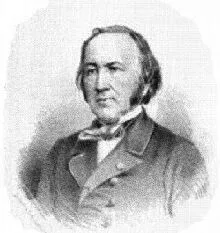
Claude Bernard
Human Design Chart
Biography
British physician Anna Kingsford, who became an impassioned anti-vivisectionist and a spiritualist, claims to have killed him along with Paul Bert with her "spiritual thunderbolts for torturing and baking animals to death."
Bernard died on 10 February 1878, Paris.
What does Generator 5/1 mean for Claude Bernard?
Generator 5/1 — Design at a Glance
Claude Bernard's design had a fundamental tendency towards reacting rather than initiating. As a Generator, he possessed considerable sacral energy that gave him high endurance – comparable to a robust workhorse with the strength to perform tasks only when motivated by their purpose. This energy did not unfold through self-driven initiative but exclusively in response to external impulses.
The central mechanics of his design required him to wait for signals from life and then act when his sacral center gave a clear "yes". This strategy of reacting was the key to his effectiveness. When Claude Bernard acted in harmony with this inner signal, he could materialize things sustainably and was rewarded with deep satisfaction and a sense of genuine fulfillment. No one could stop him if he followed this natural flow.
Conversely, deviating from this pattern led to specific risks. Two main pitfalls shaped his energetic potential: First, the risk of burnout when he invested energy in tasks for which he felt no inner resonance – a pure waste of his strength. Second, frustration when prevented from working on projects close to his heart despite having full energy available. If Claude Bernard initiated independently without an external trigger or suppressed his inner "yes", he would eventually encounter persistent frustration and a noticeable lack of energy. His path to effectiveness therefore always lay in waiting for the right moment and then acting with consequent, gut-driven response.
Sacral Authority
Claude Bernard's decision-making followed a clear internal logic: He reacted to external stimuli rather than proactively planning. His inner authority was the Sacral, meaning his strategy and decision support were identical. This greatly simplified his process. Instead of thinking in his head, he relied on physical resonance. These often manifested as loud grunts, hums or an agreeing "Hmm". Such signals marked the moment when his system became active.
Important for him was the pause. Only through brief waiting could he distinguish between mere reflex and a clear response. When this inner confirmation came, he felt a powerful surge of energy. He felt vital and alive, equipped with inexhaustible energy. In these moments, he immersed himself in his tasks driven by great enthusiasm. Acting freely from purpose-driven motivation; the joy of doing stood at the forefront, not the result.
With his Spleen center activated and possibly connected to the Sacral Center, he had a supportive instinctual authority. This allowed him particularly fast and spontaneous reactions. He had immediate access to his physical well-being and was reliably guided by this intuitive perception. His energy source therefore lay deep in the body, not in the mind. Through trusting this "gut feeling", he could act effectively without overburdening himself or fighting against his natural rhythm.
The 5/1 Profile — Heretic / Investigator
Claude Bernard's design created a specific tension: the magnetic attraction as a problem solver stood in contrast to the need for a profound, private research process. As Profile 5/1 (Hero/Researcher), he appeared to others like an expert offering treasures of knowledge that people urgently needed. This Line-5 characteristic drew inquiries and expectations towards him while his inner Line 1 aimed at deepening and securing knowledge for himself first.
The challenge lay in balancing these two poles. Without clear boundaries, overloading was imminent: The unbridled demand for solutions could quickly drain his energy, similar to an expert exhausted after hours of consultation with new questions already waiting. His design challenged him to develop the ability to say "no". Only through setting such limits could he reconcile serving others with deepening his own knowledge.
Gate 53 in his Line 5 connected assertiveness with fresh beginnings under high expectations; Neptune as amplification gave these starts a mystical quality, while Earth marked pragmatism and the risk of failure on new paths. Simultaneously, his Line-1 experience – characterized by diversification and completion – challenged him to conclude experiences without repeating them to gain security. Thus, Claude Bernard had to learn to carry out his commitments until the end without getting lost in expansion or neglecting the power of the Sacral Center. This protected him from exhaustion and allowed a sustainable use of his gifts.
Split Definition — Defined & Open Centers
Claude Bernard revealed himself as someone with a deeply rooted inner stability and a clear sense of direction. His design was characterized by defined centers: the G Center, which gave him a reliable identity; the Sacral Center, providing constant vital energy; and the Throat, Spleen, and Root Centers, enabling expression, spontaneous intuition, and forward-moving pressure. This mechanism meant that he did not initiate but rather reacted to what life brought him, supported by an intuitive perception in the present moment and a consistent expression of his truth.
In contrast, the Head, Ajna, and Heart Centers were open. This made him vulnerable to mental confusion and the pressure to find answers or concepts that did not originate from within himself. He tended to question whether he was inspired enough or if he needed to prove his intelligence. The open Heart Center led to the risk of making promises to demonstrate his value, even though the energy for this was not consistently available. Additionally, his open Solar Plexus absorbed and amplified emotions from the environment, leading him to interpret others' moods as his own internal state or avoid conflicts out of fear of rejection. His challenge lay in disentangling himself from these situational influences and instead trusting his inner authority and sacral reaction rather than mental pressure or a need for voluntary confirmation.
Channels for leadership, reflection, ambition and maturation.
Claude Bernard was a personality whose influence rested on recognizing logical patterns and making them accessible to the collective. His authority did not stem from imposing pressure but from being invited by his environment to take the lead. This aligned with the mechanics of the Alpha Animal Channel 7-31, connecting the G Center with the Throat Center. Gate 7 provided the logical role and understanding of societal trends, while Gate 31 spoke as a collective leader. His effectiveness depended on gaining the trust of the majority; only then could he articulate his visions. He functioned less as an autocrat but rather as someone who showed the way so long as the community followed.
Parallel to this, his life was marked by a deep need to fully experience situations and extract wisdom from them. The Ripe Fruit Channel 53-42 connected the Root Center with the Sacral Center, driving him to go through each cycle – whether a project or a relationship – from start to finish. Gate 53 initiated the beginning, while Gate 42 enabled growth and reflection. Only through this patient completion could he understand the hidden lessons of an experience and convey them to others. This process of maturation was essential for him to gain deep insights from mere experiences.
Additionally, the Lost Son Channel 13-33 also connected the G Center with the Throat Center. Here, Gate 13 gathered information and secrets as a listener, while Gate 33 withdrew to reflect on these data. This supported his ability to look beneath the surface and reveal truths only after careful consideration. The Transformation Channel 54-32 further propelled him through ambition and the desire for recognition. Gate 54 in the Root Center sought opportunities for social advancement, supported by an instinctive perception of talents through Gate 32 in the Spleen. This combination of logical leadership, cyclical maturation, and reflective listening shaped his specific work.
Collective Circuitry — Circuit Signature
Claude Bernard's design linked cool, future-oriented logic with wave-like emotionality from the past. The Understanding Circuit connected his Throat and Identity Centers (Channel 31-7), generating a tendency to formulate rational strategies for societal improvement – free of emotional conditioning, purely as 'emotionless ratio'.
Parallel to this, the Meaning Circuit was at work. It consisted of two separate parts: a connection between Throat and Identity Centers (Channel 33-13) and a connection between Sacral and Root Centers (Channel 42-53). This configuration demanded sharing felt insights to enable collective learning from past experiences. Emotions ran in cycles – with beginning, peak, and end – complementing or challenging the rational planning of the Understanding Circuit through intuitive waves.
The Ego Circuit (Channel 32-54) connected Spleen and Root Centers. It emphasized cooperation and resource management without constant Sacral energy. This required rest periods to regenerate the necessary power for collaborative creation.
As a person with split definition, Claude Bernard showed these energies as parallel existing forces: on one hand, the alert mind designing structures for the future, and on the other, the emotional need to invest meaning in the past and share this knowledge. The tension lay in how logical clarity was interrupted or enriched by the cyclical nature of feelings – never a constant stream but shifting states that needed to be shared to become effective.
Left Angle Cross of Cycles 1
Claude Bernard's Design established a fundamental approach to life that did not view it as a straight path of progress but rather as a series of repeating phases. This configuration shaped his inner experience of time and development through cyclical dynamics instead of linear processes. He was marked by the "Left Cross of Cycles 1," a structure that sharpened his awareness of rhythmic recurrence. For him, existence was a pattern of cycles in which topics and challenges repeatedly presented themselves in new forms. This did not mean mere repetition but rather a deeper penetration of the same fundamental structures over the years. His Design demanded the ability to recognize these rhythms and not resist the natural flow of things but instead dance with them. The energy of this Cross supported an understanding that growth often occurs in spirals: old themes resurface, are processed, temporarily dissolve, and reappear later at a deeper level. Claude Bernard lived this insight as a fundamental truth of his nature. It was not a philosophical choice but the mechanical reality of his chart. This cyclical perspective helped him interpret setbacks or apparent standstills not as failures but as necessary parts of a larger pattern. The recurrence was for him not an error in the system but the system itself. Through this lens, he experienced his own development and that of the world around him as an organic process with its own laws of rise and fall, of gathering and letting go.
Saturn Return · Uranus Opposition · Chiron Return · 2nd Saturn Return — Life Cycles
Claude Bernard's life followed a clear cyclical structure defined by four astrological turning points that shaped his career, academic success, and personal crises. His first Saturn return around age 28 marked the beginning of his scientific career: in 1841 he worked as an assistant to the physiologist François Magendie at the Collège de France. This cycle condensed years of preparatory work into a solid professional foundation.
The Uranus opposition around age 40 brought a breakthrough in public recognition. In 1853, he earned his Doctorate in Natural Sciences with a thesis on liver function, cementing his academic success and opening new perspectives.
The Chiron return between ages 47 to 51 represented a phase of fulfillment as his incarnation purpose unfolded more fully. In 1860, he became an associate member of the Prussian and Russian Academies of Sciences, indicating that his work had found international resonance and meaning was becoming tangible.
His second Saturn return around age 57 brought a personal crisis: in 1870, he divorced Marie-Françoise Martin. This turning point demanded a reorganisation of private structures while previous cycles had already established professional stability and recognition. The sequence of these events illustrates how Claude Bernard's design was marked by clear phases where external successes alternated with internal upheavals.
Generator · Sacral Authority — Synthesis
Claude Bernard was a Generator whose life was marked by a deep, sacral-driven energy. His ability to perform sustained work through reactions to external impulses (Sacral Authority) formed the thread of his actions. This was evident in his commitment to research and willingness to take on new challenges as long as the Sacral Center signaled that there was available energy. The connection to the defined G Center gave him a clear identity and direction, while the open Head made him receptive to new ideas – constantly absorbing and processing information to communicate it through the defined Throat (Channel 7/31). Repeated evidence from cycles where professional successes correlated with phases of intensity and engagement underscored this responsiveness and flourishing in response to appropriate impulses.
At the same time, a central paradox was revealed: Although Claude Bernard relied on external stimuli to activate his energy, he possessed through Channel 53/42 a deep need to fully experience situations and gain wisdom from them. This led to a tension between the desire for spontaneous reaction and an inner drive towards maturation and perfection of processes. Cyclical events (Saturn Return, Uranus Opposition) showed that he combined phases of intensive work with times of reflection and reorientation – an interplay of action and contemplation that shaped his path.
4 Defined Channels
Incarnation Cross - Left Angle Cross of Cycles 1
Solar Return
The Solar Return shows the moment when the sun returns to its exact birth position - your personal solar year.
Life Cycles
Discover the life cycles with a detailed triple view (birth chart, cycle chart, composite).
Human Design Profile
- Type
- Generator
- Strategy
- To respond - wait for something to respond to
- Authority
- Sacral Authority
- Profile
- 5/1 - Heretic / Investigator
- Definition
- Split Definition
- Incarnation Cross
- Left Angle Cross of Cycles 1
- Date of Birth
- 12.07.1813 03:30
- Place of Birth
- St.Julien, France
Frequently Asked Questions
What was Claude Bernard's Human Design type?
Which Profile did Claude Bernard have?
What Authority guided Claude Bernard?
What incarnation cross did Claude Bernard have?
When was Claude Bernard born?
Discover your own Human Design
Are you also a Generator? Find out in a personal reading how to use your sacral energy correctly and discover deep satisfaction.
More Personalities
Back to overviewAaliyah

Alexia

Angèle

Anne-Marie

Arcángel

Arno