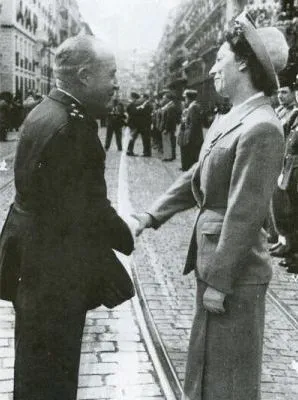
Colette Béatrice Aboulker-Muscat
Human Design Chart
Biography
These books include Mea Culpa: Tales of Resurrection (1997), Alone With the One: Poetry (2000), Life is not a Novel (2003), The Encyclopedia of Mental Imagery: Colette Aboulker-Muscat's 2,100 Visualization Exercises for Personal Development, Healing, and Self-Knowledge (2012) and Reversing Cancer through Mental Imagery (2017).
As a young woman, she took part in the Resistance movement in Vichy Algeria with her father Dr. Henri Samuel Aboulker and brother Jose Aboulker and, as a result, was awarded the Croix de Guerre in January, 1948. She studied philosophy at the Sorbonne as well as psychology with French psychotherapist Robert Desoille, becoming interested in mental imagery and dream imagery, which would become her life's work. A practitioner of The Kabbalah of Light, in 1954 she moved to Jerusalem where she was honoured with the Yakir Yerushalayim (Worthy Citizen of Jerusalem) award in 1995.
She had two children with her first husband, Samuel Danan. Her second husband was Aryeh Muscat, a Russian-born lawyer who held the post of The Municipality Comptroller of the city of Jerusalem. Colette Béatrice Aboulker-Muscat died on 25 November 2003 at age 94 in Jerusalem.
Colette Béatrice Aboulker-Muscat as a Generator 1/3 in Human Design
Generator 1/3 — Design at a Glance
Colette Béatrice Aboulker-Muscat possessed the endurance of a Generator designed as an energetic workhorse. Her design indicated that she had a large amount of sacral energy, which could be efficiently utilized not through independent initiatives but by responding to external impulses. This mechanism meant for Colette Béatrice Aboulker-Muscat that success and deep satisfaction only occurred when she responded to signals from her environment - ideally with an inner 'yes' coming from the gut.
If Colette Béatrice Aboulker-Muscat initiated independently without such a prompt or suppressed her inner voice, it led to energy loss and frustration. The design warns of two specific risks: first, wasting power on tasks that do not resonate, which can lead to long-term exhaustion. Second, holding back from heart projects despite still having full power available. For Colette Béatrice Aboulker-Muscat, the key to materializing her goals lay in the strategy of waiting and responding. Only by aligning with this principle could she unleash her immense endurance without depleting herself. The deep fulfillment promised by her design was thus directly tied to this correct use of her sacral power.
Sacral Authority
Colette Béatrice Aboulker-Muscat had a direct, physically anchored decision-making authority. As a Generator, her inner authority was identical with her strategy of responding, simplifying her process for living. She did not respond through prolonged deliberation but by immediate physical signals to external stimuli. This 'gut feeling' manifested as grunting, humming or a palpable surge of energy in the lower abdomen. Such reactions marked moments of true vitality and enthusiasm; here she felt alive and had inexhaustible energy. Her activities were carried out with great joy, free from rigid purposefulness, driven by her sacral motor.
Additionally, an instinctive support worked through her activated Spleen Center. This added spontaneity to her reaction speed and a direct access to physical well-being. She could reliably orient herself towards this instinctive perception that complemented her sacral response. The combination of the clear strategy of waiting for the right stimulus and the quick, intuitive processing by the spleen allowed her a harmonious interplay between energy and judgment. Her design suggested that she made decisions most efficiently by listening to these inner physical resonances rather than submitting to external expectations or intellectual constraints. This mechanism shaped how she moved through life: authentically, energetically, and in harmony with her biological nature.
The 1/3 Profile — Investigator / Martyr
Colette Béatrice Aboulker-Muscat was someone who combined theoretical foundation with practical validation. Her design indicated a tendency to make judgments only after thorough study and experience. As an Investigator and Experimenter (Profile 1/3), she lived in a cyclical process of learning and testing. The Sun in Gate 19 dominated her character with the search for mutual dependency and resource exploration, where fear of identity loss through one-sided bonds was a driving force. This stood in tension to Line 3 (Gate 44) which was activated by errors and adaptation pressure. Errors were not failures for her but essential learning tools. When Colette Béatrice Aboulker-Muscat deemed something correct, she had thoroughly examined it; thus, her judgment was trustworthy as it rested on a rigorous combination of theory and practice. Line 1 provided the intensive search for the right context before action, while Line 3 delivered corrective mechanisms in the process. She recognized that consciousness alone was not enough; she needed support and assertiveness to see through illusions and adapt. Her life was marked by the balance between the need for theoretical security and the necessity of acting despite incomplete information.
Single Definition — Defined & Open Centers
Colette Béatrice Aboulker-Muscat revealed herself as someone who did not seek her strength in proactive actions but rather in patiently waiting for life to unfold. Her design indicated a tendency towards constant vital energy, which was only activated through reaction. The defined Sacral Center served as her motor; it generated a daily supply of life force that felt like a continuous hum. Her strategy involved refraining from initiatives and waiting until a question or opportunity arose on which she could react with an inner "yes" or "no". Only this affirmative response would release her full energy; any mental planning without sacral confirmation eventually led to frustration and exhaustion.
This reactive capability was governed by her defined Spleen Center, serving as intuitive authority. It provided immediate, non-rational judgments about what was healthy and correct. Colette Béatrice Aboulker-Muscat had to trust these subtle impulses in the moment since she did not have time for analysis; the Spleen Center never repeated its warning or recommendation.
At the same time, her open centers made her vulnerable to external influences. Her open Head and Ajna Centers allowed her to function without constant mental inspiration; she tended to engage with foreign questions or seek answers that were not hers, often leading to confusion. Her open G Center meant she did not have a fixed identity or life direction but reflected these through the environment and relationships; she did not actively search for meaning but waited to be brought to the right place. Additionally, her open Solar Plexus absorbed other people's emotions, which could make her feel emotionally unstable if she confused others' feelings with her own. Her open Heart Center prevented her from using willpower as a constant tool; failing to keep promises was a typical pitfall since she lacked the consistent energy for ego structures. Finally, her open Root Center took on external stress, leading to a feeling of pressure that she did not generate herself and could only be resolved through distance or proper exhalation.
Channels for caring nourishment and proven values.
Colette Béatrice Aboulker-Muscat revealed herself as someone whose aura automatically attracted the trust of others. She appeared as a natural provider who protected tribal values and nourished others—whether through direct care or maintaining structures. This attitude stemmed from Channel 27-50, which connects Gate 27 (Caretaking) with Gate 50 (Values). The energy flowed from the Sacral Center, representing selfless interest, to the Spleen, which stands for instinct and values. This created a constant radiation of reliability. People sought her support because she was capable of taking responsibility and preserving communities.
However, this mechanism required strict boundaries. As Colette Béatrice Aboulker-Muscat was prone to overloading herself, she had to learn to take on responsibilities only when there was clear internal confirmation. The principle of "enlightened self-interest" applied to her: Only by first correctly caring for one's own health could she serve and guide others. Without this sacral reaction, overload threatened as the energy would otherwise flow uncontrollably.
Additionally, Gate 19 shaped her relationship with resources and territory, as well as the beginning of a spiritual path within the community. Gate 33 promoted reflection and active withdrawal to process experiences and avoid repetition. Gate 44 brought awareness and the ability to transform through proper interaction. Gate 24 steered mental mutations and the search for inner peace and knowledge law. Gate 5 set the basic rhythm of her life processes, with fixed habits building energy. Finally, Gate 57 enabled intuitive clarity in the present moment as well as survival consciousness. This constellation formed a person who stabilized their environment through care and internal rhythms.
Tribal Circuitry — Circuit Signature
Colette Béatrice Aboulker-Muscat revealed herself through a deep, instinctive connection to the protection and preservation of her genetic line. Her design anchored this attitude in the Protector Circuit, which specifically connected her Sacral Center with Life Force and Spleen Center with Intuition for Nourishment via Channel 27-50, known as the Preservation Channel.
This circuit carries ancient energies aimed at securing the survival of the family and thus the continuation of one's genetics. In Colette Béatrice Aboulker-Muscat’s case, this manifested less as an active search for a partner – since Channel 6-59 was not active in her design – but primarily as care and preservation. The themes "protection," "defense," and "nourishing" defined her energetic role. She embodied the principle of mother and father in terms of caring for and protecting their genetic lineage.
As Colette Béatrice Aboulker-Muscat had a simple definition, these connected centers formed a coherent, direct flow without internal conflicts or divided energies in other areas. The intuitive perception of the Spleen Center for what is essential and healthy flowed directly into the enduring Life Force of her Sacral Center. This created a stable foundation to not only nourish family and offspring but also protect them from external dangers. This configuration emphasized the timeless, instinctive task of genetic preservation as a central aspect of her energetic identity.
Right Angle Cross of the Four Ways 4
Colette Béatrice Aboulker-Muscats Human-Design legged a tendency towards a profound, archetypal structure defined by the 'Right Cross of the Four Paths' (Cross 4). This configuration did not define her life's purpose as a static trait but rather as a dynamic process of continuous self-discovery and adaptation to circumstances. Her path involved finding her truth in the world through direct experience and learning.
This cross described a developmental trajectory where life itself was understood as a journey on which the essence only gradually revealed itself over time. It wasn't about a predetermined goal but rather an ongoing process of discovery through engagement with reality. Colette Béatrice Aboulker-Muscat lived this dynamic by continuously adapting her identity and understanding of herself to the conditions of her existence. The mechanics of this cross emphasized learning as a central means for unfolding. Each experience sharpened and integrated her own truth, making it a path of maturation through proving oneself in the world, where adaptability and readiness to learn were crucial factors for realizing her inner potential.
Saturn Return · Uranus Opposition · Chiron Return · 2nd Saturn Return — Life Cycles
Colette Béatrice Aboulker-Muscats Human-Design pointed towards a marked turning point in her late thirties characterized by sudden restructuring and external validation. This Uranus cycle signaled a phase where individual development was made visible through external events. Rather than internal reflection, reacting to unexpected impulses took precedence, often leading to rapid reorganization of the life environment.
In 1948, at age 39, Colette Béatrice Aboulker-Muscat received the Croix de Guerre award. This event marked the peak of this Uranus opposition: years of work and dedication now found concrete public recognition. It was not a gradual progression but a momentary leap of confirmation legitimizing her previous life direction outwardly. Typical for her design, this accolade acted as a catalyst stabilizing internal processes through external success and paving the way for new structures. The mechanics show how external events were not passively experienced but actively integrated into personal development to achieve a new level of self-efficacy.
Generator · Sacral Authority — Synthesis
Colette Béatrice Aboulker-Muscat lived a life deeply marked by her ability to respond to external impulses (sacral authority) and learn through experience (Profile Researcher/Experimentor). This combination led to an ongoing search for authenticity and a need to prove herself in various contexts - a process amplified by the open definition of several centers. She intensely perceived energies around her, adapted accordingly, gathered diverse experiences, and developed a unique ability to recognize the essential (Gate 33). Her defined Sacral Center provided deep satisfaction when immersed in activities that activated her energy, while open centers like Head and G Center invited her not to cling to rigid identities.
A central tension lay in having a strong internal reaction to stimuli (sacral center) but also being open to influences from others (open Heart, Root, and Solar Plexus Centers). This led to a dynamic interaction between the need for autonomy and the ability to connect with others. She could act as an independent researcher or absorb energy from others and integrate it into her own work - a balance requiring constant adaptation that enabled her to build authentic connections.
1 Defined Channel
Incarnation Cross - Right Angle Cross of the Four Ways 4
Solar Return
The Solar Return shows the moment when the sun returns to its exact birth position - your personal solar year.
Life Cycles
Discover the life cycles with a detailed triple view (birth chart, cycle chart, composite).
Human Design Profile
- Type
- Generator
- Strategy
- To respond - wait for something to respond to
- Authority
- Sacral Authority
- Profile
- 1/3 - Investigator / Martyr
- Definition
- Single Definition
- Incarnation Cross
- Right Angle Cross of the Four Ways 4
- Date of Birth
- 28.01.1909 11:00
- Place of Birth
- Algiers, Algeria
Frequently Asked Questions
What is Colette Béatrice Aboulker-Muscat's Human Design type?
What Profile did Colette Béatrice Aboulker-Muscat have in Human Design?
What Authority did Colette Béatrice Aboulker-Muscat have?
What incarnation cross did Colette Béatrice Aboulker-Muscat have?
When was Colette Béatrice Aboulker-Muscat born?
Discover your own Human Design
Are you also a Generator? Find out in a personal reading how to use your sacral energy correctly and discover deep satisfaction.
More Personalities
Back to overviewAaliyah

Alexia

Angèle

Anne-Marie

Arcángel

Arno