
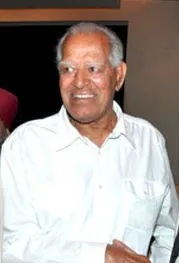
Dara Singh
Human Design Chart
Biography
Dara Singh married twice. He had three sons and three daughters.
He was admitted to Kokilaben Dhirubhai Ambani Hospital on 7 July 2012 following a cardiac arrest. He died on 12 July 2012 at his home in Mumbai.
Dara Singh — Manifesting Generator with Profile 2/5
Manifesting Generator 2/5 — Design at a Glance
Dara Singh showed himself as someone who worked with hybrid energy: He possessed the constant power of a Generator but also had the ability to skip steps and quickly draw results into his life. As an Manifesting Generator, he was neither purely reactive nor exclusively initiative-driven, but rather a mix of both principles. His design suggested that his greatest challenge lay in not moving too fast or skipping important stages, which often led him to return later and make up for missed steps. This speed also drew him towards pursuing multiple projects simultaneously as he responded to many different impulses at once.
The strategy for his design was to not initiate life himself but wait for external stimuli before acting, only when his Sacral Center gave a clear “yes”. Only through this reaction rather than initiation could he channel his enormous creative power without falling into frustration – his non-self theme. By following this strategy and regularly checking if his authority agreed with the paths he had begun, he found deep satisfaction. His design promoted a „Play Mode“ where variety and parallel work were not distractions but sources of energy. Thus, his potential for scattering turned into powerful, satisfying creativity based on resonance rather than compulsion.
Emotional Authority
Dara Singh lived with an inner authority deeply rooted in the emotional center. This defined Solar Plexus Center fundamentally determined his decision-making and always took precedence over all other defined areas of his design. He was subject to a natural rhythm of emotional waves that showed in constant mood swings. His perception of the world was always colored by the current emotional state: What appeared inspiring at one moment could seem negative in the next. These immediate reactions only formed transient impressions, not his deeper truth.
Quick, spontaneous decisions stemming directly from these fleeting emotions often proved disadvantageous for him. His design required patience and time to gain clarity. By letting important choices sleep and reviewing them multiple times, intense feelings subsided. Only when this emotional wave ebbed did calmness set in and a comprehensive insight emerged. This process of waiting and maturing was essential for him, especially with long-term decisions that would shape his life trajectory. Through consciously enduring this emotional dynamics, he found the way to clear, authentic actions not driven by transient moods.
The 2/5 Profile — Hermit / Heretic
Dara Singh showed himself as someone torn between a deep need for withdrawal and the expectations of his environment. His Profile 2/5 created tension: As an „Hermit“, he needed isolated phases to gain inner clarity and conserve energy. At the same time, the „Hero Line“ (5) made him appear magnetic to others; they projected their problems onto him and expected immediate solutions. This dynamic led Dara Singh to often be called upon before he was ready to engage.
The second line taught him the principle of delegation: He had to learn to delegate responsibility and trust experts rather than wanting to prove everything himself. Without this distance, frustration loomed as he did not know who truly depended on him. The fifth line brought social expectations that fueled his ambition but also carried the risk of failure if he overextended himself. His design challenged him to carefully examine in solitude where he wanted to apply his strength. Only through this conscious choice could he prevent an open ego from leading to over-stress and exceeding his means. He learned to strategically use his „alone time“ to set boundaries and not act as a cure-all for others.
Triple Split Definition — Defined & Open Centers
Dara Singh's Human Design profile indicated a tendency towards clear, willful communication that stemmed from a firm inner identity and a deep sense of direction. His defined Throat Center served as a reliable anchor: He not only expressed thoughts but also transformed information into concrete actions and words. This voice was more than just a reflection of the mind; it was an expression of his dependable structure.
His defined G Center endowed him with a stable self-identity and the feeling of being lovable. Dara Singh knew his own direction and could show others new paths without becoming dependent on them. Simultaneously, his defined Heart Center shaped his approach to resources and willpower. He determined his life himself, kept promises, and sought recognition for his contribution. His 'I' statements originated from this source of power, which enabled him to act both successfully and competitively as long as he followed his inner guidance.
As a Generator, Dara Singh possessed a defined Sacral-Motor that gave him constant vitality. His strategy was not to initiate but to wait for life and then respond from the gut. This sacral energy was only available for things he deeply supported internally; any other action led to resistance and exhaustion.
At the same time, his design revealed specific vulnerabilities. His open Head Center made him susceptible to mental pressure and confusion when trying to find answers to questions that were not his own. He tended to get entangled in endless thought processes or rely on others' inspiration instead of trusting his inner authority. Combined with an open Ajna Center, his mind could be flexible enough to adopt new ideas but without distance there was a risk of adopting foreign concepts as personal truth or feeling uncertain because he lacked a firm mental structure. This openness challenged him to ignore mental noise and listen instead to his emotional clarity and sacral response.
Channels for charisma, devotion, recognition, exploration and awakening.
Dara Singh exhibited a fundamental attitude based on authentic self-affirmation and the ability to be clear in the present moment. His design combined inner strength with direct expression aimed at loving himself and carrying this stance outward.
The Awakening Channel 10-20 connected his G Center with his Throat Center, enabling Dara Singh to implement personal principles into proper action. Through the Gate of Appearance (10) and the Gate of Now (20), he spoke for himself and lived his decisions as an expression of awakened self-love. This helped him avoid resistance by allowing others to sense the clarity of his presence.
Simultaneously, the Exploration Channel 34-10 between Sacral and G Center provided deep support. The Gate of Power (34) supplied the inner strength to hold onto beliefs while the Gate of Self Behavior (10) initiated this behavior. Thus, Dara Singh followed his inner compass independently of external expectations and demonstrated through his reactive energy the value of self-acceptance.
The connection of these energies occurred via the Charisma Channel 34-20 between Sacral and Throat Center. This configuration drove him to directly set generative power into the world. Dara Singh acted quickly and charismatically when responding to external stimuli. His ability to maintain activity over longer periods was based on his actions springing from sacral reaction, not mental constraints.
Additionally, the Channel of Devotion 44-26 between Spleen and Heart Center shaped his instinctive intuition. He used deep tribal memories (Gate 44) combined with ego strength (Gate 26) to predict what others needed. This gave him an entrepreneurial quality: he could formulate persuasive messages and strategically address his environment, often before people recognized their own need.
The Recognition Channel 30-41 between Solar Plexus and Root Center added emotional intensity. The drive for new experiences (Gate 41) was fueled by emotional waves (Gate 30). Dara Singh sought intense meaning and feeling in his experiences, learning to trust the emotional wave to gain clarity before making decisions.
Individual Gates like Gate 14 (Power Handling), Gate 8 (Contribution), and Gate 29 (Persistence) underscored his ability to master challenges with endurance and structured contributions.
Individual Circuitry — Circuit Signature
Dara Singh's design indicated a tendency towards fortified individuality, paired with the capacity to build resources through cooperation. As a Triple Defined person, he had three separate, non-directly connected energy streams. The Centering Circuit in him linked Identity and Sacral Centers via Channel 10-34 (Exploration). This promoted bold personalities with strong convictions; however, lacking connection to Throat Center often made firm views hard to verbalize. Parallel existed the Purpose Circuit linking Solar Plexus and Root Centers via Channel 30-41 (Recognition). Here it was about reflecting on past, emotions, and finding meaning in past events shared with the collective. The third stream was the Ego Circuit connecting Heart and Spleen Centers through Channel 26-44 (Devotion). This focus lay on cooperation, mutual support, and creating resources together; lacking a Sacral connection necessitated periods of rest for regeneration. Additionally, the Integration Circuit linked Throat, Sacral, and Identity Centers via Channels 20-10 (Awakening) and 20-34 (Charisma). This ensured survival through power from reactions to life guided by proper behavior and intuitive knowledge manifested in the present moment. Dara Singh thus showed himself as someone with high individuality who held inner values, reflected emotional waves, and acted through devotion and direct communication in the moment. The three main groups remained energetically separate, creating parallel but non-fusing experience fields.
Right Angle Cross of Contagion 4
Dara Singh carried the right infection cross four. This configuration established a specific energetic alignment that manifested through a deep connection with the collective and its destiny. In Human Design, this cross often describes a strong empathy for the state of the community as well as the ability to absorb and process collective energies. Dara Singh's design indicated that he did not act in isolation but always understood his identity and actions within the context of the larger social fabric. He was predisposed to feel the tensions and challenges of the group and used these feelings as motivation for his own work. This structure promoted a stance of dedication to the welfare of all, often working behind the scenes to support the stability of the overall system. His energy flowed not primarily from individual ambition but from the need to contribute to harmony and continuity in his environment. Dara Singh lived this connection by adapting to the currents of time and accepting his role as part of a larger pattern. The right infection cross four thus imparted him with an intuitive understanding of how the collective operates, allowing him to respond to it with a calm, integrative presence that often had a stabilizing effect on his surroundings.
Saturn Return · Uranus Opposition · Chiron Return · 2nd Saturn Return — Life Cycles
Dara Singh demonstrated himself as someone who knew and utilized his strength in structured phases. His design indicated a tendency towards cyclical development where external recognition corresponded with internal milestones. In 1953, he won the Professional Indian Wrestling Championship – a typical moment of the first Saturn return: years of groundwork condensed into a solid success that cemented his position.
Later, in 1966, he received the title 'Rustam-e-Punjab'. This fell during the Uranus opposition phase, a time when the design often demands unexpected turns or new roles. The award was not just a reward but a confirmation of his unique standing within the system, created by this planetary configuration.
With the Chiron return around 1978, he reached his peak period. In this fulfillment cycle, his incarnation purpose unfolded increasingly; he was honored with 'Rustam-e-Hind'. This was not a healing process but the visible realization of what he was destined to be – provided he had followed his strategy. The meaning of his path became tangible and recognized here.
In 1983, he ended his career. This occurred during the second Saturn return phase, one of realignment and letting go. His design showed its limit: after the peak came a necessary pause. The end was not a crisis in a negative sense but a logical consequence of the cyclical nature of his design, which required rest after intense activity.
Manifesting Generator · Emotional Authority — Synthesis
Dara Singh lived a life path marked by profound inner strength and a drive towards self-realization. His design as an Manifesting Generator (with defined Sacral Center) points to someone who constantly provided energy yet was also capable of acting swiftly and initiating things – a dynamic interplay of responsiveness and initiatory power. This energetic endowment was reinforced by the defined Throat Center, enabling communication and expression always in tune with the body's inner impulses (Channel Awakening). Emotional authority required careful maturation of decisions, weighing feelings over time to find authentic answers.
A central paradox in his design lay in the tension between a need for withdrawal (Line 2) and the expectation from others to be present as a hero and savior (Line 5). This configuration suggests that he often felt torn between wanting inner peace and the need to take responsibility for others. The cycles confirm this dynamic: successes followed phases of crisis, indicating a personality that continually took on new challenges and redefined itself.
5 Defined Channels
Incarnation Cross - Right Angle Cross of Contagion 4
Solar Return
The Solar Return shows the moment when the sun returns to its exact birth position - your personal solar year.
Life Cycles
Discover the life cycles with a detailed triple view (birth chart, cycle chart, composite).
Human Design Profile
- Strategy
- To respond - wait for something to respond to
- Authority
- Emotional Authority
- Profile
- 2/5 - Hermit / Heretic
- Definition
- Triple Split
- Incarnation Cross
- Right Angle Cross of Contagion 4
- Date of Birth
- 19.11.1928 03:30
- Place of Birth
- Amritsar, India
Frequently Asked Questions
What was Dara Singh's Human Design type?
What Profile did Dara Singh have in Human Design?
Which Authority guided Dara Singh's decisions?
What incarnation cross did Dara Singh have?
When was Dara Singh born?
Discover your own Human Design
Are you also a Manifesting Generator? Find out in a personal reading how to unfold your multi-talents and direct your energy wisely.
More Personalities
Back to overviewSissy Spacek

Aldair

Alizée

Anémone

Angeli

Ann-Margret
