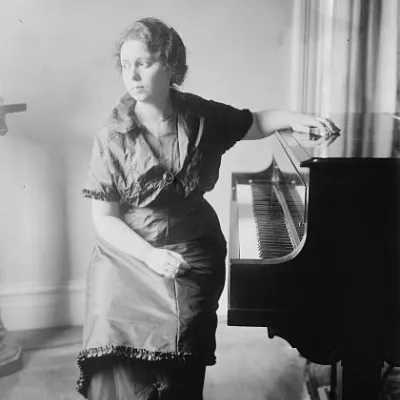
Photo: Wikimedia Commons
Elisabeth Schumann
Human Design Chart
Biography
Schumann died 23 April 1952, New York, NY.
Elisabeth Schumann — Manifestor with Profile 1/3
Manifestor 1/3 — Design at a Glance
Elisabeth Schumann's design established her as a pioneer and visionary. She was a Manifestor type, designed to lead the world into a new future. This profile shaped her basic attitude: she often thought beyond her surroundings, which led to polarization. Some loved and followed her for these big dreams, while others rejected or even hated her because of them. This split state was a central pain point in her design; misunderstandings by others were part of her constitutive experience.
Her strategy involved informing others early and precisely about her intentions and visions. This wasn't to seek permission but clarity so that the right followers could find her. When Elisabeth Schumann lived true to this strategy and followed her inner authority, she was rewarded with a sense of inner peace. Acting against her design led to an enduring, deep anger within her. This emotional reaction served as immediate feedback for the alignment of her actions. Her character was thus defined by leadership, potential rejection, and the necessity of clear communication.
Emotional Authority
Elisabeth Schumann's inner compass was the Defined Emotional Center, making her an Emotional Authority. This mechanism had absolute priority: regardless of which other centers were defined in her design or what other strategies might exist, her decision-making always followed this emotional wave. She experienced the world colored by her current mood profile, showing constant ups and downs. What she felt enthusiastic about at one moment could seem negative the next. Her immediate feeling was just a snapshot, an initial impression that didn't yet represent her deeper truth. Spontaneous decisions made in this emotional heat would often be misguided. Instead, her design required patience and conscious hesitation. She needed to take time for decisions to mature, ideally by sleeping on them multiple times. Only when intense feelings subsided and emotional distance was gained did clarity and calmness set in. This process of waiting was crucial for long-term life decisions as it allowed access to deeper, comprehensive insight rather than reacting to fleeting moods.
The 1/3 Profile — Investigator / Martyr
Elisabeth Schumann's design leaned towards a dual approach: she was both a researcher and an experimenter. Her Profile 1/3 shaped her life by the compulsion to acquire knowledge not just theoretically but practically through trial and error. Often, Line 1 energy took control; then she hesitated because she felt she didn't know enough yet to implement it. This conflicted with Line 3's push to try things out and learn from mistakes. Self-earned insights were crucial for her: if she valued something as good, she had tested it both theoretically and practically.
Gate 12 (Line 1) conveyed the impulse to withdraw to prepare mutations – similar to a monk needing support to arm himself for social contexts. At the same time, Gate 22 demanded a mutative commitment to self-discovery in interpersonal relationships. On the other hand, Gate 36 (Line 3) marked the transition from decline to upswing through adaptability. Pluto here increased her ability to rebuild after crises and joyfully accept changes. The danger was giving herself guilt or holding onto old feelings, which made this acceptance harder. Elisabeth Schumann lived this tension: she withdrew to gain clarity, then returned to the world to validate her insights through experience. Her judgment was trustworthy because it was based on this double testing – theory and practice united.
Single Definition — Defined & Open Centers
Elisabeth Schumann's design showed a tendency towards consequent mental structuring and emotional depth. Her defined Ajna Center ensured constant, trustworthy mental processes; she thought continuously and was hard to influence from the outside. This combined with her defined Throat Center, which translated her concepts into clear communication. She did not speak impulsively but articulated well-thought-out content.
Her inner authority came from her defined Solar Plexus Center. Here lay the need to give emotional waves time before decisions were made. Emotional clarity only emerged at the end of the wave cycle, not in the impulsive moment. This stability was supported by her defined Spleen Center, which stood for spontaneous intuition and well-being, as well as her defined Root Center, delivering a steady pressure towards material mastery.
In contrast to these stable pillars were her open centers as areas of receptivity. Her open Head Center tended to engage with foreign questions or doubts when it did not trust inner authority. The open G Center meant that identity and direction were not fixed but initiated through correct environments and relationships; she adapted rather than taking on a rigid role.
Her open Heart Center showed vulnerability to the pressure of proving herself or making promises that could not be kept. Here lay the trap of self-worth, measured by performance. Her open Sacral Center received energy from the environment, which could lead to overload if boundaries were not respected. Elisabeth Schumann's challenge was to use her defined mental and emotional clarity to protect these open fields from conditioning through foreign energies and expectations.
Channels for curiosity, synthesis, intuition and change.
Elisabeth Schumann showed a deep curiosity that drove her to constantly seek new inspirations. The Channel of Curiosity 11-56 connected her thinking ability with her expressive capacity; she was less interested in rigid facts than in transforming ideas into stories that taught or entertained others. This ability to turn abstract information into an influential narrative by filling gaps characterized how she shared knowledge.
At the same time, her design was marked by a strong need for belonging and emotional balance. The Channel of Synthesis 19-49 connected the pressure of survival with her emotional wave movement. This created a fine sensitivity to her position within a group or family. She sought principles that strengthened cohesion and was willing to invest work to protect resources and territory. Loyalty and feeling needed were crucial for her well-being, as this channel provided the emotional glue determining who belonged to the community.
Her intuition often worked as an immediate flash of insight in the here and now. The Channel of Brainwave 20-57 allowed her to spontaneously express inner truths based on a deep, instinctive understanding. She knew intuitively what was right at any moment without much thought, thus encouraging others to use their own survival intelligence.
Furthermore, she drove herself towards new experiences sometimes even by creating crises to generate movement. The Channel of Transience 35-36 connected her emotional wave with the urge for change. She learned through direct experience and shared this adventurous spirit, accepting that feelings are transient. Her wisdom emerged from this restless search for depth and new perspectives, which she offered others as advice.
Collective Circuitry — Circuit Signature
Elisabeth Schumann's design inclined towards impulsive, creative insights directly woven into her perception and emotional processing. As a Simple Defined individual, she possessed one continuous energetic flow: Head, Ajna, Throat, Spleen, and Solar Plexus Centers were connected by channels while the Root Center remained isolated.
The Knowledge Circuit worked through her specifically via Channel 20-57 (Flash of Insight), connecting the Throat with the Spleen. This promoted innovative acoustic ideas stemming from gut feelings and articulated immediately. Simultaneously, the Meaning Circuit flowed over Channels 11-56 (Curiosity) and 35-36 (Transience). Here Ajna Center connected to Throat and Solar Plexus Centers. This configuration directed energy towards emotional reflection on the past to gain insights and share them visually as well as emotionally with others.
The Ego Circuit was only fragmented: Channel 49-19 (Synthesis) linked Solar Plexus and Root Centers. This generated a rhythmic, probing energy between emotional judgment and survival pressure without integrating into the rest of the flow. Overall, Elisabeth Schumann's chart featured a blend of spontaneous creativity, deep emotional meaning-making process, and a separate pulsating life force requiring pauses.
Right Angle Cross of Eden 2
Elisabeth Schumann's design carried the signature of Eden's right cross. This configuration established a specific energetic alignment characterized by a deep interest in connecting the material and spiritual realms. In Human Design, this cross represents a bridge: it connects Earth with Heaven, the practical with the transcendent. For Elisabeth Schumann, this meant that her life energy was directed towards translating spiritual truths into tangible, everyday forms. She did not seek abstract theory but rather how higher principles could manifest in concrete life.
This mechanism worked as a constant invitation to make the invisible visible. The energy of this cross promoted an attitude of humility and service to the whole without sacrificing personal individuality. Elisabeth Schumann was marked by a drive to establish harmony between inner conviction and outer action through this structure. It was not a struggle against the world but rather an integration of different levels. Her design supported her in understanding complex connections and living or expressing them in ways that appeared accessible and grounded to others. The challenge always lay in maintaining balance without losing oneself in the material or veering into pure spirituality. Her chart indicated a nature that could most powerfully unfold precisely at this intersection – by bringing the divine into everyday life, making it experiential for others.
Saturn Return · Uranus Opposition · Chiron Return · 2nd Saturn Return — Life Cycles
Elisabeth Schumann's design showed a clear tendency towards structural anchoring and recognition through established institutions. Her path was marked by milestones corresponding to major planetary cycles in her Human Design chart. In 1918, at age 30, she appeared in the premiere of the opera 'Master Grobian'. This coincided with her first Saturn return, a period when years of hard work and discipline often consolidate into a solid professional foundation. Ten years later, in 1928, she was awarded the title of chamber singer. This event marked her Uranus opposition, a phase of maturity where personal potential becomes publicly visible and shifts from individual achievement to recognized authority.
The peak of her inner development was evident in 1937 when she was appointed an honorary member of the Vienna State Opera. At age 49, she went through her Chiron return, a fulfillment cycle in which one's incarnation cross unfolds and purpose becomes experiential. It was not a moment of healing old wounds but rather the bloom of her life task. Finally, in 1944 at age 56, she became a citizen of the USA. This corresponded to her second Saturn return, a phase of deep restructuring and new responsibility-taking that set her career on an entirely new foundation. Each step confirmed the mechanics of her design: structure, recognition, and the gradual unfolding of inner purpose.
Manifestor · Emotional Authority — Synthesis
Elisabeth Schumann was a Manifestor whose life was marked by an unstoppable urge to explore and share novel insights. The combination of emotional authority and the Profile of Explorer/Experimenter (1/3) led to a profound engagement with themes that she only deemed valid through personal experience and repeated testing. This process was not confined to the inner world; the Channel of Curiosity (Gate 11-56) indicates that she was destined to share her knowledge and inspire others through her stories – an ongoing search and discovery reflected in professional successes such as receiving a title or being appointed an honorary member.
However, her design contained a central paradox: the Manifestor energy of moving forward and initiating clashed with the emotional wave requiring thorough maturation of decisions. While the essence of a Manifestor lies in action and inspiration, she needed time to emotionally process her impulses. This likely led to internal tension between the desire for immediate implementation and the necessity of validating decisions through repeated reflection – an interplay of initiation and introspective evaluation that shaped her life.
4 Defined Channels
Incarnation Cross - Right Angle Cross of Eden 2
Solar Return
The Solar Return shows the moment when the sun returns to its exact birth position - your personal solar year.
Life Cycles
Discover the life cycles with a detailed triple view (birth chart, cycle chart, composite).
Human Design Profile
- Type
- Manifestor
- Strategy
- To inform others before acting
- Authority
- Emotional Authority
- Profile
- 1/3 - Investigator / Martyr
- Definition
- Single Definition
- Incarnation Cross
- Right Angle Cross of Eden 2
- Date of Birth
- 13.06.1888 08:00
- Place of Birth
- Merseburg, GER
Frequently Asked Questions
What was Elisabeth Schumann's Human Design type?
What profile did Elisabeth Schumann have in Human Design?
What authority did Elisabeth Schumann possess?
What incarnation cross did Elisabeth Schumann have?
When was Elisabeth Schumann born?
Discover your own Human Design
Are you also a Manifestor? Find out in a personal reading how to use your initiation power peacefully and dissolve resistance.
More Personalities
Back to overviewAaliyah

Alexia

Alizée

Angèle

Anne-Marie

Arcángel