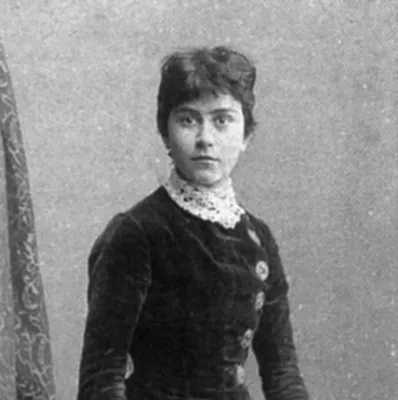
Else Lasker-Schüler
Human Design Chart
Biography
Despite winning the Kleist Prize in 1932, as a Jew she was physically harassed and threatened by the Nazis. She emigrated to Zürich but there, too, she could not work. She traveled to Palestine in 1934 and finally settled in Jerusalem in 1937. She had always led an eccentric and unpredictable life, and she spent her last years in poverty.
She published many anthologies of poetry. A large part of her work is composed of love poetry, but there are also deeply religious poems and prayers. Transitions between the two are often quite fluid. Her later work is particularly rich in biblical and oriental motifs.
In 1944 Lasker-Schüler's health deteriorated. She suffered a heart attack on January 16, and died in Jerusalem on 22 January 1945.
The Human Design of Else Lasker-Schüler: Projector 4/6
Projector 4/6 — Design at a Glance
Else Lasker-Schüler was someone who immediately recognized flaws in other people's systems. As a projector, she had a dense, focused aura that shone like a bright flashlight, casting light into dark corners of others and revealing where things weren't working properly. If she addressed these deficiencies directly, however, she often encountered resistance; her bright light could be perceived as uncomfortable when shone in someone's face. A more elegant approach for her was to radiate harmony herself. By doing so, she attracted people who came to her seeking advice on their own accord. Her best strategy involved waiting for a respectful and honest invitation rather than taking the initiative herself. Since projectors lack a defined Sacral Center, Else Lasker-Schüler lacked the constant intrinsic life energy of a generator. She experienced phases of high activity followed by necessary rest periods to avoid burning out. Living according to this design and waiting for invitations rewarded her with success. Ignoring this strategy and acting without invitation led sooner or later to her non-self theme: bitterness. Her path, therefore, was not constant action but radiant presence that drew others in.
No Inner Authority
Else Lasker-Schüler lacked inner authority, a rare configuration that fundamentally shaped her decision-making process. Instead of relying on physical impulses, she oriented herself towards external interactions and time. As a mental projector or reflector – depending on the specific center activation in her design – she was dependent on gathering information through exchanges with other people. In these dialogues, energetic resonances in her open centers activated latent potentials, allowing her to view issues from multiple perspectives and express them differently.
This process of information intake was complex and required calm. Else Lasker-Schüler needed time alone to sort out the mass of impressions, filter out what was essential, and discern a thread of truth. Only then could she develop what made sense for her and belonged to her. Her high resonance capacity helped her find the right environment and trustworthy people with whom she could exchange ideas.
For her decisions, she did not let herself be rushed. If she was a reflector, she followed the lunar cycle of about 28 days to experience reliable conditioning patterns. As a mental projector, she deepened her intuition through long-term dialogue in familiar circles. In both cases, the ability to structure her own truth from many voices was her decisive capital. She consciously sought spaces of well-being to conduct this complex evaluation undisturbed.
The 4/6 Profile — Opportunist / Role Model
Else Lasker-Schülers design inclined towards a tension-filled alternation between social engagement and detached reflection. In her first thirty years, she acted experimentally, especially in relationships and friendships, as the sixth profile line still functioned like a third one. Later, the character conflict of the 4/6-profile became apparent: the heart (line 4) yearned for belonging to a community, while the head (line 6) desired withdrawal to ponder existential questions. This dynamic often created internal confusion as she oscillated between the need for connection and the urge towards isolation.
Her fourth profile line drove her to carry revolutionary principles outward and find support for her party program, with human rights playing a central role in the political context. At the same time, she faced the challenge of avoiding immature promises. The sixth line promoted breakthroughs and mutations through new knowledge; her mind quickly recognized paths towards a new order. She only engaged with people who supported this transformation but had to be careful not to lose touch with reality. In her later years, it was expected that she would act as an exemplary role model through cooperation, always carefully guarding her large heart to prevent injury from false individuals.
Single Definition — Defined & Open Centers
Else Lasker-Schüler's Human Design profile indicated a tendency towards constant, unchanging mental structure. Her defined Ajna Center ensured that she always constructed concepts and theories in the same manner; her mind was perpetually active and served as an external authority for others. This mental rigidity directly influenced her communication: The also defined Throat Center allowed her to reliably express what her mind thought. Thus, she appeared as someone whose voice was closely linked with her conceptual thinking – she did not speak impulsively or emotionally but articulated her conceptual processes.
This firm core stood in contrast to her high receptivity to external influences in other areas. Her open Head Center made her susceptible to mental pressure and the questions of others; she tended to be distracted by the inspiration or confusion of her environment rather than relying on her own inner clarity. Similarly, her open G Center: Without a fixed identity, she adapted herself to those around her and sought direction through reflection of others, making her vulnerable to false relationships or places. Additionally, her Heart Center was open, meaning that she did not consistently act with willpower but risked giving promises to prove worth rather than acting from inner security. Likewise, the open Sacral Center meant that her energy was unstable; she absorbed the life force of others and risked overexertion due to a lack of constant generative power. This configuration shaped a life where mental clarity and articulated truth met with continuous absorption and processing of environmental energies, identities, and expectations.
Channels for intuitive insight and digested expression.
Else Lasker-Schüler's Human Design profile indicated a tendency towards radical mental innovation paired with the necessity to pour these insights into clear formulas. Her mind received spontaneous breakthroughs that often seemed light-years ahead and made her appear as an outsider in the collective initially. This dynamic was shaped by Channel 43-23: Gate of Insight (43) in the Ajna Center absorbed inspired knowledge, which was then processed and expressed through Gate of Assimilation (23) in the Throat Center. This process required patience; her unique perspectives could only be effective if communicated at the right time, as premature speaking led to rejection. The challenge lay in letting go of control and allowing the mind to assimilate its knowledge at its own pace before passing it on as efficient, transformative language.
Alongside this individual mental structure, other energies operated on the level of the cross. Gate 49 introduced the principle of upheaval, connected with emotional wave dynamics and readiness for sacrifice for higher principles within family or tribe. This contrasted with the logical, future-oriented Gates 4 and 17. Gate 4, the Gate of Formulation, developed strategies to clarify suspicious patterns and created protective formulas against retaliation, while Gate 17 stood for logical teaching and upholding human rights. This combination showed a tension between emotional need for upheaval and rational search for stable succession and emancipation. Else Lasker-Schüler had to learn to align her innovative yet often misunderstood insights (Channel 43-23) with the logical structuring of Gate 4 and the serving rule of Gate 17, in order to see her messages not only as freak domain but as collective progress.
Individual Circuitry — Circuit Signature
Else Lasker-Schüler's Human Design profile indicated a tendency towards structured individual expression. She was someone who brought inner thoughts into orderly form and then articulated them. This orientation stemmed from the Knowledge Circuit, which brings the innate path and transformation of new knowledge into the world. In Else Lasker-Schüler, however, this circuit was not fully active; it consisted only of a specific part: Channel 43-23 ("Structuring"). This channel directly connected the Ajna Center (thoughts, focus) with the Throat Center (expression, communication). It was a simple definition, meaning that this connection appeared isolated and did not merge with other energetic streams in the chart. The energy flowed clearly from thinking to speaking or writing without being filtered through other centers such as the Solar Plexus (emotions) or Head Center (inspiration). This shaped a form of communication that relied less on impulsive inspiration or emotional wave movement – as offered by other channels of this circuit – but rather on conscious, structural ordering of expression. Her unique identity thus showed itself in her ability to pour thoughts into clear, structured forms and express them directly, a process of creativity and individuality that always took the path from head to mouth without detours through emotional processing.
Right Angle Cross of Explanation 1
Else Lasker-Schüller was marked by the configuration of the right cross of explanation in her Human Design chart. This structure points to a specific way of seeking and conveying clarity. It wasn't just about information but rather the need to make connections so clear that misunderstandings were avoided. The energy of this cross promoted a direct, often blunt expression aimed at getting to the point.
In her life, this manifested as a strong impulse to articulate her truths clearly and hope for resonance or even demand it. The mechanics of the right cross of explanation support people in expressing complex inner states in understandable words without losing intensity. For Else Lasker-Schüller, this meant constant engagement with the question of how to remain authentic while also being understood.
This configuration suggested that she sought or created situations where her voice was heard. She aimed to influence through clear communication and provoke thought in others. The energy of the cross helped her reduce uncertainties through definitive statements, both for herself and in dealing with her environment. Thus, a pattern emerged where explanation wasn't just a means to an end but a fundamental part of her being.
Saturn Return · Uranus Opposition · Chiron Return · 2nd Saturn Return — Life Cycles
Else Lasker-Schüller was marked by intense, often painful turning points throughout her life that correlated with planetary cycles. Her design revealed a structure where severe crises and creative breakthroughs were intricately intertwined.
In 1897 at the age of 28, she experienced the death of her father. This coincided with her first Saturn return, a cycle traditionally associated with maturity and responsibility. For her design, this moment marked a deep crisis that profoundly shaped her further development.
Ten years later in 1909 at the age of 40, she published the drama “Die Wupper”. This occurred during the Uranus opposition, a phase of rebellion and change. Here, her drive for artistic self-determination showed as a counter-movement to earlier bindings.
The peak of this development came in 1919 when at age 50, the premiere of “Die Wupper” took place at the Deutsches Theater Berlin. This marked her Chiron return, a fulfillment cycle. During this period, her artistic identity crystallized; her life's work found visible confirmation and meaning without healing old wounds - rather, it highlighted the bloom of her individual expression form.
The series concluded in 1927 with the death of her son Paul from tuberculosis at age 58. This coincided with her second Saturn return, often associated with final conclusions and heavy loss. This constellation underscores the harshness of her life line: creative bloom and existential grief followed each other closely, driven by the specific dynamics of her astrological cycles.
Projector · No Inner Authority — Synthesis
She was a projector whose energy was geared towards recognizing and bringing out the potential in others - often with direct, focused intensity. However, this ability to uncover flaws in the system (Channel 43-23) required a subtle approach as an unconsidered statement could generate resistance. Her mental center (Ajna) was defined and consistently produced concepts and insights that she expressed through her throat center.
A central paradox shaped her life: the conflict between the desire for community (Line 4 in Profile) and the need for independent reflection (Line 6). This internal contradiction intensified due to a lack of inner authority, making her dependent on exchanges with others to gain clarity. The cycles showed that crises - such as the loss of a child (1927) - and career peaks (1909, 1919) were intricately intertwined; transformation through knowledge and creative expression (Knowledge Circuit) seemed always connected to profound personal experiences.
1 Defined Channel
Incarnation Cross - Right Angle Cross of Explanation 1
Solar Return
The Solar Return shows the moment when the sun returns to its exact birth position - your personal solar year.
Life Cycles
Discover the life cycles with a detailed triple view (birth chart, cycle chart, composite).
Human Design Profile
- Type
- Projector
- Strategy
- Wait for the respectful invitation
- Authority
- No inner authority - learn more
- Profile
- 4/6 - Opportunist / Role Model
- Definition
- Single Definition
- Incarnation Cross
- Right Angle Cross of Explanation 1
- Date of Birth
- 11.02.1869 02:00
- Place of Birth
- Elberfeld, Germany
Frequently Asked Questions
What was Else Lasker-Schüler's Human Design type?
What Profile did Else Lasker-Schüller have in Human Design?
What Authority did Else Lasker-Schüller have?
What incarnation cross did Else Lasker-Schuler have?
When was Else Lasker-Schuler born?
Discover your own Human Design
Are you also a Projector? Find out in a personal reading how to unfold your leadership qualities and recognize the right invitations.
More Personalities
Back to overviewSissy Spacek

Alain-Fournier

Anémone

Angeli

Ann-Margret

Bourvil