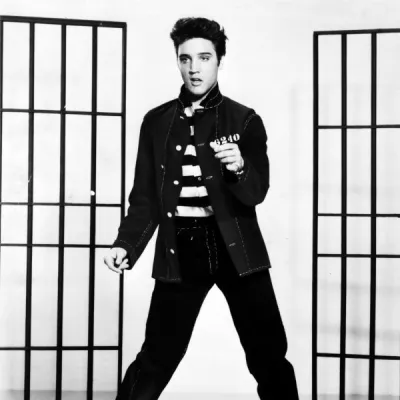
Photo: Wikimedia Commons
Elvis Presley
Human Design Chart
Biography
Presley was born in Tupelo, Mississippi; his family moved to Memphis, Tennessee, when he was 13. He began his music career in 1954 at Sun Records with producer Sam Phillips, who wanted to bring the sound of African-American music to a wider audience. Presley, on guitar and accompanied by lead guitarist Scotty Moore and bassist Bill Black, was a pioneer of rockabilly, an uptempo, backbeat-driven fusion of country music and rhythm and blues. In 1955, drummer D. J. Fontana joined to complete the lineup of Presley's classic quartet and RCA Victor acquired his contract in a deal arranged by Colonel Tom Parker, who managed him for the rest of his career. Presley's first RCA Victor single, "Heartbreak Hotel", was released in January 1956 and became a number-one hit in the US. Within a year, RCA Victor sold ten million Presley singles.
The Human Design of Elvis Presley: Generator 3/5
Generator 3/5 — Design at a Glance
Elvis Presley's design established a fundamental tendency towards high endurance and a specific kind of energy activation. As a Generator, he possessed much sacral power that made him extremely resilient, similar to a strong workhorse – provided this energy was used for appropriate tasks. His design did not manifest through initiating actions but exclusively through reacting to internal impulses. The central motto of his system was "React instead of Initiate." This was the only way to achieve true energy efficiency and deep satisfaction.
Two main pitfalls shaped his energetic architecture. First, the danger of burnout if he continuously engaged in tasks that he had no inner desire for and thus wasted his strength. Second, the risk of being held back from his heart's project even though his inner self still wanted to continue working with power. The energy of his sacral center was only freed when it could react to a signal from life. When this center gave a clear "yes," he responded through action. If Elvis Presley lived in harmony with this design, his system rewarded him with a feeling of deep fulfillment. However, if he constantly initiated actions himself or ignored the inner signal, sooner or later he would encounter persistent frustration and a lack of energy. His success thus depended on acting from the gut and not swimming against the current of his own nature.
Emotional Authority
Elvis Presley's inner authority lay in his defined Emotional Center. This fundamentally shaped his decision-making: he was subject to a constant emotional wave, an ongoing up and down of feelings. The world always appeared colored by the current mood. In one moment, he could be totally enthusiastic about something, only to see it completely negatively in the next.
This configuration meant that feeling in the moment was just a snapshot – a first impression, not necessarily his truth yet. Quick, spontaneous decisions based on such emotions often had negative consequences because they were unreliable reactions to transient states.
The mechanics of his authority required patience and time delay. The more time Elvis Presley took to let a decision ripen, the deeper and more comprehensive he could see. This meant concretely that he should sleep on decisions multiple times. Through this waiting period, intense feelings subsided, emotional distance was gained. Only then did clarity and calmness set in – proof that he had gone through the process. This necessity was particularly important for long-term decisions with a major impact on his life course. The defined Emotional Center always carried the authority, independent of other defined centers in his chart.
The 3/5 Profile — Martyr / Heretic
Elvis Presley's Design established a fundamental attitude that oscillated between the urgent need to try everything himself and his role as an attractive problem solver for others. As a 3/5 Profile – Explorer and Hero – he initially believed little in prescribed doctrines. Instead, he learned through direct action, made mistakes, and processed public failures. This practical accumulation of experience became the foundation of his later impact: He used his self-acquired knowledge to offer solutions for collective problems.
Line 3 promoted a skeptical attitude towards established structures. Ambition and drive often arose from secret interactions or circumventing official obstacles, paradoxically enhancing his allure. At the same time, Line 5 carried responsibility during crisis times. Here it was about further developing viability through individual mutations – new forms he provided to the collective to protect against threats.
This configuration created a strong tension: On one hand, Elvis Presley had to experiment in full public view and risked public failures, which could be painful. On the other hand, this authenticity did not diminish his heroic role but made him attractive to others who wanted to learn from his experiences. His intuition was tested during crises; when it was overwhelmed, he developed independently further to establish new, generalizable forms of survivability. Thus, he transformed personal adventures and mistakes into heroic knowledge for others.
Single Definition — Defined & Open Centers
Elvis Presley's Human Design profile established a foundational structure of immense, available energy that was marked by emotional depth and existential pressure. His defined Sacral Center served as the engine generating daily vital force. This energy was only accessible when he responded to life – his inner voice answered with a clear 'Yes' or 'No'. Initiating actions without this confirmation led to exhaustion and frustration because the sacral power did not support mental decisions.
Additionally, his defined Solar Plexus Center acted as an emotional authority. Here, there was no truth in the 'Now'. Elvis Presley was designed to wait for the wave movement of his feelings before gaining clarity. Impulsive decisions at the peak or depth of the wave created chaos; only after going through the emotional cycle did the deeper truth reveal itself. This emotional warmth and allure colored his environment as people with open Solar Plexus Centers amplified this frequency.
This was underpinned by a defined Root Center, providing constant, adrenalized pressure for forward movement. This existential stress drove him to rise materially and survive. Without guidance through his sacral reactions and emotional patience, however, this pressure could become obsessive and harmful as false stress.
Simultaneously, his design revealed specific vulnerabilities. His open G Center meant no fixed identity or direction; he tended to blend with the environment and often sought 'borrowed' security in relationships. The open Heart Center led to the temptation of proving self-worth through promises and competition – a cycle of self-doubt due to lacking consistent willpower. Furthermore, his open Throat Center was susceptible to needing to force attention rather than waiting for an invitation to speak. His open Head and Ajna made him receptive to foreign inspirations but tended towards confusion when trying to find answers to others' questions.
Channel 3-60: Mutation — Channels & Gates
Elvis Presley's inner rhythm was characterized by a pulsating tension between evolutionary change and restless longing, resulting from the interplay of two defined channels in his design.
The Channel of Mutation 60-3 connected the Root Center with the Sacral Center through the Gate of Limitation (60) and the Gate of Order (3). This mechanism generated a powerful but unpredictable energy that brought melancholy. Elvis Presley had to learn to accept limitation and patiently wait for his inner pulse, rather than breaking down melancholic phases through arguments or coercion. This channel drove him to bring innovation and renewal into his environment, where change often emerged suddenly like music from nowhere. The constant movement from chaos to order required a deep commitment to his process even when nothing seemed to happen externally.
Simultaneously, the Channel of Recognition 41-30 connected the Root Center with the Solar Plexus Center. Through the Gate of Limitation (41), an intense drive and restlessness was created that sparked countless scenarios in imagination. This desire for new experiences was modulated by the Gate of Recognizing Feelings (30), leading to a deep need to fully immerse life sensually and emotionally. Elvis Presley felt the pressure to quench this thirst for experience but discovered that fulfillment was only temporary. The emotional wave gave him necessary time for clarity before he leaped into new adventures, making his experiences more profound and deeply touching others.
Additionally, Gates like 54 (Ambition and Spiritual Worldliness), 53 (Pioneer Spirit) and 29 (Persistence in the Sacral Center) acted as supportive factors that amplified his drive for development and desire for confirmation. His design required a balance between waiting for the right moment of mutation and consciously choosing new experiences through emotional clarity.
Individual Circuitry — Circuit Signature
Elvis Presley's Human Design profile showed a dual structure: on one hand, a driving impulse towards transformation with new knowledge, and on the other, a cyclical processing of past experiences. These two forces were parallel-connected via the Root Center but did not form a direct energetic unit between the other centers.
In the Knowledge Circuit, his Channel 3-60 (Mutation) connected the Sacral Center to the Root Center, generating pulsating, acoustic energy that propelled deviation from existing and fostered an innate path for identity generation through creative mutations.
Parallel to this, in the Meaning Circuit, the Channel 30-41 (Recognition) linked the Solar Plexus Center with the Root Center. Here flowed a visual, cyclical energy that processed emotions and experiences from the past. The focus was on recognizing meaning behind the past and contributing these emotionally shared insights to collective learning.
While the Sacral-Root system actively created new forms through mutation, the Solar Plexus-Root system reflected the past in wave-like sequences. Both systems utilized the Root Center as a common interface for survival energy and impulse but remained distinct in their functions – active creation versus emotional reflection. This shaped a lifestyle oscillating between the drive for innovative change and the necessity to process and integrate past feelings.
Right Angle Cross of Penetration 4
Elvis Presley's design carried the structure of the right cross of penetration. This configuration established a specific dynamics where inner impulses pushed outward to break through resistance and bring clarity into chaotic situations. It was not mere aggression but rather a precise mechanism: the ability to resolve complex entanglements through direct, often intuitive action.
In Human Design, the right cross of penetration describes an energy geared towards overcoming obstacles and forging new paths. Elvis Presley appeared as someone whose inner compass was directed toward this kind of approach. His nature tended not to skirt around problems but rather to confront them head-on to get to the heart of the matter. This created a radiance of determination and direct impact.
The mechanics of this cross meant that decisions were often made from a deep, intuitive drive to break through stagnation. Elvis Presley lived in a reality where this penetrative capacity was central. It shaped his way of dealing with challenges: not by prolonged deliberation but by cutting knots. This energy served to reduce confusion and open up action spaces by pointing out the most direct path to resolution. It was a design feature that combined drastic measures and efficiency to translate inner truth into outer reality.
Saturn Return · Uranus Opposition — Life Cycles
Elvis Presley's design set a tendency towards periodic upheavals, manifesting as cycles of transformation and realignment. This structure marked his life journey through recurring phases where old patterns were dissolved and new directions taken. In 1962, at the age of 27, he released the studio album 'Pot Luck'. This point marked his first Saturn return, a cycle that often condenses years of groundwork into a stable foundation for further development. It was a moment of consolidation in his career.
Later, another significant shift occurred. In 1975, at age 40, Presley returned to the studio in Hollywood and successfully recorded albums. This corresponded with the Uranus opposition, an astrological aspect indicating deep changes and a need for freedom or renewal. During this cycle, he demonstrated the ability to start anew despite past structures and achieve success. The mechanics of these cycles described not only external events but also internal processes of letting go and beginning again. Elvis Presley moved through these phases, with each return or opposition heralding a new chapter where his orientation changed. These recurring patterns underscored the dynamics of his design, geared towards change and adaptation.
Generator · Emotional Authority — Synthesis
He was a Generator whose life was marked by deep, sacral energy (Sacral Center). This power source demanded constant activity and expression, yet the path to it was rarely straightforward. The Profile of the Experimenter and Helper (3/5) points to a lifestyle where trying out new paths and learning from experiences took precedence – followed by a desire to share this knowledge. Emotional authority required time for decisions to mature, while sacral energy signaled immediate reactions; an internal conflict between the need for deliberation and the impulsive power of action.
A central paradox in his design lay in the combination of the Channel of Mutation (3-60) and defined Sacral Center. The melancholy and unpredictability of the channel created a constant search for new forms of expression, while the Sacral Center provided the energy to realize them – but only if they were authentic. Successes (charted event 1975) and creative steps (charted event 1962) often followed phases of uncertainty and experimentation, hinting at a deep inner tension between the desire for innovation and the necessity to confront personal limitations.
2 Defined Channels
Incarnation Cross - Right Angle Cross of Penetration 4
Solar Return
The Solar Return shows the moment when the sun returns to its exact birth position - your personal solar year.
Life Cycles
Discover the life cycles with a detailed triple view (birth chart, cycle chart, composite).
Human Design Profile
- Type
- Generator
- Strategy
- To respond - wait for something to respond to
- Authority
- Emotional Authority
- Profile
- 3/5 - Martyr / Heretic
- Definition
- Single Definition
- Incarnation Cross
- Right Angle Cross of Penetration 4
- Date of Birth
- 08.01.1935 04:35
- Place of Birth
- Tupelo, United States
Frequently Asked Questions
What is Elvis Presley's Human Design type?
What Profile did Elvis Presley have?
What was Elvis Presley's Authority?
What incarnation cross did Elvis Presley have?
When was Elvis Presley born?
Discover your own Human Design
Are you also a Generator? Find out in a personal reading how to use your sacral energy correctly and discover deep satisfaction.
More Personalities
Back to overviewAaliyah

Alexia

Alizée

Angèle

Anne-Marie

Arcángel