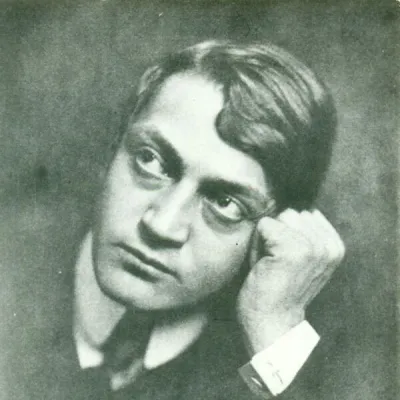
Endre Ady
Human Design Chart
Biography
Ady's poetry was strongly influenced by French Symbolism and by Baudelaire and Verlaine. His work reflects the decadent end times and social injustice of the Hungarian monarchy.
He died on 27 January 1919 in Budapest, Hungary, aged 41.
The Human Design of Endre Ady: Manifesting Generator 1/3
Manifesting Generator 1/3 — Design at a Glance
Endre Ady revealed himself as someone who possessed a rare combination of constant endurance and lightning-fast implementation power. His design as a Manifesting Generator combined the stable energy source of the sacral center with the ability to skip steps in the realization of ideas. This configuration allowed him to quickly bring things into his life, but it also carried the risk of rushing. If he skipped important stages or started too many projects at once without waiting for an inner impulse, this would quickly lead to frustration – the specific suffering path of this type.
The mechanics of his design required a clear strategy: not initiating but reacting to life. He should only act when his sacral center signaled a clear "yes." This reaction to the inner impulse was the key to effectively using his speed instead of fighting against it. With correct application of this strategy, the potential source of stress transformed into deep satisfaction. Endre Ady then found his true state in "play mode," an attitude of playful variation and creative freedom. For him, it was neither necessary nor beneficial to complete one thing before starting another; rather, his creative power flourished through simultaneous engagement with various impulses as long as they were sanctioned by the inner "yes." His energy thus thrived not despite but because of this dynamic, multifocal approach to his work.
Sacral Authority
Endre Adys decision-making process was oriented towards a clear inner structure: the sacral authority functioned as the primary instance. This design characteristic was specific to his type, the Generator, where strategy and inner authority are identical – a configuration that simplified the process of choice. Endre Ady did not react through head-driven planning but rather responded to external stimuli with physical signals. His "gut feeling" manifested in the form of grunting, humming, or a simple yes-no sensation in his abdomen. These physical impulses served as his only valid compass.
When his sacral motor engaged with an impulse, Endre Ady had vital energy and enthusiasm at his disposal. He could then immerse himself joyfully in activities without the need for external purposefulness. Life became energetically satisfying through this spontaneous reaction. Crucial to this mechanism was the state of the emotional center: it needed to be open so that the sacral authority could operate unimpeded. Through this system, Endre Ady moved through life with joy and utilized his inexhaustible power where inner resonance aligned.
The 1/3 Profile — Investigator / Martyr
Endre Ady revealed himself as someone whose identity was inseparably linked to the process of research and practical experimentation. His design established a structure where life revolved around learning, trial, and error. As a person of Profile 1/3, the Researcher-Experimenter, he combined the theoretical depth of a scientist with the joy of action of an adventurer.
The first line of his design brought a pressing need for theoretical completeness. Here, an energy was at work that used power as a survival mechanism or demonstrated competence through intensive preparation. Often this led to a fear of taking the step into implementation, as there was a feeling of not knowing enough yet. At the same time, the third line of the profile called for active experimentation, especially in the area of relationships and intimacy. Experience and self-confidence arose for Endre Ady only through practical tests, possible failures or separations.
The integration of these two forces meant that a judgment was valid with him only if it had undergone both intensive theoretical planning as well as rigorous practical testing. Self-discovered insights, which were put to the test on heart and gut, shaped his way of perception. When Endre Ady considered something to be right or good, this was based on double validation: theoretical understanding and lived experience. This interplay created a high degree of trust in his self-found solutions, which never remained purely abstract but were always tested in the fire of life.
Single Definition — Defined & Open Centers
Endre Ady was characterized by a defined triad of Sacral, G, and Throat centers, which provided him with a constant energy source and reliable expression structure. The Sacral center supplied the vital response energy, the G center offered firm identity and direction, while the Throat made this truth effective through speech and action. In contrast, his open centers – Head, Ajna, Heart, Solar Plexus, Spleen, and Root – did not have their own consistent patterns in thinking, willpower, emotion, intuition, or stress but reflected environmental stimuli.
The challenge lay in using the defined triad through reacting rather than initiating without getting lost in conditioning within the open centers. The open Head and Ajna centers tended to absorb mental inspirations and concepts from the environment, leading to doubts or attempts to solve others' problems. Instead of consistent willpower, his open Heart center acted as a mirror for the desire for validation, putting him at risk of proving himself through promises he could not keep.
The open Solar Plexus center absorbed emotional moods from the surroundings, which led to experiencing other people's feelings as his own and avoiding confrontation to avoid stirring up waves. At the same time, the open Spleen center made him vulnerable to survival fears and a tendency to cling to unhealthy situations just for a sense of security or well-being. The open Root center took on external stress, leading to cycles of taking in pressure and trying to escape it through hyperactivity.
Endre Ady's design challenged him to trust his inner authority to use the energy of the defined triad correctly while learning to use the open centers as informative mirrors rather than their own truth. By waiting and reacting, he could avoid getting lost in mental confusion, emotional waves, or stress-induced overload and instead express his authentic voice and direction.
Channels for powerful manifestation and persistent determination.
Endre Ady showed a dominant physiological urgency for immediate action. His design was marked by the Channel of Charisma 34-20, connecting the Sacral center with the Throat center. This configuration generated constant energy that demanded expression in the here and now. The raw power of Gate 34 had to be directed through sacral reactions to external stimuli; without this inner guidance, chaotic outbursts or possession threatened. It was about self-confirmation: Endre Ady had the right not to be available for satisfying activities and to show self-absorption, which released his true vitality.
Alongside this manifesting power, the Channel of Discovery 29-46, connecting Sacral with G center, played a role. Here, the persistence of Gate 29 came into play: by positively affirming impulses, he could get lost in experiences and persist long-term until their meaning became clear. This fostered a deep connection to his own path independent of external expectations.
Additionally, individual gates contributed to expression. Gate 59 followed a genetic strategy of pairing and bonding, while Gate 55 in the Solar Plexus brought extreme mood swings and emotional awareness. Gate 45 in the Throat center represented tribal energy and material expression, supported by the willpower of the Heart. Gate 23 promoted amoral communication and freedom of difference, while Gate 8 emphasized individual contribution to the group. Finally, Gate 27 carried a genetic role of care for tribe and self-preservation, underlining his activities with warm intensity. This combination created a profile oscillating between urgent manifestation and deep, persistent experiential world.
Individual Circuitry — Circuit Signature
Endre Ady's design combined emotional depth with powerful presence. His energy flowed in waves: feelings and experiences from the past were processed to become effective in the present moment. This happened through two specific circuits. The Meaning Circuit (Channel 46-29) connected his identity center with the Sacral center. Here, it was not about cool logic but reflecting on the past. Emotional waves from the Solar Plexus – even though this center is not directly part of the channel, the energy is wave-like – sought meaning behind events. These felt insights served to be shared and learned together. Parallel, the Integration Circuit (Channel 20-34) connected the Throat with the Sacral center. This was the power of charisma: energy from reacting to life was translated through Gate 34 into powerful action and manifested in the present moment. Both circuits shared the Sacral center as a common source but were energetically separate from each other. Endre Ady thus showed a synthesis: emotional processing of the past (identity) did not directly flow into charisma, but existed parallel to individual presence in the moment (throat). His strength lay in this duality – deep cyclical understanding of meaning and immediate acoustic-visual presence. The energy was highly personal, directed towards survival through correct behavior and intuitive resonance in the here and now.
Right Angle Cross of the Sleeping Phoenix 4
Endre Ady's design indicated a tendency towards profound transformation that was not openly expressed. His identity did not form through external actions or loud speech but rather from inner silence. This configuration is known as the right cross of the sleeping phoenix, describing a process of rebirth happening in secret. The energy was not directed outward to convince or lead others, but rooted deeply within being itself. It was paradoxical power: rest and waiting were not passivity but necessary prerequisites for internal alchemy. Endre Ady emerged as someone whose essential development took place internally, far from public performance. The design emphasized that true change often happens quietly before it becomes visible. Identity formed through this silent condensation, not external validation. It was a path of inner transformation where the old burned away in silence to make room for new – without needing or desiring communication about this process externally. This structure shaped an attitude of trust in the timing of one's own development, independent of external circumstances or others' expectations.
Saturn Return · Uranus Opposition — Life Cycles
Endre Ady's design showed a tendency to experience personal maturation and professional affirmation closely intertwined. This structure suggested that inner growth often became visible through external milestones touching both career and partnership.
A turning point occurred in 1906 when Endre Ady, at the age of 29, published his poetry collection “Új versek” and achieved success. This fell within his first Saturn return cycle. In Human Design mechanics, this period often marks a condensation of years of groundwork into a solid, public result. For Endre Ady, it cemented his artistic positioning; the inner structure found its external validation through literary breakthrough.
Another significant point emerged in 1915 when he married Berta Boncza at age 38. This coincided with his Uranus opposition. This cycle often brings unexpected changes or sudden clarity in interpersonal bonds. The marriage was thus not mere coincidence but an expression of this dynamic shift in relationship life.
In summary, the sequence of Saturn returns and Uranus oppositions shaped Endre Ady's life path: first solidifying his own work, followed by a profound change in partnership. Both events served as concrete anchor points for personal development and demonstrated how astrological cycles worked through his design in relation to himself and others.
Manifesting Generator · Sacral Authority — Synthesis
Endre Ady lived a life marked by deep inner dynamism. The combination of manifesting generator energy and sacral authority indicates someone who possessed both the ability to quickly respond to impulses and carry a constant source of life energy within them. This interplay was evident in an unstoppable creative force, yet always accompanied by the necessity to listen to the body's internal voice and not skip steps. His profile as a researcher and experimenter underscored this process of continuous learning and experimentation, with the need for deep examination preceding any implementation taking precedence. The open definition in key centers like Head, Ajna, Heart, and Root points to high sensitivity to external influences that had to be channeled through inner authority to avoid being overwhelmed by conditioning.
A central paradox in Ady's design lies in the tension between the generator's quick manifestation power and the open nature of his centers. He was destined to react to life and tackle things swiftly, yet also vulnerable to external influences and conditioning. This tension likely led to a constant oscillation between the urge for spontaneity and the need for inner orientation, manifesting in the search for authenticity and profound experiences. The ability to learn from mistakes and gain insights was essential to finding his direction and using energy correctly.
2 Defined Channels
Incarnation Cross - Right Angle Cross of the Sleeping Phoenix 4
Solar Return
The Solar Return shows the moment when the sun returns to its exact birth position - your personal solar year.
Life Cycles
Discover the life cycles with a detailed triple view (birth chart, cycle chart, composite).
Human Design Profile
- Strategy
- To respond - wait for something to respond to
- Authority
- Sacral Authority
- Profile
- 1/3 - Investigator / Martyr
- Definition
- Single Definition
- Incarnation Cross
- Right Angle Cross of the Sleeping Phoenix 4
- Date of Birth
- 22.11.1877 18:00
- Place of Birth
- Érmindszent, Romania
Frequently Asked Questions
What was Endre Ady's Human Design type?
Which profile did Endre Ady have?
What authority guided Endre Ady?
What incarnation cross did Endre Ady have?
When was Endre Ady born?
Discover your own Human Design
Are you also a Manifesting Generator? Find out in a personal reading how to unfold your multi-talents and direct your energy wisely.
More Personalities
Back to overviewAlain-Fournier

Aldair

Alizée

Angeli

Arletty

Artus