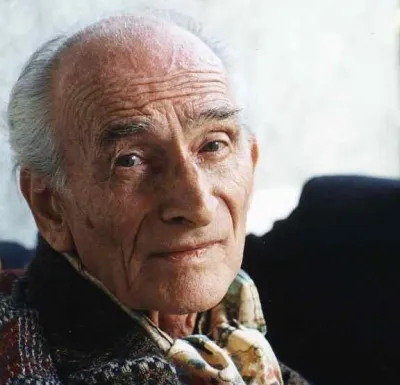
Ephraim Kishon
Human Design Chart
Biography
Kishon's books have been translated into 37 languages and sold particularly well in Germany.
In 2002, he was awarded the Israel Prize for lifetime achievement & special contribution to society and the State of Israel.
He died 29 January 2005.
The Human Design of Ephraim Kishon: Manifesting Generator 6/2
Manifesting Generator 6/2 — Design at a Glance
Ephraim Kishon's design features a hybrid energy structure: As an Manifesting Generator, he possesses the constant power of the sacral center combined with the ability to skip steps and quickly draw results into his life. This configuration marks him as someone who not only reacts but acts at a speed that pure generators often lack.
However, the mechanics of his type require a precise strategy: He must respond to impulses and then act only when his sacral center gives a clear "yes." Without this inner confirmation, frustration threatens, which is the specific non-self theme of this type, especially if he pushes too quickly or skips important steps. Additionally, his energy tends to work on multiple projects simultaneously. Rather than focusing on one task at a time, he finds his creative power in variety and playful mode. As long as strategy and inner authority align, he can use this multitasking ability to draw deep satisfaction from his work. The classic advice "one thing at a time" does not suit his nature; rather, he thrives on the dynamic interaction of various interests, provided they are legitimized by his inner signal.
Emotional Authority
Ephraim Kishon exhibited an internal decision-making structure characterized by rhythmic emotional waves rather than spontaneous impulses. His design featured Emotional Authority, meaning his defined Emotional Center was always the leading authority for his choice decisions – regardless of which other centers were also defined in his graph. This priority rule is a central mechanism: The emotional wave dictated the process, not the mind or external circumstances.
Kishon lived with constant ups and downs of his feelings; his perception of the world was always colored by the current mood. What appeared inspiring at one moment could seem negative in the next. These fluctuations were not instability but rather a necessary process for clarification. Since immediate feeling was only a snapshot and not necessarily the deeper truth, quick decisions based on emotion often proved problematic.
Instead, his authority manifested through patience. Kishon needed time to let decisions ripen. This process required repeatedly "sleeping on" important questions and being willing to hesitate. Only when intense feelings subsided and emotional distance was gained did clarity and calmness set in for him. Only then was a decision considered guided by the process and thus authentic enough to support his life journey.
The 6/2 Profile — Role Model / Hermit
Ephraim Kishon's design is characterized by a clear developmental line: In his youth, he experimented intensively with various life paths, guided by the principle of trial and error. This phase was about gathering personal experiences and figuring out which commitments were truly meaningful. Often, after failures, he withdrew to carefully weigh his options before embarking on new paths.
After turning thirty, this approach fundamentally changed. The mechanics of Line 6 became active, leading to a period of intense reflection. Kishon metaphorically retreated into his "cave" to look back at the earlier experiments in his life with great distance. This time served for healing and deeper self-knowledge. Through this ascetic withdrawal, marked by selective focus on what is essential here and now, he matured into a wise person.
Later, he emerged from this isolation. Others recognized his gained wisdom of life and sought his advice to learn from his ability for deep introspection. The transition from initial confusion in choosing commitments to clear perseverance in the second generation defined his entire work. He demonstrated that it was only through withdrawal and careful examination of his experiences that he found the strength to serve as a role model for others.
Split Definition — Defined & Open Centers
Ephraim Kishon's design inclined towards a constant, clear strength of expression that arose from a deep inner resonance. His defined Throat Center served as a pivot point for communication and action; it directed information out of the body into the world. This voice did not speak from arbitrary intellect but from reliable sources like Heart or Sacral Center, imprinting an honest, direct manner of speaking.
This capacity to express was fueled by his generative power: The defined Sacral Center provided him with a vast source of vital energy. As a Generator, he was designed to react rather than initiate. His strategy involved waiting for questions or offers from the environment before responding with a "Yes" or "No" from the gut. This sacral response determined whether energy was available for a task. When he reacted, he had the strength to sustain tasks until mastery and overcome stagnation phases.
However, he did not make decisions impulsively but included his emotional depth. His defined Solar Plexus Center functioned as an inner authority. It demanded patience: Ephraim Kishon needed to wait out the emotional wave—the ups and downs of feelings—before acting. Only at the end of this cycle did emotional clarity emerge, protecting him from impulsive misjudgments on emotional highs or lows.
At the same time, his defined Root Center propelled him forward through physical and existential pressure. This stress was not a flaw but a set energy form that helped him survive and move in the material world as long as he followed his strategy.
In contrast, his open Head Center did not show constant mental inspiration. He tended to absorb others' mental pressure or grapple with doubts that were not his own. Here lay the risk of losing himself in non-self intellect and seeking answers for other people's problems. His open Ajna Center also meant he embraced concepts and theories flexibly but did not solidify them as personal truth. He was a mirror for intellectual currents rather than their rigid originator.
Channels for powerful presence and emotional waves.
Ephraim Kishon showed a basic attitude marked by intense and often restless life energy. His design included the Channel of Charisma 34-20, connecting the Sacral Center with the Throat Center. This configuration generated a strong urge for immediate expressiveness: The raw physiological energy of Gate 34 (Power) was channeled through the thyroid gland and demanded expression in the "now" via Gate 20. It made it difficult for him to sit still; his vitality needed constant activity to avoid obsession or chaotic outbursts. His energy served primarily for self-reinforcement and was not meant to be tapped by others.
At the same time, the Channel of Emotional Release 39-55, connecting the Root Center with the Solar Plexus, set a pulsating emotional wave in motion that swung between melancholy and ecstatic joy. Ephraim Kishon was equipped to touch other people's minds through provocation (Gate 39) and live his own moods authentically. He learned that he could only fully unfold his creative depth when he did not resist these mood swings but used them as a source of emotional truth.
Additionally, his design included Gates promoting Persistence (Gate 29) and Detail Work (Gate 9), along with elements of Emotional Upheaval (Gate 49) and Mutative Experimentation (Gate 16). This combination underscored his ability to persist in challenges and strive for perfection through repeated pattern correction. The acceptance of limitations (Gate 60) helped him transform pressure into creative transformation, while the fundamental rhythm of Gate 5 built up his energy when he followed his own habits.
Individual Circuitry — Circuit Signature
Ephraim Kishon's design inclines towards pulsating, acoustic forms of expression. As a person with split definition, his energy system consists of two independent blocks: one connecting the Throat and Sacral Centers, and another separate connection between the Solar Plexus and Root Centers. These blocks are not directly connected to each other; they exist as parallel, independent forces.
The Knowledge Circuit in him operates through the Channel "Release Emotions" (Gates 55–39). This connects the Solar Plexus Center with the Root Center. Here it is about transforming new insights through emotional waves that manifest as an acoustic pulse in the present moment. It does not involve a continuous flow to identity or Head, but rather this specific emotional condensation and the urge to initiate change through expressive strength.
Parallel to this, his Integration Circuit shapes his survival through the Channel "Charisma" (Gates 20–34). This connects the Throat Center with the Sacral Center. Here power is gained from reacting to life and guided by proper behavior as well as intuitive knowledge in the present moment. This creates a high degree of individuality, which however operates energetically separate from the emotional impulses of the other block. Ephraim Kishon thus lives with these two distinct energies: on one hand, the emotional, transformative expression from the Solar Plexus-Root block, and on the other hand, the charismatic, intuitive action from the Throat-Sacral block, without these areas sharing a direct inner flow.
Left Angle Cross of Industry 2
Ephraim Kishons design points to a tendency towards methodical and sustained work. His energy follows the logic of 'The left cross of diligence 2', a configuration that does not rely on spontaneous inspiration or dramatic breakthroughs, but rather on the power of repetition and gradual refinement. This structure shaped him as someone whose effectiveness grew from his ability to consistently dedicate himself to a topic over long periods without being distracted by external disturbances.
In Human Design, this cross describes a specific kind of diligence: it is not about hard labor, but about the intelligent organization of effort. In practice, Ephraim Kishon demonstrated an attitude that used errors and setbacks not as dead ends, but as necessary information for the next step. His strength lay in endurance, in maintaining the process until the result ripened. This mechanism acted as an inner compass guiding him to exercise patience and trust in his own work method, even when progress was initially invisible. His path was characterized by this calm persistence that solved complex tasks through consistent small steps rather than arbitrary acts of force.
Saturn Return · Uranus Opposition · Chiron Return · 2nd Saturn Return — Life Cycles
Ephraim Kishons design points towards structural anchoring and later revolutionary expansion. This dynamic manifested concretely in his career: In 1952, at the age of 28, he began writing a daily column for the newspaper Ma’ariv under the pseudonym Chad Gadja. This marked his first Saturn Return, a cycle where years of groundwork often condenses into a solid public result and internal structure becomes outwardly effective.
Ten years later, in 1964 at the age of 40, Kishon made his directorial debut with 'Sallah – or: Exchange Daughter for Apartment'. This fell during the Uranus Opposition, a phase often marked by sudden changes and a desire for individual freedom. Here the impulse emerged to leave established paths and explore new independent forms of expression, moving away from pure writing towards visual staging.
In 1971 at age 47, he directed 'God Pomerantz – or The Ball of the Throw-On'. This corresponded to his Chiron Return, a fulfillment cycle. During this life phase, one's incarnation cross increasingly unfolds; if the person has followed their strategy, the inner meaning and purpose become experiential. Kishons work in this period was not just change but deepening and realization of his creative core, which now blossomed in a new medium.
Manifesting Generator · Emotional Authority — Synthesis
He was an Manifesting Generator whose life was marked by a steady flow of sacral energy (Sacral Center defined). This energy found expression through the defined Throat Center and the Channel of Charisma, giving him immediate, powerful communication skills. The connection between Generator and Manifestor traits allowed him to seize opportunities quickly, often accompanied by an inner emotional wave (Emotional Authority). The profile as a role model and natural talent indicates that he developed a wise perspective after intense experiences, which he could then pass on – a pattern visible in various career phases.
A central paradox lay in the tension between the drive for rapid manifestation and the necessity of emotional maturation. He tended to initiate things quickly (Channel 34-20), yet emotional authority required time to digest decisions and ensure they aligned with his inner truth. This may have led to phases of experimentation and error (6/2 Profile), followed by times of reflection and wisdom, from which new creative impulses emerged (Knowledge Circuit).
2 Defined Channels
Incarnation Cross - Left Angle Cross of Industry 2
Solar Return
The Solar Return shows the moment when the sun returns to its exact birth position - your personal solar year.
Life Cycles
Discover the life cycles with a detailed triple view (birth chart, cycle chart, composite).
Human Design Profile
- Strategy
- To respond - wait for something to respond to
- Authority
- Emotional Authority
- Profile
- 6/2 - Role Model / Hermit
- Definition
- Split Definition
- Incarnation Cross
- Left Angle Cross of Industry 2
- Date of Birth
- 23.08.1924 00:00
- Place of Birth
- Budapest, Hungary
Frequently Asked Questions
What was Ephraim Kishon's Human Design type?
What Profile did Ephraim Kishon have in Human Design?
What Authority did Ephraim Kishon have?
What incarnation cross did Ephraim Kishon have?
When was Ephraim Kishon born?
Discover your own Human Design
Are you also a Manifesting Generator? Find out in a personal reading how to unfold your multi-talents and direct your energy wisely.
More Personalities
Back to overviewAldair

Alizée

Angeli

Arletty

Artus

Balthus