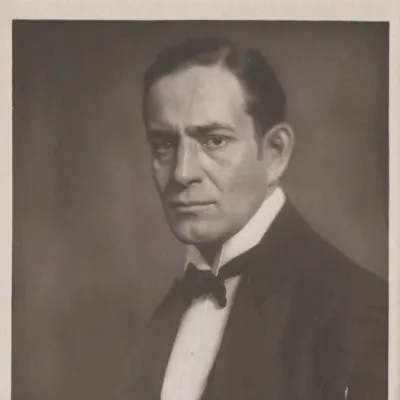
Erich Kaiser-Titz
Human Design Chart
Biography
Kaiser-Titz made his film debut in 1911. From 1913 to 1915 he worked for the producer Oskar Messter as a partner of Henny Porten. During the First World War, he was known to a large audience primarily as the elegant detective Engelbert Fox. Another important film role was E. T. A. Hoffmann in the 1916 adaptation of the opera Hoffmann's Tales. Another significant role was the title character of Ferdinand Lassalle in the 1918 film of the same name. In the 1920s Kaiser Titz was still seen in many supporting roles. He died on 22 November 1928, aged 53, in Berlin.
What does Projector 5/2 mean for Erich Kaiser-Titz?
Projector 5/2 — Design at a Glance
Erich Kaiser-Titz's design points to a tendency towards focused, penetrating perception. As a projector, he did not have an intrinsic source of life energy, which led to alternating phases of high activity and necessary rest periods to prevent exhaustion. His aura acted like a bright flashlight that was directed specifically toward weaknesses in systems or the environment around others. He immediately recognized where processes were bumpy or errors lay.
The challenge was not to communicate these insights directly and confrontationally, which often triggered resistance from those around him. Instead, his effective approach was through setting an example: by embodying harmonious states himself, he became attractive to others who then sought advice from him. His strategy involved waiting for a sincere invitation before exercising his leadership role.
If Erich Kaiser-Titz lived according to this pattern, he was rewarded with success. Ignoring these dynamics and trying to push through resistance in his environment or being constantly available without an invitation led sooner or later to feelings of bitterness – his non-self theme. His design required him to conserve his energy and only direct it where he was explicitly asked to shed light on darkness.
Splenic Authority
Erich Kaiser-Titz's design points towards intuitive, momentary decision-making. His inner authority lay in the Spleen Center, home to survival intelligence and alarm systems. For this authority to be effective, his Emotional and Sacral Centers were open; such a configuration is unique to projectors or manifestors.
The defined Spleen Center provided him with spontaneous inner knowledge about what was right for his health and well-being. This impulse served as a reliable indicator of suitable environments and societies, as well as rigorous boundaries against harmful influences. Since the spleen voice was very subtle and only appeared once in the moment, it required high vigilance to not be drowned out by external influences.
Decisions had to be made for Erich Kaiser-Titz in the moment; the first spontaneous impulse was correct. This allowed him to take excellent care of himself. At the same time, this structure meant that plans could change at short notice since knowledge about what was right only became available in each situation. Long-term commitments were therefore difficult; his design required a lot of space and flexibility rather than rigid structures. A temporary retreat could be helpful to hear this fine inner impulse clearly and not ignore it.
The 5/2 Profile — Heretic / Hermit
Erich Kaiser-Titz's design points towards an internal tension field: the desire for recognition as a hero clashed with the need to remain undisturbed in his own den. As a 5/2 profile, he carried this contradiction within himself. The Line 5 demanded admiration and the application of collective solutions during crises, while Line 2 urged him to initially hide his gifts from the world.
In his development, Erich Kaiser-Titz worked hard on himself, using alone time to build strength. Gate 53, whose second line is called 'Swing', projected outward the ability to start anew – but only upon recognition did it become clear where this energy was leading. Success could lead to further success if the next venture was also successful. Mars energy in this configuration often promoted early triumph followed by impatience and unwise actions.
As long as the world had not yet 'discovered' him, he remained reserved. If he merely waited to be found as a hero, bitterness and frustration loomed since being a hero does not work in an isolation mode. His path involved examining his own expectations and daring to step onto the stage. Once he did so, his presence and clear insight were appreciated by others – always with respect for clear boundaries and sufficient time alone.
Single Definition — Defined & Open Centers
Erich Kaiser-Titz showed himself to be marked by a defined Spleen Center, which gave him deep intuition and a strong instinct for health and well-being. He relied on spontaneous judgments that could not be rationalized but sprang from direct bodily intelligence. This existential awareness allowed him to make trustworthy decisions by following the subtle warning signals of his body without overstimulating them with logical reasoning. His defined Root Center provided a constant, adrenalized pressure that propelled him forward in the material world and helped him cope with stress by nourishing his survival consciousness.
At the same time, Erich Kaiser-Titz was characterized by several open centers, making him vulnerable to external influences. His open Head Center meant he did not have consistent mental inspiration; instead, he tended to get stuck in doubts and confusion when trying to find answers to questions that were not his own. He had to learn to release mental pressure by remaining a detached observer of his thoughts. His open Ajna Center allowed for a flexible mind capable of taking on many concepts but often led him to interpret answers as personal opinions or feel uncertain without firm theoretical foundations.
The open G Center showed that Erich Kaiser-Titz did not have a fixed identity or direction. He was dependent on being initiated by his environment to discover who he is and where his life is going. This made him vulnerable in relationships, as he easily adopted borrowed identities. His open Heart Center meant he was not designed to exercise willpower in the sense of competition or keeping promises; he tended to want to prove his worth through overexertion, which could lead into a cycle of self-doubt. The open Sacral Center showed that his energy was unstable and he easily became exhausted when amplifying the generative power of others without setting limits. Finally, his open Solar Plexus absorbed the emotions of his surroundings, making him vulnerable to emotional conditioning; he had to learn not to personalize these feelings as his own but rather observe them as passing waves in order to remain emotionally stable.
Channels for ambitious transformation through persistent effort.
Erich Kaiser-Titz's design indicated a tendency towards sustained effort and social ascent. The Channel of Transformation 54-32 connected the Root Center with the Spleen Center, driven by the ambition of Gate 54 and the instinctive evaluation through Gate 32. This configuration promoted the desire to rise above one’s birth level through competence, where the fear of failure or survival of the "clan" served as a driving force. Erich Kaiser-Titz often showed himself willing to work harder than others to gain recognition and secure a position – a process marked by social interactions and feedback from others.
Additionally, other energies influenced him. Gate 53 in the cross brought the impulse for pioneering work and new cycles, while Gate 48 offered the ability to recognize patterns and logical corrections, often accompanied by deep frustration over imperfections. In the material realm, Gate 21 stood for control and overcoming obstacles through power, where respect within the community was crucial.
On the level of personality, gates like 18, which distinguished between necessary corrections and political or collective processes, as well as Gate 44, which required vigilance and resource management, played a role. Gate 57 fostered intuitive clarity in the here and now, while Gate 28 steered decisions based on risks and the present moment. Finally, Gate 39 in the design contributed an aspect of provocation and analysis to trigger mutations. Together, these elements formed a complex web of ambition, instinct, corrective drive, and risk-taking that significantly shaped Erich Kaiser-Titz’s life path.
Tribal Circuitry — Circuit Signature
Erich Kaiser-Titz revealed himself as someone who experienced transformations and turned them into concrete actions. His design connected the Spleen Center with the Root Center through Channel 32-54. This connection created a direct flow between instinctive perception and urgent action. The Spleen Center provided the intuitive ability to recognize patterns and changes, while the Root Center immediately translated these insights into energy for action. It was a simple definition, meaning that these two centers were the only ones directly connected; other defined areas existed separately without an energetic exchange with this core flow.
This mechanism shaped his way of creating resources within the context of the Ego Circuit. Although this circuit generally promotes cooperation and the exchange of giving and taking, Erich Kaiser-Titz lacked a connection to the Sacral Center. Without this constant life force, he could not work continuously. Instead, he needed rest breaks to gather new energy for collaborative creation. His strength lay in intuitively grasping transformative impulses and pursuing them with immediate urgency, always aware of the necessity to withdraw when energy was depleted. This rhythm of impulsive action and necessary recovery characterized his approach to tasks and relationships within his community.
Left Angle Cross of Endeavour 2
Erich Kaiser-Titz's design indicated a tendency towards sustained, goal-directed effort. He was someone who forged his path through consistent action and persistent striving. This attitude aligned with the pattern of the Left Cross of Effort 2. In this Human Design context, this configuration represents a life task that does not rely on passive waiting or spontaneous insights but rather on the principle of continuous work. It was about achieving results through persistent effort and developing inner discipline in the process.
For Erich Kaiser-Titz, this meant that his path often required him to actively engage in processes and push them forward with his own strength. The mechanics of this cross emphasize the importance of endurance and the will to overcome obstacles not by circumventing them but by systematically working through them. His design promoted a sense of responsibility for his own creation, focusing on the process of action itself. It was less a path of easy success and more one of conscious, often arduous shaping. Through this constant effort, he could create and stabilize structures that would not have emerged without such commitment. The energy of this pattern supported him in engaging in situations requiring patience and sustained attention to find long-term effective solutions.
Saturn Return · Uranus Opposition · Chiron Return — Life Cycles
Erich Kaiser-Titz revealed himself as someone whose life rhythm was marked by clear phases of consolidation and sudden change. His design indicated a tendency towards structured milestones that often came with external confirmations. This became visible in 1905 at the age of 30: he belonged to the ensemble of the Leipzig Playhouse. This point marked his first Saturn return, a cycle during which years of groundwork and inner maturity condensed into a solid professional foundation. Instead of just dreaming, he anchored his abilities in a stable institution.
Later, another dynamic became effective: the Uranus opposition at the age of 41. This aspect often brings unexpected breaks or innovative turns that break old patterns. For Erich Kaiser-Titz, this energy manifested in success as the performer of the E. T. A. Hoffmann role in the film adaptation of "Hoffmann's Tales" in 1916. Here, it was not just chance but rather the typical Uranus effect: an established artist uses a moment of change to prove himself in a new, modern medium. Thus, his design combined the serious structure of Saturn with the revolutionary power of Uranus – first through anchoring, then through innovative expansion.
Projector · Splenic Authority — Synthesis
Erich Kaiser-Titz lived a deeply observant life path, marked by an acute ability to recognize the potential and weaknesses of others (Projector with defined Spleen Center). This gift, combined with the Transformation Channel (54-32), drove him to improve his position in life through personal effort – a drive stemming from the desire to make a difference and be seen. The defined Spleen Center provided an instinctive compass that helped him make healthy decisions for his well-being and shield himself from harmful influences. He sought opportunities to promote talents and advance his tribe, with the left cross of Effort 2 pointing towards continuous work on himself to fulfill this role.
A central paradox in his design lay in the interplay between Hero Archetype (Line 5) and the need for withdrawal (Line 2). He aspired to help others and gain admiration, yet simultaneously required time alone to refine his gifts. This led to an internal tension between the desire for recognition and the necessity of working in solitude – a dynamic that also manifested in documented events where professional successes (1905, 1916) coincided with periods of intense self-commitment.
1 Defined Channel
Incarnation Cross - Left Angle Cross of Endeavour 2
Solar Return
The Solar Return shows the moment when the sun returns to its exact birth position - your personal solar year.
Life Cycles
Discover the life cycles with a detailed triple view (birth chart, cycle chart, composite).
Human Design Profile
- Type
- Projector
- Strategy
- Wait for the respectful invitation
- Authority
- Splenic Authority
- Profile
- 5/2 - Heretic / Hermit
- Definition
- Single Definition
- Incarnation Cross
- Left Angle Cross of Endeavour 2
- Date of Birth
- 07.10.1875 22:00
- Place of Birth
- Berlin, Germany
Frequently Asked Questions
What Human Design type was Erich Kaiser-Titz?
What Profile did Erich Kaiser-Titz have in Human Design?
Which Authority guided Erich Kaiser-Titz?
What incarnation cross was assigned to Erich Kaiser-Titz?
When was Erich Kaiser-Titz born?
Discover your own Human Design
Are you also a Projector? Find out in a personal reading how to unfold your leadership qualities and recognize the right invitations.
More Personalities
Back to overviewSissy Spacek

Alain-Fournier

Anémone

Ann-Margret

Arletty

Arno