
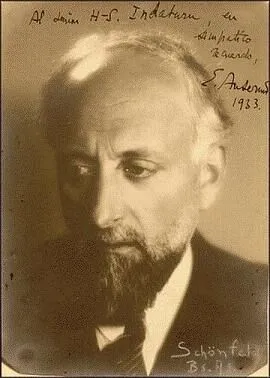
Ernest Ansermet
Human Design Chart
Biography
Died on 20 February 1969, Geneva.
The Human Design of Ernest Ansermet: Manifesting Generator 6/2
Manifesting Generator 6/2 — Design at a Glance
Ernest Ansermet's Human Design presented as a hybrid nature that combined the speed of a Manifestor with the constant energy of a Generator. This configuration allowed him to skip steps and achieve results quickly. His defined Sacral Center provided continuous power, but his strategy was not to initiate himself but rather to react to impulses from the environment.
However, this ability to accelerate carried specific risks. If Ansermet acted too hastily and neglected important intermediate steps, he often had to return to make up for deficits – a process that quickly led to frustration, the central non-self theme of this type. Additionally, he tended to pursue multiple projects simultaneously, driven by different impulses. Without inner consent and strategic alignment, his initial creative enthusiasm rapidly turned into overextension.
Deep satisfaction came only when he responded to life and his Sacral Center gave a clear 'yes'. Regularly reviewing his own projects for sustained resonance was crucial under these conditions. Under these circumstances, Ansermet benefited from his versatility; the demand to focus on one thing alone would have hindered him more. His optimal state was a 'play mode', where variety and fun nourished his creative power and allowed him to work on different tasks simultaneously without losing inner consent.
Emotional Authority
Ernest Ansermet's Human Design showed a tendency towards thoughtful restraint at crucial decision points. His internal authority came from the defined Solar Plexus Center, which subjected him to emotional wave motion. This mechanism meant that his perception was constantly colored by an emotional mood: in one moment he could be enthusiastic about something, in the next view it negatively. His immediate feeling was just a snapshot, not yet the truth. Spontaneous decisions made from this emotional heat carried the risk of proving false later.
Clarity for Ernest Ansermet only emerged through time and patience. He needed space to let decisions ripen – often by sleeping on them multiple times. This process of 'finessing' was no hesitation out of weakness, but a necessary strategy to move from colored perception to calm insight. As time passed, the intense emotions subsided, emotional distance set in, and true clarity emerged. This rule took precedence: as long as his Solar Plexus Center was defined, this emotional authority had priority over all other defined centers in his chart. Ernest Ansermet therefore had to learn to trust the first impulse but not act on it immediately, waiting instead for the wave to subside and reveal deeper truth.
The 6/2 Profile — Role Model / Hermit
Ernest Ansermet's Human Design featured a clear developmental line: from an experimental phase in youth to detached wisdom later in life. As a 6/2 Profile, he acted like a 3-line before his thirtieth year, driven by the principle of trial and error. This period was about seeking authenticity through personal experience; setbacks were followed by withdrawal for processing.
Around thirty years old, the sixth line activated fully. Ansermet metaphorically retreated into a 'cave on the mountain' to look back at his earlier experiments with great distance. This phase of intense reflection fostered deep self-knowledge and healing. Gate 1 in this line gave him the ability for objectivity in dealing with creativity. He learned to distinguish true creative value from mere trends – an assessment that needed time to prove authentic.
Simultaneously, the second line shaped his timing and tolerance. Ansermet developed a deep understanding that misunderstandings often stem from wrong timing, not lack of intelligence. This fostered acceptance of limitations within himself and others. When he finally emerged from introspection, he showed up as a wise role model. Others sought his counsel to partake in the objectivity gained through time and distance and learn the art of deep introspection. His wisdom did not come from quick answers but from the mature ability to see value systems clearly.
Split Definition — Defined & Open Centers
Ernest Ansermet had a constant reactive life energy through his defined Sacral Center. This power source generated daily vitality, but it could only be used correctly by waiting for external impulses; initiatives without prior questioning led to energy loss and frustration. At the same time, he possessed available willpower and ego strength from his defined Heart Center. This allowed him to keep promises and control resources autonomously, provided that these decisions of will aligned with the sacral response. His expression was consistently and reliably marked by a defined Throat Center. He did not communicate out of fleeting intellect but transmuted information from his motor centers into clear actions or words. The challenge lay in the tension between Heart and Sacral: If he initiated with heart's willpower before the sacral responded, his energy would stagnate. Healthy functioning required using willpower only when the sacral response was affirmative.
Simultaneously, Ansermet was vulnerable to conditioning through several open centers. His open Head Center made him susceptible to mental pressure and foreign inspirations; he tended to engage with doubts or questions that did not originate from himself instead of trusting his inner authority. Likewise, his Ajna Center was open, meaning he absorbed concepts and theories from the environment without needing to identify them as personal truth. His open G Center led to a lack of fixed identity, reflecting in relationships and environments; he often sought direction or love through others rather than defining it from within himself. Additionally, his open Root Center absorbed stress and adrenaline from the environment. Instead of using this pressure as self-motivation, he risked overextension when trying to match external rhythms instead of waiting for his own rhythmic energy.
Channels for intimacy, powerful impact and inner devotion.
Ernest Ansermet's design inclined towards intense emotional fusion paired with a self-reinforcing manifesting power. This tension between the urge for intimacy and active assertion in the here and now shaped his energetic expression significantly.
The Channel of Union 59-6 connected the Sacral Center to the Solar Plexus through the Gates of Sexuality (59) and Friction (6). This created a powerful quantum energy that manifested as intimacy. The sexual essence of Gate 59 met with the emotional wave of pleasure and pain from Gate 6. This combination fostered relationships that were personal, penetrating, and potentially fruitful. The urge for fusion allowed Ernest Ansermet to quickly penetrate into others' aura and ease confidentiality. However, the emotional wave of Gate 6 determined the timing of each release; it pulled or pushed, requiring patience to gain clarity about emerging connections.
Simultaneously, the Channel of Charisma 34-20 was at work. It connected the sacral energy through the Gate of Power (34) with the Throat Center via the Gate of Now (20). This delivered a manifesting self-reinforcing energy in the here and now. The raw physiological power from Gate 34 was transformed by the thyroid system into a component that reinforced survival. The sacral exerted pressure to express itself immediately, allowing Ernest Ansermet to maintain prolonged activity and act in the moment. However, this energy was only effective when guided by sacral response; otherwise, obsession or misdirected momentum threatened.
Moderating this dynamic was the Channel of Devotion 44-26. It connected the Spleen Center (Gate of Alertness, 44) with the Heart Center (Gate of Egotists, 26). This brought entrepreneurial alertness and instinctive assessment into play. Ernest Ansermet had the gift to instinctively evaluate others and identify fitting solutions or ideologies. This combination of deep tribal memory and ego strength enabled him to convincingly convey his gifts and effectively utilize resources.
The Sun in Gate 1 (Uniqueness) emphasized a focus on individual creativity and 'here and now'. As an isolated imprint without direct channel connection, it acted as an energetic backdrop for a unique creative expression that operated free from constraints.
Tribal Circuitry — Circuit Signature
Ernest Ansermet exhibited through a split definition, forming two parallel operating energy threads not directly connected. On one hand, the Ego Circuit shaped his actions: Here, Channel 26-44 linked the Heart with the Spleen Center. This connection promoted devotion and strategic cooperation in jointly creating resources. Since this circuit lacked direct connection to the constant life force of the Sacral Center, this resource-oriented dynamic required necessary rest pauses for regeneration; giving and taking followed a wave-like rhythm rather than steady flow.
Parallel to this, the Archer Circuit was at work through Channel 6-59 connecting Ernest Ansermet's Sacral Center with his Solar Plexus. This created a primal power base for protecting and defending one's genetics and family. The emotional intensity of the Solar Plexus here was directly fueled by the vital energy of the sacral center, suggesting instinctive action towards preservation and nourishment.
Additionally, there existed a third connection: The Integration Channel 20-34 linked the Throat Center with the Sacral Center. This allowed him to draw power from reacting to life (Gate 34) and make it effective in immediate expression or action (Gate 20). This constellation generated tension between the cooperative, pause-requiring resource exchange of the Ego Circuit and the deep emotionally-driven protective instincts as well as the direct expressiveness of other connections. Ernest Ansermet lived these different energetic demands side by side without them melting into a single continuous stream.
Left Angle Cross of Defiance 2
Ernest Ansermet's Human Design featured the imprint of the left challenge cross. This configuration established a foundational stance characterized by a profound engagement with internal and external obstacles. In Human-Design terms, this cross marks a specific archetypal path that does not aim for simple solutions or harmonious adaptation but rather seeks to directly confront challenges and use them as catalysts for growth.
The mechanics behind this pattern describe an energy activated through friction and confrontation. For Ernest Ansermet, it was not about avoiding difficulties or protecting oneself from them, but integrating them as essential elements of his own path. This structure promoted a stance of resilience and critical questioning. Instead of seeking validation, the focus was on what needed to be tested.
This archetypal influence shaped his approach to life situations. Challenges were not seen as disruptive factors but as central elements that enabled clarity and depth. The left challenge cross demands a direct encounter with resistance, through which character strength and clear self-understanding could develop. For Ernest Ansermet, this meant that his path was defined by the conscious acceptance of trials that shaped him and sharpened his perspective. It was a process of growth through confrontation that found stability in navigating complexity.
Saturn Return · Uranus Opposition · Chiron Return · 2nd Saturn Return — Life Cycles
Ernest Ansermet's career development followed a clear pattern of structural milestones marked by planetary cycles. His design showed an ability to translate internal maturation processes into external institutional stability. This became evident in 1912 when, at the age of 29, he became conductor of the Kursaal in Montreux – a typical moment for the first Saturn return, where years of groundwork often condense into a solid result and initial professional responsibility is taken on.
A decade later, in 1922 at the age of 39, he founded the Argentine National Orchestra in Buenos Aires. This coincided with the Uranus opposition, a cycle that often releases expansive impulses and a desire for broader influence or new structures. Here his tendency to transcend established boundaries and create innovative organizational forms was evident.
The second Saturn return in 1938, at age 55, crowned this development: Ernest Ansermet founded the Lucerne Festival as well as the Orchestre de la Suisse romande (OSR). This cycle symbolizes deepening and solidifying one's life structure. The founding of these institutions was no coincidence but a logical consequence of a design seeking stability through long-term commitments. These events demonstrate how Ernest Ansermet used his inner authority to create cultural infrastructure that should endure beyond his own work.
Manifesting Generator · Emotional Authority — Synthesis
Ernest Ansermet lived a life profoundly influenced by immediate environmental reactions. His Manifesting Generator profile with defined sacral authority indicated that while he had the ability to quickly initiate things, his true drive came from responding to impulses and subsequently implementing this energy. This combination, reinforced by a defined Throat and Heart Center, revealed a person both proactive and consistent in their expression – a creative engine functioning most effectively when aligned with the flow of life. The repeated evidence of professional initiatives (1912, 1922, 1938) reflects this impulse, yet always embedded within a deeper reaction to given circumstances and opportunities.
The core of his design lay in a paradox between the need for expression and the necessity of emotional clarity. As an Emotional Authority type, he required time to process emotions before making decisions. This stood in tension with his manifesting energy that urged him to act quickly. The connection of Sacral and Solar Plexus Centers suggests that his creativity sprang from a deep emotional reservoir but required careful deliberation to avoid impulsive action. This internal field of tension shaped his life as a dynamic interplay between quick response and reflective action.
3 Defined Channels
Incarnation Cross - Left Angle Cross of Defiance 2
Solar Return
The Solar Return shows the moment when the sun returns to its exact birth position - your personal solar year.
Life Cycles
Discover the life cycles with a detailed triple view (birth chart, cycle chart, composite).
Human Design Profile
- Strategy
- To respond - wait for something to respond to
- Authority
- Emotional Authority
- Profile
- 6/2 - Role Model / Hermit
- Definition
- Split Definition
- Incarnation Cross
- Left Angle Cross of Defiance 2
- Date of Birth
- 11.11.1883 09:45
- Place of Birth
- Vevey, Switzerland
Frequently Asked Questions
What was Ernest Ansermet's Human Design type?
What Profile did Ernest Ansermet have in Human Design?
What Authority did Ernest Ansermet have?
What incarnation cross did Ernest Ansermet have?
When was Ernest Ansermet born?
Discover your own Human Design
Are you also a Manifesting Generator? Find out in a personal reading how to unfold your multi-talents and direct your energy wisely.
More Personalities
Back to overviewAaliyah

Aldair

Alexia

Alizée

Angèle

Angeli
