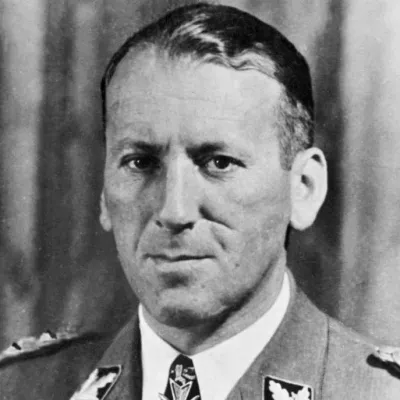
Ernst Kaltenbrunner
Human Design Chart
Biography
Ernst Kaltenbrunner as a Manifesting Generator 1/3 in Human Design
Manifesting Generator 1/3 — Design at a Glance
Ernst Kaltenbrunner's design inclined towards rapid action sequences. As an Manifesting Generator, he possessed constant sacral energy that allowed him to skip steps in his actions and quickly draw things into his life. This hybrid configuration combined the endurance of a Generator with the initiative power of a Manifestor.
The mechanics of this type carry specific risks: The speed led to important intermediate steps being skipped, which inevitably required going back later to fill these gaps. Such feedback loops generated frustration, the central non-self theme of this design. Furthermore, Kaltenbrunner tended to pursue multiple projects simultaneously by reacting to various impulses at once. Without strict adherence to strategy—namely waiting and then acting only when the sacral center clearly confirmed—it quickly tipped into overburdening.
However, with correct application of his inner authority, he could draw deep satisfaction from his work. His design promoted a 'play mode' where variety and parallel working were not seen as distractions but rather as sources of strength. The challenge always lay in respecting the internal confirmation to use this immense energy efficiently without frustrating setbacks.
Sacral Authority
Ernst Kaltenbrunner's design inclined towards spontaneous, physically carried reactions. As a Generator, he possessed sacral authority, meaning his strategy and inner decision-making were identical: responding to external stimuli with an immediate gut feeling. This mechanism manifested in the form of bursts of power or vital impulses like grunting or humming, signaling whether a situation released or blocked energy.
A crucial factor for this function was his open emotional center. Since emotions fluctuated and did not provide a reliable basis for decisions, he had to rely on the stable rhythm of his sacral center. This simplified his process: He followed neither logic nor fleeting moods but direct physical feedback.
Additionally, his activated spleen center acted as a supporting instance. Through its connection to the sacral center, this enabled quick, instinctive judgments about safety and well-being. Ernst Kaltenbrunner could thus react spontaneously and make decisions based on deep, bodily intuition. When his sacral motor kicked in, he acted with enthusiasm and inexhaustible energy, fully immersed in his tasks without needing external purposefulness. His system was designed to function through joy in execution, guided by this combined power from sacral and spleen impulses.
The 1/3 Profile — Investigator / Martyr
Ernst Kaltenbrunner's design inclined towards accumulating knowledge not just theoretically but validating it through hard practice and personal experience of failure. As a person with Profile 1/3, the Researcher and Experimenter, his nature was marked by an ongoing interplay between Line 1, seeking depth and fundamental understanding, and Line 3, urging to try things out and learn from failures.
This configuration meant that a judgment or decision of his only held up if it had been thoroughly intellectually digested as well as practically tested on heart and gut. The energy of Gate 48 in Line 1 gave him the ability to instinctively recognize practical connections; something had to be feasible for him to matter. Simultaneously, he was under pressure from the third line, as described by Receptor 39: Responsibility here was not understood abstractly but worked out through trial and error. This pattern demanded self-sacrifice in the process of change—mutation was impossible without this hard test. His character trait lay in breaking clichés and superficial platitudes to get to the real depth. What he deemed right or effective thus rested on a double verification: theoretical insight into the structure and practical proof in actual events.
Split Definition — Defined & Open Centers
Ernst Kaltenbrunner's design inclined towards structured, willful action capability. His defined Heart Center provided a constant source of willpower and the ability to keep promises as well as control resources. This energy worked in conjunction with his defined Throat Center, serving as a pivot point to translate these intentions into clear communication and action. He not only spoke but acted from a position of self-determination.
At the same time, he had a defined Sacral Center, indicating an enormous vital energy source. However, this power was reliably available to him only when he reacted rather than initiated; impulsive actions without internal confirmation often led to resistance and exhaustion in this configuration. His defined Root Center provided constant pressure to move forward in the world and shaped his way of dealing with stress – either logically focused or through mutative energy outbursts.
In contrast, his Head, Ajna, and G Centers were open. The open Head and Ajna Centers meant that he did not have a fixed mental strategy but rather absorbed ideas and concepts from the environment. He tended to identify with foreign thoughts or become mentally confused if he did not trust his inner authority. The open G Center showed a lack of firm identity; he often adapted himself to those around him and sought direction through external initiations, instead of being guided by an internal compass. This openness made him vulnerable to conditioning: He could easily adopt the values and goals of others, which put his defined willpower in service that did not necessarily align with his true self. The tension between his strong action-capable energy (Heart, Throat) and the receptive, adaptable mentality (open centers) shaped his character significantly.
Channels for focused energy and material realization.
Ernst Kaltenbrunner's design inclined towards extreme focus paired with a strong will for material control. Channel Concentration 52-9 connected the Root Center to the Sacral Center and created a steady pressure to remain still in order to evaluate details precisely. This format energy drove him to challenge and perfect patterns as long as he could concentrate on one thing; without such focus, this energy became restless.
Parallel to this, Channel Line 21-45 acted as an adjacent channel between the Heart Center and Throat Center. It conveyed a claim of responsibility and control over resources, coupled with a need for independence. Kaltenbrunner was willing to work hard, but his success depended on following his own rhythm and not being controlled. The tension between serving the collective (Gate 21) and the authoritative voice of possession (Gate 45) shaped his approach to power structures.
Additional Gates deepened this dynamic: Gate 39 promoted analysis and provocation to trigger mutations, while Gate 38 showed resistance against harmful forces to preserve individual integrity. Gate 48 enabled the recognition of deeper connections through logical correction but often led to frustration in the collective. Emotional fluctuations were steered by Gate 41, which used evolutionary changes and crises as a source of feeling. In the Heart Center, Gate 26 worked with the ability to push innovations against conservative resistance, while Gate 29 in the Sacral Center demanded persistent affirmation towards challenges. Finally, Gate 19 secured the connection to resources and territory as a basis for security and community bonding.
Collective Circuitry — Circuit Signature
Ernst Kaltenbrunner's design inclined towards structured, emotionless ratio, separate from a parallel power for resource acquisition. These two areas did not engage in direct energetic exchange but existed as independent systems. In the Understanding Circuit, Channel Concentration (9-52) connected the Sacral Center to the Root Center. This created a direct flow between constant life force and immediate reaction. Ernst Kaltenbrunner demonstrated this ability by focusing on implementing logical strategies without being distracted by emotional waves. The energy was directed towards sharing rational insights that should structure a better future. Parallel to this, in the Ego Circuit, Line 21-45 connected the Heart Center with the Throat Center. This channel regulated the exchange of support and material well-being based on a clear give-and-take principle. Since there was no connection to the Sacral Center, this resource generation required necessary rest pauses for regeneration. Ernst Kaltenbrunner thus operated with two separate focuses: on one hand, the goal-oriented, cool implementation of plans through the Root-Sacrum connection; on the other hand, the cooperative creation of prosperity through the Heart-Throat system. Both functions ran alongside each other without feeding or blocking each other, characterizing a design with clearly delineated action fields.
Right Angle Cross of Tension 3
Ernst Kaltenbrunner's Human Design configuration indicated a tendency towards intense internal tension, which was expressed through the so-called Right Cross of Tension 3. This setup did not describe an external ability in the classical sense but rather a deep, often unconscious drive to resolve conflicts and tensions. It was an energy that was not controlled by rational planning or conscious strategy but worked as a constant background process driving him to recognize imbalances and dissolve them – often with high emotional or psychological intensity.
The mechanics of this cross meant that Ernst Kaltenbrunner did not find peace in situations of pressure or uncertainty, but rather felt an internal dynamic demanding movement and change. This was not a choice but a structural feature of his design: as long as tensions existed, he remained internally activated. The resolution of these tensions brought him relief, yet the recurrence of new conflicts reactivated this cycle. Thus, he lived in a constant state of readiness to react to inner and outer dissonances, which significantly shaped his way of dealing with challenges.
Saturn Return · Uranus Opposition — Life Cycles
Ernst Kaltenbrunner's Human Design configuration indicated a tendency towards structural anchoring, which intensified during the first Saturn Return. This cycle often marks the transition from searching for identity to establishing a stable life form. In 1934, at age 31, he married Elisabeth Eder – a step that carried his inner stabilization outward and entered into a lasting commitment.
Later, his energy was shown in a radical realignment driven by the Uranus Opposition. This phase often demands breaking old structures for new authority or responsibility. In 1943, at age 40, Kaltenbrunner was appointed Chief of Security Police and SD. He did not take this position gradually but as a marked change reflecting the disruptive power of this astrological moment: old orders were broken to make way for a new centralized power structure. The mechanics of his chart thus linked personal anchoring with later systemic upheaval – each at points where planetary cycles activated these energetic misalignments.
Manifesting Generator · Sacral Authority — Synthesis
Ernst Kaltenbrunner lived a life marked by a strong drive towards testing and verification. As an Manifesting Generator with sacral authority (and the Profile Researcher/Experimentator), he responded to external stimuli with a constant energy source (Sacral Center) but needed time to filter and verify information – a pattern of learning through trial and error. The defined Throat indicated that his communication came from an inner drive, while Channel Concentration (Gate 52/9) signaled a capacity for focus and formatting of information. This interplay between sacral springing forward and the need for thorough verification formed a red thread in his actions.
A central paradox lay in the combination of his manifesting energy and the need for verification. While he had the potential to act swiftly, his Profile 1/3 required careful preparation and weighing of facts. Events around 1943 (Uranus Opposition) showed this: a rapid rise into a new position was slowed by the necessity to integrate into complex structures. This tension between quick action and thorough analysis shaped his decision-making and created an inner conflict between the desire for progress and fear of incomplete knowledge.
2 Defined Channels
Incarnation Cross - Right Angle Cross of Tension 3
Solar Return
The Solar Return shows the moment when the sun returns to its exact birth position - your personal solar year.
Life Cycles
Discover the life cycles with a detailed triple view (birth chart, cycle chart, composite).
Human Design Profile
- Strategy
- To respond - wait for something to respond to
- Authority
- Sacral Authority
- Profile
- 1/3 - Investigator / Martyr
- Definition
- Split Definition
- Incarnation Cross
- Right Angle Cross of Tension 3
- Date of Birth
- 04.10.1903 03:15
- Place of Birth
- Ried, Australia
Frequently Asked Questions
What was Ernst Kaltenbrunner's Human Design type?
What profile did Ernst Kaltenbrunner have in his Human Design?
What authority guided Ernst Kaltenbrunner's decisions?
What incarnation cross characterized Ernst Kaltenbrunner's Human Design?
When was Ernst Kaltenbrunner born?
Discover your own Human Design
Are you also a Manifesting Generator? Find out in a personal reading how to unfold your multi-talents and direct your energy wisely.
More Personalities
Back to overviewAldair

Alizée

Angeli

Arletty

Artus

Balthus