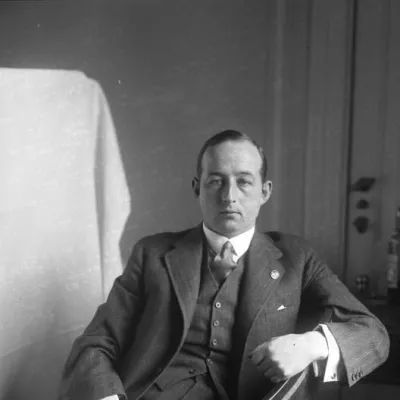
Ernst Rüdiger Starhemberg
Human Design Chart
Biography
november 1923 (Munich).After his retreat he was abroad and fighted for the Allied troops.He died 15 march 1955 in Schruns.
Ernst Rüdiger Starhemberg — Generator with Profile 1/3
Generator 1/3 — Design at a Glance
Ernst Rüdiger Starhemberg possessed immense endurance and high capacity for energy production. His design as a Generator laid the foundation for functioning based on constancy and powerful propulsion, comparable to the strength of a strong horse. This power was not unleashed through spontaneous initiatives but rather through a specific reactive approach. The mechanics of his sacral center required him to wait for signals from his environment and respond accordingly instead of taking independent action.
This strategy of “reacting” was crucial for his functionality. When Ernst Rüdiger Starhemberg received impulses that his inner system answered with a clear yes, he could effectively convert this energy into material results and act from the gut feeling. If he did not live by this principle, such as acting against his internal resistance or being held back from his true drive by external pressures, his energy would stagnate. Instead of the deep fulfillment that a Generator experiences when harmoniously utilized, frustration set in or there was a noticeable lack of energy. His functioning thus depended on him not initiating but reacting to life to be able to fully unleash his power.
Emotional Authority
Ernst Rüdiger Starhemberg showed himself as someone whose inner orientation was strongly influenced by an emotional wave. His design carried Emotional Authority in the defined Emotional Center, meaning that his feelings were subject to constant ups and downs; he saw the world colored by his current mood. In one moment, he could be totally enthusiastic about something, in the next it appeared completely negative.
This configuration established that his immediate feeling was only a snapshot, not his ultimate truth. Quick, spontaneous decisions based on such emotions often had negative consequences because they were based on fleeting impulses. Therefore, his design mechanics required patience: He needed to take time for decision-making to mature through multiple reconsiderations and allowing questions to be asked.
Over time, the intense feelings subsided, giving him emotional distance. Only then did clarity and calmness set in – a sign that he had completed the inner process. This strategy was particularly important for long-term decisions with significant influence on his life course. His inner authority took precedence over all other defined centers; it largely determined how he evaluated action options and ultimately chose, always dependent on the emotional clarity that set in after the initial waves subsided.
The 1/3 Profile — Investigator / Martyr
Ernst Rüdiger Starhemberg showed himself as a person who linked theoretical knowledge with practical application. His design laid out a tendency towards research and experimentation: He sought new insights and tested them through his own actions. This configuration describes the profile of a Researcher and Experimenter. Here, learning through trial and error is key. Sometimes, the energy of the first line took control, leading to fear of implementation because he felt he did not know enough yet. This contradicted the third line's desire to try things out and learn from mistakes. Self-earned insights were central. If he deemed something good, he had previously examined it both theoretically and practically. His judgment was therefore trustworthy. The first line represented introspection and authority in sharing new insights. Jupiter symbolized luck, expansion, and breaking rules. Expressing a new insight could undermine established value systems. Negative consequences arose when new ideas were introduced into existing structures. Gate 49 addressed dissatisfaction and the struggle between responsibility and irresponsibility. It was about confronting outdated principles. Once reservations were cleared away, this enabled their destruction. The second generation showed a lack of sensitivity leading to brutal annihilation of the old order. The signal was clear: He no longer belonged there and had to leave, breaking ties.
Triple Split Definition — Defined & Open Centers
Ernst Rüdiger Starhemberg's Human Design profile revealed a tendency towards consequent determination and mental penetration. His defined Heart Center provided him with a constant source of willpower, enabling him to keep promises and actively steer his own life. This energy was channeled through his also defined Ajna Center; his mind was constantly active in generating concepts and theories without being easily influenced from the outside. The connection between these centers allowed him to directly translate his mental processes into communication via his defined Throat Center, speaking what he thought, giving his statements a clear yet stubborn structure.
His defined Sacral Center generated continuous vital energy, but it was only correctly available in response to external impulses. Initiatives not based on such responses led to frustration and resistance. Parallel to this, his defined Solar Plexus acted as an emotional authority; he had to wait out the waves of his feelings to gain clarity rather than acting impulsively in highs or lows. The defined Spleen Center supported this through spontaneous intuitive signals in the present moment, while the defined Root Center provided a constant pressure to maintain the life impulse.
In contrast, his vulnerability was revealed in the undefined centers. His open Head Center made him susceptible to mental confusion and the pressure to find answers to questions that were not his own; he tended to identify with others' doubts or seek inspiration to fill this void. Similarly, lacking a firm identity in his open G Center, he took on directions and characters from his environment, making him vulnerable to 'borrowed' identities. Instead of an inner compass, he relied on the right place and people to initiate him into feeling belonging and security.
Channels for clear structure, focus, principles and devotion.
Ernst Rüdiger Starhemberg channeled his energy into precise, focused patterns. The Channel of Concentration 52-9 connected his Root Center with his Sacral Center, creating an inner pressure towards silence. This formative energy allowed him to filter out distractions and focus entirely on details to logically perfect processes. He did not act impulsively but waited for the clear reaction from his Sacral Center before investing energy.
Parallel to this, the Channel of Synthesis 19-49 between Root and Solar Plexus drove him to create a sense of belonging and define loyalty through emotional waves of acceptance or rejection. He sought principles that held the tribe together and was sensitive to community needs to protect resources and territory.
His thinking was shaped by the Channel of Structuring 23-43, connecting Ajna with Throat Center. Here he received spontaneous insights (Gate 43) and processed them into clear, innovative statements (Gate 23). This ability enabled him to formulate new perspectives that could change collective understanding, provided he followed the right timing.
Additionally, he possessed the Channel of Devotion 44-26 between Spleen and Heart Center. This gave him an instinctive sense for markets and ideologies; he could recognize what others needed before they knew it themselves and used his willpower to convincingly communicate these offers. This combination of analytical rigor, tribal loyalty, innovative communication, and intuitive persuasion shaped his work sustainably.
Tribal Circuitry — Circuit Signature
Ernst Rüdiger Starhemberg's design was characterized by three separate, parallel operating energetic streams. He had no direct connection between these blocks but acted with isolated focal points. In the Knowledge Circuit, Channel 43-23 connected Ajna Center (Thinking) to Throat Center (Expression). This allowed him to formulate mental structures and articulate them verbally—a pulsating acoustic power for articulating individual paths.
Independently, in the Understanding Circuit, Channel 9-52 between Sacral and Root Centers generated a focused visual energy for logical strategy and concentration on future goals. This rational level was emotionless and served structured improvement of situations through clear intellect.
The third stream lay in the Ego Circuit, which however split into two non-connected parts. On one hand, Channel 26-44 connected Heart Center (Will) to Spleen Center (Intuition), fostering devoted support and traditional value orientation. On the other hand, Channel 49-19 between Solar Plexus and Root Centers linked emotional waves with the necessity of structure. As these groups did not communicate with each other, Ernst Rüdiger Starhemberg experienced these forces as distinct, coexisting aspects: structured communication, rational strategy, and separate areas of will-based support and emotional synthesis.
Right Angle Cross of Explanation 2
Ernst Rüdiger Starhemberg carried the design of the right cross of statement two. This configuration conveyed a deep, often unconscious motivation to solidify one's existence and identity through clear definitions. It was less about intellectual debate than providing life with a comprehensible structure by reducing complex relationships to their essential elements. For him, speaking or formulating truths was a means of self-orientation; only through the explicit naming of what is could he feel secure and centered. This mechanism acted as an inner compass that urged him to resolve uncertainties through definitive statements. He sought after the one correct formulation that would offer stability both for himself and his environment. The right cross of statement two fostered a stance oscillating between the need for absolute clarity and the fear of misunderstandings. His way of understanding the world was closely linked with the ability to name things unequivocally, thereby making them tangible. This shaped his interaction with others: He often expected that his explanations would be accepted as definitive truths because they held existential significance for him. The energy of this cross helped him transform chaos into order by creating narrative structures intended to provide meaning.
Saturn Return · Uranus Opposition · Chiron Return — Life Cycles
Ernst Rüdiger Starhemberg showed a life path marked by clear cycles of consolidation and upheaval. His design indicated a tendency towards public leadership roles that anchored in firm structures. This became visible at the age of 31 in 1930: The first Saturn return marked the peak of his institutional power as leader of the Heimwehr and Minister of the Interior. In this phase, years of work condensed into a stable position radiating stability and authority.
Yet this consolidation was not final. The Uranus opposition at age 37, specifically in 1936, brought a necessary tearing apart. Starhemberg relinquished all governmental functions. This step corresponded to the mechanical logic of the cycle: Old structures that no longer fit the current life phase were radically dissolved to make room for new orientations. It was not a failure but a structural necessity to break free from outdated role models.
Later, at age 48 (1947), the Chiron return occurred. This fulfillment cycle did not bring healing of old wounds but rather the blossoming of his own purpose. When his lawyer Ludwig Draxler filed for a stay of execution, it was not an isolated legal detail but an expression that Starhemberg was on the path to restore his position and influence. The Chiron return confirmed here that previous phases of consolidation and upheaval served to make the true life purpose experiential.
Generator · Emotional Authority — Synthesis
Ernst Rüdiger Starhemberg was a Generator, whose life was marked by deep sacral energy and the drive to shape something through concentrated work (Channel 52/9). This format-energy manifested in his ability to develop concepts and inspire others (defined Ajna Center), while he constantly sought new insights and tested them through practical experience (Profile 1/3). The pursuit of knowledge and willingness to experiment was a central motive driving him to continually explore new paths and live out his individual identity – a process amplified by the Knowledge Circuit.
At the same time, he lived in an emotional wave (Emotional Authority), causing him to oscillate between enthusiasm and skepticism. This inner dynamic created a paradox: On one hand, he needed time to let decisions mature and find a clear direction from emotions; on the other hand, his sacral center and experimental profile demanded quick implementation and concrete action. The documented events – both professional successes and crises – reflect this internal conflict where the necessity of emotional alignment met the energy for action.
4 Defined Channels
Incarnation Cross - Right Angle Cross of Explanation 2
Solar Return
The Solar Return shows the moment when the sun returns to its exact birth position - your personal solar year.
Life Cycles
Discover the life cycles with a detailed triple view (birth chart, cycle chart, composite).
Human Design Profile
- Type
- Generator
- Strategy
- To respond - wait for something to respond to
- Authority
- Emotional Authority
- Profile
- 1/3 - Investigator / Martyr
- Definition
- Triple Split
- Incarnation Cross
- Right Angle Cross of Explanation 2
- Date of Birth
- 10.05.1899 15:00
- Place of Birth
- Eferding, AUS
Frequently Asked Questions
What was the Human Design type of Ernst Rüdiger Starhemberg?
What Profile did Ernst Rüdiger Starhemberg have?
What Authority did Ernst Rüdiger Starhemberg have?
Which incarnation cross was assigned to Ernst Rüdiger Starhemberg?
When was Ernst Rüdiger Starhemberg born?
Discover your own Human Design
Are you also a Generator? Find out in a personal reading how to use your sacral energy correctly and discover deep satisfaction.
More Personalities
Back to overviewAaliyah

Alexia

Angèle

Anne-Marie

Arcángel

Arno