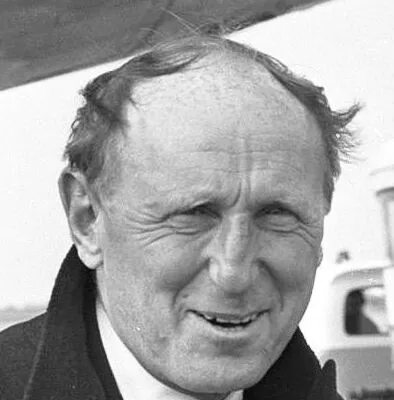
Etienne Bally
Human Design Chart
Biography
Bally's first major competition was the 1946 European Championships held in Oslo, where he finished fourth in the final of the 100 metres—his time was equal to that of the bronze medalist, Carlo Monti. He also competed at the 1948 Olympics in London, where he reached the quarter-final of the 200 metres, but he failed to finish his heat of the 100 metres.
Bally's achieved his greatest success at the 1950 European Championships in Brussels, where he won gold in the 100 metres and silver in both the 200 metres and the 4 × 100 metres—he ran the first leg of the final and was followed by Jacques Perlot, Yves Camus and Jean-Pierre Guillon. His final major championships were the 1952 Olympics in Helsinki, where he reached the quarter-finals of both the 100 metres and the 200 metres and finished fifth in the final of the 4 × 100 metres.
Etienne Bally — Projector with Profile 6/2
Projector 6/2 — Design at a Glance
Etienne Bally's design showed a tendency towards a dense, focused aura that acted like a bright flashlight. He was someone who immediately recognized system errors in his environment – the light fell directly on areas in others that were still "in the dark" or not functioning properly. This ability to quickly identify flaws in the system was central to his way of perceiving things.
However, the mechanics of this projector type explain an important behavior: Directly addressing these faults often triggered defensiveness, akin to shining a bright light directly into someone's face. Instead, Etienne Bally's design worked most effectively through elegant attraction. By himself radiating harmony – for example, through stable relationships or actions – he drew others in automatically. People came to him of their own accord seeking advice because his role model character was so appealing. The strategy involved waiting for a respectful and sincerely meant invitation rather than taking the initiative to correct things.
Since Etienne Bally does not have a defined Sacral Center as a projector, he did not have a constant source of intrinsic life energy. His rhythm consisted of phases of high activity followed by necessary rest periods to prevent burnout. When he lived according to this design, he was rewarded with success; when he deviated from it, his non-self theme of bitterness would eventually arise.
Splenic Authority
Etienne Bally's design inclines towards spontaneous, intuitive decision-making. His inner authority lies in the defined Spleen Center – the biological health and alarm system. This grants a pronounced survival intelligence: The first, spontaneous impulse was always the most reliable truth for his well-being and health. Etienne Bally knew immediately if a situation or environment was beneficial. However, this subtle spleen impulse occurred only once; it could easily be overshadowed or ignored by external influences. Therefore, his mechanics required high vigilance to not miss these subtle signals. Retreats served to provide the necessary clarity.
Since the right course of action only became visible in the moment, long-term planning contradicted this inner logic. Plans could change at short notice as intuition flexibly responded to new circumstances. Etienne Bally showed himself to be someone who needed a lot of space and flexibility to not work against his own nature. Long-term commitments complicated this process; spontaneous arrangements fit better with his mechanics. Crucial was the strict demarcation from harmful influences, since his body directly signaled what harmed him. Only Projectors or Manifestors can carry this authority, as the Emotional Center and Sacral Center must be open – a structural requirement that Etienne Bally's design fulfilled. His path consisted in trusting the immediate impulse rather than overlaying it with analysis.
The 6/2 Profile — Role Model / Hermit
Etienne Bally's design is characterized by a clear two-phase life path. In the first three decades, an experimental phase dominated: trial and error shaped his actions, followed by necessary retreats after failures. This early period served to gather raw experiences without preconceived wisdom.
After about 30 years, a fundamental change occurred through the activation of Line 6 in Profile 6/2. Etienne Bally metaphorically retreated into a "cave on the mountain" to gain distance. This isolation was not an escape but space for intensive reflection and healing. He looked back at his earlier experiments with new clarity and extracted deep self-knowledge from them.
The mechanics of Line 6 require this process overview: it asks who can conclude processes and whether one can trust in growth. Simultaneously, the second line worked through its characteristic selectivity and adaptation to limitations. Etienne Bally learned to question habits even as old constraints fell away – a capacity for mutation rather than rigid routine.
In his later life, he emerged as a wise mentor. From his reflective phase, he shared his insights with others. Line 2 enabled him to let others participate in his growth process. Those who turned to him could learn from this ability for deep introspection. His path showed how early experimentation through late distance is transformed into transmissible wisdom – a process based on trust in one's own inner circuitry.
Single Definition — Defined & Open Centers
Etienne Bally's design inclined towards clear and authentic communication and spontaneous intuition. His defined Throat ensured a reliable voice; he did not speak from fleeting intellect or shifting emotions but acted and articulated from a stable inner source. However, this consistent way of manifesting was only healthy if it trusted his Strategy and Authority rather than impulsively following every urge. Parallel to this, his defined Spleen Centre provided intuitive warning signals in the present moment. Etienne Bally had to trust these subtle, non-verbal alarm signals immediately without wanting to rationalize them; the mind could easily overpower this existential intuition.
These inner supports contrasted with his open centres, which made him vulnerable to conditioning. His open Head and Ajna Centres did not mean constant mental inspiration; he tended to get entangled in doubts or seeking answers from others rather than possessing his own conceptual truths. The open G Centre lacked a fixed identity; Etienne Bally allowed himself to be initiated by environment and place, rather than prescribing a rigid direction. His open Heart Centre did not drive him towards willpower or promise-keeping; he avoided proving his worth through competition. The open Sacral led to inconsistent energy availability; he worked in spurts and needed rest breaks instead of persistently pushing forward. Additionally, his open Solar Plexus absorbed foreign emotions, making him emotionally vulnerable, and his open Root Centre took on external stress which he could not misinterpret as personal pressure.
Channels for intuitive clarity and precise self-expression.
Etienne Bally revealed himself as someone who could directly articulate intuitive knowledge into clear words. His design marked the ability to communicate spontaneous insights from the gut without much thought. This happened through the Lightning Flash Channel 57-20, connecting the Spleen Center with the Throat Center. Here, his individual intuition of the Gate of Intuitive Insight (57) flowed as a "wave of knowledge" directly to the Gate of Now (20). This connection enabled profound self-awareness, often expressed in the feeling: "I know that I am living now." Etienne Bally used this mechanism to encourage others to awaken their own inner survival intelligence. His verbal outbursts of pure intuition reached the core of a matter faster than those around him, provided he was grounded in the moment and his timing was accurate.
Additionally, other Gates contributed to his internal dynamics. Gate 42 emphasized experience and growth; it was about closing processes to take on new commitments, where obstacles could arise if decisions were delayed. Gate 32 stood for continuity and material success in service of the tribe, assessing situations for stability and initiating radical changes when necessary. Gate 60 brought acceptance of limitations to enable transcendence, where melancholy as a physical experience could be overcome through creativity. Finally, Gate 56 promoted inspiration and abstraction; it allowed him to translate mental processes into figurative representations and narratives, which was crucial for understanding collective stories. Together, these elements formed a Profile that set the stage for intuitive action in the Now, structured experiences, and narrative processing.
Individual Circuitry — Circuit Signature
Etienne Bally's design inclined towards innovative creativity that directly translated into expression. His Channel of Knowledge connected his Throat Center exclusively with the Spleen Center via Channel 20-57, known as the "Flash of Genius." This channel generated intuitive and creative impulses from the Spleen Center – the center for intuition and survival strategy – and channeled them directly to the Throat Center, responsible for external articulation.
The energy of this circuit was pulsating and acoustically marked. It served to follow one's own path and transform newly acquired knowledge through personal identity rather than merely acquiring it. As Etienne Bally had a Simple Definition, this energy flowed as a continuous force from the Spleen to the Throat. There were no separate segments or disconnected centers within this circuit. The Spleen provided emotional grounding and creative spark; the Throat Center brought it into the world. This enabled an expression form based on individual intuition that heralded change through this specific, personal channel. The focus was always on transforming new knowledge via this direct connection between inner inspiration and external expression.
Left Angle Cross of Limitation 1
Etienne Bally's design indicated a tendency towards clear demarcation. He was someone who not only accepted boundaries but actively used them to define his own structure and identity. This attitude stemmed from the influence of the left cross of limitation 1 in his chart.
This cross describes a mechanism of self-determination through setting limits. It is not about isolation or rejection of others, but rather about the necessity to clearly delineate one's own space and energy so that it can remain effective. For Etienne Bally, this meant finding strength in knowing exactly where he ended and others began. This demarcation provided him with stability and allowed him not to lose himself in external expectations or other people's needs.
The dynamics of this cross promoted a direct, often pragmatic way of dealing with the world. Etienne Bally lived by the principle that clear boundaries are the prerequisite for true freedom. Without these limits, his energy would have dissipated; through them it became focused and actionable. His design supported him in making decisions that preserved his integrity, even if this sometimes appeared as distant or inflexible to others. It was however a protective mechanism that helped him stand authentically and powerfully in his life.
Saturn Return · Uranus Opposition · Chiron Return · 2nd Saturn Return — Life Cycles
Etienne Bally's design indicated a tendency towards external validation through measurable successes, especially when internal structuring encountered resistance. This configuration describes a process where identity is not only felt but anchored by visible results in the outside world. The first Saturn return marks here the decisive turning point: Long-term work condenses into a solid foundation that clearly defines and makes one's role in the world recognized.
In 1950, at the age of 27, Etienne Bally won gold over 100 meters and silver over 200 meters at the European Championships in Brussels. This event was exemplary for his design: It was the moment when years of discipline and inner alignment condensed into a public triumph. The Saturn return acted as an initiation that not only confirmed his capability but made it the basis for further development. Through this success, his identity became visible and stabilized in the outside world, which is essential for carrying and developing one's potential sustainably.
Projector · Splenic Authority — Synthesis
Etienne Bally's life was characterized by a deep ability to recognize the potential of others and intuitively respond to their needs (Channel 20/57). This gift, combined with a Spleen Center as inner authority, points to someone who instinctively knew what was right for him and felt this knowledge in the moment. He did not start out with a clear direction (open G Center), but absorbed the energy of others and reflected it – a talent that allowed him to adapt to various situations and gain wisdom from other people's experiences. The repeated successes, such as winning gold at the European Championships (1950), seem to have been facilitated by this ability to recognize the right moment and act intuitively.
A central tension field in Etienne Bally's design lies between his natural gift as a projector, illuminating the potential of others, and the tendency to be carried away by external influences (open centers). He was capable of recognizing errors in the system (Throat Center), yet the open definition in several centers suggests that he was susceptible to conditioning and had difficulties distinguishing his own inner voice from other people's expectations. This dynamic may have led to phases of self-alienation, but also to a deep ability for adaptation and understanding various perspectives.
1 Defined Channel
Incarnation Cross - Left Angle Cross of Limitation 1
Solar Return
The Solar Return shows the moment when the sun returns to its exact birth position - your personal solar year.
Life Cycles
Discover the life cycles with a detailed triple view (birth chart, cycle chart, composite).
Human Design Profile
- Type
- Projector
- Strategy
- Wait for the respectful invitation
- Authority
- Splenic Authority
- Profile
- 6/2 - Role Model / Hermit
- Definition
- Single Definition
- Incarnation Cross
- Left Angle Cross of Limitation 1
- Date of Birth
- 17.04.1923 01:00
- Place of Birth
- Vénissieux, France
Frequently Asked Questions
What was Etienne Bally's Human Design type?
Which Profile did Etienne Bally have in his Human Design?
What Authority did Etienne Bally possess?
What incarnation cross did Etienne Bally have?
When was Etienne Bally born?
Discover your own Human Design
Are you also a Projector? Find out in a personal reading how to unfold your leadership qualities and recognize the right invitations.
More Personalities
Back to overviewSissy Spacek

Alain-Fournier

Aldair

Anémone

Ann-Margret

Bourvil