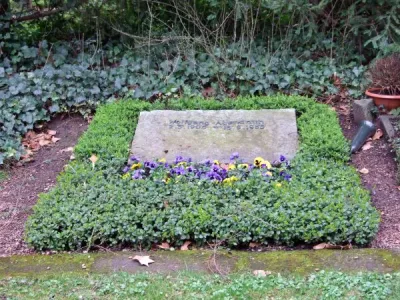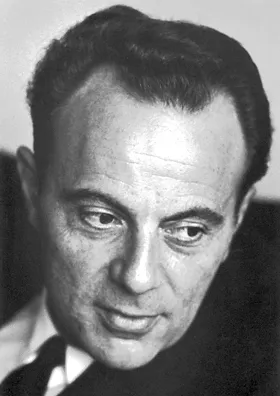
François Jacob
Human Design Chart
Biography
In 1961 Jacob and Monod described how cells control the activities of their genes and a disturbance can initiate uncontrolled replication of the DNA, which develops into cancer. They saw in their studies an explanation for why some cancers caused by viruses are activated after having been dormant in the body for long periods of time.
Jacob was married to Lise Bloch with four kids. In 1999 he married a second time, Geneviève Barrier. He died on 19 April 2013.
Human Design Analysis: François Jacob as Reflector 4/6
Reflector 4/6 — Design at a Glance
François Jacob revealed himself as a person without a steady, constant inner energy, but rather as a sensitive mirror of his surroundings. His design as a Reflector did not have defined centers, meaning he did not carry his own unchanging impulses. Instead, he absorbed the energies of other people and the rhythms of nature, such as seasons or celestial constellations, particularly intensely and reflected them. This openness required a specific lifestyle: important decisions could not be made impulsively. His strategy was to wait for at least one lunar cycle, that is, a month, before acting. This waiting allowed him to clearly recognize the changing influences and live in harmony with natural cycles. By following this strategy, he automatically found people and environments that suited him. He could observe the world free from attachment and was rewarded with a feeling of joyful surprise. However, if he lived against this design, it led to deep, lasting disappointment with himself or the state of the world. His essence was therefore not characterized by constant self-activity, but by the ability to mirror the collective energy of humanity and react to it when the external conditions were right.
No Inner Authority
François Jacob lacked inner authority, an extremely rare trait that marked him as a mental projector. His design did not have defined centers below the throat, meaning he could not rely on immediate, physical intuition for decisions. Instead, he found his truth through intense exchange with other people. In these dialogues, the energetic interactions in his open centers activated dormant potentials and provided him with specific information. This high resonance ability allowed him to examine issues from numerous perspectives and express them in different ways.
This process was, however, complex and required time. François Jacob needed phases of solitude to evaluate the collected data. Only in silence could he discern the thread, distinguish what made sense and what fit him. Thus, he developed his specific intelligence: the ability to filter out the essential from a mass of information and structure it meaningfully. This formed his central capital of success. Another key lay in the choice of his environment. He had to be in spaces where he felt comfortable and could exchange trustfully with the right people. This trustful dialogue deepened over time his sense of what was right for him and replaced the lack of a direct physical answer with clarity gained through reflection.
The 4/6 Profile — Opportunist / Role Model
François Jacob showed himself as someone who throughout his life swung between two poles: the urgent desire for deep connection and the need for detached wisdom. In the first three decades of his life, before the return of Saturn, he behaved like an experimenting seeker. His Profile 4/6 initially appeared as a pure 4-line; he intensively examined relationships and friendships to find his position in the community.
Only later did the conflict emerge that shaped his design. The heart, represented by the fourth line, strove for cooperation and the passing on of 'mutations' - that is, new ideas or truths. But the head, the sixth line, withdrew to ponder the meaning of these experiences, far from expectations. This inner conflict between the social networker and the solitary role model often created confusion.
The fourth line required him to recognize the right moment to communicate his message persuasively, while he could struggle with speech difficulties. At the same time, the sixth line demanded justice without purposefulness; experiences should be valued for their own sake. In his later years, he was expected to act as a wise role model. His great heart remained cautious, always to avoid opening up to the 'wrong' people and getting hurt. He learned that crises were correct if they arose from pure feelings and eventually looked beyond the sense-making process to innocence.
No Definition — Defined & Open Centers
François Jacobs Human-Design profile was consistently open, without a single defined center. This structure did not rely on internal, consistent energy or a rigid will, but rather functioned as a sensitive receptor for the environment. He was someone who initiated himself through interaction with others and places, rather than presenting a fixed identity or direction.
The open G Center meant that he did not carry a fixed, unchanging identity. Instead, he absorbed the qualities of his environment and crystallized himself only in correct relationships. The open Heart Center freed him from the need to prove his worth through competition or promises; he was not designed to act with willful strength.
Mentally, his profile was presented through the open Head and Ajna Centers. He did not have a consistent mind to solve problems but was open to inspirations from all directions. This allowed him to act as a mirror for the thoughts of others without identifying with their confusion or doubts. He tended to observe mental pressure waves rather than taking them on as his own tasks.
The open Throat Center indicated that he did not need to communicate constantly to gain attention. His expressions arose spontaneously when invited, rather than being forced. The open Sacral Center meant that he did not possess generative life force but amplified the energy of others. He had to learn to rest rather than overextend himself with borrowed energy.
Emotionally, he was a barometer for the climate around him through the open Solar Plexus Center, without personalizing these emotions. The open Spleen Center made him vulnerable to survival fears that he could not resolve through spontaneous decisions but through wisdom in handling intuition. Finally, his open Root Center absorbed the stress of the environment, which he regulated through detachment rather than through hectic activity. His entire profile was designed to reflect and receive rather than to produce or lead.
Channels & Gates
François Jacob operated in the tension between emotional mood and analytical distance. His profile connected the poetic, mutative quality of Gate 12 in the Cephalic Center with the visual memory power of Gate 11. Gate 12, one of the three stop codons that can be bypassed under certain conditions, shaped a communicative expression strongly guided by the inner emotional wave. This contrasted with Gate 11, which described a harmonious state for assessing the situation before acting, serving ideas of investigation and analysis that should be shared collectively.
At the same time, François Jacob experienced cyclical movements of crisis, represented by Gate 36. This gate symbolizes the darkening of light and allowed for the release of strong emotional energy, where the decline was an impersonal, cyclical process preparing the ground for new experiences. This development always had a beginning, a middle, and an end.
The further development in his life was driven by Gate 6, the Gate of Friction. As an elemental design component, it regulated the BH value as a biological threshold for opening or closing. Without this emotional motor, no growth was possible, and the six different emotional waves in the context of fertility or infertility determined the intensity of his reactions. The combination of the creative, individual mutation of Gate 12 and the necessary friction of Gate 6 created a space where restraint and the necessity of movement met. François Jacob used this configuration to form visual memories and integrate crises as a necessary part of a larger developmental process, with the emotional mood always setting the framework for his actions and his ability to assess the situation.
Circuit Signature
François Jacob operated without fixed, energetically anchored patterns in his design. His chart showed no defined centers, meaning there were no internal channels or circuits that would have generated automatic, recurring behavior or emotional reactions. This configuration, known as 'No Definition' or Projection Profile, gave him a special openness and adaptability. Since there were no fixed energy flows, he was not restricted by predetermined 'right' or 'wrong' paths. Instead, he absorbed the energies of his environment and the people he interacted with like a mirror. This allowed him to immerse himself in various situations and perspectives without being blocked by his own, rigid beliefs. His strength lay in his ability to flexibly respond and absorb new information, as his system was free from fixed energetic blockages. He could easily attune himself to the dynamics of others, making him a sensitive observer and learner. Without the burden of defined expectations or automatic reactions, he was free to consciously shape each moment rather than fall into old patterns. This openness allowed him to continuously develop and adapt to changing circumstances without clinging to past patterns.
Right Angle Cross of Eden 2
François Jacobs Human-Design profile carried the signature of the right cross of Eden 2. This configuration set a specific inner tension arising from the interplay of two opposing forces. On one side, there was a deep, almost mystical intuition seeking the meaning behind things. On the other side, there was a hard, analytical mind that scrutinized facts and created logical structures. For François Jacob, this meant that he did not simply think or feel, but had to unite both worlds within himself. He lived in the constant task of understanding the invisible through the visible. This duality was not a weakness but his driving force. It compelled him to constantly align his intuition with reality. Only when feeling and logic came together could he make a decision that felt right to him. This process was often arduous, as the two poles sometimes contradicted each other. Yet, it was precisely in this friction that his strength lay. He learned that true insight arises when one does not just follow one path but integrates both paths. His design challenged him to find this balance to live his own truth. It was a path of constant adaptation and deep understanding that shaped him.
Saturn Return · Uranus Opposition · Chiron Return · 2nd Saturn Return — Life Cycles
François Jacob was someone who transformed his intellectual ambitions into concrete, recognized results through structured, long-term work. His design indicated a tendency towards methodical thoroughness and the ability to systematize and solidify complex information. This was particularly evident in his first Saturn return, a cycle often symbolizing the crystallization of years of groundwork into stable structures in Human-Design.
In 1947, at the age of 27, François Jacob completed his medical studies and earned his doctorate. This event was typical for his design: The first Saturn return often marks the transition from an exploratory phase to a phase of consolidation and professional establishment. Here, his scientific education solidified into a reliable foundation. The mechanics of this cycle support the development of endurance and the ability to take responsibility for one's achievements. François Jacob's path shows how inner discipline and the pursuit of clarity through Saturn's influence culminated in a recognized qualification. This laid the groundwork for his later career, giving him the necessary authority and knowledge to work in his field. The connection of personal effort and external validation was a defining characteristic of this phase of his life.
Reflector · No Inner Authority — Synthesis
François Jacob was a Reflector whose life was marked by the perception and reflection of the energy around him. Without defined centers, he perceived the world as a mirror, an open system constantly permeated by external influences. This ability to grasp the energy of others and nature shaped his approach and led to a life distinguished by adaptability and the search for authentic resonances. The experience of surprise and joy that came with following this strategy seemed to be a recurring pattern in his existence – a life in harmony with natural cycles and open to constant changes.
A central tension field in his design lay in the constellation of Heart and Head (Lines 4 and 6 in the Profile). The desire for belonging and cooperation (Line 4) clashed with the need for independent thinking and the search for deeper meaning (Line 6). This inner conflict, which was evident in his early years through his experimental spirit, led him to a continuous struggle with his role and place in the community. The undefined Head Center amplified this dynamic, as he was susceptible to external influences and confusion while simultaneously trying to find his own, mutative path (Gate 12).
Incarnation Cross - Right Angle Cross of Eden 2
Solar Return
The Solar Return shows the moment when the sun returns to its exact birth position - your personal solar year.
Life Cycles
Discover the life cycles with a detailed triple view (birth chart, cycle chart, composite).
Human Design Profile
- Type
- Reflector
- Strategy
- Wait a lunar cycle (approx. 28 days)
- Authority
- No inner authority - learn more
- Profile
- 4/6 - Opportunist / Role Model
- Definition
- No Definition
- Incarnation Cross
- Right Angle Cross of Eden 2
- Date of Birth
- 17.06.1920 09:00
- Place of Birth
- Nancy, France
Frequently Asked Questions
What was François Jacob's Human Design type?
What Profile did François Jacob have in Human Design?
What Authority did François Jacob have in Human Design?
What incarnation cross did François Jacob have?
When was François Jacob born?
Discover your own Human Design
Are you also a Reflector? Find out in a personal reading how to find the right environment and understand your unique mirror effect.
More Personalities
Back to overviewBaekhyun

Jihyo

Nadar
Rune Aanderaa

George Abell

Wolfgang Abendroth