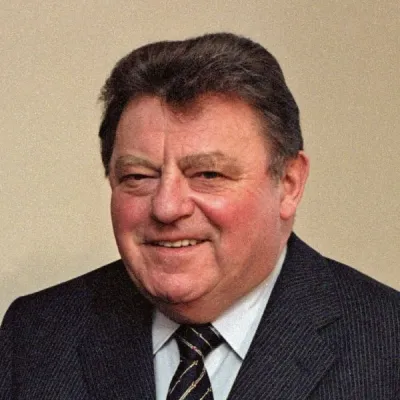
Franz Josef Strauss
Human Design Chart
Biography
Franz Josef Strauss as a Manifesting Generator 2/4 in Human Design
Manifesting Generator 2/4 — Design at a Glance
Franz Josef Strauss showed himself to be someone who quickly brought things into his life and could skip steps in the process. As an Manifesting Generator, he had constant sacral energy, which gave him enormous creative power. This hybrid configuration combined the endurance of a Generator with the direct action of a Manifestor.
His design indicated that he reacted to impulses rather than initiating on his own. When his Sacral Center said a clear "yes," he could act with great speed. This quickness allowed him to push multiple projects forward simultaneously and fall into a productive play mode.
However, this configuration also carried specific risks. Due to the tendency towards haste, Franz Josef Strauss sometimes skipped important intermediate steps. In such cases, he had to backtrack and make up for missing elements, which could quickly lead to frustration – his type's non-self theme. Additionally, he tended to fragment his own energy by engaging in many tasks at once when strategy and inner authority were not aligned.
He only drew deep satisfaction from his work when he responded to life and regularly checked whether his projects were still supported by his inner energy. Under these conditions, the simultaneous handling of various tasks was no obstacle but rather a source of his dynamic effectiveness and fulfillment.
Emotional Authority
Franz Josef Strauss exhibited a decision-making style characterized by emotional wave movements. His design featured Emotional Authority, meaning his defined Emotional Center took over as his inner guidance – independent of other defined centers in his chart. This configuration created a constant up and down of feelings; the perception of the world was always colored by the current mood. What appeared inspiring at one moment could turn negative in the next.
For Franz Josef Strauss, therefore, immediate feeling was only a snapshot, not a final judgment. Quick, spontaneous decisions from such an emotional state carried the risk of developing unfavorably. The mechanics of his authority required time: Only through patience and repeatedly sleeping on questions could he let intense feelings subside. Only when emotional distance had been gained did clarity and calm set in. This process of maturation was particularly crucial for long-term decision-making, which influenced his life course sustainably. He needed to take his time to ensure that his choice was not based on a passing wave movement but on the deeper truth that only became apparent after the initial emotion had subsided.
The 2/4 Profile — Hermit / Opportunist
Franz Josef Strauss lived in a constant tension between the deep need for withdrawal and the urge to connect. His design indicated a tendency to periodically withdraw to gain inner clarity before re-engaging actively in his social environment. This dynamic resulted from his Profile 2/4: Line 2 conveyed the hermit's desire, while line 4 promoted the wish for community with chosen individuals. It was crucial for him to clearly communicate these needs – when he needed company and when he wanted to be undisturbed. During his alone time, he reflected intensely, delved into internal processes, and reorganized impressions from his network. Only after this inner process was complete did he emerge again to spend time with his trusted companions.
This structure allowed him to evaluate the knowledge of his environment and develop new ideas from it. Line 2 from Gate 64 contributed to him often being observed and sometimes perceived as confused, even though he felt secure in his internal development. At the same time, line 4 from Gate 35 worked with a strong drive for change and the desire to accumulate personal experiences. This transpersonal aspect focused him on progress, while he often did not take misunderstandings from the second generation personally but accepted them as part of the learning process. Thus, Franz Josef Strauss used the interplay between isolation and connection to sharpen his perspectives and continuously further develop himself.
Split Definition — Defined & Open Centers
Franz Josef Strauss was someone who operated under constant mental pressure to ask questions and find answers. His defined Head and Ajna centers created a continuous mental activity; he thought constantly, conceptualized theories, and exerted an inspiring but also oppressive influence on his surroundings. This definition between the Head and Ajna did not provide him with the energy for direct implementation of these thoughts. Instead, his mind served as a source of inspiration for others, while he himself had to learn to trust the timing of his ideas rather than acting hastily.
His ability to act stemmed from other sources: His defined Sacral center endowed him with enormous vital strength and endurance, which only flowed correctly in response to external requests. If he initiated independently, he risked frustration and exhaustion. Parallel to this, his defined G center shaped a firm self-identity and a clear sense of direction; he knew who he was and where he was going without being dependent on others. His defined Solar Plexus ensured that decisions were only made after the emotional wave had run its course – truth revealed itself to him only with time, not in the moment of impulse.
In contrast to these stable pillars stood two open centers, making him vulnerable to conditioning. The open Heart center lacked consistent willpower; he tended to prove his worth through promises and performance, which could lead into a cycle of self-doubt if these were not kept. Additionally, his Spleen center was open, bringing with it a fundamental fear of survival questions and health. He unconsciously sought security from others or clung to situations that gave him a false sense of well-being rather than trusting his inner authority. This constellation of powerful mental and sacral energy on the one hand and vulnerability through lack of willpower and existential insecurity on the other deeply shaped his work.
Channels for logical leadership, doubt, rhythm, principles and change.
Franz Josef Strauss was someone who combined logical structures with deep emotional dynamics. His design tended towards skeptical analysis, paired with a drive for change and collective leadership.
The Logic Channel 63-4 linked the Head Center to the Ajna Center through the Gate of Doubt (63) and the Gate of Formulation (4). This created a mind that constantly filtered patterns; skepticism was essential here as logic only held true if it functioned verifiably. Unstable patterns generated pressure until an answer was found.
Simultaneously, the Rhythm Channel 5-15 between Sacral and G Centers operated. Through the Gate of Fixed Rhythms (5) and the Gate of Extremes (15), he determined an inner life flow. This magnetism drew others into his energy flow based on natural, recurring patterns that were neither steered by intellect nor emotions.
Leadership appeared through the Alpha Channel 7-31, connecting G Center to Throat Center. The Gate of Self Role (7) provided logical leadership role while the Gate of Leading (31) represented collective voice. This configuration required leadership to be invited by the collective; it was oriented towards shared responsibility and maintaining existing patterns, not absolute authority.
Emotional depth came from the Synthesis Channel 19-49 between Root and Solar Plexus Centers. The Gate of Claims (19) sought belonging while the Gate of Principles (49) rejected anything that did not fit into the core. This created an emotional glue for loyalty and belonging, regulated by an emotional wave of acceptance or rejection.
The Transience Channel 36-35 between Solar Plexus and Throat Centers drove the search for new experiences forward. The Gate of Crisis (36) and the Gate of Change (35) resisted restrictive patterns to set things in motion. This led Franz Josef Strauss often to seek new perspectives through emotional unrest or crisis creation, to experience the depth of life.
Additionally, Gates like 64 (Clarity from Past), 17 (Logical Teaching), and 52 (Pattern Correction) reinforced his analytical stance and focus on future organization.
Collective Circuitry — Circuit Signature
Franz Josef Strauss was someone who combined rational strategies for the future with emotional waves from the past. His design tended towards structured logic, paired with a deep need to reflect on past experiences and create resources in the collective.
The Understanding Circuit marked him through two separate segments: Head and Ajna Centers worked together for focused, emotionless ratio and forward-looking planning. Simultaneously, Throat, Identity, and Sacral Centers connected rhythm and the “Alpha Animal,” enabling a powerful but pulsating expression of logical insights to be shared.
In the Meaning Circuit, the connection between Throat and Solar Plexus Centers was evident. Here it wasn’t about cold logic but cyclical emotional waves. Strauss sought meaning behind past events, sharing these felt insights with the collective and learning from them.
The Ego Circuit concluded with the connection of Solar Plexus and Root Centers. This promoted cooperation and the joint creation of resources through mutual support. As there was no direct link to the Sacral Center, rest was necessary for regenerating energies to sustainably work within the tribe.
This split definition meant these forces existed parallel without a single continuous flow. Strauss navigated between futuristic strategy, emotional past processing, and resource-oriented collaboration, always adapting to his energetic cycles.
Right Angle Cross of Consciousness 3
Franz Josef Strauss exhibited a fundamental disposition marked by the search for hidden truths. His Human Design suggested that he uncovered connections that remained concealed to others and actively shared these insights with his environment. This configuration corresponds to the 'right cross of consciousness 3'. It describes a specific life task: not just possessing knowledge but conveying it in such a way that others can actually absorb and apply it. Strauss acted as someone who bridged the gap between abstract understanding and practical implementation. The mechanics of this cross emphasize the necessity of penetrating deeper structures and then presenting them in a form accessible to his surroundings. It was not about pure theorizing, but rather the drive to uncover hidden connections and pass them on to others. This orientation shaped his way of communicating and interacting. He sought what lay beneath the surface and felt compelled to share these discoveries. The right cross of consciousness 3 gives this attitude a clear direction: finding truth and making it accessible. Strauss lived out this dynamic by not keeping his insights for himself but bringing them into exchange with others. This ability to decipher complex issues and convey them clearly formed the core characteristic of his conscious expression.
Saturn Return · Uranus Opposition · Chiron Return · 2nd Saturn Return — Life Cycles
Franz Josef Strauss was someone who redefined his role in phases of external upheaval and internal realignment. His design indicated a tendency to find deeper fulfillment of purpose through crisis moments. In 1962, at age 47, this became evident: the Chiron Return marked an achievement cycle where the incarnation cross should have unfolded. Instead, Strauss resigned due to the Mirror Affair scandal. This crisis did not serve as an end but rather a necessary interlude for the later flourishing of his life's work.
His design reacted strongly to generational shifts and structural breaks. The Uranus opposition around age 40 often brought unexpected turns. In 1955, Strauss became Federal Minister for Atomic Affairs – a career leap that translated this disruptive energy into political power.
Later, he was shaped by demands for stability and responsibility. His second Saturn Return around age 57 called for confrontation with established structures. In 1972, Strauss delivered a 'General Settlement' speech in the Bundestag against Ostpolitik. This was not merely a political act but an expression of his design's need to question old orders and assert personal principles during this life phase. Strauss did not passively live out these mechanical cycles but used them as catalysts for his political orientation.
Manifesting Generator · Emotional Authority — Synthesis
Franz Josef Strauss' life was marked by a constant interplay between the drive to push things forward quickly and the necessity of emotionally maturing decisions. As an Manifesting Generator (MG), he had the ability to seize opportunities immediately (Sacral Center), yet his emotional authority required time for deeper evaluation – an internal conflict that manifested repeatedly in crises (documented through events in Uranus cycles and Saturn Return). The connection between Head and Ajna Centers (Channel of Logic) intensified this process by creating a constant mental pressure to question patterns and find answers.
This interplay manifested in a central paradox: Strauss' pursuit of control and swift action (Understanding Circuit) stood in opposition to the need for withdrawal and inner clarification (Profile 2/4). He moved between the desire to implement his visions and the necessity to explore the emotional landscape – a rhythm that propelled him forward while continually presenting challenges. The ability to inspire others (defined Head Center) was inseparable from his own internal doubt and search for stability.
5 Defined Channels
Incarnation Cross - Right Angle Cross of Consciousness 3
Solar Return
The Solar Return shows the moment when the sun returns to its exact birth position - your personal solar year.
Life Cycles
Discover the life cycles with a detailed triple view (birth chart, cycle chart, composite).
Human Design Profile
- Strategy
- To respond - wait for something to respond to
- Authority
- Emotional Authority
- Profile
- 2/4 - Hermit / Opportunist
- Definition
- Split Definition
- Incarnation Cross
- Right Angle Cross of Consciousness 3
- Date of Birth
- 06.09.1915 10:00
- Place of Birth
- München, Germany
Frequently Asked Questions
What was the Human Design type of Franz Josef Strauss?
What Profile did Franz Josef Strauss have in Human Design?
What Authority did Franz Josef Strauss have?
Which incarnation cross was active for Franz Josef Strauss?
When was Franz Josef Strauss born?
Discover your own Human Design
Are you also a Manifesting Generator? Find out in a personal reading how to unfold your multi-talents and direct your energy wisely.
More Personalities
Back to overviewAldair

Alizée

Angeli

Arletty

Artus

Balthus