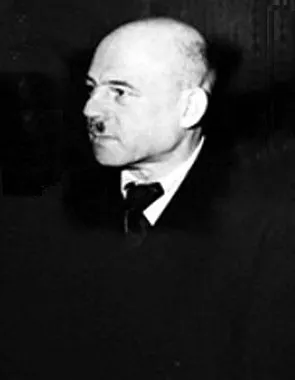
Fritz Sauckel
Human Design Chart
Biography
Hanged at Nuremberg 0n 16 October 1946.
The Human Design of Fritz Sauckel: Generator 3/5
Generator 3/5 — Design at a Glance
Fritz Sauckel's design indicated a tendency towards extreme endurance and strength. As a Generator, he possessed a lot of sacral energy that made him work like a strong draft horse—provided he acted in harmony with his inner impulses. His life force was primarily unleashed through reactions to environmental signals rather than through self-initiated actions. Therefore, the motto for his approach was: wait and then respond from the gut when an internal signal said "yes."
If Fritz Sauckel lived according to this strategy, his system rewarded him with deep satisfaction and a sense of fulfillment. When he could react to his heart projects without being hindered by external factors, his full potential became apparent. Conversely, two significant stumbling blocks threatened: first, the waste of energy on tasks that did not hold intrinsic appeal for him, which eventually led to exhaustion. Second, the inhibition of activities that he still had the energy to respond to enthusiastically. If he violated this principle and instead initiated actions or forced things through without an internal signal, persistent frustration and a noticeable lack of energy would inevitably follow. His chart-based potential was thus conditional on his ability to react to life impulses rather than forcing them himself.
Sacral Authority
Fritz Sauckel was a Generator whose decision-making was characterized by Sacral Authority. This internal guidance is specific to this type and simplified his process because strategy and authority were identical: reacting to life. A prerequisite for this was his open Emotional Center, meaning he could not rely on short-term emotional waves but had to wait for the physical truth of his Sacral Center.
His authority manifested in a direct physical reaction to external stimuli – as gut feeling or surge of energy. These signals often appeared as grunting, humming, or an affirming "Mhm" when his motor kicked in. Once this resonance occurred, he felt vital and had inexhaustible energy. He lived to dive into activities with enthusiasm without needing an external purpose; the joy of doing was the motivation.
Additionally, his activated Spleen Center served as a supportive instance. This gave him the ability to react particularly quickly and spontaneously. He had immediate access to his instinctive perception and physical well-being. This combination allowed him to make decisions not only from deep drive but also with high speed, guided by a reliable inner intuition that revealed itself in the moment of contact with the environment.
The 3/5 Profile — Martyr / Heretic
Fritz Sauckel revealed himself as someone who understood his life as a continuous series of practical experiments. His Profile 3/5 established a fundamental attitude: He initially believed in nothing predetermined and had to try everything out for himself to develop functional solutions. This line of the Adventurer drove him to take risks – often without rational justification – to achieve personal goals. Through these tough learning experiences, he accumulated a rich treasure trove of practical knowledge that he presented as an authority figure.
The fifth line of his design was projected by his environment as heroic leadership qualities. Others saw in him the rescuer who solved complex problems, even though he himself may not have had any outward-directed ambition for this role. This projection flattered his design, as 3/5s live to learn from their experiences and be perceived as attractive authorities. At the same time, his chart carried within it the danger that this public experimentation in front of an audience could fail – a painful aspect of his constellation. His development depended on becoming more selective over time in dealing with risks and making rational decisions rather than blindly following the expansive force. Thus, he acted as someone who had learned through personal failure to then serve as an example for others – a role that brought him both power and the burden of public expectations.
Single Definition — Defined & Open Centers
Fritz Sauckel's design shows a tendency towards vital endurance and instinctive orientation, accompanied by high vulnerability to external mental and emotional pressure. His defined Sacral Center generated a constant source of energy that manifested as restlessness or the need for active engagement. However, this power was only available when there was an affirmative response to external requests; initiated actions without such confirmation led to frustration and exhaustion, as the sacral energy would be lacking. Parallel to this, he had a defined Spleen Center, which gave him spontaneous intuition about health and wellbeing. His body signaled in the present moment what was correct for survival – information that he needed to trust rather than question rationally.
In contrast, several centers revealed his vulnerabilities. His open Head Center made him susceptible to mental confusion and pressure to find answers to others' questions. He tended to get entangled in other people's problems instead of remaining detached as an observer of his thoughts. Similarly, his open Ajna Center reflected the concepts of the environment, leading to a habit of pretending to have false security or adopting others' ideas as his own truth. His open G Center meant he lacked a firm identity; he adapted himself to people and places in search of love and direction rather than defining them for himself. The open Heart Center drove him to prove his worth through promises and competition – a cycle that ended in self-doubt when these were not fulfilled. Additionally, his open Solar Plexus absorbed others' emotions, leading to emotional instability if he did not recognize these as foreign. Finally, the open Root Center amplified external stress, causing him to work excessively to escape this pressure rather than trusting inner peace.
Channels for caring preservation of traditional values.
Fritz Sauckel revealed himself as someone who automatically attracted the trust of others and had a strong inclination to take responsibility for the supply and protection of a community. This attitude was rooted in his configuration: Channel of Preservation 27-50 connected his Sacral Center with the Spleen Center. Through Gate 27, the Gate of Nourishment, selfless energy for nurturing was at work, while Gate 50, the Gate of Values, guarded traditional laws and order structures. This combination created a deep need to stabilize and protect the "tribe" – that is, the community or organization he belonged to – through clear rules and material support. He was capable of carrying great burdens but often acted out of an instinctive drive to ensure the survival of the collective by defending infrastructure and values.
Additionally, other energies influenced him. Gate 28 demanded decisions in the here and now, coupled with the risk of losing personal meaning if action wasn't clear. Gate 31 brought the mechanics of leadership as pure transmission of power into play; he only achieved effect through this energetic transfer to others. Gate 41 propelled him evolutionarily forward, focused on specific experiences and crises that required transformation. In the background, gates like 14 (skillful power preservation), 32 (continuity and material success of the tribe), and 44 (vigilant resource management) were at work. Gate 57 offered intuitive clarity in a survival context, while Gate 42 represented the ability to conclude processes to take on new commitments. Overall, these elements shaped a profile of a provider and preserver who established stability through structure and care, but always had to be mindful of his own energy capacity to avoid taking on too much.
Tribal Circuitry — Circuit Signature
Fritz Sauckel's design showed a tendency towards instinctive care and the protection of his own genetics. This configuration appeared as a driving impulse to preserve and nourish his family or tribe. The mechanics behind this were clear: For Fritz Sauckel, there was a simple definition that directly connected his Sacral Center with his Spleen Center. This connection occurred exclusively through the Channel of Preservation (Gates 27-50).
This specific circuit, the Hunter Circuit, is timeless and primordial in its nature. It links the life force of the Sacral Center with the instinctive energies of the Spleen. However, for Fritz Sauckel, the emotional component of the Solar Plexus as well as the mating element (Channel 6-59) was missing since these channels were not active. Thus, his energy focused purely on aspects of care, preservation, and the physical survival of the group. It was a separate but powerful connection between the center for life energy and the center for instinct and health. This configuration marked him as someone whose actions were strongly guided by the need to secure resources and protect the physical integrity of his environment without being influenced by emotional waves or romantic bonding impulses specific to this circuit. The energy flowed directly between the will to live and the instinctive knowledge of what is necessary.
Right Angle Cross of the Unexpected 3
Fritz Sauckel's design indicated a tendency towards unpredictable turns that often proved challenging. This configuration, known as the Unexpected Right Cross 3, described a life dynamic where external circumstances frequently did not align with inner expectations. Instead of a linear progression, there was a pattern of sudden changes and unexpected obstacles that limited his range of action.
The mechanics of this cross suggested that Fritz Sauckel faced situations he could not control. It was an energy breaking through stability, forcing him to be flexible in response to the unforeseen. This did not necessarily mean chaos but rather a continuous adaptation to new conditions that often arose abruptly. Fritz Sauckel's experience was characterized by the feeling that his life path kept changing before it could stabilize.
This structure generated pressure arising from the discrepancy between planning and reality. Fritz Sauckel had to learn to cope with this uncertainty, as it was an integral part of his energetic signature. The challenge lay in not clinging to rigid expectations but acknowledging the constantly shifting conditions as part of his own experience. This shaped his interaction with the world through a certain reserve towards fixed future plans.
Saturn Return · Uranus Opposition · Chiron Return — Life Cycles
Fritz Sauckel's design indicated a tendency toward strategic power concentration, which reached its full impact during the Chiron Return phase. This cycle does not mark a healing process in an emotional sense but rather a fulfillment period when the individual incarnation cross – if strategy and authority were observed – unfolded as a meaningful life task. For Sauckel, this 'bloom' occurred around 1942 at age 48. In that year, he became Generalbevollmächtigter für den Arbeitseinsatz (GBA). This event illustrates the mechanics of the Chiron Return: long-term orientation towards certain energetic patterns condensed into a concrete public role reflecting the core of his design. It was not an accident but the visible result of a development line reaching its peak in this life phase and centralizing his power to act. The Chiron Return here acts as a catalyst, bringing inner potentials outward and translating them into structural positions, making the personal purpose tangible in the public sphere.
Generator · Sacral Authority — Synthesis
Fritz Sauckel lived deeply rooted in his sacral energy (Sacral Center defined), which made him an indefatigable actor. His profile as an experimenter and hero (3/5) indicates that he learned through personal experiences and then applied this knowledge to solve problems for others – a dynamic evident in his engagement (documented event 1942). The Channel of Preservation (27-50) reinforced this tendency by nurturing values and traditions, ensuring preservation. This combination of generative power, practical knowledge, and the need to preserve formed the red thread of his actions: an unceasing cycle of gathering experience, preserving it, and passing it on.
A central paradox in his design lay in the interplay between sacral authority – the immediate yes/no impulse of the body – and the Guardian Circuit. While the sacral reaction propelled him to respond spontaneously to external stimuli and mobilize energy for what seemed right, the circuit focused on preservation and defense of existing structures. This created a tension between the drive for active shaping through experience (Line 3) and the need to protect and preserve what already existed – a dance of innovation and conservation.
1 Defined Channel
Incarnation Cross - Right Angle Cross of the Unexpected 3
Solar Return
The Solar Return shows the moment when the sun returns to its exact birth position - your personal solar year.
Life Cycles
Discover the life cycles with a detailed triple view (birth chart, cycle chart, composite).
Human Design Profile
- Type
- Generator
- Strategy
- To respond - wait for something to respond to
- Authority
- Sacral Authority
- Profile
- 3/5 - Martyr / Heretic
- Definition
- Single Definition
- Incarnation Cross
- Right Angle Cross of the Unexpected 3
- Date of Birth
- 27.10.1894 09:00
- Place of Birth
- Hassfurt, GER
Frequently Asked Questions
What Human Design type was Fritz Sauckel?
What Profile did Fritz Sauckel have in Human Design?
Which Authority guided Fritz Sauckel's decisions?
What incarnation cross characterized Fritz Sauckel?
When was Fritz Sauckel born?
Discover your own Human Design
Are you also a Generator? Find out in a personal reading how to use your sacral energy correctly and discover deep satisfaction.
More Personalities
Back to overviewAaliyah

Alexia

Angèle

Anne-Marie

Arcángel

Arno