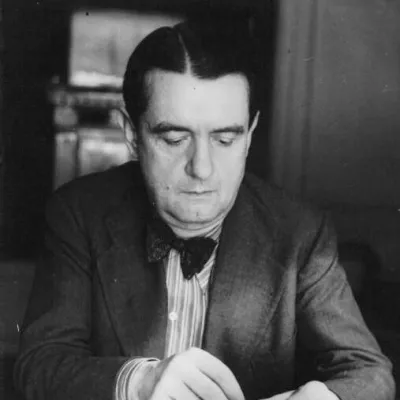
Georges Auric
Human Design Chart
Biography
Auric died 7/23/`983 in Paris.
The Human Design of Georges Auric: Generator 3/5
Generator 3/5 — Design at a Glance
Georges Auric possessed immense sacral endurance that made him seem like a strong workhorse. His life energy was not an endless reservoir for arbitrary initiatives but rather a powerful engine that only ran efficiently in response to external impulses. His design suggested that true satisfaction and unceasing creative power were released by responding to signals from the environment – not through constant self-motivation.
This mechanism, however, carried two specific risks. First, there was the danger of energy waste if he engaged in tasks that did not provide inner joy; this led to long-term exhaustion and burnout. Second, there was the risk of being held back from his heart project even when his power was still fully present. Such interruptions or ignoring the internal 'yes' from the gut resulted in frustration and a noticeable energy deficit.
In harmony with his nature as a Generator, Georges Auric showed himself most effective when he waited for a life signal to respond with full force. This strategy of reacting rather than initiating was key to his deep fulfillment. If he followed this logic, nothing could stop him; if he deviated and tried to force things instead, sooner or later he encountered the feeling of persistent frustration. His success thus depended less on constant activity than on choosing the right moments to bring forth his full potential.
Sacral Authority
Georges Auric displayed a decision-making stance deeply rooted in his body. His inner authority lay in his defined Sacral Center, marking him as a Generator. This configuration greatly simplified his decision process, as strategy and authority were one: he responded to external stimuli rather than initiating or thinking.
His responses manifested not primarily through cognitive deliberation but through immediate physical signals. Georges Auric learned to listen to his 'gut feeling' – a physical grunting, humming, or groaning that served as a clear yes or no. When his Sacral motor responded to a stimulus, he felt a powerful surge of energy. This gave him vitality and what seemed like an inexhaustible energy source. In these moments, he tackled his work with great enthusiasm and immersed himself in the task, free from compulsive purposefulness.
The design described him as someone born to go through life with joy and satisfaction. The authenticity of his energy depended directly on whether he trusted this spontaneous physical response. By listening to this inner resonance, Georges Auric found the necessary confirmation for his actions. His well-being and effectiveness were thus not products of will but results of a correct reaction to the environment, guided by the defined Sacral Center as the central authority.
The 3/5 Profile — Martyr / Heretic
Georges Auric appeared initially skeptical about taking much at face value. His design indicated that he did not absorb knowledge merely through listening but tested it in practice – often with errors and setbacks serving as indispensable learning material. This attitude stemmed from his Identity Line, which demanded experimental learning through direct experience. He accepted life like a wave: without claiming permanent fulfillment but marked by transient ease and resignation to fate.
From these accumulated practical insights developed his outward impact. While he learned internally to take things as they were, his design projected an aura of heroism and problem-solving to the outside world. Others saw in him someone with a treasure trove of life experience who could be trusted. This attractiveness rested on the tension between his necessary public failures during experimentation and the expectation from his environment that he was a competent savior. His innate dignity often appeared as power or arrogance – a protective mechanism to maintain this projection, even though reality behind the scenes was marked by constant uncertainty and the need to test everything himself.
Single Definition — Defined & Open Centers
Georges Auric revealed himself as someone with a clear inner structure and steady energy. His defined Heart Center gave him willpower and the desire to determine his own life path. He knew his worth and kept promises, which built trust. The defined Sacral Center provided vital endurance; he reacted to requests rather than acting proactively. His defined Spleen Center gave him intuition in the moment for health and survival. The defined Root Center delivered constant pressure for forward movement.
These four centers formed his stable foundation. In contrast, Head, Ajna, Throat, G-, and Solar Plexus Centers were open. His open Head Center allowed him to absorb mental inspiration from the environment but led to confusion when he tried to solve problems that weren't his own. The open Ajna Center made his mind flexible for concepts without holding them as personal truth. The open Throat led him to seek attention or speak to be heard rather than allowing spontaneous entry. His open G-Center meant no fixed identity; he sought direction and love through relationships and places, often questioning who he was. The open Solar Plexus absorbed emotions from the environment, making him vulnerable to others' moods and prone to avoiding confrontation or taking on guilt for feelings not his own. These opennesses made him sensitive to his surroundings while the defined centers gave him stability.
Channels for devotion, focus and caring preservation.
Georges Auric showed a calm, constant tension that enabled him to logically analyze patterns and perfect them. This attitude stemmed from Channel of Concentration 52-9, a format energy connecting Root Center with Sacral Center. Through Gate 52 of Non-action he kept himself away from distractions while Gate 9 of Focusing directed his attention to details. This mechanism allowed him to sit quietly and use energy precisely to confirm or refute formulas or processes step by step. Without this inner stillness, the powerful logical analysis would not have been possible; it served to correct and improve what his design was set for.
Parallel to this, an instinctive alertness in him released entrepreneurial energy to offer useful solutions to the clan. Channel of Devotion 44-26 connected Spleen Center with Heart Center and gave him a sense of what others needed often before they knew it themselves. Gate 44 of Alertness used historical memory to recognize threats or improvement potentials while Gate 26 of Ego provided the willpower to convincingly convey these insights. Georges Auric acted as an intermediary who sold products or ideas by intuitively assessing his target group's needs and adapting his message accordingly. This combination of logical precision and instinctive sales talent shaped his work: He not only identified essentials through focused analysis but also knew how to present this knowledge in a way that was accepted and valued. Both channels worked together to ensure that his contributions were both substantively grounded and communicatively effective.
Tribal Circuitry — Circuit Signature
Georges Auric showed himself as someone who combined rational strategy with resource-oriented cooperation and instinctive family protection. His design integrated these forces into a synthesis of emotionless logic for future shaping, exchange of material resources in the clan context, and primal preservation of genetics through care.
The Understanding Circuit shaped this approach. In Georges Auric it connected Sacral with Root Center via Channel of Concentration. This allowed a focused, logical approach to the future free from emotional conditioning, supported by his life force and endurance.
Parallel to this, the Ego Circuit worked. It linked Heart with Spleen Center in him through Channel of Devotion. This promoted cooperation and the creation of resources within the clan. It was about mutual support and a balanced relationship between giving and taking, where rest periods for regeneration were necessary as there was no direct connection to Sacral Center.
The Archer Circuit rounded out the picture. It also linked Sacral with Spleen Center, this time via Channel of Preservation. This brought primal energies of protection and preservation of family into play. It involved instinctive care, nurturing, and securing the survival of one's genetics, tied in with the life force of Sacral Center.
Together these circuits created a structure where strategic clarity, resource-aware cooperation, and deeply rooted protective instincts coexisted. Georges Auric used this combination to develop future-oriented plans as well as stabilize his immediate environment through practical care and cooperation.
Right Angle Cross of Contagion 1
Georges Auric was marked by the right Infection Cross 1. This configuration conveyed a deep, often unconscious connection to collective currents and the pulse of his time. It wasn't about superficial adaptation but rather a fundamental resonance that made him a sensitive receiver of societal or cultural waves.
The mechanics of this cross describe an osmotic process of information and energy absorption from the environment. Those who carry this structure not only consciously take in knowledge but also absorb moods, trends, and unconscious patterns of their surroundings. This created a natural antenna for Georges Auric to pick up on what was moving or developing beneath the surface. The challenge lay in not misinterpreting these intensively received impulses as his own isolated truth but rather understanding them as part of a larger dynamic whole.
This ability to be infected – in a neutral sense of forwarding and transforming energies – shaped his way of behaving within groups or projects. He was a medium through which collective forces flowed. The strength of this design showed in the authenticity of this connection; he could not only recognize trends but also amplify and carry them forward through his own presence. It was a passive yet effective force that linked him to the zeitgeist without him actively seeking such a connection. It occurred as soon as he moved within a field offering resonance.
Saturn Return · Uranus Opposition · Chiron Return · 2nd Saturn Return — Life Cycles
Georges Auric's design set a tendency towards sudden, unexpected interruptions breaking established rhythms and forcing necessary realignment. This dynamic stemmed from his Uranus Opposition in his cycle, a configuration often abruptly questioning stability. Instead of linear progress, his path was marked by crisis moments acting as catalysts for profound changes.
This mechanism became concretely active in 1940 when Georges Auric, at the age of 41, experienced a car accident with Marie-Laure de Noailles. This event did not mark mere randomness but the peak of cyclical tension. The sudden crisis broke previous order completely and forced confrontation with new realities. For his design, this meant that external shocks were not to be dismissed as disruptions but served as essential impulses to dissolve old structures. Only through such radical interruption could a new alignment unfold. The accident thus functioned as the concrete expression of Uranus dynamics: a moment of destruction of the known to make way for necessary transformation. Georges Auric had to learn in this phase to cope with the unpredictability of his own rhythm and accept resulting changes rather than fight against them.
Generator · Sacral Authority — Synthesis
Georges Auric lived a life deeply reactive to his environment. His Generator design and sacral authority indicated he was most fulfilled when responding to external impulses and investing energy into activities that truly attracted him. This natural ability to react was strengthened by the Profile of the Experimenter/Hero – a person who gathers experiences to pass them on further. The defined Root Center provided constant drive and endurance to make these experiences and bring them into the world, while his open G-Center made him receptive to diverse influences from his environment and helped him form authentic connections.
A central paradox in Auric's design lies in the interplay of spontaneity and the need for validation. His sacral center demanded an immediate reaction to life, while the open centers – especially Head and G-Center – made him susceptible to external influences. This led to a tension between the impulsive desire to immerse himself in new experiences and the subtle search for validation and direction from outside. Thus, he was an independent explorer who simultaneously sought resonance with others to find his own truth.
3 Defined Channels
Incarnation Cross - Right Angle Cross of Contagion 1
Solar Return
The Solar Return shows the moment when the sun returns to its exact birth position - your personal solar year.
Life Cycles
Discover the life cycles with a detailed triple view (birth chart, cycle chart, composite).
Human Design Profile
- Type
- Generator
- Strategy
- To respond - wait for something to respond to
- Authority
- Sacral Authority
- Profile
- 3/5 - Martyr / Heretic
- Definition
- Single Definition
- Incarnation Cross
- Right Angle Cross of Contagion 1
- Date of Birth
- 15.02.1899 08:00
- Place of Birth
- Lodève, France
Frequently Asked Questions
What was Georges Auric's Human Design type?
Which Profile did Georges Auric have?
What Authority guided Georges Auric's decisions?
What incarnation cross did Georges Auric have?
When was Georges Auric born?
Discover your own Human Design
Are you also a Generator? Find out in a personal reading how to use your sacral energy correctly and discover deep satisfaction.
More Personalities
Back to overviewAaliyah

Alexia

Alizée

Angèle

Anne-Marie

Arcángel