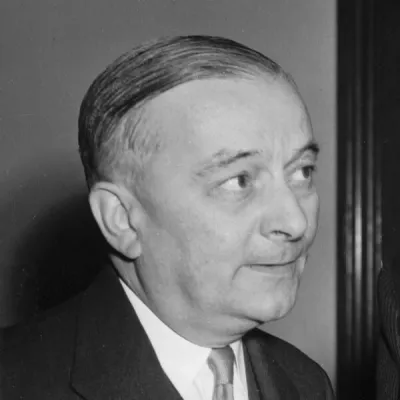
Georges Bidault
Human Design Chart
Biography
Died on 27 January 1983 in Cambo-les-Bains, France, near Bayonne
What does Generator 4/1 mean for Georges Bidault?
Generator 4/1 — Design at a Glance
Georges Bidault's design laid the groundwork for immense endurance paired with the ability to turn projects into reality. This power stems from his defined Sacral Center, which provides him as a Generator with abundant energy – comparable to a strong workhorse that only runs effectively when properly guided.
His functional principle was strictly reactive: Bidault's energy does not unfold through initiative but exclusively in response to external impulses. The motto was clear: do not initiate, but wait until the Sacral Center signals a clear 'yes'. Only then could he respond with full force and act.
This design contained two central risks. If Bidault acted on things that internally repelled him or for which he felt no intrinsic motivation, he would squander his resources senselessly, leading to burnout in the long term. Conversely, frustration and energy deficiency arose when he was prevented from doing his actual work despite an inner drive to continue.
The deepest satisfaction and a feeling of fulfillment only emerged if Bidault used his energy in harmony with this reactive pattern. By waiting for signals from life and then acting upon them instead of pushing forward independently, he avoided the trap of persistent frustration. His success thus did not rest on proactive initiative but rather on precise gut reactions once the inner signal was ready.
Sacral Authority
Georges Bidault's design inclined him to make decisions not through intellectual analysis but via direct physical signals. As a Generator, his inner authority was Sacral Authority, which functioned as the sole instance in his chart since strategy and authority are identical here. This fundamentally simplified his decision-making process: he reacted to external stimuli with an 'inner voice' – audible as grunts or hums – or felt an immediate surge of power. These physical responses were the legitimate source for his actions, independent of rational considerations.
His design foresaw that such reactions would vitalize and energize him, enabling him to carry out tasks with great enthusiasm and without obsessive purposefulness. He was born to immerse himself in what his body positively responded to. Additionally, an active Spleen Center served as a supportive instance. This endowed him with the ability to react particularly quickly and spontaneously to situations. Through this connection, Georges Bidault had direct access to his instinctive perception and physical well-being, which he could reliably guide himself by. His life energy thus ignited not through planning but through listening in these quick, intuitive moments of reacting to the environment.
The 4/1 Profile — Opportunist / Investigator
Georges Bidault's design established a deep inner fixation: his essence was so rooted that he barely deviated from his individual path. As a 4/1 (Networker/Forscher), a large but cautious heart was evident. Well-meaning impulses for change by others were often perceived as non-acceptance; consequently, Bidault quickly excluded these people. External observers frequently interpreted this as stubbornness or lack of critical thinking, which could weaken his self-confidence.
This dynamic arises from the 4-line, which is concerned with connection and protection from injury, combined with the unchangeable nature of the fixed profile. Bidault neither wanted to nor could change his essence. The 1-line complemented this by adding a need for experience collection and pressure to dissolve old forms to start anew. Interrupting or criticizing his path led to frustration; in the long term, however, he preferred short cycles as long-term goals could be discouraged by limitations.
Only when Bidault recognized his own nature and life theme did he become stable like a rock in the waves. In this inner security, he was teachable and could impart greatness to others. His design marks the transition from 'I' to 'You', where personal identity remains strong while social interaction is defined through the network. The challenge lay in not misinterpreting this inner rigidity as a deficit but rather understanding it as a necessary protective mechanism for his deepest authenticity.
Single Definition — Defined & Open Centers
George Bidault's Human Design shows a tendency towards inner stability and clear identity, supported by defined G-, Heart-, Sacral-, and Spleen Centers. This configuration created an autonomous base: The defined G Center provided him with a reliable compass for his life direction and self-love, while the Heart Center supplied willpower and resource control. His energy source came from the Sacral Center, which generated constant vitality but was dependent on reaction rather than initiation. The Spleen Center ensured intuitive health protection instincts in the present moment.
This firm internal structure contrasted with five open centers: Head, Ajna, Throat, Solar Plexus, and Root. This openness functioned as a resonance field for environmental information. George Bidault tended to absorb mental inspiration or doubt from his surroundings (open Head/Ajna Centers), without automatically personalizing this as his own truth. Emotionally, he was vulnerable to mirroring others' moods (open Solar Plexus), which made him prone to observation rather than identification with foreign feelings. External stress or adrenal impact was absorbed by the open Root Center, leading him to unconsciously misinterpret this pressure as his own drive or try to escape it through hyperactivity. In communication (open Throat Center) too, spontaneity depended on external invitations rather than being planned.
The challenge lay in not overstimulating the powerful autonomous energy of Heart and Sacral by the pressure from open Root or emotional waves from Solar Plexus. Instead, his inner authority – rooted in G, Spleen, and Sacral – served as a filter for all external impulses. George Bidault thus maintained a clear, unwavering personal direction despite absorbing diverse external stimuli, so long as he trusted his sacral response and did not attempt to compensate the uncertainty of open centers through mental control or forced communication.
Channels for authentic intuition, self-assertion and inner strength.
George Bidault was someone who based himself on inner conviction and intuitive security. His design tended towards individual reinforcement, where self-love and authentic behavior formed the foundation of his actions. This is supported by Channel of Investigation 34-10: Gate 34 provides the power to hold onto personal convictions while Gate 10 initiates the resulting behavior. This configuration promoted a stance of trust in one's own reaction, independent of external expectations.
Additionally, Channel of Perfect Form 57-10 linked intuitive awareness with this self-expression. Gate 57 brings acoustic sensitivity and intuitive insight that enabled spontaneous and appropriate adjustment to current surroundings. This supported behavior rooted not in future anxieties but in the present moment, allowing George Bidault to live out his individual potential without unnecessary burdens.
In strategic contexts, Channel of Devotion 44-26 came into play. This channel connects the intuitive vigilance of Gate 44 with the willpower and ego of Gate 26. It was an entrepreneurial dynamic where instinct was used to recognize environmental needs and offer convincing solutions or ideologies. This gave him the ability to act as a mediator or seller who recognizes what is needed before others know.
Finally, Channel of Power 34-57 shaped his intuitive vigilance. By connecting Gate 57 (intuitive scrutiny) with Gate 34 (sacral response), a strong survival instinct emerged. This mechanism allowed for quick, spontaneous decisions based on constant inner evaluation of the environment, helping George Bidault protect himself from threats and maintain his individual integrity.
Individual Circuitry — Circuit Signature
George Bidault was a person of deep internal strength and strong individual orientation. His design linked Identity with Sacral Center (Channel 10-34, Centering Circuit). This connection created a direct line between his divine identity and the constant life energy of the Sacral. It formed a foundation of bold, fortified convictions and high individuality. Since this circuit does not connect to Throat Center, these strong internal values often remained verbally unarticulated; the conviction was there but the expression was not primarily verbal.
Parallel to this, the Ego Circuit operated through Channel 26-44 (Devotion). This connected Heart with Spleen Centers. Here a tendency towards cooperation and strategic resource management in the collective emerged. It involved mutual support and the ability to contribute to groups without dissolving one's own identity.
A third aspect came from integration (Channels 10-57 and 34-57). These connected Sacral, Identity, and Spleen Centers into a closed loop. This promoted aspects of self-reinforcement: power derived from reacting to life was channeled through intuitive knowledge and proper behavior in the present moment.
Overall, these mechanisms shaped a person who affirmed his own individuality through sacral energy (Centering) while also supporting cooperative structures (Ego), always integrating his own survival and intuition (Integration). The missing Throat connection in the Centering Circuit meant that this inner strength was felt more through mere presence and action than through words.
Juxtaposition Cross of Depth
Georges Bidault's design carried the signature of the Cross of Depth Juxtaposition. Since this configuration remained without detailed mechanical differentiation in his structure, his inner compass did not manifest through specific, clearly defined behavioral patterns or unequivocal strategic impulses. Instead, an abstract fundamental orientation towards themes of depth and simultaneous consideration of seemingly opposing poles – juxtaposition – was evident. Without concrete expressions of this mechanism, however, he lacked the specific tools to translate this tension into tangible decisions or characteristic courses of action. The design offered no clear navigational point but rather an open space whose content was not predetermined by its pure structure alone. Thus, a stance emerged that was less defined by set goals and more influenced by the mere presence of these deep, juxtapositional dynamics without them manifesting in concrete actions or recognizable life patterns. This mechanism remained an abstract potential that did not shape Georges Bidault's path through specific events or character traits derivable from the chart but rather as a background possibility.
Saturn Return · Uranus Opposition · Chiron Return · 2nd Saturn Return — Life Cycles
Georges Bidault's design is marked by the clear rhythm of astrological transits, structuring his life phases. His first Saturn return signaled a phase of maturation and taking on responsibility, followed by the Uranus opposition, often experienced as a period of change and detachment from earlier structures. The Chiron return appeared as a fulfillment cycle in which one's essence unfolds and meaning becomes tangible – not as healing old wounds but as the blossoming of individual destiny. His second Saturn return concluded this arc by bringing previously gained insights into a stable, long-term form. These cycles shaped Georges Bidault's development: they did not appear as isolated events but rather as connected phases that carried his inner structure outward. Without specific Human Design mechanics like Gates or Channels, the description is limited to these temporal patterns which nonetheless reveal a clear dynamic – from initial consolidation through change to full unfolding and final stabilization.
Generator · Sacral Authority — Synthesis
Georges Bidault's design reveals a central thread of deeply rooted self-determination fueled by the combination of a sacral-defined Generator with a fixed Profile. The ability to generate energy through reaction (sacral center) is reinforced by the deep inner guidance of the G Center and finds expression in a stable, unchanging essence (4/1 Profile). This constellation points towards someone who acts from the gut but also follows a strong internal compass – a blend of spontaneous vitality and deeply rooted individuality. Open centers absorb energy from others and amplify it, making him a mirror for his environment while he simultaneously maintains a firm foundation in his own reaction.
Bidault's design harbors a central paradox: the tension between the need for inner autonomy and the ability to form deep connections with others. While defined centers provide clear internal direction, his open centers are receptive to external influences, potentially leading to confusion or conditioning. He is both an independent Generator who reacts on his impulses and a receiver and amplifier of energy from his environment – a dynamic balance between self-assertion and adaptability.
4 Defined Channels
Incarnation Cross - Juxtaposition Cross of Depth
Solar Return
The Solar Return shows the moment when the sun returns to its exact birth position - your personal solar year.
Life Cycles
Discover the life cycles with a detailed triple view (birth chart, cycle chart, composite).
Human Design Profile
- Type
- Generator
- Strategy
- To respond - wait for something to respond to
- Authority
- Sacral Authority
- Profile
- 4/1 - Opportunist / Investigator
- Definition
- Single Definition
- Incarnation Cross
- Juxtaposition Cross of Depth
- Date of Birth
- 06.10.1899 15:00
- Place of Birth
- Moulins, France
Frequently Asked Questions
What is Georges Bidault's Human Design type?
What Profile does Georges Bidault have in Human Design?
What Authority guides Georges Bidault?
Which incarnation cross is active for Georges Bidault?
When was Georges Bidault born?
Discover your own Human Design
Are you also a Generator? Find out in a personal reading how to use your sacral energy correctly and discover deep satisfaction.
More Personalities
Back to overviewAaliyah

Alexia

Angèle

Anne-Marie

Arcángel

Arno