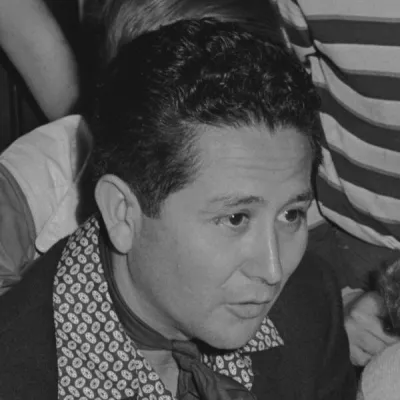
Gus Arriola
Human Design Chart
Biography
Gus Arriola as a Generator 5/1 in Human Design
Generator 5/1 — Design at a Glance
Gus Arriola's Human Design shows an immense, sacral endurance energy. He appeared as someone who was extremely strong and resilient like a workhorse – provided he received the necessary energy for his tasks. His central dynamic lay in the 'sacral yes.' Energy and deep satisfaction unfolded only through reacting to impulses from life. Ignoring this signal or taking independent initiative led to frustration, lack of energy, and burnout.
As a Generator, Gus Arriola had plenty of sacral energy to materialize things in his life. However, it worked differently than for other types: The energy of the sacral center was primarily released when reacting to impulses. Not initiating but reacting was his motto. His most successful strategy involved responding to a signal from life and then answering with action once the sacral center said 'Yes! Let's get started!'
Living in harmony with this design, nothing could stop him. He was rewarded with a deep sense of fulfillment. Living against it – for example, constantly wanting to initiate things – likely led to persistent frustration and energy loss sooner or later. Another stumbling block was when he was prevented from working on his heart project despite still being full of power.
Sacral Authority
Gus Arriola demonstrated decision-making based not on cognitive analysis but on direct inner resonance. His internal authority lay in the defined sacral center, marking him as a Generator. This type is unique because its strategy – waiting for the trigger – aligns with its internal authority, simplifying his process of decision-making.
His orientation occurred through physical signals as reactions to external stimuli. This manifested as an 'inner voice,' audible as grunts, hums or short mhm sounds. Such noises signaled that his sacral motor had started up. In these moments, he felt vital and alive; he was endowed with inexhaustible energy enabling him to perform tasks with great enthusiasm. He was born to go through life with joy and satisfaction, fully immersed in what he did without the need for external purpose.
Supporting this was the spleen center. As it was activated and possibly directly connected to the sacral center, it acted as a supportive authority. This endowed Gus Arriola with the ability for particularly quick and spontaneous reactions. He had immediate access to his physical well-being and instinctive perception. These instincts could be reliably used to make decisions in alignment with his natural energy.
The 5/1 Profile — Heretic / Investigator
Gus Arriola displayed the tension between a magnetic, heroic external appearance and a deep need for withdrawal. His design as a 5/1 profile ('Hero/Researcher') shaped this dynamic: Line 5 attracted attention through storytelling and projection while line 1 required a solid knowledge base and self-sufficiency. Others projected expectations onto him, sought solutions, and saw him as an authoritative figure. This could lead to overextension if boundaries were not clearly set – similar to a scientist who is exhausted after intensive consultation. The mechanics demanded that Gus Arriola learn 'no' to maintain the balance between sharing his gifts (line 5) and the necessary phase of learning and research for himself (line 1). Without this boundary, exhaustion loomed; with it, he could optimally utilize his role. Line one also emphasized the fundamental necessity of caring for oneself without causing harm, where envy served as a signal for deficits in self-sufficiency. Gus Arriola's path involved protecting this inner research work to authentically and sustainably impact others from the outside rather than merely meeting projected expectations.
Single Definition — Defined & Open Centers
Gus Arriolas Design established a tendency towards powerful but reactive energy. His defined Sacral Center served as the motor for vital force and responsibility; it required waiting on questions to check the availability of his energy through spontaneous yes or no responses – often felt as tone sounds. Initiating actions without this confirmation typically led to resistance and exhaustion, while reactive action provided lasting satisfaction.
This sacral endurance was reinforced by his defined Root Center, which delivered a constant adrenaline-driven pressure for forward movement. This inner drive provided the necessary tension to survive and progress in the material world, so long as it wasn’t blocked by false initiatives. Additionally, his defined Spleen Center acted as an intuitive instance for health and well-being. It offered momentary non-rational warning signals or confirmations in “now,” which promoted safe survival and a strong immune system if one trusted this subtle body knowledge.
In contrast, his open centers revealed specific vulnerabilities to external influences. His open Head Center tended to absorb mental pressure waves and questions from the environment, leading to confusion or the compulsion to find answers that belonged to others. Similarly, his open Solar Plexus absorbed foreign emotions; without detachment, he risked personalizing these as his own moods or instabilities and being swept away by emotional waves of others. His open G Center also meant no fixed identity; Gus Arriola was set up to adopt directions and roles from his environment, making him flexible but also dependent on the right context. The challenge lay in not suffocating in the search for a static identity or mental clarity, but trusting the mechanical process of reacting and intuiting.
Channels for evolutionary change and meaningful life struggle.
Gus Arriola emerged as someone who propelled individual evolution through accepted limitations and a stubborn fight for integrity. His design was marked by the energy of Mutation (Channel of Mutation 60-3), which connected the Root Center with the Sacral Center. This channel promoted evolutionary change but depended on the ability to accept limitation and move beyond the confusion of a new beginning. The pulsating on/off energy of this connection often led to melancholy when no new mutation occurred; patience was crucial as change developed beneath the surface.
Parallel to this, the Channel of Life Struggle (Channel of Life Struggle 38-28), which connected the Root Center with the Spleen Center, came into play. This channel was about fighting for meaning in life and finding significance in these struggles. Gate 28 recognized whether a fight was appropriate, while Gate 38 exerted pressure to defend individual integrity against external forces. This combination endowed Gus Arriola with a stubborn determination to walk his own path and fight for values that mattered to him.
Additionally, prioritized gates contributed to the expression: Gate 56 allowed mental processes to be abstracted into pictorial representations and stories. Gate 27 brought genetic care and warmth into all activities. Gate 52 called for self-imposed pauses for concentration and pattern correction, while Gate 42 emphasized experience as a key to development. Gate 39 provided fuel for mutations through provocation and analysis. Together, these elements created a Profile that focused on inner tension, intuitive evaluation, and transformative forms of expression.
Individual Circuitry — Circuit Signature
Gus Arriola's design was characterized by a pulsating, acoustic creativity that stemmed from his unique path. His system was simply defined, which meant he had a coherent, undivided energy source: the connected group of Sacral, Root, and Spleen Centers formed a closed circuit. This direct connection allowed him to carry inner impulses outward without disturbance.
The knowledge circuit significantly shaped this mode of expression. For Gus Arriola, two specific channels were at work here. The Channel of Mutation (3-60) encouraged deviations from the known; it pushed him to explore new paths and break free from established patterns. This laid the groundwork for innovative flashes of insight. Simultaneously, the Channel of Life Struggle (28-38), which spans between Root and Spleen Centers, transformed pressure and stress into spontaneous intuitive perception. Energy flowed directly from the Sacral source through the Root Center to the Spleen, enabling quick, accurate judgments.
The mechanics of this circuit aimed at acquiring entirely new knowledge and transforming it through his own identity. Although the general circuit also includes emotional expression via the Solar Plexus Center, these channels were absent in Gus Arriola's design. Therefore, his focus was not on emotional wave motion but rather on directly implementing mutation and intuitive perception into concrete action or expression. The energy was always grounded in the present moment, driven by a desire to initiate change through individual deviation. This configuration ensured him a clear, unobstructed line between inner drive and outer effect.
Left Angle Cross of Distraction 1
Gus Arriola's Design carried the signature of the left cross of distraction. This configuration shaped a life dynamic where attention and energy often focused on areas that diverted from the core task at hand. Since no specific Gates or Channels were defined in the raw content, it is not possible to derive a detailed mechanical impact; rather, there remains an image of a general tendency towards distraction.
In Human Design, this cross describes a structure that tends to fragment focus through secondary interests or external stimuli. For Gus Arriola, this meant his path was not always linear. Instead, a pattern emerged where distractions were part of the experience. Without further mechanical details like defined Centers or Channels, no specific strategy or tactic can be derived. The description therefore remains limited to the basic principle: the presence of an energy that easily veers from the center.
This aspect of his design was an integral part of his inner landscape. It did not operate as a flaw but rather as a characteristic trait influencing his perception and reaction to the world. The mechanics of the left cross of distraction created a backdrop against which other aspects of his character developed. Gus Arriola lived with this disposition, which may have caused him to look around more often than necessary before committing. It was a dynamic of searching and wandering in the mental space without a clearly defined path through specific Channels.
Saturn Return · Uranus Opposition · Chiron Return · 2nd Saturn Return — Life Cycles
Gus Arriolas Design featured structural life phases marked by external triggers. In 1946, at the age of 29, he continued "Gordo" as a daily strip after being discharged from the army. For his Human Design, this was his first Saturn return: a phase where years of groundwork often condenses into a solid result and internal maturity becomes visible externally. This event illustrates how such cycles can foster stability and focus by translating past efforts into concrete actions.
Ten years later, in 1956 at the age of 39, he settled in Carmel-by-the-Sea. This coincided with his Uranus opposition, an astrological cycle often bringing unexpected changes and a desire for new freedom. In Gus Arriola's case, this was reflected as a spatial change signaling a break from previous structures. Both events underscore the mechanics of his design: while the Saturn return marked consolidation and confirmation, the Uranus opposition signalled a turning point towards new orientation. These phases did not shape his life path as random sequences but rather as rhythmic development where external events mirrored and propelled internal developmental stages.
Generator · Sacral Authority — Synthesis
Gus Arriola lived a life deeply marked by the necessity to pay attention to inner signals and transform them into external action. His design as a Generator with sacral authority required him to react first to impulses from life before he could find energy for a task – a principle that significantly influenced his work style. The connection of Format Energy (Channel 60/3) and the Life Struggle (Channel 38/28) suggests that he went through phases of mutation and transformation, always searching for meaning and significance in his activities, with the ability to accept limits and face new challenges being central. He drew strength from the constant alternation between action and rest, a pulsing rhythm that fueled his creativity and enabled him to innovate.
A central tension field in his design lay in the interplay of open emotional centers and the ability to perceive others' emotions, with the need for individuality and authentic expression (Knowledge Circuit). While he was easily influenced by external factors, he was also destined to walk his own path and develop new perspectives. This dynamic might have led to internal struggles between a desire for harmony and the necessity of living one's truth – a paradox that shaped his personality and drove him to constantly seek out new forms of expression.
2 Defined Channels
Incarnation Cross - Left Angle Cross of Distraction 1
Solar Return
The Solar Return shows the moment when the sun returns to its exact birth position - your personal solar year.
Life Cycles
Discover the life cycles with a detailed triple view (birth chart, cycle chart, composite).
Human Design Profile
- Type
- Generator
- Strategy
- To respond - wait for something to respond to
- Authority
- Sacral Authority
- Profile
- 5/1 - Heretic / Investigator
- Definition
- Single Definition
- Incarnation Cross
- Left Angle Cross of Distraction 1
- Date of Birth
- 23.07.1917 19:00
- Place of Birth
- Florence, Arizona, United States
Frequently Asked Questions
What was Gus Arriola's Human Design type?
Which Profile did Gus Arriola have?
What authority did Gus Arriola have?
What incarnation cross was assigned to Gus Arriola?
When was Gus Arriola born?
Discover your own Human Design
Are you also a Generator? Find out in a personal reading how to use your sacral energy correctly and discover deep satisfaction.
More Personalities
Back to overviewAaliyah

Alexia

Angèle

Anne-Marie

Arcángel

Arno