
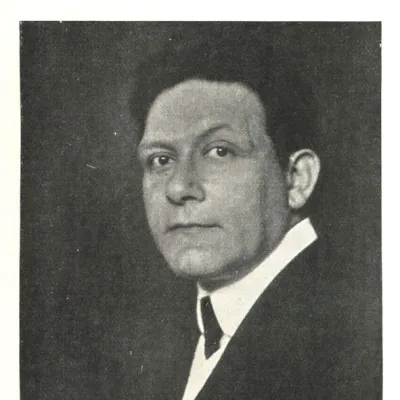
Hans Carossa
Human Design Chart
Biography
Carossa died on 12 September 1956, Bei Passau, Germany.
What does Generator 1/3 mean for Hans Carossa?
Generator 1/3 — Design at a Glance
Hans Carossa revealed himself as someone with remarkable endurance, but he did not ignite his strength through self-initiated actions; rather, it was sparked by quick responses to external impulses. As a Generator, he possessed abundant sacral energy – an inner workhorse that was extremely powerful if there was actual 'fuel' for the task at hand. This energy was most freely released when his design could react to signals from life; here, the motto was clear: not initiate but respond.
His most successful strategy involved waiting for such a signal and only then taking action once the sacral center gave a clear 'yes'. Living in harmony with this mechanism rewarded him with a deep sense of fulfillment. However, if he went against this rhythm – perhaps by doing things he did not want to do or being kept away from his heart project – he was at risk. Then frustration and an energy shortage loomed, as Generators quickly hit their limits when misused. Hans Carossa had to learn to make decisions from the gut: Only if the inner resonance felt right could his enormous endurance be effective without exhausting him.
Emotional Authority
Hans Carossa revealed himself as someone who never acted on his internal impulses immediately but subjected them to a necessary maturation period. His design carried emotional authority, anchored in the defined Emotional Center. This configuration determined a central rule: Regardless of which other centers were defined in his chart, this emotional level always took precedence in decisions.
He was subject to a wave-like emotional dynamics that showed itself in constant ups and downs of his feelings. The world appeared colored by his current mood; what excited him one moment could appear negative the next. His immediate feeling was merely a snapshot, an initial impression that did not necessarily reflect deeper truth. Quick, spontaneous decisions from this emotional heat would often have negative consequences for him.
Instead, his path required patience and conscious hesitation. He took time to let decisions mature, slept on them multiple times, and asked himself repeatedly. Only when the intense feelings subsided and an emotional distance was gained did clarity and calm set in. This process of waiting allowed him to recognize more deeply and comprehensively what was crucial for long-term life decisions.
The 1/3 Profile — Investigator / Martyr
Hans Carossa revealed himself as a person whose life was marked by a constant interplay between theoretical understanding and practical testing. His design as a 1/3 Profile – the Researcher and Experimenter – established a foundational stance based on self-earned insights. He did not seek pre-fabricated truths but learned through trial and error.
This dynamic arose from the interaction of two lines. The first line brought with it the gift of serendipity: the ability to be in the right place at the right time to absorb mental sustenance. Here, there was a strong need for acceptance by like-minded individuals and fear of anonymity if his ideas were not recognized. At the same time, this line demanded deep collaboration to expand consciousness.
The third line complemented this through a drive toward adaptation and binding. It allowed him to receive support even from seemingly weak positions but required loyalty in return for intimacy. This process was often marked by waves of approach and avoidance. Through dissolving and rebuilding connections, Hans Carossa learned to adapt.
Single Definition — Defined & Open Centers
Hans Carossa revealed himself as someone who drew his strength from an inner, vital source that was filtered through deep emotional reflection. His defined Sacral Center gave him constant energy and a need for satisfaction through active action; he reacted to his environment rather than taking initiative. This physical life force was connected to his also defined Solar Plexus Center. Here lay his internal authority: He needed time to let emotional waves pass before gaining clarity and making decisions. Impulsiveness was avoided by this configuration; instead, he cultivated a deep, slowly unfolding perception.
In contrast, his design revealed several areas of susceptibility to external influences. His open Head Center made him vulnerable to mental confusion and the pressure to find answers to questions that were not his own; he tended to get entangled in others' doubts rather than pursuing his own inspiration. The open Ajna Center amplified this: He could take on concepts but suffered from conditioning to feel mentally secure to be accepted. His open G Center meant he did not have a fixed identity or direction, but received these through relationships and places; he often sought a place where he felt belonging instead of defining it himself.
Additionally, his open Heart and Spleen Centers were at play. He was not designed to hold willpower or promises, which made him vulnerable to self-doubt when trying to prove himself. His open Spleen Center caused him to absorb fears and health conditions from his environment; spontaneous decisions were risky for him as they often rested on conditioned fear. Finally, his open Root Center took in external stress, leading to a feeling of hectic if he tried to avoid this pressure. His wisdom lay in not seeing these open centers as deficiencies but as mirrors reflecting the world around him while relying on his sacral reaction and emotional clarity.
Channels for intimacy and deep emotional connection.
Hans Carossa was characterized by a deeply rooted ability to create intimacy and emotional connection. His design was marked by Channel of Union 59-6, a powerful link between sacral sexuality and the wave of pleasure and pain. This tribal channel anchored him in an energy that made relationships personal, profound, and potentially fruitful. His nature sought fusion; through patience and nurturing contacts over time, he could ease intimacy and pave the way for creative fertility. The emotional wave determined the timing of his release by making him attractive or repulsive, allowing him to recognize with time if a genuine connection had formed.
Alongside this relational intensity, Hans Carossa carried the themes of Gate 11: visual memories and harmonious assessment before action, combined with curiosity about collective ideas. Additionally, Gate 12 influenced him, emphasizing restraint, individual mutation, and poetic expression, where emotional mood affected communication. The experience of crises as cyclical movement for development (Gate 36) along with the genetic role of care and self-preservation through Gate 27 rounded out his profile. This configuration described a person seeking intimacy but also being reserved and poetic, seeing crises as necessary movements towards personal growth and care as a central genetic role.
Tribal Circuitry — Circuit Signature
Hans Carossa was marked by a deep, instinctive connection between his life force and emotional waves. His design was determined by the simplicity of a single, continuous energetic group: The Sacral Center stood directly in contact with the Solar Plexus Center. This configuration formed the basis for a primal experience that relied less on intellectual analysis than on immediate physical perception.
Central to this was the Archer Circuit, which in him was specifically activated through Channel of Union (Gates 59 and 6). This channel linked the rhythmic energy of the Sacral Center with emotional fluctuations in the Solar Plexus. It was not about abstract concepts but the elemental need for protection, care, and preservation of the close ones. The energies of
Right Angle Cross of Eden 4
Hans Carossa had the right cross of Eden 4 in his design. This configuration is characterized by a stance marked by deep inner security and clear orientation towards one's true self. In Human Design, this cross represents the ability to use an internal compass to make decisions from the center of oneself rather than being guided by external expectations. It describes a path where authenticity precedes adaptation, with actions arising from a profound familiarity with one's nature.
For Hans Carossa, this meant a fundamental stance of inner constancy. He was someone who aligned his steps internally before taking them externally. This mechanism fostered a kind of leadership or presence that did not rely on loudness but rather the quiet certainty of a firm conviction. The right cross of Eden 4 connects various energetic centers in such a way that a feeling of "belonging at home" within oneself arises, independent of circumstances.
This structure supported him in maintaining a reliable axis even during uncertain times. It was not about ignoring the world but shaping his own reaction to it from a place of clarity. Hans Carossa used this energy to firmly anchor his identity and engage with his environment from that foundation. The resulting aura was one of calm assurance, often serving as a stabilizing factor for others without him needing to actively dominate.
Saturn Return · Uranus Opposition · Chiron Return · 2nd Saturn Return — Life Cycles
Hans Carossa's design revealed a clear structure of his professional development, with its peak moments occurring at specific planetary cycles. In 1906, at the age of 28, he came into contact with Richard Dehmel and Hugo von Hofmannsthal through the Insel-Verlag. This marked his first Saturn return, a time when years of groundwork often culminates in a solid achievement and new responsibilities are taken on.
Ten years later, in 1916 at the age of 38, he published "Die Flucht. Ein Gedicht aus Doktor Bürgers Nachlaß". This fell during his Uranus opposition, a period of inner upheaval that often leads to creative breakthroughs or new forms of expression when old structures no longer fit.
The Chiron return around the age of 50 is an achievement cycle in which one's incarnation cross unfolds and meaning becomes experiential. In 1928, Carossa published "Verwandlungen einer Jugend", reflecting this bloom period of his design. Finally, in 1936 at the age of 58, he released "Geheimnisse des reifen Lebens" during his second Saturn return. This cycle solidified his position and confirmed the long-term value of his previous work by bringing deep maturity into his creations.
Generator · Emotional Authority — Synthesis
Hans Carossa was a Generator whose life was marked by a profound, sacral energy. This power source, combined with emotional authority, guided him through a constant wave of feelings that he only learned to integrate after careful consideration. The Profile of the Researcher and Experimenter (1/3) reflected an unceasing urge to test things thoroughly before accepting them as valid – a process that was promoted by the need to validate insights both theoretically and practically.
His recurring professional successes in 1906, 1916, 1928, and 1936 speak to a lifestyle where experimenting and re-evaluating went hand in hand with expressing his vital energy.
Central to Hans Carossa was the tension between the need for deep involvement – fuelled by the defined Sacral Center (and Channel 59-6) – and an emotional wave that required a cautious approach. He lived in a constant interplay of impulsive energy and hesitation until clarity was reached. This paradox between instinctive reaction and emotional maturity shaped both his creative work and interactions, with protection and preservation (Guardian Circuit) of his inner world playing a crucial role.
1 Defined Channel
Incarnation Cross - Right Angle Cross of Eden 4
Solar Return
The Solar Return shows the moment when the sun returns to its exact birth position - your personal solar year.
Life Cycles
Discover the life cycles with a detailed triple view (birth chart, cycle chart, composite).
Human Design Profile
- Type
- Generator
- Strategy
- To respond - wait for something to respond to
- Authority
- Emotional Authority
- Profile
- 1/3 - Investigator / Martyr
- Definition
- Single Definition
- Incarnation Cross
- Right Angle Cross of Eden 4
- Date of Birth
- 15.12.1878 10:00
- Place of Birth
- Bad Tölz, Germany
Frequently Asked Questions
What was Hans Carossa's Human Design type?
What Profile did Hans Carossa have in Human Design?
What Authority did Hans Carossa have?
What incarnation cross did Hans Carossa have?
When was Hans Carossa born?
Discover your own Human Design
Are you also a Generator? Find out in a personal reading how to use your sacral energy correctly and discover deep satisfaction.
More Personalities
Back to overviewAaliyah

Alain-Fournier

Alexia

Angèle

Angeli

Anne-Marie
