
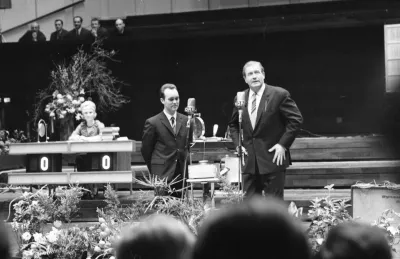
Hans-Joachim Kulenkampff
Human Design Chart
Biography
Died in Seeham, Austria on 14 August 1998.
Hans-Joachim Kulenkampff as a Generator 5/1 in Human Design
Generator 5/1 — Design at a Glance
Hans-Joachim Kulenkampff was someone whose endurance and strength were based on a specific inner resonance. As a Generator, he had an abundance of sacral energy that made him an extremely powerful 'workhorse' – provided he acted in accordance with his design. His energy wasn't released through arbitrary initiation but only awakened when he responded to impulses from his environment. The clear motto for him was: Don't initiate, react.
When his sacral center clearly said 'yes', he would respond with full action and could hardly be stopped. In these moments, his system rewarded itself with a feeling of deep fulfillment and satisfaction. Conversely, ignoring these inner signals led to two serious pitfalls. Either he wasted his energy on tasks that did not give him internal pleasure, making him vulnerable to exhaustion, or he was prevented from pursuing his heart project even though he still had plenty of power left. Such phases of non-reaction or misjudgment inevitably resulted in lasting frustration and a noticeable lack of energy. His path to effectiveness therefore always lay in responding intuitively to what truly spoke to him.
Emotional Authority
Hans-Joachim Kulenkampff's decision-making followed a rhythmic pattern: he needed time to gain clarity. His inner authority was Emotional Authority, carried by the defined Emotional Center. In Human Design mechanics, this authority is considered primary; it determines the course of decisions independently of other defined centers in the design.
This center operated on a wave-like dynamic of emotional highs and lows. Perception of the world was always colored by current mood – sometimes enthusiastic, sometimes negative. However, an initial impulse did not represent final truth but only a snapshot moment. Spontaneous decisions based on this immediate feeling often proved problematic as they ignored the full context.
The strategy consisted in allowing decisions to mature. Through waiting and repeatedly 'sleeping on' questions, intense emotional waves subsided. Only with this emotional distance would deep, comprehensive clarity set in. This process of calmness was particularly crucial for long-term life decisions, ensuring that choices were not based on a passing mood but on a stable inner truth. Patience and allowing hesitation were thus no weakness but essential tools for navigating his emotional landscape.
The 5/1 Profile — Heretic / Investigator
Hans-Joachim Kulenkampff emerged as someone who used deep knowledge to offer practical solutions to others in crises. His Profile 5/1 combined Line 1 of the Investigator with Line 5 of the Hero. This created a nearly magnetic presence: others actively sought his advice and resources.
Gate 27 on Line 5 gave him the ability to manage foreign means effectively and build trust, but this access to power and resources also carried risks like fraud or loss of reputation if boundaries were lacking. Simultaneously, Gate 19 on Line 1 stood for mutual dependence and exploring individual peculiarities in approaches. He had to learn who the right partner was without losing his own identity through one-sided dependency.
The challenge lay in maintaining balance between retreating into research (Line 1) and public problem-solving (Line 5). Without clear 'no's', he risked exhaustion, similar to an expert left drained after hours of consultation. His design challenged him to optimally use his gifts by protecting resources and basing relationships on recognition of individual differences rather than falling into dependency traps.
Triple Split Definition — Defined & Open Centers
Hans-Joachim Kulenkampff's design was characterized by a reliable, powerful presence based on several defined centers. His defined G Center gave him a firm sense of self-identity and clarity of direction; he knew who he was and radiated this security without needing to force others to follow him. Simultaneously, his defined Heart Center provided constant willpower: He could make promises and keep them, giving him the ability to take responsibility for his resources and work rhythms.
As a Generator with a defined Sacral Center, he had an enormous source of vitality. However, this energy was only available when responding to external stimuli – not through self-initiative but by reacting. His defined Throat Center served as a focal point for communication; it allowed him to articulate his messages clearly and consistently if they stemmed from his inner authority. Additionally, his defined Spleen Center provided spontaneous intuition in the present moment, protecting him from health or existential risks by allowing him to make trustworthy judgments without rational analysis.
In contrast, his vulnerability was evident in the mental centers. His open Head and Ajna Centers meant that he did not have a consistent personal mind. Instead, he tended to absorb mental pressure waves from the environment and interpret foreign questions or concepts as his own problems. This could lead to inner confusion when trying to find answers that were not his responsibility. Similarly, his open Root Center absorbed external stress and adrenaline. He was prone to misinterpreting other people's pressure as his own drive, which could push him into cycles of unnecessary frenzy to escape this foreign pressure rather than trusting his internal clarity.
Channels for community, reflection and caring preservation.
Hans-Joachim Kulenkampff's design was marked by a deep reflective ability and the role of guardian of collective stories. A central imprint was Channel of the Lost Son 13-33, connecting the G Center with the Throat Center: Gate 13 actively listened, gathered secrets and memories while Gate 33 withdrew to condense these experiences before passing them on as deeper truths. This created a stance of patient observation that sorted lessons from the past rather than hastily looking into the future.
Parallelly, Channel of Preservation 27-50 between Sacral and Spleen Centers worked. Gate 27 brought selfless care while Gate 50 guarded traditional values and tribal laws. This connection generated an aura of trust; Hans-Joachim Kulenkampff acted as a natural provider who took responsibility for others – whether through direct support or by preserving shared structures. His energy was directed towards maintaining the status quo and nurturing what gave stability to the collective.
Channel of Community 37-40 linked Solar Plexus and Heart Centers. Gate 37 sought recognition and its place in the whole, while Gate 40 was ready to work but needed breaks and rewards. This promoted understanding of fair agreements and building relationships based on mutual benefit and emotional clarity rather than spontaneous impulses.
Additionally, other Gates shaped his essence: Gate 28 called for decisions here and now as well as taking appropriate risks according to his strategy. Gate 19 connected him with resources, territory, and the search for spiritual partners in a safe environment. In the background, Gate 10 worked with its complex ability to integrate genetically fixed behavioral rules. Gates like 42 (Completion of processes), 23 (Understanding through explanation) and 48 (Pattern recognition) supported his analytical depth while emotional dynamics were modulated by Gates 6 (Friction/Fertility), 55 (Mood swings) and 36 (Crisis as movement) along with the openness of Gate 22 and the transformative power of Gate 3 in the Sacral Center.
Tribal Circuitry — Circuit Signature
Hans-Joachim Kulenkampff was marked by three separate, parallel operating energy blocks. His design connected Throat with Identity Center via Channel 'The Lost Son'. This promoted a cyclical emotional processing of the past; insights were retrieved and shared wave-like to enable collective learning.
A second block linked Heart and Solar Plexus Centers through Channel 'Community'. Here it was about mutual support within the ego circuit: the principle of give-and-take ('Today I give, tomorrow you give') required pauses for resource regeneration as there was no direct connection to the Sacral Center.
The third block connected Sacral and Spleen Centers via Channel 'Preservation'. In the Guardian Circuit, instinctive survival energies worked together with life force to protect, nourish, and preserve family and genetics – a primal dynamic of care.
This triple definition did not mean one single flow but three independent focal points: emotional meaning through sharing, cooperative resource building with pause needs as well as instinctive protection of genetic heritage. Each area operated independently from the others, leading to a complex yet clearly delineated internal landscape.
Left Angle Cross of Alignment 1
Hans-Joachim Kulenkampff's design indicated a tendency towards clear inner orientation. He was someone who did not align his steps with external expectations but rather based them on an internal compass. This attitude corresponded to the left cross of Alignment 1 in Human Design terms, meaning that there was energy for a stable and self-determined direction. It wasn't about constant searching or hesitation but rather an inherent ability to recognize and consistently follow one's path. Alignment 1 emphasized clarity and direct action capability in everyday life. Hans-Joachim Kulenkampff lived this structure by focusing on what felt internally coherent, creating a basis for decisions that were not clouded by uncertainty. Instead, his way of acting was the result of a deep connection to his own rhythm and personal truth. The left cross supported making this inner orientation visible and effective externally without constant external validation.
Saturn Return · Uranus Opposition · Chiron Return · 2nd Saturn Return — Life Cycles
Hans-Joachim Kulenkampff's design was characterized by clear structuring abilities and the capacity to fulfill defined roles. This trait became evident in 1950 at age 29: with his first Saturn return, he began as an announcer for Hessischer Rundfunk. This cycle marked the transition from preparation to stable professional identity, culminating in years of groundwork in a viable position.
However, his path was not linearly stable but subject to periodic breaks and renewals. In 1961 at age 40, Uranus opposition occurred. Kulenkampff starred in the film comedy “Drei Mann in einem Boot” and set a record with extended airtime. This phase brought unexpected changes and breakthroughs to greater visibility often through breaking old patterns.
The Chiron return around 1969 (age 48) marked the flowering of his incarnation purpose. Kulenkampff openly supported SPD Chancellor candidate Willy Brandt. This was not a healing process but rather a phase of full unfolding of his personal purpose in public life, where his role and influence became clearly perceptible.
The second Saturn return in 1979 (age 58) reinforced these achievements again. Kulenkampff was reappointed as moderator for “Einer wird gewinnen.” This cycle condensed previous experiences into a new stable life structure based on accumulated successes and established identity. His design thus promoted development from professional foundation through disruptive success to purposeful confirmation and final stabilization of his role.
Generator · Emotional Authority — Synthesis
Hans-Joachim Kulenkampff was a Generator whose life was deeply influenced by sacral energy and the need to express this in meaningful work. Emotional authority required time for decision maturation, while the Profile Hero/Researcher urged him to accumulate knowledge and make it available to others (Line 5), supported by deep inner research (Line 1). This combination led to a lifestyle where he continually faced new challenges—whether through professional stations or public appearances—to gather experiences and reflect on them. The Channel Lost Son points to an internal process of listening, storing, reflecting before sharing insights.
A central paradox in his design lay in the tension between the need for continuous activity as a Generator and emotional waves requiring cautious decision-making. He seemed to be someone both driven by a strong urge to act (Sacral Center) and deeply influenced by an inner world (emotional center). This dynamic led him to continually face new challenges (evident through professional successes and engagements), but always needed time to process these experiences and learn from them.
3 Defined Channels
Incarnation Cross - Left Angle Cross of Alignment 1
Solar Return
The Solar Return shows the moment when the sun returns to its exact birth position - your personal solar year.
Life Cycles
Discover the life cycles with a detailed triple view (birth chart, cycle chart, composite).
Human Design Profile
- Type
- Generator
- Strategy
- To respond - wait for something to respond to
- Authority
- Emotional Authority
- Profile
- 5/1 - Heretic / Investigator
- Definition
- Triple Split
- Incarnation Cross
- Left Angle Cross of Alignment 1
- Date of Birth
- 27.04.1921 03:00
- Place of Birth
- Bremen, Germany
Frequently Asked Questions
What was Hans-Joachim Kulenkampff's Human Design type?
What Profiles did Hans-Joachim Kulenkampff have?
What Authority did Hans-Joachim Kulenkampff have?
What incarnation cross did Hans-Joachim Kulenkampff have?
When was Hans-Joachim Kulenkampff born?
Discover your own Human Design
Are you also a Generator? Find out in a personal reading how to use your sacral energy correctly and discover deep satisfaction.
More Personalities
Back to overviewSissy Spacek

Aaliyah

Alexia

Anémone

Angèle

Ann-Margret
