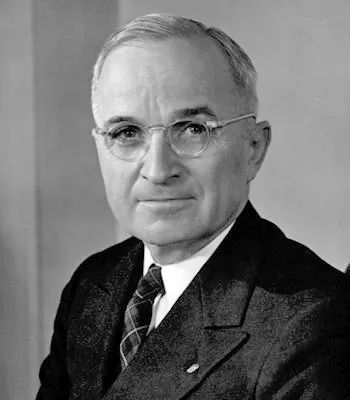
Harry S. Truman
Human Design Chart
Biography
As a youth, he worked as a construction clerk, road overseer, bank clerk and mail attendant on a newspaper. Running a clothing store in Kansas gave him no success. It was as a Captain in WW I that he learned he had a native talent for leadership. After the war, in the arena of politics, he found his niche.
Truman was sworn in as President on 12 April 1945, age 60, upon Roosevelt's death. During his presidency, Truman, after much deliberation, ordered the atomic bomb dropped on Japan on 6 August 1945, 09:15 AM, Tokyo. As a result of the bombing, Emperor Hirohito of Japan gave an address surrendering the war on August 15, 1945.
Truman established the Atomic Energy Commission and placed it under the control of civilians and not the military commanders who considered it their domain. While in office, he set up the CIA. In November 1948, he captured re-election in the face of polls predicting defeat and was again inaugurated on 20 January 1949. When the Korean War began in June 1950, he established the Office of Defense Mobilization.
On 11 April 1951, Truman signed the Treaty of Peace with Japan.
He married Bess Wallace on 28 June 1919 and they had one daughter, Margaret. Truman died on 26 December 1972, 7:50 AM, Kansas City, MO.
Human Design Analysis: Harry S. Truman as Projector 6/2
Projector 6/2 — Design at a Glance
Harry S. Truman appeared through his dense aura like a flashlight that immediately uncovered system errors and guided others. His design as a Projector endowed him with this focused quality: He recognized flaws in structures or relationships instantly. However, direct confrontation with these insights risked resistance; instead, Truman attracted others by setting an example of harmony, leading them to seek his advice. This magnetism was based on the strategy of waiting for an honest invitation. Through this patience, he avoided bitterness and secured respectful recognition for his leadership.
Since his Sacral Center was undefined, Truman did not have a constant energy source. Instead, he experienced phases of high work intensity followed by necessary rest periods for regeneration. This cyclical pattern protected him from burnout, even if societal structures often ignored it. By following his design – through shining by example rather than intrusive criticism and respectful pauses – he was rewarded with success. His influence did not come from constant presence but from precise, inviting leadership that his nature as a Projector allowed.
Self-Projected Authority
Harry S. Truman revealed himself as a Projector with the rare authority in Self. This design gave him great openness but also carried the risk of being distracted by external motoric energies. The biggest trap was losing oneself in this openness and constantly seeking energy from outside. His inner truth lay in his identity. Decision-making occurred through two pathways: either through self-dialogues or when invited into dialogues with others. Crucial was listening deeply into these conversations to discern when it was his Self speaking versus his mind. What was spoken spontaneously without thought expressed his true essence. This spontaneous expression made his uniqueness recognizable to others. The second path was a physical feeling that drew him in a certain direction, which could be geographical or thematic. When he recognized and followed this personal direction in life, he became a guide for others. There lay his specific potential for success. The mechanics of this authority did not require quick action but rather deep inner clarity through listening and sensing the direction physically, instead of getting lost in the flood of external influences. Truman lived this dynamic by learning to separate the voice of his Self from that of his mind and relying on physical directional feelings rather than being driven by external forces. His strength lay in guiding others through loyalty to this internal compass needle, rather than being driven by external factors.
The 6/2 Profile — Role Model / Hermit
Harry S. Truman's Human Design profile was marked by a clear life journey: from experimental restlessness to calm wisdom. In his younger years, before turning thirty, the sixth line of his Profile still appeared as the third. This shaped a phase of active experimentation where trial and error were the driving principles. Mistakes were not only possible but necessary; after each failure came a withdrawal to reorder. During this time, he strengthened his individuality through direct experience and sought material security, often accompanied by the need to defend against external changes.
After turning thirty, this dynamic fundamentally changed. The sixth line became active, leading Harry S. Truman into a phase of intense introspection. He metaphorically retreated into his "cave on the mountain" to look back at earlier experiments in life with great distance. This withdrawal was not isolation in a negative sense but rather a process of healing and deep self-awareness. Here he processed past mistakes and developed a stable inner stance.
From this period of reflection, Harry S. Truman later emerged as a wise figure. His role was to show others how to gain clarity through deep self-observation. He became an example for those who wanted to integrate their own experiences into a grounded wisdom rather than continuing to experiment blindly.
Single Definition — Defined & Open Centers
Harry S. Truman revealed himself through his defined G Center as someone with a constant, reliable self-identity and a clear sense of direction. This inner security allowed him to love others without becoming dependent on them, and gave him the ability to comfort people in their uncertainty about humanity's future by explaining the nature of our evolutionary development. His expression was marked by the also defined Throat Center: He did not speak impulsively from passing thoughts or emotions but articulated his truth directly from his personal identity and Higher Self. This endowed his voice with a steady, though limited clarity and honesty; he communicated what his essence was, not just what his mind thought at the moment.
This stable core self stood in stark contrast to his seven open centers, which made him situationally receptive to external influences. His open Head Center made him vulnerable to mental pressure and doubt; he tended to engage with questions that were not his own and sought external inspiration to resolve confusion. The open Ajna Center meant that his conceptual thinking was flexible but did not provide a constant source of answers – he could take on others' opinions without identifying them as his own truth.
His open Heart Center led him to be undesignable in asserting willpower or making promises to prove his worth; instead, he risked falling into a cycle of self-pity and trying to legitimize himself through overwork. The open Sacral Center made him sensitive to the energy of others; he could absorb their vitality and amplify it, leading to exhaustion if he did not trust his inner authority to set boundaries. Emotional waves from the environment were absorbed and amplified by his open Solar Plexus, putting him at risk of interpreting foreign moods as his own instability. Finally, his open Root Center took on external stress and adrenaline, pushing him to become hyperactive to escape this pressure rather than letting it go.
Channels for inspiring presence and logical leadership.
Harry S. Truman revealed himself as someone who lived a dialectic between individual inspiration and collective logic. His design connected two parallel mechanisms in the G-Throat Circuit: Channel of Inspiration 1-8 and Alpha Animal Channel 7-31.
The Channel of Inspiration 1-8 shaped his ability to act through authentic presence. This valve between G and Throat Centers allowed him to express a mutative perspective creatively – not primarily through words, but by showcasing his unique identity. He was designed to draw public attention and inspire others to live their own uniqueness. As this channel did not offer built-in social adaptability, Truman had to cultivate patience and develop communication skills to make his potential as co-creation with his environment effective.
Simultaneously, the Alpha Animal Channel 7-31 worked, representing logical collective leadership. This was not about sole rule but gaining community trust through understandable patterns and future-oriented competence. Truman needed an invitation from the majority to lead; his authority rested on recognition of his ability to understand existing trends and guide society. This channel emphasized that leadership only succeeded when carried by a collective context.
The integration of these two channels required Truman to both display his individual authenticity and wait for community invitation. Success arose only through balance between bold expression of uniqueness (Gates 1 and 8) and demonstrated ability to act logically and trustworthy for the collective (Gates 7 and 31). Without this balance, neither the inspiring effect nor accepted leadership would have been fully effective.
Individual Circuitry — Circuit Signature
Harry S. Truman revealed himself as someone who logically structured new insights and clearly articulated them. His design connected the Throat Center directly with the Identity Center, enabling a continuous flow between individual essence and expression. This connection formed the basis for two separate energetic sub-sections within the same circuit.
In the Knowledge Circuit, Channel 1-8 (Inspiration) worked. This channel brought impulsive, acoustic input from outside – spontaneous flashes of insight or intuitive perceptions in the here and now. This inspiration flowed directly into the ability to articulate it through the Throat Center. It was a pulsating energy that made new impulses immediately verbally tangible.
Parallel to this, Channel 31-7 (The Alpha Animal) worked in the Mind Circuit. This channel connected the Identity Center with the Throat Center and brought focused, visual logic into play. It was about strategic thinking and the ability to rationally penetrate complex connections and lead towards a better future. This 'emotionless ratio' enabled sharing insights free from conditioned patterns.
Both channels used the same expression channel (Throat-Identity), but different sources: once spontaneous inspiration, once cool strategy. Harry S. Truman did not unite these forces in one stream but had two parallel paths to manifest his unique identity – either through sudden impulse or through thoughtful logic. This shaped an expressive style that was both creatively and analytically grounded.
Left Angle Cross of Defiance 1
Harry S. Truman's Human Design profile was marked by the archetypal structure of the 'Challenge Left Cross'. This established a foundational stance where life was not seen as a peaceful unfolding but rather as an ongoing test. The mechanics of this configuration describe an inner compass that focuses on obstacles and trials. For Harry S. Truman, this meant evaluating situations not primarily based on their comfort or ease, but on the resistance they presented and how these could be overcome.
The term 'Challenge' here is no metaphorical addition but defines the structural principle of his path. It was an inner orientation that saw difficulties as a necessary part of personal development. Harry S. Truman thus showed himself to be someone whose energy and attention were focused on problem-solving rather than avoiding problems. The structure did not guarantee conventional external success, but it created a framework in which growth happened through confrontation with the difficult.
Since the raw content does not list specific Gates, Channels or Centers, the mechanical impact on this abstract level remained limited. There were no detailed instructions for particular fields of action like career or relationships, but an overarching life task: to accept challenges and find his own form within them. Harry S. Truman lived within this framework where overcoming resistance was the central drive. His experiential world was thus defined by this archetypal structure that encouraged him to always engage with what required effort and commitment rather than seeking easy solutions.
Saturn Return · Uranus Opposition · Chiron Return · 2nd Saturn Return — Life Cycles
Harry S. Truman's life journey was marked by two specific cyclical turning points, signifying sudden changes and profound role shifts. These phases did not appear as gradual development but as concrete career-related upheavals that redefined his societal positioning.
The first of these points occurred in 1922 when Truman, at the age of 38, was elected Judge of the County Court of Jackson County. This Uranus transit signaled a moment of sudden change where existing structures were broken through and a new authoritative role could be assumed. It was not a gradual ascent but a clear break in his professional identity that demonstrated his ability to quickly adapt to changed circumstances and take on responsibility.
Ten years later, in 1933, Truman reached the Chiron Return cycle at age 49 when he was appointed head of a job creation program. This cycle marks a phase of fulfillment and blooming where one's life purpose potential unfolds. The appointment did not mark the beginning of healing old wounds but rather the realization of a long-developing trajectory. Truman found here a role that integrated his previous experiences and allowed him to contribute at a higher level. Both events demonstrate how astrologically-specific Human Design transits triggered concrete power or role shifts that profoundly shaped Truman's career.
Projector · Self-Projected Authority — Synthesis
Harry S. Truman lived much of his life in recognizing patterns where improvements were necessary (Projector Type, Gate 1). This ability to see the potential for change was closely tied to a deep need to express his unique identity and make a contribution (Knowledge Circuit, Channel 1-8). His decision-making was based on inner reflection and listening to spontaneous impulses (Authority in Self), enabling him to act authentically and impart wisdom, especially after an intense phase of personal experience and withdrawal (Profile 6/2).
A central paradox in Truman's design lay in the tension between his Projector nature – the need to be recognized and invited to offer insights – and his natural inclination to initiate something new through the channel of inspiration (Gate 1). He was designed to bring light into darkness, yet how he did this carried the risk of irritating others. This led to a dance between the desire for recognition of his perspectives and the necessity of communicating them in a way that would be accepted by others.
2 Defined Channels
Incarnation Cross - Left Angle Cross of Defiance 1
Solar Return
The Solar Return shows the moment when the sun returns to its exact birth position - your personal solar year.
Life Cycles
Discover the life cycles with a detailed triple view (birth chart, cycle chart, composite).
Human Design Profile
- Type
- Projector
- Strategy
- Wait for the respectful invitation
- Authority
- Self-Projected Authority
- Profile
- 6/2 - Role Model / Hermit
- Definition
- Single Definition
- Incarnation Cross
- Left Angle Cross of Defiance 1
- Date of Birth
- 08.05.1884 16:00
- Place of Birth
- Lamar, MO, United States
Frequently Asked Questions
What was Harry S. Truman's Human Design type?
What Profiles did Harry S. Truman have?
What Authority did Harry S. Truman possess?
What incarnation cross did Harry S. Truman have?
When was Harry S. Truman born?
Discover your own Human Design
Are you also a Projector? Find out in a personal reading how to unfold your leadership qualities and recognize the right invitations.
More Personalities
Back to overviewSissy Spacek

Alain-Fournier

Anémone

Ann-Margret

Bourvil
Christian-Jaque