
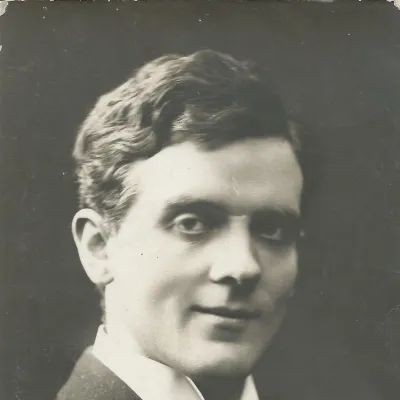
Heinrich Schlusnus
Human Design Chart
Biography
Schlusnus died on 18 June 1952 in Frankfurt, Germany.
The Human Design of Heinrich Schlusnus: Manifesting Generator 2/4
Manifesting Generator 2/4 — Design at a Glance
Heinrich Schlusnus revealed himself as someone who possessed energy for quick action without ignoring the necessity to first wait on external impulses. His design as an actualizing generator combined the constant power of the sacral center with the ability to skip steps in implementing ideas, allowing him rapid progress in his endeavors but also carrying the risk of missing important stages and having to correct them later.
Characteristic for him was a tendency to push several projects forward simultaneously rather than focusing linearly on one task. This multitasking worked satisfactorily only when he strictly reacted to what his sacral center confirmed. Once the inner 'yes' was lacking or authority didn't match, his creative enthusiasm quickly turned into frustration – the typical non-self experience of this type.
His path lay in seeking variety and falling into a playful mode rather than sticking rigidly to one project. Through regular checks whether ongoing work still aligned with his internal approval, he could use his speed without overburdening himself or neglecting important foundations. Thus, he drew deep satisfaction from his work by learning the balance between rapid implementation and patient reaction to life.
Sacral Authority
Heinrich Schlusnus revealed himself as someone who did not make decisions in his head but acted based on an immediate bodily response. As a generator, his strategy was also his inner authority: sacral authority. This fundamentally simplified his decision-making process, as he needed neither external advisors nor lengthy deliberation phases to find the right path. A prerequisite for this was his open emotional center, ensuring that this physical reaction wasn't distorted by passing moods.
His design set a tendency to react to external stimuli with a clear 'gut feeling'. This manifested in bursts of energy or loud noises like grunting or humming – immediate feedback whether something engaged his energy or not. When his sacral motor was activated, he felt vital and alive. Then he had inexhaustible energy and tackled tasks with great enthusiasm. His life was characterized by the ability to immerse himself in activities without them being strictly goal-oriented. Joy and satisfaction arose from doing itself. Additionally, his activated spleen center supported this dynamic. It gave him a quick, instinctive access to his physical well-being so he could listen reliably to his inner perception.
The 2/4 Profile — Hermit / Opportunist
Heinrich Schlusnus revealed himself through constant oscillation between the deep need for withdrawal and the desire to connect with his closest community. His design required setting clear boundaries: He had to learn precise communication about when he sought company and when he wanted solitude. In phases of isolation, he immersed in internal processes to gain clarity; only once this inner peace was reached did he actively return to his circle.
This dynamic allowed him to reflect on the knowledge of his network during solitude and develop brilliant ideas from it. Simultaneously, his profile contained aspects of leadership and self-awareness that were often unfolded through interaction with others. The need to recognize the right moment for direction changes as well as a certain discretion shaped his approach to conflicts. Higher goals stood above the urge for external recognition. Through awareness of these cyclical needs, he could secure the quality of his relationships and effectively utilize his inner work without isolating himself from or losing himself in the community.
Single Definition — Defined & Open Centers
Heinrich Schlusnus revealed himself as someone with a deeply rooted, unshakeable identity and a clear sense of his life direction. His defined G Center gave him this inner stability: He knew where he belonged and could show others new horizons without becoming dependent on them. This solid foundation was fueled by his defined Sacral Center, the motor of his existence. As a Generator, he had a constant source of vital energy that only worked satisfactorily when he responded to external impulses rather than initiating himself. His mantra was: Wait and Respond. Only this way could he use his power without frustration and pursue tasks until mastery.
This physical endurance was protected by his defined Spleen Center, which gave him a spontaneous, intuitive perception of the „now“. He had an instinct to recognize what was healthy for him and acted from this momentary body awareness, not rational planning. His defined Throat Center ensured that these inner processes emerged as clear, reliable communication in the world; his voice was the expression of his truth, free of hesitation.
Yet this stable interior stood in contrast to his open mental and emotional fields. His open Head and Ajna Centers made him vulnerable to mental confusion and the pressure to find answers to questions that were not his own. He tended to get stuck in endless thought spirals or adopt foreign concepts as his own truth, rather than trusting the silent space of unknowing. At the same time, his open Solar Plexus absorbed the emotions of his environment like a sponge. He mirrored others' moods and risked personalizing these foreign feelings or fleeing from emotional confrontations to maintain calm. His open Heart Center lacked consistent willpower; he had to learn not to prove his worth through promises or competition but simply accept his existence without needing justification.
Channels for reflection, inspiration, rhythm, change, leadership, intuition and charisma.
Heinrich Schlusnus revealed himself as someone who drew attention through his mere presence and unique style. This inclination resulted from the Channel of Inspiration 1-8, which connected his G Center with his Throat Center. Through Gate 1 (Self-expression) and Gate 8 (Contribution), he was designed to act not through words but through a exemplary life. His individual way of seeing the world inspired others to live out their own uniqueness, much like how a pianist's playing can inspire listeners to play the piano.
At the same time, he possessed a powerful, generative energy that created new directions. The Channel of Beat 14-2 connected his Sacral Center with his G Center and gave him the ability to set innovative impulses through Gate 14 (Power Competence) and Gate 2 (Higher Knowledge). He was made to trust reactions from within himself and thus give others an unconscious new orientation.
This creative force, however, followed a pulsating rhythm of change. The Channel of Mutation 60-3 between Root and Sacral Centers brought through Gate 60 (Limitation) and Gate 3 (Order) a melancholic but transformative energy with it. Heinrich Schlusnus had to learn to accept the pauses between impulses, as mutation only occurs at the right moment.
In leadership, he oriented himself by logical patterns. The Channel of Alpha Animal 7-31 connected Gate 7 (Role) and Gate 31 (Leadership), giving him the competence to work within existing structures and gain trust through competence rather than exercising absolute authority.
For deepening, he withdrew. The Channel of Lost Son 13-33 allowed him to collect experiences via Gate 13 (Listening) and reflect them via Gate 33 (Withdrawal) before sharing them. His technical mastery was shaped by the Channel of Wavelength 48-16, which connected intuitive depth (Gate 48) with practical skillfulness (Gate 16), to perfect talents.
His direct, charismatic impact came from the Channel of Charisma 34-20. This channel linked sacral power (Gate 34) directly with expression in the now (Gate 20), giving him immediate action capability if he responded to inner signals.
Individual Circuitry — Circuit Signature
Heinrich Schlusnus was marked by a simple, coherent energy structure. His design connected Throat, Identity, Spleen, Sacral and Root Centers into one flow. This created a cohesive expression that united intuition, strategy, and vital power.
The Knowledge Circuit worked strongly here: Inspiration (Channel 1-8) sparked ideas, the Beat (2-14) gave them rhythm, mutations (3-60) allowed deviations from the known. These forces flowed directly into identity and Throat Center, promoting unique, transformative insights. Charisma (Channel 20-34) also linked sacral with root energy, translating spontaneous reactions to life immediately into powerful action in the now.
Parallel to this, the Understanding Circuit worked. Through Wavelength (16-48) and Alpha Animal (31-7), it connected Spleen intuition with strategic focus in Identity Center, sharing rational insights free from conditioning. This served to improve future structures.
The Meaning Finding Circuit contributed through the lost son (33-13) by reflecting emotional experiences from the past and expressing their significance in Throat Center. Although this circuit was only a part, it complemented other streams by processing past feelings.
Overall, this resulted in a personality that poured intuitive perception, logical strategy, and vital impulses into a clear, authentic expression – without inner conflict, as all defined parts were energetically connected.
Right Angle Cross of the Sphinx 3
Heinrich Schlusnus carried the design of the right cross of the Sphinx, a configuration that pointed him towards a specific pillar: the path of spiritual truth. His Human Design was not geared towards getting lost in everyday material affairs or striving for conventional success. Instead, his chart showed a deep, almost compulsive alignment with the Divine and the search for the highest meaning of life.
This configuration means in Human Design that the person is gifted as a "Seer," but only finds clarity when fully detached from the illusions of the material world. It represents an archetypal path where external circumstances often unfold in such a way that they compel the individual to recognize and live their spiritual nature. Heinrich Schlusnus did not experience this impulse as a choice, but as an inherent structure of his being. His design challenged him to penetrate the deepest secrets of the universe and embody these insights in his own existence.
The mechanics of this cross work with a strong polarity between earthly experience and transcendent goal. For Heinrich Schlusnus, this was not an abstract concept but the defining force of his character. He did not seek answers for others but had to walk his own path to know the truth. His life thus followed an inner logic of spiritual deepening, far from superficial goals or societal expectations.
Saturn Return · Uranus Opposition · Chiron Return · 2nd Saturn Return — Life Cycles
Heinrich Schlusnus revealed himself in his career through significant turning points that corresponded with the Saturn returns of his design. The first Saturn return occurred in 1915 when he was 27 years old. In this year, he debuted at the Hamburg City Theatre as a herald in Lohengrin. This cycle often marked the transition from training to established professional identity; here, his artistic groundwork condensed into a concrete and visible entry into his career.
The second Saturn return took place in 1945 when he was 57 years old. This was a phase of profound testing and reorientation. At that time, Schlusnus was on the blacklist of the US military government. This crisis forces the design to confront its own structures and limits. Instead of mere confirmation, it involved reviewing his previous life path under extreme pressure. Human Design shows how this external intensification can compel inner clarity. Both events illustrate how Saturn cycles shaped Schlusnus’ career: once as a founding moment, the other time as a necessary break that required realignment with his true nature.
Manifesting Generator · Sacral Authority — Synthesis
Heinrich Schlusnus lived a life path characterized by an inner dynamic between creative energy and the need for withdrawal. As a Manifesting Generator, he had the ability to quickly initiate things (Sacral Center), yet his Profile as a natural talent and networker revealed a constant pendulum swing between the desire for solitude to gather internally (Line 2) and the longing for exchange with a chosen community (Line 4). This tension was reflected in his ability to express new perspectives through the Channel of Inspiration (Gate 1/8) and motivate others, while simultaneously requiring phases of intense self-reflection. The defined Throat Center indicated that his voice was an expression of transformative processes initiated from deeper centers.
A central paradox in his design lay in the combination of quick action and the need for inner clarity. The Manifestor component enabled him to seize opportunities and set things in motion, yet the Sacral Center demanded that he pay attention to internal impulses (Sacral Authority) and not act prematurely. This led to a lifestyle marked by phases of activity and withdrawal – an interplay between expressing his creativity and recharging his energy in silence, which was also evident in documented events.
7 Defined Channels
Incarnation Cross - Right Angle Cross of the Sphinx 3
Solar Return
The Solar Return shows the moment when the sun returns to its exact birth position - your personal solar year.
Life Cycles
Discover the life cycles with a detailed triple view (birth chart, cycle chart, composite).
Human Design Profile
- Strategy
- To respond - wait for something to respond to
- Authority
- Sacral Authority
- Profile
- 2/4 - Hermit / Opportunist
- Definition
- Single Definition
- Incarnation Cross
- Right Angle Cross of the Sphinx 3
- Date of Birth
- 06.08.1888 20:00
- Place of Birth
- Braubach, GER
Frequently Asked Questions
What was Heinrich Schlusnus' Human Design type?
What Profile did Heinrich Schlusnus have in Human Design?
What Authority did Heinrich Schlusnus have?
What incarnation cross was Heinrich Schlusnus assigned to?
When was Heinrich Schlusnus born?
Discover your own Human Design
Are you also a Manifesting Generator? Find out in a personal reading how to unfold your multi-talents and direct your energy wisely.
More Personalities
Back to overviewAaliyah

Aldair

Alexia

Alizée

Angèle

Angeli
