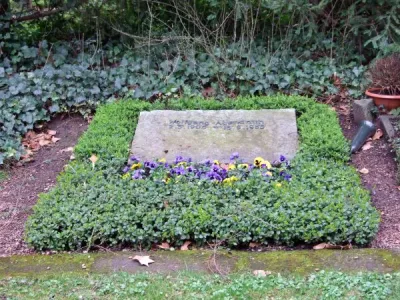
Photo: Wikimedia Commons
Heinrich Wilhelm Gottfried Von Waldeyer-Hartz
Human Design Chart
Biography
Waldeyer's name is sometimes associated in neuroscience with the so-called "neuron theory" and for popularizing the term "neuron" to describe the basic structural unit of the nervous system. Waldeyer used the path-breaking discoveries by neuroanatomists (and later Nobel Prizewinners) Camillo Golgi (1843–1926) and Santiago Ramón y Cajal (1852–1934), who had used the silver nitrate method of staining nerve tissue (Golgi's method) to formulate a short brilliant synthesis, even though he did not contribute with any original observations.
This method allowed them to study in exquisite detail the branching processes of nerve cells (axons anddendrites) and how they seemed to interconnect among themselves, forming chains and neural networks which could explain the physiological mechanisms underlying the phenomena of information transfer between neurons. Waldeyer learned Spanish in order to absorb Cajal's extraordinary detailed studies using Golgi's method and became his friend, mentor and promoter in the German-dominated field of microscopic anatomy. The theory was published in a series of papers in the main medical journal of Germany, Deutsche Medizinische Wochenschrift, which became extremely influential. However, as Cajal points out, though Waldeyer "supported the theory with the prestige of his authority, he did not contribute a single personal observation. He limited himself to a short brilliant exposition of the objective proofs, adduced by His, Kölliker,Retzius, van Gehuchten and myself, and he invented the fortunate term neuron.
What does Reflector 5/1 mean for Heinrich Wilhelm Gottfried Von Waldeyer-Hartz?
Reflector 5/1 — Design at a Glance
Heinrich Wilhelm Gottfried Von Waldeyer-Hartz was revealed as a person without firmly anchored personal energies. His design lacked defined centers, meaning he did not have a constant inner strength independent of external influences. Instead, he acted as a mirror to his environment. He perceived the energy of other people and natural rhythms such as seasons or astronomical constellations intensely and reflected these back into his interactions.
This structure suggested that his well-being depended heavily on the quality of his surroundings. His ideal strategy involved waiting at least one month – corresponding to a lunar cycle – for important decisions. By waiting, he could observe changing energies and thus find people and situations that suited him. Living in harmony with this approach meant being free from attachment and rewarded with a joyful sense of surprise about life. Ignoring this cyclical nature and acting impulsively or isolated likely led to deep, lasting disappointment regarding himself and the state of the world. His design therefore required constant adaptation to external circumstances rather than maintaining a rigid internal stance.
No Inner Authority
Heinrich Wilhelm Gottfried Von Waldeyer-Hartz did not have an inner physical authority. This was a rare configuration that either made him a mental projector or reflector. As a mental projector – a group of around 1.7% of humanity without center activation below the throat center – he found his orientation through dialogue with other people rather than internal impulses. Through these conversations, dormant potentials in his open centers were activated, allowing him to view and express issues from multiple perspectives. This high resonance ability helped him identify the right environment and conversation partners. However, evaluating the collected information was a complex process requiring time and solitude. Only in this quiet could he discern the thread of truth, filter out the essential from an abundance of information, and structure it meaningfully – his specific capital for success. Alternatively, he might have functioned as a reflector (approximately 1–1.5% of the population) without any defined centers. In this case, his decision-making depended on the lunar cycle: He needed about 28 days to move through the entire body graph and recognize reliable conditioning patterns. Regardless of the exact variant, it was crucial that he never rushed himself. His path involved exchanging in a trustworthy environment with suitable people over time to develop an acute sense for what truly belonged to him and what meaning could be derived from it.
The 5/1 Profile — Heretic / Investigator
Heinrich Wilhelm Gottfried Von Waldeyer-Hartz revealed through his 5/1 profile as someone who used deep, independently acquired experiences to offer solutions to others later. Line 1 focused on the slow accumulation of knowledge and maturation through personal experience before insights were shared externally. This created a fundamental knowledge base that was initially for himself.
Line 5 gave him a nearly magnetic presence: Others actively sought his answers and solutions. This 'hero' trait attracted people seeking collective paths in crises or uncertainty. However, this demand could quickly become overwhelming if clear boundaries were not set. The risk lay in the urge to help – often driven by fear of personal inadequacy – disrupting the necessary peace for new research cycles.
Waldeyer-Hartz had to learn to say no to maintain balance between his private process of learning (Line 1) and public role as a problem solver (Line 5). Only in this way could he optimally utilize his gifts: by dissolving old forms and transforming valuable elements into new, sustainable structures without exhausting his own energy through unchecked external influence. His design required him to go deep first before offering the results of the world.
No Definition — Defined & Open Centers
Heinrich Wilhelm Gottfried Von Waldeyer-Hartz's Human Design profile featured a completely open center configuration, which resulted in extreme sensitivity to the energetic and mental fields of his environment. Without defined centers, he lacked a consistent internal energy source or fixed identity; instead, he acted as a mirror for the dynamics of others. His open Head Center and Ajna Center allowed him to absorb inspirations and concepts without anchoring them as personal truth; he tended to reflect mental confusion rather than generate it himself. The open G Center meant that his identity and life direction were shaped by external initiation—he did not actively seek a path but waited to be led to the right place. His open Heart Center made him vulnerable to the pressure of proving his worth, despite lacking the constant willpower to do so. Undefined Sacral and Solar Plexus Centers caused him to absorb and amplify the vitality and emotions of his environment, making him appear emotionally unstable when he did not release these foreign waves. His open Spleen Center gave him a deep intuition for health and danger, yet without trusting spontaneous impulses often driven by conditioned fear. Finally, his undefined Root Center took on the stress of the world, leading him to feel pressured to escape this adrenergic feeling. His mechanics lay in using these open fields as an information source without identifying with the absorbed energies or making decisions under non-self pressure.
Channels & Gates
Heinrich Wilhelm Gottfried Von Waldeyer-Hartz's Human Design profile indicated a tendency towards deep pattern recognition and a drive for worldly success, serving as a foundation for spiritual development. Gate 48 endowed him with the ability to correct and perfect logical connections; this enabled an understanding of deeper structures in the collective, often associated with what is called 'black magic'—manipulating or uncovering hidden things. However, this depth also led to frustration because pure insight did not necessarily translate into practical experiments. Instead, it served as expert knowledge to assert his value for the common good—a 'necessary basic suitability'.
Parallel to this, his drive for control over material things was evident through Gate 21. This gate helped him overcome intentional obstacles through power and direction. Crucial here was respect and recognition within the community, as material life was regulated there. His life path also followed the rhythm of development cycles: Gate 53 opened up freedom for new experiences and the beginning of new phases, allowing him to pioneer old paths. Without a proper conclusion, this could lead to depression because human developmental processes follow unchanging cycles.
Gate 54 concluded his profile by linking worldly success with mystical insight. For Heinrich Wilhelm Gottfried Von Waldeyer-Hartz, material triumph was not an end in itself but a prerequisite for spiritual enlightenment. The drive towards power and success characterized this gate strongly; a 'Buddy' or partner supported his development. This configuration thus combined the sober analysis of patterns with active direction of material resources and the pursuit of higher states of consciousness through earthly fame.
Circuit Signature
Heinrich Wilhelm Gottfried Von Waldeyer-Hartz's Human Design profile did not feature any defined centers. This meant that he had no firmly established, automatic energetic patterns guiding his actions or perceptions. Instead, he was constantly exposed to a stream of external influences and reacted flexibly to the environment. Without internal values, he always had to reorient himself and could not see any experience as absolutely true. His energy did not flow in stable channels but was permeable for everything around him. This shaped him as someone who could easily adapt but was also constantly confronted with uncertainty. Since no centers were defined, there were no separate groups or isolated fields of power; his entire system was undefined and open. He lived in a constant interaction with other energies without having an own, unchanging foundation. This configuration required him not to rely on fixed beliefs but to continually re-evaluate reality. His life showed itself as a process of learning through experience and adapting to changing circumstances, free from internal constraints but also lacking inner security.
Left Angle Cross of Endeavour 2
Heinrich Wilhelm Gottfried Von Waldeyer-Hartz's design inclined towards persistent, often laborious work. His character was marked by an inner drive that did not aim for quick results but rather focused on the perseverance in the process itself. This orientation stemmed from the "left cross of effort," a configuration defining a specific life task: enduring resistance and continuous exertion as a path to mastery. For him, progress was not a sudden leap but the result of prolonged, disciplined activity. His design called for patience with himself and his environment; it fostered an attitude in which failure or stagnation were not seen as endings but as necessary phases of deepening. His energy was directed towards tackling complex tasks through constant effort, where the value often only became visible in retrospect on the work accomplished. This mechanism created a person distinguished by endurance and constancy, ready to take the more challenging path to uncover or stabilize deeper structures. The challenge lay in accepting these efforts not as a burden but as an essential part of his existence without seeking immediate affirmation.
Saturn Return · Uranus Opposition · Chiron Return · 2nd Saturn Return — Life Cycles
Heinrich Wilhelm Gottfried Von Waldeyer-Hartz's design established a tendency towards structured milestones that were reinforced by external validation. In 1864, at the age of 28, he habilitated in anatomy and physiology in Breslau. This coincided with his first Saturn return, a cycle during which years of groundwork often culminate in a solid achievement and strengthen one's positioning.
Later, his path showed another development: In 1877, at the age of 41, he was admitted as corresponding member to the Society of Sciences in Göttingen. This fell within the period of Uranus opposition, a phase often associated with sudden expansions of horizons or unexpected new connections in Human Design. The mechanics of this cycle favour moments when existing structures dissolve and are replaced by broader networks.
For Heinrich Wilhelm Gottfried Von Waldeyer-Hartz, this meant integration into scientific communities beyond his immediate surroundings. Both events illustrate how astrological transits in his design acted as catalysts for concrete professional recognitions, with the Saturn return laying the groundwork and the Uranus opposition broadening the framework.
Reflector · No Inner Authority — Synthesis
Heinrich Wilhelm Gottfried Von Waldeyer-Hartz lived a life marked by deep observation and adaptation. As a Reflector without defined centers, he intensely perceived the energy of his environment and reflected it back. This openness, combined with the Profile of Hero/Researcher (5/1), led him to collect information and make it available to others – a process that was reinforced by his undefined Head Center, making him particularly receptive to other people's perspectives. The cycles of Saturn and Uranus confirm a lifestyle in which professional development was closely linked to absorbing impulses from the outside; he adapted and found his place through resonance.
A central paradox lay in his ability to recognize deep patterns (Gate 48) while lacking inner authority. He could grasp the complexities of the collective, yet decision-making was difficult for him as he relied on external stimuli. This constellation likely led to frustration, as recognizing problems did not automatically come with the ability to solve or control them independently – a dynamic that was amplified by his left cross of Effort 2 and kept him in constant search for validation and direction.
Incarnation Cross - Left Angle Cross of Endeavour 2
Solar Return
The Solar Return shows the moment when the sun returns to its exact birth position - your personal solar year.
Life Cycles
Discover the life cycles with a detailed triple view (birth chart, cycle chart, composite).
Human Design Profile
- Type
- Reflector
- Strategy
- Wait a lunar cycle (approx. 28 days)
- Authority
- No inner authority - learn more
- Profile
- 5/1 - Heretic / Investigator
- Definition
- No Definition
- Incarnation Cross
- Left Angle Cross of Endeavour 2
- Date of Birth
- 06.10.1836 21:00
- Place of Birth
- Hehlen, GER
Frequently Asked Questions
What Human Design type was Heinrich Wilhelm Gottfried Von Waldeyer-Hartz?
What Profile did Heinrich Wilhelm Gottfried Von Waldeyer-Hartz have in Human Design?
What inner authority did Heinrich Wilhelm Gottfried Von Waldeyer-Hartz have?
What incarnation cross was determined for Heinrich Wilhelm Gottfried von Waldeyer-Hartz?
When was Heinrich Wilhelm Gottfried von Waldeyer-Hartz born?
Discover your own Human Design
Are you also a Reflector? Find out in a personal reading how to find the right environment and understand your unique mirror effect.
More Personalities
Back to overviewBaekhyun

Jihyo

Nadar
Rune Aanderaa

George Abell

Wolfgang Abendroth