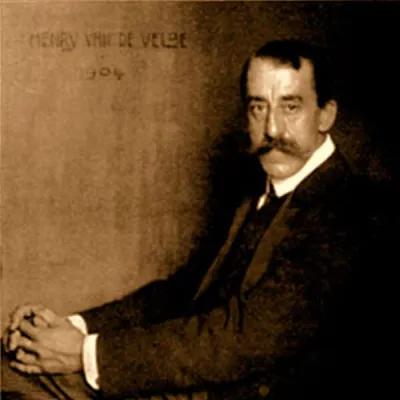
Henry van de Velde
Human Design Chart
Biography
The Human Design of Henry van de Velde: Manifesting Generator 4/6
Manifesting Generator 4/6 — Design at a Glance
Henry van de Velde was someone who combined hybrid energy: the constant power of a Generator with the lightning-fast alignment of a Manifestor. His design featured a defined Sacral Center, which provided him with continuous life force and advised him not to initiate but rather respond to inner impulses. At the same time, he had an active connection from Motor to Throat Center, allowing him to skip steps while acting and quickly draw things into his life.
This speed brought specific challenges. Henry van de Velde tended to take on multiple projects simultaneously as he responded to various impulses. Without confirmation of his inner authority, this creative drive could quickly turn into frustration, his non-self theme. Also, skipping important phases sometimes forced him to backtrack and make up for missed steps.
He achieved deepest satisfaction when he correctly reacted to life and answered his Sacral Center with a clear 'yes'. In this state, working on different tasks in parallel was no longer an obstacle but a source of fulfillment. He entered into a play mode where variety nourished his creative power rather than splitting it. Thus, his design allowed him to work efficiently and versatilely as long as inner consent remained onboard.
Emotional Authority
Henry van de Velde showed a decision-making stance marked by the necessity of waiting. His design carried emotional authority in the defined Emotional Center. This configuration was subject to a permanent emotional wave, an up-and-down of feelings that colored his perception of the world through current mood. What seemed inspiring at one moment could appear negative in another. His immediate feeling formed merely a snapshot, not final truth. Quick, spontaneous decisions from this emotional excitement often proved problematic.
The mechanics of his inner authority required patience: The longer he gave space to a decision, the deeper and more comprehensive he could perceive it. This demanded conscious hesitation, multiple reconsiderations of options, and readiness for questioning. Only with time did intense feelings subside, emotional distance set in, and clarity as well as calmness emerged. This process was particularly significant for long-term decisions that profoundly influenced his life course. Emotional authority always took precedence over other defined centers in his chart; it determined the rhythm of his orientation independent of further mechanical factors.
The 4/6 Profile — Opportunist / Role Model
Henry van de Velde's design inclined towards experimental action in early years, which later condensed into a role as a wise networker. As a 4/6 profile, he initially lived like a 3/4: Intensively seeking connections and testing relationships through trial and error. This phase served to cautiously open the great heart of Line 4 without entrusting himself to false people and getting hurt.
With the activation of Line 6, an internal conflict emerged: The desire for community stood against the need to withdraw and contemplate the meaning of life. This contradiction between heart and head shaped his development up to the expectation of becoming a role model. His task was to emerge through cooperation with others while maintaining an unyielding stance that endured misunderstandings until they transformed into clear influence.
Additionally, Line 4 worked on Gates 21 and 45. It enabled him transpersonal control and leadership by carefully assessing hostile forces and responding appropriately. Through service to the tribe and work for the common good, this configuration supported his ability to lead effectively. Henry van de Velde used his instinct on a material level to succeed while always needing protection from the other side to fulfill his leadership role. His life showed a balance between building networks and maintaining an inner distance for reflection.
Triple Split Definition — Defined & Open Centers
Henry van de Velde revealed himself as a person with immense internal dynamism and persistent mental pressure. His design combined defined Head and Ajna centers, creating a constant source of inspiration and conceptual thinking. He was constantly engaged in questioning and developing concepts but felt the pressure of not being able to implement these ideas immediately due to lacking direct energy for it. Instead, he acted as a catalyst: his aura pressured those with undefined Head center to think and encouraged them to put his visions into action.
This mental activity flowed into his defined Throat center, allowing him to communicate his thoughts and concepts reliably. However, the real engine of his actions lay deeper: A defined Sacral center gave him vital generative energy that could only be correctly released in response to external stimuli. Henry van de Velde tended to initiate things, often leading to frustration when he tried to push mental plans against the resistance of reality. His strategy was to wait and listen for the sacral answer – an inner yes or no – before acting.
Emotionally, he was marked by a defined Solar Plexus center that gave him emotional authority. He had to let his feelings flow in waves to gain clarity instead of making decisions impulsively based on highs or lows of his mood. This often created tensions in relationships as he unconsciously colored the emotional environment of others.
An open G center, however, meant that he did not have a fixed identity or direction. He tended to orient himself outwardly and borrow identity from his surroundings. This led to confusion: internally questioning who he really was or where his place was instead of trusting that the right direction and love would be brought through correct initiations from outside. Instead of using this openness as flexibility, he sometimes desperately sought a fixed definition of self, making him vulnerable to false environments in which he did not feel comfortable.
Channels for intuition, success, clarity, change and maturation.
Henry van de Velde showed himself as someone who combined intuitive depth with technical perfection. This resulted from the Channel of Wavelength 48-16: Gate 48 searched for life-critical information while Gate 16 perfected skills through repetition until they became talents.
His material level was shaped by the Channel of the Money Line 21-45. Here, the Hunter's will (Gate 21) to maintain control met the authoritative voice of the Gatherer (Gate 45). This created a dynamic between service and resource management, seeking independence to avoid stress.
Mentally, the Channel of Awareness 61-24 was at work. Gate 61 received spontaneous inspiration that Gate 24 rationalized. Knowledge did not enter through logical thinking here but as sudden insight when the mind was still.
Emotionally, he was driven by the Channel of Transience 35-36. Gate 35 craved new experiences ("I've been there before") while Gate 36 felt inadequacies and created crises to force movement. This led to a restless search for emotional depth.
The learning process followed the Channel of Maturation 42-53 in his design. It began with intention (Gate 53), went through the cycle until satisfaction (Gate 42) to gain wisdom that he could then reflect upon.
Additionally, isolated gates were at work: Gate 9 promoted detail work and focus in the Sacral center; Gate 17 organized for the future through logical teaching; Gate 5 established a natural rhythm; Gate 18 corrected corruption in the collective; Gate 32 secured continuity and tested stability.
Collective Circuitry — Circuit Signature
Henry van de Velde's design laid out a tendency towards separate, parallel functioning energy blocks. As a Triple Defined individual, he did not have a continuous connection between all his defined centers but rather three isolated fields of power. This shaped his experience world as a series of specific, non-interconnected competencies and impulses that acted independently.
The Knowledge Circuit connected his Head and Ajna center through the Channel of Awareness (Gates 24–61). This promoted innovative flashes of insight and a drive for new knowledge and individual identity, yet without direct connection to other energy centers.
Parallel to this, the Understanding Circuit worked via the channel 'The Wavelength' (Gates 16–48) between Throat and Spleen center. Here sharing logical, rational insights was at the forefront, driven by a focused, future-oriented intuition that remained free of emotional influence.
A third block formed with the Meaning-Finding Circuit. It consisted of two unconnected parts: On one side, it connected Throat and Solar Plexus center (Gates 35–36) to express cyclical, emotional waves from the past. On the other hand, it linked Sacral and Root center (Gates 42–53) for the maturation of experiences. These two parts were energetically separate.
Finally, the Ego Circuit worked through the 'Money Line' (Gates 21–45), connecting Throat and Heart center. This supported cooperation, giving and taking as well as building material resources within a community, always as an independent function isolated from the rest of his design.
Right Angle Cross of Tension 1
Henry van de Velde showed a pronounced inclination to not suppress internal tensions and conflicts but rather use them as driving forces for his development. This attitude stemmed from his configuration of the right cross of tension 1. In this design pattern, the ability to consciously endure dissonances and transform them into constructive impulses is at the forefront. Instead of striving for immediate harmony or resolution, he learned to acknowledge pressure as a necessary motor for profound changes. This mechanism promoted a lifestyle that did not view resistance as obstacles but rather as essential sources for growth and innovation. Through this inner dynamic, a constant process of friction emerged, which did not work destructively but released creative energy. Henry van de Velde used this tension to chart new paths and challenge established structures critically. The configuration imparted him the insight that true progress often arises from confrontation with unresolved questions. Thus, the ability to integrate conflicts rather than avoid them became a central characteristic of his actions and thinking. This inner tension shaped his way of moving in the world: always in flux between resistance and movement, without seeking rest but meaning.
Saturn Return · Uranus Opposition · Chiron Return · 2nd Saturn Return — Life Cycles
Henry van de Velde was someone whose creative power was characterized by clear structure and long-term commitment. His design showed a tendency towards sustained work on projects that matured over years. This attitude reflected his first Saturn return: in 1892 at the age of 29, he stayed in Knokke-Heist to learn appliqué embroidery – a moment when years of groundwork condensed into a viable result.
His life continued following this rhythm of consolidation. The second Saturn return marked 1920 as the beginning of the architectural project for the Kröller-Müllers' private museum. Here, his energy flowed into enduring structures that promised stability.
Parallel to this was a more dynamic force: the Uranus opposition around 1904 brought unexpected turns. In this year, his twins Thylbert and Thylberthe were born in Weimar – an event that reordered his personal world and created new responsibilities.
The Chiron return around 1914 at age 51 marked the bloom of his purpose. During this phase of fulfillment, he took over the leadership of the Cranach Press in Weimar during World War I. This was not a moment of healing old wounds but rather a time when his incarnation cross increasingly unfolded and meaning became tangible. His career condensed here into a clear expression form of his design.
Manifesting Generator · Emotional Authority — Synthesis
He was an Manifesting Generator whose life was marked by a profound inner tension between the drive for rapid implementation and the necessity of emotional maturation. The connection of the sacral center with the throat center (Design view) gave him a steady energy source, which, however, required an emotional authority filter. This combination led to his ability to tackle ideas swiftly and seize opportunities – particularly in early life stages (Cycles) – but always relied on decisions ripening over longer periods to avoid mistakes. The profile as Networker/Role Model (Profile Role) reinforced this inclination towards connection and exchange, with the need for authenticity and the search for one's path at its core (Switch Circuits).
A central paradox in his design lay in the interaction between the defined mental center – a source of constant inspiration and questions (Centers) – and the emotional wave. This inner dynamic led to an ongoing conflict between heart and mind (Profile Role), a search for meaning that manifested as experimental enthusiasm and a desire for profound understanding. The channel of wavelength (Channels/Gates) points to a capacity to recognize and refine hidden abilities, yet this depth always required tuning into one's instincts to avoid mental confusion.
5 Defined Channels
Incarnation Cross - Right Angle Cross of Tension 1
Solar Return
The Solar Return shows the moment when the sun returns to its exact birth position - your personal solar year.
Life Cycles
Discover the life cycles with a detailed triple view (birth chart, cycle chart, composite).
Human Design Profile
- Strategy
- To respond - wait for something to respond to
- Authority
- Emotional Authority
- Profile
- 4/6 - Opportunist / Role Model
- Definition
- Triple Split
- Incarnation Cross
- Right Angle Cross of Tension 1
- Date of Birth
- 03.04.1863 01:00
- Place of Birth
- Antwerp, Belgium
Frequently Asked Questions
What was Henry van de Velde's Human Design type?
What Profile did Henry van de Velde have in Human Design?
What Authority did Henry van de Velde have?
What incarnation cross did Henry van de Velde have?
When was Henry van de Velde born?
Discover your own Human Design
Are you also a Manifesting Generator? Find out in a personal reading how to unfold your multi-talents and direct your energy wisely.
More Personalities
Back to overviewAldair

Alizée

Angeli

Arletty
Artus
Baekhyun