
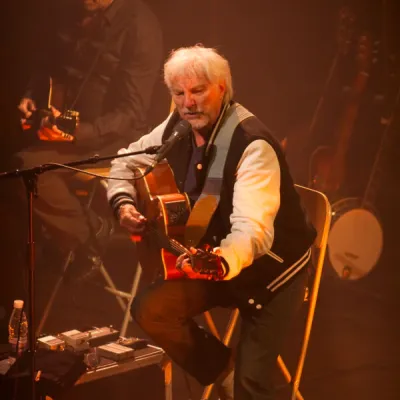
Hugues Aufray
Human Design Chart
Biography
Aufray represented Luxembourg in the 1964 Eurovision Song Contest, performing "Dès que le printemps revient" and finishing fourth. His most famous songs are "Santiano", "Céline", "Stewball", "Hasta luego" and in Spanish, "Barco de Papel". In 2023, he has gone on tour to sing in cathedrals. On 2 September 2023, at the age of 94, he married his girlfriend Murielle Megevand, born in 1974, in a Roman catholic ceremony.
Aufray is well known for his French covers of Bob Dylan's songs.
Human Design Analysis: Hugues Aufray as Manifesting Generator 1/3
Manifesting Generator 1/3 — Design at a Glance
Hugues Aufray's design shows a tendency towards great dynamism paired with the necessity to channel this energy through inner confirmation. As an Manifesting Generator, he combined the constant power of the sacral center with the ability to skip steps and achieve results quickly. However, this hybrid nature meant that initiatives without prior reaction to an impulse often ended in frustration – the specific non-self theme of this type.
The mechanics show: Hugues Aufray was dependent on not initiating himself but reacting to life. Only when his sacral center signaled a clear 'yes' could his speed be useful. Otherwise, he tended to overlook important processes or get distracted by parallel projects, which without inner consent quickly led to exhaustion.
Deep satisfaction did not arise from linear work but from a 'play mode'. This state occurred when he sought variety and pursued multiple paths simultaneously – provided each endeavor still resonated with his authority. Regularly checking whether a project was still fun was crucial. Thus, his potential rush transformed into efficient creative power that allowed him to quickly draw things into his life without neglecting the foundation of inner consent.
Emotional Authority
Hugues Aufray's design shows a tendency towards decision-making that requires time and navigating emotional waves. His inner authority stems from the defined Emotional Center. This mechanism means that his feelings oscillate in a permanent up-and-down; the world appears colored by the current mood. A moment of enthusiasm could quickly be replaced by a negative view of the same topic.
For Hugues Aufray, however, immediate feeling was only a snapshot, not a final judgment. Quick, spontaneous decisions from this emotional heat were prone to error and could have negative consequences. The mechanics of his design required patience: he had to 'sleep on' decisions and take time to reflect. Only through this waiting did the intense feelings subside, gaining emotional distance and true clarity and calmness set in.
This process was essential for long-term course corrections that influenced his life path. Emotional authority takes precedence over all other defined centers in his chart; it is the primary source of his inner direction, independent of further configurations. Hugues Aufray thus showed himself as someone who reached profound insight through savoring the emotional rhythm rather than trusting the first impulse. This need to gain distance shaped how he dealt with important life questions.
The 1/3 Profile — Investigator / Martyr
Hugues Aufray's design shows a tendency not to shape identity through static knowledge but through self-experienced insights. His Profile 1/3 defines his life task as a cyclical process of theoretical preparation and practical experimentation. This created an inner conflict: Line 1 required complete information before action, while Line 3 had the urgent impulse to test immediately and learn from mistakes.
The first line with Gate 29 represents the recruit who takes on commitment and adapts to the fight. Here it was about learning when endurance was necessary and when restraint was needed. This energy required time to grow and accumulate experiences. Simultaneously, Gate 8 in the third line brought the theme of hypocrisy: the tendency to hide true nature to be accepted. The third line characterized itself through trial and error as well as adaptability. Here style took precedence over content.
The authenticity of Hugues Aufray's judgments only emerged through integrating this theory and practice. His design trusted only what it had tested itself. If he evaluated something as good, he had previously validated it both intellectually and empirically. This process of planning, risk-taking, and learning experience shaped his credibility. He showed himself to be someone who did not just consume knowledge but tested it through personal experience on the heart and gut level, making his judgment absolutely trustworthy.
Single Definition — Defined & Open Centers
Hugues Aufray revealed himself as an autonomous actor with a fully defined energy architecture, meaning a high, constant presence in all areas of life. His mental conception (defined Ajna Center) and communication (defined Throat Center) were always active; he translated his thoughts directly and consistently into the world without being distracted by external influences. This expressive ability was marked by his defined G Center, which gave him a firm identity and clear sense of direction, as well as his defined Heart Center, which endowed him with willpower and the ability to keep promises.
His strategy was based on his defined Sacral Center: He had an enormous vital energy source that could only be effectively used in response to external requests. Initiatives driven by personal motivation risked losing this power. Additionally, his defined Solar Plexus served as internal authority; he needed time to wait out emotional waves before making decisions, as immediate reactions were often impulsive and regretted later. The constant pressure of his defined Root Center propelled him forward but required a balance between work and rest to stay healthy.
In contrast, his Head and Spleen Centers were open. His open Head Center meant that inspiration did not come from within himself but was absorbed from the environment; he tended to identify with others' questions or feel mental pressure to find answers that were actually not his own. His open Spleen Center made him vulnerable to conditioned fears about survival and health issues. He unconsciously sought security through others, which could lead him to cling to unhealthy situations or make spontaneous decisions to generate a false sense of wellbeing rather than trusting his own constant inner guidance.
Channels for inspiration, rhythm, intimacy, power, structure and growth.
Hugues Aufray's Human Design profile set a tendency towards deep affirmation of life and persistence. This power manifested as present but solo-activated energy of the Personality Sun in Gate 29 (Line 1). It represented the fundamental "yes" to life and its challenges; false affirmations led to difficulties, while correct action brought inevitable rewards. It was about the depth of the I Ching and avoiding an inner "no."
This foundational stance was reinforced by specific channels. Channel of Inspiration 1-8 connected the G Center with the Throat Center, allowing Hugues Aufray as an individual to live and draw attention not through words but through a exemplary life of his unique identity. This inspired others to express their own uniqueness, though it required patience in timing.
Channel of the Beat 2-14 linked the Sacral with the G Center. As one of the tantric channels, it drove mutation and innovation forward. Hugues Aufray could create new directions through trust in sacral reactions without knowing the path ahead. This energy supported creative efforts materially and mechanically encouraged others through a healthy aura.
Channel of Union 59-6 connected the Sacral with the Solar Plexus Center. It rooted itself in sacral and emotional energy called intimacy. The drive was to merge; Hugues Aufray could quickly penetrate into other people's aura. Emotional waves determined timing for friendships before deeper intimacy, to avoid misunderstandings about his intensity.
Channel of the Money Line 21-45 connected the Heart with the Throat Center. It carried responsibility for material survival and control. Hugues Aufray worked best as his own boss, followed his natural rhythm, and sought independence to avoid stress.
Channel of Manifestation 23-43 linked the Ajna with the Throat Center. It allowed spontaneous insights that were clearly expressed to reinforce efficiency. Hugues Aufray had to wait for his innovative thinking to be recognized at the right time; otherwise, he felt rejected.
Channel of Ripening 42-53 connected the Root with the Sacral Center. It demanded fully experiencing and reflecting on experiences before new cycles began. This created wisdom for future generations based on empirical history without fixed expectations.
Additionally, Gates like Gate 30 (Recognizing Feelings), Gate 60 (Accepting Limitations), and Gate 11 (Visual Remembrance in Harmonic Condition) worked to complement these mechanisms.
Individual Circuitry — Circuit Signature
Hugues Aufrays Design shows a dense connection between individual creativity and emotional experience. The Knowledge Circuit linked his Ajna, Throat, Identity, and Sacral Centers into one flow. This promoted the expression of a unique identity through creative impulses (Channel 8-1) and rhythmic structuring (Channels 43-23 as well as 2-14). New knowledge emerged from the connection between mind, voice, and life force, which fostered a pulsating, acoustic presence.
Parallel to this, the Meaning Circuit connected Hugues Aufray's Sacral with his Root Center (Channel 42-53). This involved cyclical reflection on past experiences and sharing these emotional insights with others. Since both circuits use the Sacral Center, there was a strong foundation of life force for both creative innovation and emotional processing.
The Ego Circuit, however, only linked Throat and Heart Centers (Channel 45-21). Without direct connection to the Sacral life force, this configuration required structural pauses to generate resources for cooperation. Here it was about material support and exchange of giving and taking, separate from a constant energy source.
Finally, the Protector Circuit connected Hugues Aufray's Sacral with his Solar Plexus Center (Channel 59-6). This brought instinctive protection and emotional care together, focused on preserving genetics and family environment. Thus, Hugues Aufray showed an architecture where creative transformation, emotional meaning-making, and genetic protection were closely intertwined, while cooperative resource work needed its own rhythms.
Right Angle Cross of Contagion 3
Hugues Aufrays Human Design shows a tendency towards deep emotional absorption. He appeared as someone who unconsciously took on the moods and energies of his environment, leading to both strong empathy and the risk of over-identification with others. This configuration is known in Human Design as the right cross of infection. It describes a dynamic where foreign influences—whether feelings or even physical states—must be processed.
For Hugues Aufray, this was an ongoing filtering process. His exposure to other people's energies required him to maintain clear boundaries so he wouldn't merge with their energy. This wasn't about conscious analysis but rather intuitive transformation of what reached him. His challenge lay in integrating these absorbed impulses without losing his own essence. The design here doesn't offer a classical choice, but instead shows a mechanical reaction to the environment: absorb, process, transform. Those who don't understand this mechanism tend to carry others' burdens as their own. Hugues Aufray faced the task of using this infectious capacity as a tool by learning to distinguish between his own and others', without being overwhelmed by the intensity of the exchange. It's a path of resilience through conscious distancing in moments of high emotional charge.
Manifesting Generator · Emotional Authority — Synthesis
The central red thread in Hugues Aufrays Human Design is a dynamic interaction between the need for authentic expression and the ability to influence others. This manifests through the connection of defined Throat and G Centers (the voice of self) with Channels 1-8 (Inspiration) and 35-27 (Maturity), creating a powerful combination of individuality and collective impact. His defined sacral authority, coupled with the manifesting generator type, points to someone who can react spontaneously but reaches deep satisfaction by waiting for inner confirmation—this process nourishes his creative energy and allows him to inspire others through his authentic presence.
The central paradox lies in the tension between the urge for quick reaction (manifesting generator) and the need for emotional clarity (emotional authority). While he has the ability to initiate things quickly, his design also requires waiting out the emotional wave to ensure that actions align with inner truth. This duality leads to a dynamic interplay between initiation and response, between expressing individual self and adapting to collective energy—a constant navigation between spontaneity and conscious decision.
6 Defined Channels
Incarnation Cross - Right Angle Cross of Contagion 3
Solar Return
The Solar Return shows the moment when the sun returns to its exact birth position - your personal solar year.
Life Cycles
Discover the life cycles with a detailed triple view (birth chart, cycle chart, composite).
Human Design Profile
- Strategy
- To respond - wait for something to respond to
- Authority
- Emotional Authority
- Profile
- 1/3 - Investigator / Martyr
- Definition
- Single Definition
- Incarnation Cross
- Right Angle Cross of Contagion 3
- Date of Birth
- 18.08.1929 08:15
- Place of Birth
- Neuilly sur Seine, France
Frequently Asked Questions
What Human Design Type is Hugues Aufray?
What is Hugues Aufray's Human Design Profile?
What authority guides Hugues Aufray?
What incarnation cross does Hugues Aufray have?
When was Hugues Aufray born?
Discover your own Human Design
Are you also a Manifesting Generator? Find out in a personal reading how to unfold your multi-talents and direct your energy wisely.
More Personalities
Back to overviewAaliyah

Aldair

Alexia

Alizée

Angèle

Angeli
