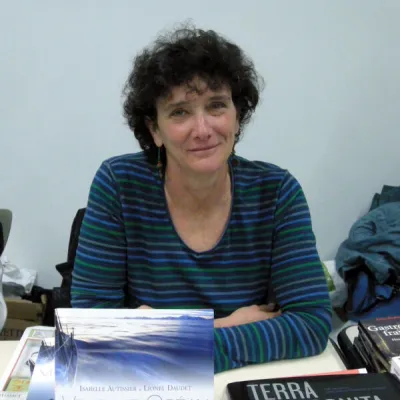
Isabelle Autissier
Human Design Chart
Biography
Autissier has completed two-and-a-half circumnavigations -The BOC Challenge in 1990-1991 and the last Vendee Globe. During The 1994-1995 BOC Challenge (now called the Around Alone race), Autissier won Leg 1 by more than five days. In a risky move that took her northeast of the fleet, she finished five days ahead of her nearest competitor, astounding the world. Her luck changed during Leg 2, when she was dismasted deep in the Roaring Forties, five days after the start in Cape Town. After jury-rigging a mast from her spinnaker pole, she managed to reach tiny Kerguelen Island, where resident French scientists helped her step a replacement mast her shore crew had found in Reunion.
What does Manifestor 5/1 mean for Isabelle Autissier?
Manifestor 5/1 — Design at a Glance
Isabelle Autissier appeared as a trailblazer with visionary aspirations, comparable to an Emperor figure who does not fight personally but shapes the realm through their will. Her design laid out a foundational stance of actively leading the world into a new future, which inevitably caused polarization: she was either loved or rejected, rarely viewed neutrally. This pain point of misunderstanding stemmed from her thinking often surpassing that of her surroundings, thereby automatically dividing people.
The central mechanics of her design lay in the strategy of informing. By clearly communicating her intentions and visions, she could minimize resistance and attract the right people – those willing to follow her lead. Without this prior information, her energy would encounter unnecessary opposition. If Isabelle Autissier lived by this strategy, informing before acting, she was rewarded with inner peace. Deviating from it and trying to fight against the current or hide led to deep, lasting anger. Her design thus did not demand adaptation to others but a clear statement of her own direction to gather the right circle around herself and remain in harmony.
Emotional Authority
Isabelle Autissier demonstrated decision-making based on emotional clarity rather than spontaneous impulses. Her design suggested that she could be guided by momentary mood feelings, yet this was an unreliable basis for significant life steps. This results from her inner authority: Emotional Authority. With her Solar Plexus Center defined, she was subject to a natural emotional wave, a permanent up and down of feelings. The world appeared colored through her current mood; enthusiasm could quickly turn into rejection.
A crucial mechanism here is the absolute priority of this authority. Regardless of which other centers are defined in her graph, the Solar Plexus Center always carries responsibility for internal decisions if it is activated. This immediate feeling is merely a snapshot, an initial impression that does not necessarily reflect the truth yet. Quick, spontaneous reactions from this emotional situation could thus have negative consequences.
Instead, her design required patience and conscious reflection on decisions. By allowing herself time to let a choice mature, she gained emotional distance. Intense feelings would fade over time, leading to true clarity and calmness. This process was especially important for long-term decisions as it ensured that her actions were based on deep, comprehensive insight rather than fleeting excitement or depression.
The 5/1 Profile — Heretic / Investigator
Isabelle Autissier showed a fundamental stance arising from the tension between profound research and public expectation. Her design indicated that she acted as a Hero (Line 5) who does not pull solutions out of thin air but draws them from a private, quality-oriented knowledge base (Line 1). This created almost magnetic attraction: others instinctively sought answers and problem-solving from her.
This dynamic brought a central challenge. Without clear boundaries, there was the risk of exhaustion as the need for help from others could drain her own energy source. Similar to an expert who is left exhausted after hours of consultation while new requests pour in, Isabelle had to learn to regulate the pressure of external feedback.
The mechanics of her design emphasized the necessity of quality in stimulation (Gate 56). Her ideas were only effective and sustainable if not diluted by trivial demands. Simultaneously, there was an instinct for adaptation during change (Line 5), which needed to be limited by a drive for personal expression to avoid conformism.
The key lay in learning to say „No“. Only then could she maintain balance: enough space for her own research and stimulation without being worn down through excessive output to others. Her gifts only reached their full potential when she protected this boundary, ensuring that her contributions remained truly valuable rather than getting lost in the mundane.
Single Definition — Defined & Open Centers
Isabelle Autissier's Human Design profile established a steady internal engine for thinking and emotional clarity, flanked by a deep situational sensitivity. Her defined Head and Ajna centers created a constant mental pressure to question and form concepts; this was not mere intellectualism but a driving force towards understanding consciousness itself. This mental inspiration flowed into her defined Throat center, enabling her to express thoughts reliably – yet not impulsively. The crucial filter was her defined Solar Plexus: As an emotional authority, her mechanics required waiting for the emotional wave before making decisions or manifesting thoughts. Truth revealed itself to her only over time, not in a momentary mental flash.
Simultaneously, five open centers shaped her experience: G, Heart, Sacral, Spleen, and Root were undefined. Without a fixed identity (open G), Isabelle Autissier tended to blend with her environment and aligned herself with the right places and people who initiated her. Her open Heart center made her vulnerable to the pressure of proving her worth through promises or competition – a trap she could only escape through deconditioning. The open Sacral center meant no constant energy flow; instead, she risked exhaustion if she borrowed vitality from the environment and ignored boundaries.
Her open Spleen center harbored a fundamental survival fear that made her cling to things not good for her just to simulate a sense of security. Spontaneous decisions were risky here as the center reacted to conditioning. Finally, her open Root center absorbed external stress and adrenaline from the environment. Rather than using this pressure as personal drive, which led to burnout, she needed to distinguish between healthy impulse and foreign pressure. Her strength lay not in constant self-assertion but in filtering mental clarity through emotional patience and opening up in correct environments without taking on others' energy as her own responsibility.
Channels for abstract imagery, emotional openness and logical acceptance.
Isabelle Autissier's design established a tendency towards mood-driven social presence. Her ability to emotionally articulate and interact depended on the inner 'wave'; she appeared warm and connecting when the mood fit, but could be abrupt or isolate herself if forced against this emotional rhythm. This mechanism is determined by the Openness Channel 22-12 in her design: It connects the Solar Plexus center with the Throat center and regulates social expressiveness through ebbs and flows of feelings. Gate 22 brings passion and drama, while Gate 12 exercises cautious restraint to direct openness towards people offering the greatest transformative potential. The voice serves here as a tool to emotionally touch others – yet authentically only at the right time.
Alongside this dominant channel, other energies work indirectly. The Acceptance Channel 17-62 appears in Juxta (interpersonal), meaning Isabelle Autissier often confronted or mirrored others' logic in relationships – a process requiring mental organization of details to be understood. Additionally, the Abstraction Channel 64-47 is active in her personality; this describes a mind that sifts experiences through kaleidoscopic images seeking a story or perspective that makes sense. This mental process serves less to solve personal problems than to understand life's mysteries and potentially form an inspiring narrative.
Moreover, prioritized gates contribute to the overall structure: Gate 32 strives for continuity and material success for the tribe but radically tests values. Gate 42 emphasizes the importance of experience and completion for growth. Gate 56 enables abstract storytelling through figurative representation, while Gate 60 sees acceptance of limitations as a prerequisite for transcendence. Gate 8 promotes individual contribution to the group, Gate 63 drives mental process forward through doubt. Gate 16 experiments in the collective, and Gate 31 transfers leadership to others. These elements frame the central dynamics of mood-dependent openness.
Collective Circuitry — Circuit Signature
Isabelle Autissier's design combined rational future orientation with emotional past reflection. As all defined centers (Throat, Solar Plexus, Ajna, Head) lie within a single group, this energy flowed as a continuous stream. The Knowledge Circuit expressed her unique identity through the Openness Channel between Throat and Solar Plexus centers. This enabled her to transform new knowledge through emotional waves and carry it acoustically into the world. Parallel to this, the Understanding Circuit connected Ajna with Throat center via the Acceptance Channel. Here, logical strategy and focused thinking free from emotions were about sharing rational insights for a better future. Simultaneously, the Meaning-Finding Circuit reflected past experiences through the Abstraction Channel between Head and Ajna centers. This cyclical energy helped her give meaning to past events and visually communicate these felt insights with others. The tension field involved integrating cool logic of understanding with emotional depth of meaning-finding and impulsive expression of knowledge. Isabelle Autissier utilized this integrated flow to radiate both innovative ideas and deep emotional resonance, always oscillating between looking ahead and processing what was.
Left Angle Cross of Limitation 2
Isabelle Autissier's Human Design shows a tendency towards clear boundaries. She appeared as someone who not only accepted but actively used boundaries to protect her resources and maintain focus. This attitude stems from the influence of the left authority of Limitation 2. In Human Design mechanics, this authority functions as an archetypal framework for life energy. It emphasizes the need to consciously separate oneself from overextension and to use energy purposefully. Those who carry this aspect often learn through experience that defining "no" is just as powerful as saying "yes." This isn't about isolation but rather creating a protected space where authentic action can take place. The energy of this authority works stabilizing, preventing one from getting lost in others' expectations. Instead, it fosters an inner clarity about where personal capacities end and others begin. This allows for a life less driven by external pressure and more grounded on the solid foundation of personal boundaries. Isabelle Autissier was prompted by this configuration to carefully dose her energy and dedicate herself only to tasks within her self-imposed limits. As a result, her way of living appeared limited but at its core was marked by great inner freedom and self-determination. The structure served as a filter against exploitation and a shield for her own integrity.
Saturn Return · Uranus Opposition · Chiron Return · 2nd Saturn Return — Life Cycles
Isabelle Autissier's Human Design profile indicated a tendency towards structured milestones where inner maturity became visible through concrete actions. Her first Saturn Return marked 1986 at the age of 30 as such a turning point: She sailed solo across the Atlantic Ocean with the steel yacht Parole, which had been under construction for three years prior to this voyage. This success condensed years of preparatory work into a tangible result and demonstrated the integration of her energy into clear physical achievement.
Her second Saturn Return around age 59 further deepened this structuring towards an inner stance. In 2015, she published the novel *Soudain, seuls* (German: *Herz auf Eis*). This publication represented another phase of maturity where previously acquired discipline and experience culminated in a new form of expressive power. The two returns acted as frameworks that accompanied her development from physical validation to intellectual and emotional depth. Throughout this process, the focus remained on the concrete implementation of her inner processes outwardly without losing substance.
Manifestor · Emotional Authority — Synthesis
Isabelle Autissier's Human Design reveals a central continuity in the dynamic balance between inner exploration and outer articulation. The defined connection of Head Center and Ajna Center, paired with an emotional Solar Plexus, points to a profound mental process that constantly seeks understanding – a steady stream of questions and inspirations. This internal drive finds its expression through the defined Throat Center, which provides the ability to communicate and manifest, yet always in harmony with the emotional cycle. The openness in Root, Sacral, and Spleen Centers amplifies this tendency by requiring a high sensitivity to external influences and a constant adaptation process to the environment.
Simultaneously, there lies a central paradox in the combination of this deep inner world and the openness to outer energies. While the design strives for clarity and understanding, it is also vulnerable to conditioning and the pressure from outside. The ability to abstract knowledge and communicate (Channel 16-63) stands in tension with the necessity to protect oneself from the overwhelming influence of the environment. This dynamic requires a constant navigation between one's inner compass and the demands of the outer world to remain authentic and realize one’s vision.
3 Defined Channels
Incarnation Cross - Left Angle Cross of Limitation 2
Solar Return
The Solar Return shows the moment when the sun returns to its exact birth position - your personal solar year.
Life Cycles
Discover the life cycles with a detailed triple view (birth chart, cycle chart, composite).
Human Design Profile
- Type
- Manifestor
- Strategy
- To inform others before acting
- Authority
- Emotional Authority
- Profile
- 5/1 - Heretic / Investigator
- Definition
- Single Definition
- Incarnation Cross
- Left Angle Cross of Limitation 2
- Date of Birth
- 18.10.1956 01:00
- Place of Birth
- Paris, France
Frequently Asked Questions
What is Isabelle Autissier's Human Design type?
What are Isabelle Autissier's Profiles?
What authority does Isabelle Autissier have in her chart?
What incarnation cross is active for Isabelle Autissier?
Discover your own Human Design
Are you also a Manifestor? Find out in a personal reading how to use your initiation power peacefully and dissolve resistance.
More Personalities
Back to overviewAldair

Cafu

Christian-Jaque

Joelinton

Kaká

Kesha