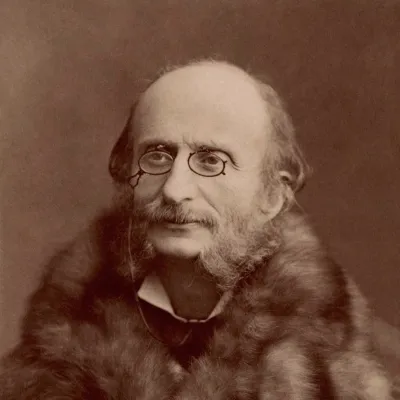
Photo: Wikimedia Commons
Jacques Offenbach
Human Design Chart
Biography
At 14, he studied violoncello at the Paris Conservatoire, 1833, before becoming a member of the orchestra of the Opera-Comique. From there, he became an operatic composer of light dramatic pieces, brilliant, humorous trifles that revolutionized the popular tastes of the period. Over the next 25 years, he produced more than 100 c(via rororo-Bio.)(ann. by mik:dead 5 not 4 october)
What does Manifestor 6/2 mean for Jacques Offenbach?
Manifestor 6/2 — Design at a Glance
Jacques Offenbach's Human Design chart marked him as a pioneer and visionary whose inner drive was aimed at steering the world towards a new future. His nature resembled that of an emperor in ancient Rome: He possessed the grand vision of a great empire but did not lead the necessary wars himself. Instead, he sent his soldiers out to conquer foreign lands on his behalf and realize his plans.
This way of acting inevitably polarized those around him. His visions often went beyond what others could comprehend, leading to misunderstandings. On one side, he was loved and followed for his enormous dreams; on the other side, precisely because of this superiority, he was hated or rejected. This pain point of not being understood was a central aspect of his design.
To find the right followership and minimize resistance, his strategy required informing others about his intentions in a timely and precise manner. This was the key to bringing harmony into his life. If Jacques Offenbach followed this strategy of informing as well as his inner authority, he was rewarded with a feeling of inner peace. Conversely, if he lived against this design without informing or listening to his guidance, he felt an enduring deep anger within himself. His path was thus characterized by the tension between the necessity of realizing his vision and the need to communicate it clearly in order to find acceptance.
Emotional Authority
Jacques Offenbach's Human Design chart indicated a tendency towards emotional wave motion. His inner authority carried the defined Emotions Center. This configuration meant that he could not make decisions spontaneously without taking risks. Instead, he was subject to constant ups and downs of feelings: What appeared inspiring in one moment could turn negative in the next. His immediate feeling was always just a snapshot, not yet the final truth.
The mechanics of his emotional authority required patience. Quick, spontaneous actions based on current mood often had negative repercussions. Instead, he needed time for intense emotions to subside and clarity to emerge. This process of 'sleeping it over' was essential to gain emotional distance and find calmness. Only then did the deep insight set in that was necessary for long-term life decisions. Jacques Offenbach thus showed himself as someone who had to be asked several times, should be questioned repeatedly, and only acted after the initial wave subsided. This strategy protected him from misjudgments resulting from passing moods and allowed him to make decisions on a stable basis.
The 6/2 Profile — Role Model / Hermit
Jacques Offenbach's Human Design chart indicated a tendency towards a two-phase development. In his youth, Profile 6/2, known as the 'Role Model/Natural Talent' type, drove him primarily to experiment. Until around age thirty, he lived by the principle of trial and error; mistakes served as learning opportunities, followed by necessary withdrawals for processing. This early phase was characterized by the energy of Line 2, which fosters existentialism and a selfless dedication to 'Here and Now' without intentional motivation. He sought recognition through authentic presence in the present moment while external projections of collective expectations often hit him.
With the entry of Line 6 after age thirty, his focus shifted fundamentally. Instead of continuing to experiment, he metaphorically retreated into a 'cave' to look back at his previous experiences with distance. This period served intensive reflection, healing, and deep self-knowledge. Line 6 requires trust in transformation and metamorphosis; it prepares for societal changes. Jacques Offenbach thus developed into a wise counselor. Only after completing this inner work did he re-emerge. Others then recognized his gained wisdom and sought his counsel to learn from his ability for deep introspection and benefit from his life lessons.
Split Definition — Defined & Open Centers
Jacques Offenbach's design inclined towards clear, willful communication stemming from a firm internal identity and emotional depth. His defined G Center endowed him with a reliable self-understanding as well as a sense of direction in life; he knew who he was and could show others new paths. This inner security flowed into his defined Heart Center where willpower and ego found their home. He enjoyed controlling his resources and using his 'I' to keep promises and shape his work autonomously.
His voice was shaped by the also defined Throat Center, serving as a focal point for carrying these internal forces outward. Since Throat, Heart, and G Centers were interconnected, he often spoke from a strong 'I want' position – honestly, directly, and with the authority of someone who knows their place. At the same time, his expression ran through the emotional wave of his defined Solar Plexus Center. His feelings formed his inner authority; he needed time to gain clarity before initiating decisive steps. This emotional depth gave his statements a seductive warmth and complex sensitivity that required patience as impulsiveness often led to later regret.
In contrast, his open Sacral Center revealed a vulnerability to external energy flows. Without constant generative power, he tended to be influenced by the vitality of his environment, leading to phases of high activity followed by exhaustion. He had to learn to set boundaries and avoid falling into the trap of always being available or misunderstanding borrowed energy as his own. His open Root Center further amplified environmental stress; he absorbed adrenalized pressure, which could propel him but also risked burnout if he did not pause. The open Head and Ajna Centers allowed intellectual flexibility and openness to new ideas but made him susceptible to mental confusion or the pressure of finding answers that belonged to others. His strength lay in not adopting these mental streams as his own truth but relying on his emotional clarity and inner direction.
Channels for intuitive form, emotional depth, pioneering spirit and change.
Jacques Offenbach's design inclined towards intuitive, self-assuring behavior. The Channel of Perfect Form 57-10 connected Spleen and G Center, giving him an acute sensitivity to the environment and spontaneous action to protect physical well-being. This created a demeanor guided by deep intuition rather than thoughts or future anxieties.
Simultaneously, emotional moodiness was evident in his social interaction. The Channel of Openness 22-12 connected Solar Plexus and Throat Center; his articulation and influence on others strictly depended on the current wave of emotion. He only spoke effectively when he felt like it, giving him the ability to create emotional resonance through voice and word – or be abrupt at inappropriate times.
Moreover, his nature was competitive and oriented towards individualization. The Channel of Initiation 51-25 in Heart Center drove him to recognize potential for independence and initiate through 'shocks'. This energy combined the desire to be first with universal love, inspiring others to exceed their limits – provided they were invited.
Additionally, there was a restless drive for new experience. The Channel of Transience 35-36 resisted restrictive patterns and actively sought change, often by creating crises or adventures to explore emotional depth. This led him to gain wisdom through direct experience and inspire others to seize the moment.
Furthermore, Gate 46 shaped his dedication to the process and nurturing the body as a temple. Gate 11 enabled him to collect visual memories and share ideas collectively. Gate 8 promoted his individual contribution to the group while Gate 26 empowered him to implement innovations in conservative environments. Gate 30 helped integrate feelings and fated insights, and Gate 13 offered the perspective of a rearview mirror for collective memory and continuity.
Individual Circuitry — Circuit Signature
Jacques Offenbach's design inclined towards inner strength and emotional expression power. His split definition created two parallel, non-directly connected energetic streams: one between Identity, Heart, and Spleen and another between Throat and Solar Plexus Centers. This meant that his internal conviction and self-worth (Heart/Identity) operated separately from his ability for emotional communication.
The Centering Circuit in him linked the Identity with the Heart Center through the Channel of Initiation. This fostered a fortified, courageous personality with strong individual beliefs, yet often hard to verbalize as no connection existed to Throat Center. Parallel to this, the Integration Circuit connected Identity with Spleen Center (Channel Perfect Form). Here it was about drawing strength from reacting to life and intuitively guiding through present knowledge, emphasizing his highest individuality.
On the other side of his design, Knowledge and Meaning circuits shaped his expression. The Knowledge Circuit linked Throat and Solar Plexus Centers (Channel Openness), allowing him to express new insights acoustically or creatively through emotional waves. Complementing this, the Meaning circuit also connected these two centers (Channel Transience). This enabled him to reflect on past experiences and emotions and share felt insights with others to learn collectively from the past. Thus emerged a profile that united inner strength with deep, emotionally-driven communication ability, where internal convictions always remained independent of external expressions.
Left Angle Cross of Education 1
Jacques Offenbach's Human Design reveals a tendency towards a profound and often unspoken responsibility for the development and structuring of his environment. His chart revealed the presence of the left cross of Education 1, a configuration not primarily defined by external actions or public achievements but rather an internal systematic order. This mechanism worked as a silent foundation: it marked him as someone who intuitively understood how knowledge and values must be passed on to have lasting impact. It was not the classical image of a teacher at a blackboard but rather an architectural stance in the background. Jacques Offenbach demonstrated his ability to create or stabilize structures that served others as a basis. The energy of this cross promoted a patient, almost nurturing approach to complex interconnections. He lived with the task of making the invisible—the principles behind things—tangible without having to stand in the spotlight himself. This inner orientation gave him stability independent of external bursts of recognition. His role was to embody “education” as a process of understanding and integration, often pulling the unseen threads that others aligned their own development around. This was not an active mission but a natural emanation of clarity and order that stabilized his environment subconsciously.
Saturn Return · Uranus Opposition · Chiron Return · 2nd Saturn Return — Life Cycles
Jacques Offenbach's Human Design showed a tendency towards deep structural transformation phases that condensed into clear life stages. The first Saturn return often marked the transition from experimentation to firm commitment. In 1844, at age 25, Offenbach married Hermine d’Alcain. This event underscored the mechanics of the first Saturn ring: inner maturity became visible through an external binding structure, laying personal foundations for the coming decades.
The opposition to Uranus brought dynamism and often unexpected changes into his life that challenged or redefined the status quo. In 1860, at age 41, Offenbach received French citizenship. This step was more than an administrative act; it reflected a significant shift in identity and belonging driven by the pressurizing aspect of Uranus, which could dissolve old bonds or enforce new official recognitions.
The second Saturn return represents confrontation with self-created structural limits and the necessity for adaptation. In 1875, at age 56, Offenbach had to close the Théâtre de la Gaîté, which he had taken over two years earlier. This crisis illustrated the harsh lesson of the second Saturn ring: self-initiated projects hit their physical or temporal limits, necessitating a fundamental review of one's life direction and strategic orientation.
Manifestor · Emotional Authority — Synthesis
Jacques Offenbach was a Manifestor whose life was marked by a profound drive towards initiation and transformation. His emotional authority (and associated wave) required time for decision maturation, yet his defined Throat Center, fueled from the Solar Plexus Center, gave him a powerful voice to express and realize these decisions. This combination of inner emotional depth and external expression created continuity in his work: he was a creative impulse giver who, through intuitive insight (Channel 57-10), blazed new trails while always maintaining personal integrity. Experiences from the early years, shaped by an experimental spirit (6/2 Profile), culminated in later wisdom that he shared and attracted others to.
A central paradox lay in Offenbach's visions and initiatives—typical of a Manifestor—often stemming from deep understanding of his own behavior and self-love (Channel 57-10) while external circumstances continually confronted him with crises. Thus, he experienced both professional advancement (citizenship) and setbacks (theater closure). This highlights the tension between inner drive for innovation and the necessity to adapt to a world that does not always share his vision.
4 Defined Channels
Incarnation Cross - Left Angle Cross of Education 1
Solar Return
The Solar Return shows the moment when the sun returns to its exact birth position - your personal solar year.
Life Cycles
Discover the life cycles with a detailed triple view (birth chart, cycle chart, composite).
Human Design Profile
- Type
- Manifestor
- Strategy
- To inform others before acting
- Authority
- Emotional Authority
- Profile
- 6/2 - Role Model / Hermit
- Definition
- Split Definition
- Incarnation Cross
- Left Angle Cross of Education 1
- Date of Birth
- 20.06.1819 03:00
- Place of Birth
- Cologne, GER
Frequently Asked Questions
What was Jacques Offenbach's Human Design type?
Which Profile did Jacques Offenbach have?
What authority did Jacques Offenbach have?
What incarnation cross did Jacques Offenbach have?
When was Jacques Offenbach born?
Discover your own Human Design
Are you also a Manifestor? Find out in a personal reading how to use your initiation power peacefully and dissolve resistance.
More Personalities
Back to overviewAaliyah

Alexia

Alizée

Angèle

Anne-Marie

Arcángel