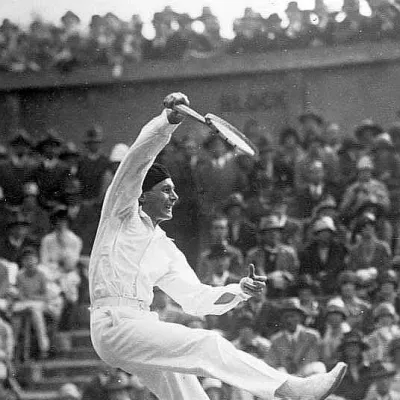
Jean Borotra
Human Design Chart
Biography
Died on 17 July 1994, Arbonne, France.
What does Manifestor 3/5 mean for Jean Borotra?
Manifestor 3/5 — Design at a Glance
Jean Borotra's design inclined towards visionary leadership and manifestor influence. As a Manifestor, he acted like an emperor in ancient Rome: He had the vision of a grand whole but did not lead battles himself; instead, he delegated execution to others. This configuration shapes a nature destined to guide the world into a new future by issuing instructions and setting processes in motion rather than personally executing every step.
This broad-minded approach inevitably polarized him. Because he often thought further ahead than his surroundings, he encountered extreme interest or rejection; some loved his big dreams and followed him, while others hated him precisely because of these visions. This misunderstanding formed a central pain point in his design.
To attract the right followers and minimize friction, it was crucial for Jean Borotra to inform others timely and accurately about his intentions. This strategy of informing served to reduce resistance and mobilize support before taking action. Living by this principle rewarded him with an inner sense of peace from his system. Acting against this design without informing or delegating led to persistent, deep-seated anger. His path thus involved making his visions effective through clear communication and utilizing the energy of others for implementation.
Emotional Authority
Jean Borotra's design inclined towards emotional fluctuation: His inner truth did not show in the first impulse but only after going through an emotional cycle. He was someone who recognized spontaneous reactions as unreliable and consciously delayed decisions to gain clarity.
This stance stemmed from his emotional authority. With his Emotional Center defined, he was subject to a constant wave of mood swings. The world appeared colored by the current emotion – sometimes enthusiastically, other times negatively. This momentary impression was merely a temporary coloring, not the deep truth. Quick, impulsive decisions based on this fleeting situation often had negative consequences.
The mechanics required patience: Jean Borotra needed to take time and sleep on his decisions. Only when intense feelings subsided and emotional distance emerged did calmness set in. This process was crucial for long-term life decisions. Emotional authority always took precedence over other defined centers in his design, regardless of further configurations. Only by enduring the cycle could he achieve the necessary inner security to act without being led astray by the current mood curve.
The 3/5 Profile — Martyr / Heretic
Jean Borotra's design set a clear path: radical self-responsibility through direct experience. As a 3/5 (Explorer/Hero), he believed nothing until he had tested it himself. Line 3 drove him to test connections and accept errors as an essential part of finding answers – an attitude often misunderstood as irresponsibility, but actually setting new priorities. These private experiments served not only him; they formed the raw material for his later role.
Line 5 transformed these individual experiences into collective wisdom. Jean Borotra then became attractive to his environment, which saw him as a hero or storyteller and wanted to learn from his practical knowledge. This projection by the collective flattered him but concealed deep vulnerability: failing in public was especially painful for him. His design required communicating personal insights so that they were accepted by the collective. He had to resist conforming to others' expectations and instead sell his own truth gained through trial and error. The tension between private failure during the learning phase and public success as a savior shaped his dynamics. His task was to turn personal setbacks into useful lessons for others without falling into the trap of collective conditioning.
Split Definition — Defined & Open Centers
Jean Borotra revealed himself as someone with a strong, constant inner structure. His design indicated a tendency towards powerful, independent willpower that consistently translated thoughts into action in the world. This consistency resulted from five defined centers: Ajna (mental conception), Throat (communication), Heart (willpower), Solar Plexus (emotional authority) and Root (stress management).
The defined Ajna Center ensured consistent, trustworthy thinking; he processed data and creativity in a constant manner. Linked with the defined Throat, he could reliably express these concepts. The also defined Heart Center gave him the strength to keep promises and control his ego as well as his resources autonomously. His emotional intelligence served as an inner authority: thanks to the defined Solar Plexus Center, he did not make decisions impulsively but waited patiently for the emotional wave until clarity emerged. The defined Root Center further ensured a consistent handling of stress and pressure.
At the same time, Jean Borotra remained open in four areas for inspiration (Head), identity finding through environment (G Center), variable energy levels (Sacral) and intuitive health signals (Spleen). These opennesses meant that he reacted situationally to his surroundings. He took inspirations, directions, energies, and well-being from the field around him rather than generating them himself. The challenge lay in not forcing his strong inner definition against these open centers. So he tended to let external conditioning influence him regarding energy or identity issues if he did not use his emotional clarity to choose the right moment for responding to impulses.
Channels for drive, clarity and emotional release.
Jean Borotra's design set a tension between material control and mutative, often misunderstood knowledge. He showed himself as someone who had to connect authority in financial matters with service to the tribe while waiting for the right timing for his innovative ideas. This dynamic shaped his life task: taking on material responsibility without losing the clarity of his unique thinking.
The money line 21-45 connected his Heart Center with the Throat Center through the Gate of the Hunter (21) and the Gate of the Gatherer (45). This created a driving force to take responsibility for resources – 'I have or I do not'. Jean Borotra had to learn to assert his will in such a way that he protected his own interests while serving others. Control and independence were key factors; he worked best as his own boss, following his natural rhythm. The challenge lay in not being controlled and at the same time securing the loyalty of the tribe through reliable engagement.
At the same time, structuring 23-43, which connected Ajna Center with Throat Center, was active. Through the Gate of Insight (43) and the Gate of Assimilation (23), he received spontaneous breakthroughs that he had to process and express. His thinking often felt light-years ahead. For this genius to be accepted, it needed strategy and inner authority. If he did not wait for the right timing, his unique knowledge was rarely understood or valued. He had to learn to let go of control and allow his mind to process its knowledge at its own pace before clearly communicating it.
Additionally, releasing emotions 39-55, which connected Root with Solar Plexus Center, was active. Through provocation (39) and the mind (55), he set the emotional wave in motion. Jean Borotra knew how to tease out the nature of the mind to find the right connection. His moodiness was not a weakness but a creative force. He learned to live authentically and accept his moods rather than rationalizing them away. Only when he was in the right mood could he inspire others with passion or probe deep truths.
Individual gates like the Gate of Formulation (4) supported him in developing logical processes for future security and clarifying suspicious patterns.
Individual Circuitry — Circuit Signature
Jean Borotra's design indicated a tendency towards two parallel, not directly connected energetic fields. Through Shared Definition, these forces existed side by side and required external validation for their integration.
One field formed the Knowledge Circuit. Here, the channel structuring (gates 43-23) connected Ajna Center with Throat Center, enabling clear articulation of thoughts. Parallel to this, the channel releasing emotions (gates 55-39) connected Solar Plexus Center with Root Center. This generated a pulsating, acoustic creativity and emotional wave movements that were not directly linked to intellectual structuring.
The second field was the Ego Circuit, part of the Tribe Group. Here, the money line (channel 45-21) connected Throat Center with Heart Center. This promoted cooperation and resource accumulation in the collective through reciprocal support. Since no Sacral Center was connected in this circuit, there was a lack of constant life force flow; rest pauses were therefore essential for regenerating resources.
The tension lay between the individual, innovative expression form of the Knowledge Circuit and the traditional, supportive function of the Ego Circuit. Jean Borotra showed himself as someone who had to bring these separate energies – pulsating individuality on one hand, timeless tribe cooperation on the other – together through external validation since there was no direct inner connection between the groups.
Right Angle Cross of Explanation 3
Jean Borotra's Human Design revealed a tendency towards radical clarity. He was someone who reduced complex issues to their essential elements and conveyed this essence transparently outward. This was not merely a rhetorical gesture but a deeply rooted mechanical need to see and represent things as they truly were—without embellishments or unnecessary complexity.
This attitude stemmed from the mechanics of what is called the "Right Cross of Manifestation." This configuration focuses on how a person communicates their inner truth or understanding of situations. The core lies in the ability to simplify: it's about filtering out noise and making pure information visible. For Jean Borotra, this meant that his actions and decisions always aimed at resolving misunderstandings through precision. He did not seek interpretations but rather the direct, unadulterated perspective.
His way of grasping the world was marked by a drive for transparency. He conveyed insights in such a manner that they became directly accessible to others. The mechanics of this cross underscore a natural gift for translating the hidden or complicated into clear, understandable structures. Jean Borotra lived this dynamic by clearly bringing out the essence of an issue. His design called upon him to act as a channel for clarity, helping things take their true name and form, free from subjective distortion or unnecessary decoration.
Saturn Return · Uranus Opposition · Chiron Return · 2nd Saturn Return — Life Cycles
Jean Borotra's life followed a clear rhythmic structure, marked by three major astrological cycles that represented pivotal turning points. Each of these phases corresponded to a specific success or liberation that shaped his design. The first Saturn return stood for the establishment of structure and recognition in a sporting context. This was evident in 1926 when he won at Wimbledon in singles and Forest Hills in mixed doubles at age 28. These successes condensed years of groundwork into a solid outcome.
The Uranus opposition cycle brought about an expansion of horizons and new partnerships. In 1936, at the age of 38, he celebrated another success in Paris in doubles alongside Marcel Bernard. This moment underscored the dynamics of new connections and openness to the outside world, typical for this phase of life's task.
Finally, the Chiron return cycle emerged as a fulfillment period during which his own incarnation cross unfolded increasingly. In 1945, at age 47, he was freed from an internment camp by American troops. This was not merely the end of a time of suffering but rather the moment when meaning and purpose became experiential – a bloom that pointed to living according to his strategy and authority. The three cycles thus formed not only sporting triumphs but also the deeper unfolding of his life's task.
Manifestor · Emotional Authority — Synthesis
Jean Borotra was a pioneer whose life was marked by profound inner dynamics. The combination of Manifestor design and emotional authority points to someone who had visions and wanted to bring them into the world but always had to filter them through his feelings. This interplay manifested in a strong will (defined Heart Center) coupled with an ability for deep self-reflection (emotional center). The thread running through his life seems to be that he did not act impulsively, but rather let things mature emotionally before communicating them outwardly (defined Throat Center). The connection between Ajna and Heart centers suggests a strong inner logic that was always attuned to feeling.
The central paradox in Jean Borotra's design lies in the tension between his manifesting impulse and his emotional wave. As a Manifestor, he had the urge to initiate things and set them in motion, yet his emotional authority required patience and waiting for clarity. This tension likely made him both a dynamic force that spurred change and someone who needed moments of pause and emotional processing. The open Sacral Center indicates a constant adaptation to external energies, enhancing his ability to move through different situations but also bringing a need for periods of rest.
3 Defined Channels
Incarnation Cross - Right Angle Cross of Explanation 3
Solar Return
The Solar Return shows the moment when the sun returns to its exact birth position - your personal solar year.
Life Cycles
Discover the life cycles with a detailed triple view (birth chart, cycle chart, composite).
Human Design Profile
- Type
- Manifestor
- Strategy
- To inform others before acting
- Authority
- Emotional Authority
- Profile
- 3/5 - Martyr / Heretic
- Definition
- Split Definition
- Incarnation Cross
- Right Angle Cross of Explanation 3
- Date of Birth
- 13.08.1898 17:00
- Place of Birth
- Biarritz, France
Frequently Asked Questions
What was Jean Borotra's Human Design type?
What profile did Jean Borotra have?
What authority did Jean Borotra possess?
What incarnation cross did Jean Borotra have?
When was Jean Borotra born?
Discover your own Human Design
Are you also a Manifestor? Find out in a personal reading how to use your initiation power peacefully and dissolve resistance.
More Personalities
Back to overviewAldair

Cafu

Christian-Jaque
Joelinton

Kaká

Kesha