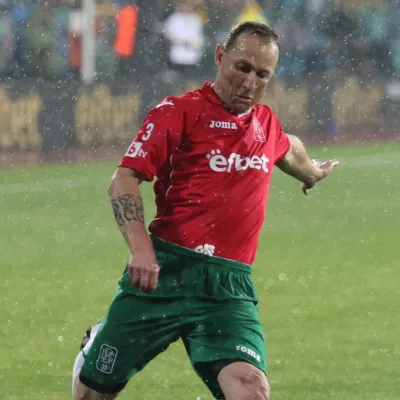
Jean-Pierre Papin
Human Design Chart
Biography
He experienced the peak of his career with Marseille, winning Ligue 1 titles in 1989, 1990, 1991 and 1992, the Coupe de France in 1989, and reached the final of the UEFA Champions League in 1991.
In 1992, he was transferred the highest in the history of football, when he left Marseille for AC Milan with whom he won Serie A in 1994 and the UEFA Champions League.
Capped 54 times, and captain 11 times, Papin played in the French team which reached the 1986 World Cup Semi final.
In May 2006, Papin took over as the new coach of Strasbourg. On 2 June 2020, Papin was announced as the new manager of Championnat National 2 side C'Chartres. He left his position in October 2022 to go back to Marseille as a technical advisor.
After his daughter, Emily, was diagnosed with cerebral palsy as an infant, Papin started running the Neuf de cœur (Nine of Hearts) foundation, which provides support to families affected by the neurological disorder.
Jean-Pierre Papin — Generator with Profile 5/2
Generator 5/2 — Design at a Glance
Jean-Pierre Papin displayed a basic attitude of endurance and strength, comparable to a workhorse that unleashes its immense energy only when it is passionate about the task. His design suggested that he was most effective not through self-initiated action but by responding to impulses from his environment. This Generator mechanism means that sacral energy becomes free only when an external signal arrives and internal confirmation follows – a gut feeling of “yes.”
For Papin, the strategy was clear: waiting for life signals and then acting in response led to deep satisfaction and a sense of fulfillment. Conversely, two specific pitfalls loomed. First, wasting his strength on tasks that did not bring him joy could lead to long-term exhaustion. Second, holding back from his heart project even though he still had plenty of power left and wanted to continue working. If he acted against this design by initiating or blocking himself instead, frustration and energy deficiency were likely consequences. His success depended on applying his great endurance precisely where inner resonance met external opportunities.
Emotional Authority
Jean-Pierre Papin displayed a basic attitude of emotional patience: spontaneity was not an advantage but a risk at crucial crossroads. His design indicated that decisions only became viable after they had run the cycle of his internal waves. This resulted from his defined Emotional Authority, carried by the Solar Plexus Center.
In Human Design mechanics, this means: The Emotional Center generates a constant wave of up and down, coloring perception. What appears as an inspiring truth in one moment can be felt negatively in the next. Therefore, the first impulse is only a snapshot, not yet deep inner clarity. Quick action based on this initial feeling tended to lead Jean-Pierre Papin into misjudgments, as emotional heat clouded his vision.
The strategy of his design was to allow time. He had to let decisions “ripen,” sleep on them multiple times, and take his time. Only when the intense feelings subsided and emotional distance was gained did calmness set in. This process of distancing was essential for Jean-Pierre Papin to move from fleeting mood to true inner truth. Especially at long-term steps influencing life’s course, this patience was key to proper orientation.
The 5/2 Profile — Heretic / Hermit
Jean-Pierre Papin displayed a basic attitude that oscillated between the urge to withdraw and the need for visible leadership. His design as Hero/Natural Talent (5/2) suggested he first sharpened his gifts in isolation within his “cave” before they became effective. This Line 2 requires external confirmation; leadership skills do not unfold through self-initiated democratic processes but must be teased out from outside. Without this discovery, frustration and bitterness threatened as passive waiting for recognition alone failed.
Simultaneously, Gate 44 in Line 5 shaped his actions through unusual pattern recognition and manipulation to secure the tribe. Hierarchy was no obstacle but a necessity for material success and structure for him. The tension lay in using this integrative power to set boundaries while still making himself visible. Once he stepped onto the podium, his presence and clarity were appreciated. The key was active trust in this integrative power rather than waiting only for others’ choice. This allowed him to take on a leading role despite the need for alone time without bitterness as a lone wolf.
Triple Split Definition — Defined & Open Centers
Jean-Pierre Papin's Human Design reveals a tendency towards constant, powerful presence: A reliable identity and inner direction (defined G Center) paired with personal willpower and resource control (defined Heart). His vital energy was unleashed not through initiation but by reaction (defined Sacral), while emotional clarity only came after waiting for the wave to pass (defined Solar Plexus). This resulted in a consistent expression style (defined Throat) under specific stress pressure (defined Root).
In contrast, situational openness was evident: Without his own constant mental structure, he was receptive to external inspiration but tended towards confusion from foreign questions (open Head and Ajna Centers). Particularly noticeable was the vulnerability to external health frequencies; the open Spleen Center drew him to seemingly safe environments, making spontaneous decisions risky. Here, it was important not to impulsively act on fears but to maintain discipline in dealing with his own uncertainty.
This mechanism described a system based on inner constancy and reactive energy while the mind remained open for the moment – yet without getting lost in mental labyrinths or false safety signals. The challenge lay in not giving away one's power through mental overload or spontaneous reactions to external fears, but rather channeling it through patient waiting and clear responses.
Channels for focus, reflection and communal connection.
Jean-Pierre Papin exhibited a fundamental disposition characterized by permanent, calm tension focused on details and facts. This energy drove logic and perfectionism, holding still to keep distractions at bay while precisely assessing relevant aspects. The Channel of Concentration 52-9 connects the Root Center with the Sacral Center through the Gate of Non-action (52) and the Gate of Focusing (9). As a format-energy, this channel carries the qualities of all other channels in the Understanding Circuit. When guided by the reaction from the Sacral Center, this energy influenced his entire design to focus, challenge patterns, correct them, and perfect them.
Additionally, the Lost Son Channel 13-33 connected the G Center with the Throat Center. Through the Gate of Listeners (13), he gathered information and secrets while the Gate of Withdrawal (33) allowed him to withdraw to reflect on these experiences. This cyclical process of maturation ended with the ability to reflect all sides of an experience before sharing it. Patience was crucial here, as he waited for deeper truths to surface beneath the surface.
The Community Channel 37-40 connected the Solar Plexus Center with the Heart Center via the Gate of Friendship (37) and the Gate of Solitude (40). This involved building community through emotional clarity and fair agreements. He sought his place within the whole, willing to work to serve others but also needing reward and breaks. The connection within the group was guaranteed by willpower backing every agreement. A good deal could not be made spontaneously but had to be carefully considered over time so that it benefited both sides. This mechanism structured relationships based on respect and mutual benefit.
Collective Circuitry — Circuit Signature
Jean-Pierre Papin acted as a pure mirror medium for collective thematic fields. As a Triple Defined individual, he did not have his own constant expression in these areas; instead, he situatively absorbed and reflected energies from his environment. His interaction with logic, emotion, or tribal resources was purely reactive and context-dependent.
The Understanding Circuit concerned the connection between Sacral and Root Centers via the Channel of Concentration (Gates 9-52). This shaped a focused, emotionally detached ratio aimed at achieving future improvements through structure and intellect.
In the Meaning-Finding Circuit, he connected Throat and Identity Centers via the Lost Son Channel (Gates 33-13). Here it was about sharing emotional waves and experiences from the past to learn together – a cyclical process without logical linearity.
The Ego Circuit linked Heart and Solar Plexus Centers through the Community Channel (Gates 40-37). This regulated the relationship of giving and taking as well as mutual support within the tribe. As there was no connection to the Sacral Center, pauses for resource regeneration were essential.
Papin's design thus showed three separate, parallel existing forces: focused future shaping, emotional past reflection, and cooperative resource sharing – each as a mirror of what he found in his environment, not as an internal, fixed structure.
Left Angle Cross of Incarnation 2
Jean-Pierre Papin's Human Design reveals a tendency towards a profound, almost fateful connection with the collective consciousness. He lived not just for himself but was deeply influenced by a larger, often unwritten order. This attitude stems from the left side of the 2nd incarnation cross, an archetypal pattern in Human Design that aims to seek truth and meaning within the community.
This cross does not describe individual career planning or personal success in the narrower sense but rather a life plan focused on building bridges between the individual and the whole. It's about understanding patterns beyond oneself and having the ability to shape these insights into something accessible for others. For Jean-Pierre Papin, this meant that his path was less driven by personal ambition than an inner necessity to be part of a larger framework.
The mechanics of this design do not require external validation through titles or wealth but find fulfillment in the authenticity of one's being within the collective. It is a path of integration where the ego steps back for a deeper resonance with themes that move society. Jean-Pierre Papin thus became a mirror for these collective currents, without losing his own identity but embedding it into a larger context.
Saturn Return · Uranus Opposition · Chiron Return · 2nd Saturn Return — Life Cycles
Jean-Pierre Papin's design shows a clear developmental line from seeking external validation to inner autonomy. This process is structured by two central planetary cycles marking identity maturation and radical change. The first Saturn return, typically beginning around the 28th year of life, condenses years of groundwork into a solid result. Exactly in this phase, in 1991, Jean-Pierre Papin received the Ballon d’Or as Europe's Footballer of the Year. This success marks the completion of a stage where self-worth was still strongly oriented towards external recognition and performance.
Yet the design demands more: The Uranus opposition, entering around the 41st year of life, calls for breaking with established structures in favor of new freedom. It forces detachment from old role models, even if they were successful. In 2004, Jean-Pierre Papin took this step by switching to FC Bassin d’Arcachon as a player-coach. This career change was not a retreat but the practical implementation of required inner autonomy. Instead of staying in the high-performance sports structure he knew, he created a new self-determined role for himself. The mechanics here describe the transition from validation through others to definition by one's own being – a necessary step for the full development of personality.
Generator · Emotional Authority — Synthesis
Jean-Pierre Papin’s life seems marked by a deep-rooted drive to generate energy and turn it into concrete results (Sacral Energy), coupled with an inner need to validate this performance through emotional maturity (Emotional Authority). This combination of powerful drive and desire for emotional clarity runs clearly through his development – from focusing on details and formatting energy (Channel 52-9) to the ability to achieve outstanding success in decisive moments (Saturn Return in 1991). The Hero/Natural Talent Profile suggests that he seeks to apply his skills while also valuing autonomy and withdrawal.
A central paradox in his design lies in the tension between the need for recognition as a competent actor (Line 5) and the desire for inner freedom and solitude (Line 2). This is reflected in the interplay of Mind and Meaning circuits: on one hand, a logical, future-oriented focus on improvement and structure; on the other, a deep emotional perception that avoids quick decisions. The shift between the desire for public performance and the longing for private reflection shapes his lifestyle.
3 Defined Channels
Incarnation Cross - Left Angle Cross of Incarnation 2
Solar Return
The Solar Return shows the moment when the sun returns to its exact birth position - your personal solar year.
Life Cycles
Discover the life cycles with a detailed triple view (birth chart, cycle chart, composite).
Human Design Profile
- Type
- Generator
- Strategy
- To respond - wait for something to respond to
- Authority
- Emotional Authority
- Profile
- 5/2 - Heretic / Hermit
- Definition
- Triple Split
- Incarnation Cross
- Left Angle Cross of Incarnation 2
- Date of Birth
- 05.11.1963 10:18
- Place of Birth
- Boulogne sur Mer, France
Frequently Asked Questions
What is Jean-Pierre Papin's Human Design type?
What profile does Jean-Pierre Papin have?
What authority does Jean-Pierre Papin possess?
What is Jean-Pierre Papin's incarnation cross?
When was Jean-Pierre Papin born?
Discover your own Human Design
Are you also a Generator? Find out in a personal reading how to use your sacral energy correctly and discover deep satisfaction.
More Personalities
Back to overviewAaliyah

Aldair

Alexia

Angèle

Anne-Marie

Arcángel