
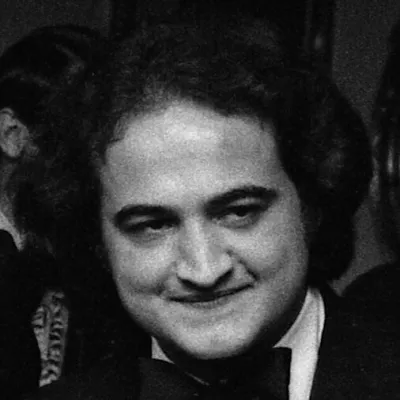
John Belushi
Human Design Chart
Biography
Born in Chicago to Albanian-American parents, Belushi started his own comedy troupe with Tino Insana and Steve Beshekas, called "The West Compass Trio". Bernard Sahlins recruited him for The Second City comedy club. Once there he met Aykroyd, Brian Doyle-Murray, and Harold Ramis. In 1975, Chevy Chase and Michael O'Donoghue recommended Belushi to Saturday Night Live creator and showrunner Lorne Michaels, who accepted him as a new cast member of the show after an audition. Belushi developed a series of characters on the show that reached great success, with an imitation of Henry Kissinger and a portrayal of Ludwig van Beethoven.
Belushi appeared in several films such as National Lampoon's Animal House, 1941, The Blues Brothers, and Neighbors. He also pursued interests in music: with Aykroyd, Lou Marini, Tom Malone, Steve Cropper, Donald "Duck" Dunn, and Paul Shaffer, he founded The Blues Brothers, which led to the film of the same name.
The Human Design of John Belushi: Generator 4/6
Generator 4/6 — Design at a Glance
John Belushi revealed himself as someone with immense energetic potential, comparable to an endurance horse created for stamina and strength. His Generator design had a lot of sacral energy that was only released through reacting to impulses from the environment rather than initiating on his own volition. This mechanism created clear tension: Only when he responded to life signals and affirmed his inner center with a clear 'yes' could he effectively utilize this energy.
If he acted against this principle – by doing things that did not resonate internally or by initiating instead of reacting – it inevitably led to frustration and energy depletion. The design warns here about two main pitfalls: wasting power on inappropriate tasks, which leads to burnout, or suppressing the urge to hold onto his heart project.
In harmony with his strategy of responding from the gut, John Belushi found deep satisfaction and fulfillment. His success depended on not forcing this sacral energy but letting it flow as a response to external stimuli. Thus, his high work potential transformed from a potential source of exhaustion into a sustainable power source for his life.
Emotional Authority
John Belushis design showed a tendency towards emotional wave movements that significantly influenced his decision-making process. He was someone whose inner truth did not lie in the immediate impulse but only emerged after emotions had subsided. This configuration describes the defined Solar Plexus Center as the carrier of his inner authority. In Human-Design, this emotional authority always takes precedence over all other defined centers regardless of additional chart features.
His perception was permanently colored by the current mood: total enthusiasm in one moment and deep skepticism towards the same thing in another. This first impression was only a snapshot, not yet his final truth. Spontaneous reactions from this fleeting emotion carried the risk of proving false or harmful.
Therefore, patience and temporal distance were required. John Belushi had to let decisions mature, often through multiple 'sleeping on it'. Only when intense emotions subsided and emotional distance was gained did clarity emerge. This process of delay served to avoid emotional distortions and ensure that long-term life decisions were based on a stable foundation rather than temporary whims.
The 4/6 Profile — Opportunist / Role Model
John Belushis design was characterized by a deep inner conflict between the heart's desire for belonging and the head-driven urge towards elitist distance. In the first thirty years of his life, Line 4, the Networker, dominated. This phase was marked by experimental social behavior; friendships and collective experiences were essential for him to recognize value. He sought adaptability in networks, with a fixation on social exchange.
With the activation of Line 6, this dynamic fundamentally changed. The focus shifted from shared interaction towards isolated wisdom-seeking and role-modeling. Here, Gate 28 came into play, demanding extreme risks and readiness for sacrifice to 'win at all costs' or gain glory. This created a rift: While his heart (Line 4) sought security in the collective, his head (Line 6) demanded boundary-crossing extremes and testing life's meaning.
This constellation led John Belushi to often oscillate between wanting to be part of a community and the impulse to distinguish himself through extreme performance or risks. Line 6 demands going beyond familiar boundaries, which stood in tension with the cautious, injury-averse nature of Line 4. His life revolved around negotiating this contradiction: How can one simultaneously be both network and solitary role model? This dynamic shaped his development from a sociable experimenter to a figure seeking profound, often risky significance.
Split Definition — Defined & Open Centers
John Belushi revealed himself as someone with immense, constant vitality and a fixed, reliable identity. His design pointed towards authentic communication that spoke directly from his personal direction and Higher Self. This configuration describes a person whose voice does not just repeat thoughts but manifests energy.
The mechanics define him through a defined Sacral Center as the guardian of a great power source that feels like a constant hum and requires activity. His inner authority lay in the Solar Plexus Center; he was designed to wait for the ebb and flow of the emotional wave before making decisions, since truth only reveals itself over time. Additionally, a defined Spleen Center supported his spontaneous intuition in the present as well as his survival consciousness. The G Center gave him a clear sense of love and direction while the Root Center provided the necessary pressure for material presence.
In contrast, Head, Ajna, and Heart Centers were open. This meant: no constant mental inspiration or conceptual clarity, nor a constant will to commit. John Belushi tended to avoid the need to prove his worth or make promises he could not keep. Instead of initiating, he reacted to life – his energy was only fully available when asked and his Sacral Center agreed. This openness protected him from getting entangled in other people's problems or mental compulsions that did not stem from his own authority.
Channels for intimacy, leadership, care and life purpose.
John Belushi revealed himself as someone who felt a strong urge for immediate, deep fusion with others while also carrying the need to take an influential, almost leading role within a group. His design created a dynamic tension between the impulsive desire for intimacy and the necessity of taking responsibility for the “tribe”.
This constellation is marked by four central channels. The Pairing Channel 59-6 connects the Sacral Center with the Solar Plexus and generates powerful energy from sexuality and emotional wave. This channel drives people into relationships that are personal, penetrating, and potentially fruitful. Emotional wave movement determines timing: it pulls or pushes, meaning true intimacy needs time to clarify. Without this patience, intensity can be misunderstood.
Simultaneously, the Alpha Channel 7-31 acts, connecting the G Center with the Throat Center. This is not an authoritarian lone-ruler design but a collective leadership style. John Belushi sought his own “pack” to influence through logical patterns and trust. He represented the group but could only lead successfully when invited by the majority.
The Preservation Channel 27-50 adds a layer of care. Through the Sacral Center and Spleen, an unselfish interest in others’ well-being arises. This aura attracts trust; people look up to him for support. It is a natural caregiver existence that requires one to first correctly take care of oneself (‘enlightened selfishness’) to nourish others.
Finally, the Life Struggle Channel 38-28 brings stubborn individualism into play. Linked with the Root Center and Spleen, it’s about finding one’s own meaning in life and fighting external forces that threaten this integrity. This channel drives one to go their own way, even if hard, and finds purpose precisely in these struggles.
In summary, a person emerges who creates closeness through his aura (Pairing/Preservation) but also has the need to structure and lead this environment (Alpha), while internally fighting a stubborn battle for his own identity (Life Struggle).
Tribal Circuitry — Circuit Signature
John Belushi revealed himself as someone whose energy did not flow constantly independently, but was activated by resonance with the environment. His design featured a Shared Definition: The groups of Solar Plexus, Sacral Center, Spleen and Root on one side, and G Center and Throat Center on the other formed two separate, parallel existing power fields. This structure meant that his identity and expression only fully came to life through exchange with others.
Within this framework, three specific circuits worked. The Knowledge Circuit connected his Spleen and Root Centers via Life Struggle Channel (28-38). This generated a pulsing, acoustic energy focused on individuality and transformation through deviation from the norm. It was about finding one’s own path.
The Understanding Circuit linked Throat and Identity Center via Alpha-Tier Channel (31-7). Here dominated a focused, visual energy of “emotionless ratio”. This mechanism served to develop logical strategies and structures to improve the future and share rational insights with others.
The Protector Circuit connected Sacral, Solar Plexus and Spleen Centers through Preservation Channels (27-50) and Pairing Channel (6-59). This configuration brought forth primordial instincts for protecting genetics and family. It dealt with timeless energies of nurturing, caring, and preserving, steered by tactile and olfactory senses as well as intense emotions. Together these three distinct segments shaped a profile that could only fully unfold strategic visions, individual expression, and instinctive protection in resonance with the environment.
Right Angle Cross of the Unexpected 4
John Belushi's design indicated a tendency towards unpredictable turns that fundamentally shaped his life path and energetic structure. This results from the constellation of the 'Right Cross of the Unexpected 4'. This specific architecture not only defines the fundamental existence framework but establishes the element of surprise as a central theme in his individual development and destiny.
In this context, John Belushi is seen as someone whose experience world was shaped by spontaneous, often unexpected events. The mechanics of this cross indicate that stability is achieved not through planning, but through the ability to deal with the unforeseen. This is a deeply rooted dynamic where the unexpected functions not as an interruption, but as a driving force. This structure influenced his way of being and interacting, creating a space in which the sudden and deviation from the norm determined everyday life. For John Belushi, this was not an optional characteristic, but the defining reality of his existence architecture, equipping his path through life with a specific unpredictability.
Saturn Return · Uranus Opposition · Chiron Return · 2nd Saturn Return — Life Cycles
John Belushi's design showed a tendency to anchor into a clear professional structure after a phase of experimental search. The first Saturn return cycle marks this transition from youthful exploration to established adult identity. In this life stage, the previously accumulated potential condenses and is transformed into a sustainable form. It is the time when individual strengths are solidified to create a stable basis for further development.
In 1975, at age 26, this mechanism became evident in John Belushi: He was recommended by Chevy Chase and Michael O’Donoghue and won an audition for Saturday Night Live, where he was accepted as a new ensemble member. This event illustrates the typical process of the first Saturn return. Years of groundwork and emerging competence culminated in concrete professional anchoring. Through this acceptance, the previous potential found a firm structure that enabled him to now contribute his skills within an established format. The cycle thus served to conclude the prior experimental phase and define a clear position from which he could act sustainably.
Generator · Emotional Authority — Synthesis
The central red thread in this design is a dynamic tension between deep engagement and the desire for freedom. A strongly defined Sacral Center signals immense work capacity and the necessity of being fulfilled through action – yet this energy must respond to external impulses, not initiate them. This is reinforced by the emotional center, which allows decisions only after an internal wave has ripened, describing a process of intense confrontation with oneself and the environment. The anchoring in the G Center gives this person a firm identity and direction, while open centers for definition allow the uptake of influences from the surroundings, which in turn shapes inner experience.
The central paradox lies in the combination of defined power and open receptivity. The energy of the Sacral Center pushes towards expression and action, while open centers require constant adaptation to external stimuli. This leads to an internal tension between the need to be authentic and true to oneself (G Center) and the ability to embrace others and integrate their energies. The defined Throat Channel ensures clear expression, which is continually reshaped by open perception.
4 Defined Channels
Incarnation Cross - Right Angle Cross of the Unexpected 4
Solar Return
The Solar Return shows the moment when the sun returns to its exact birth position - your personal solar year.
Life Cycles
Discover the life cycles with a detailed triple view (birth chart, cycle chart, composite).
Human Design Profile
- Type
- Generator
- Strategy
- To respond - wait for something to respond to
- Authority
- Emotional Authority
- Profile
- 4/6 - Opportunist / Role Model
- Definition
- Split Definition
- Incarnation Cross
- Right Angle Cross of the Unexpected 4
- Date of Birth
- 25.01.1949 05:12
- Place of Birth
- Chicago, Illinois, United States
Frequently Asked Questions
What is John Belushi's Human Design type?
What Profile does John Belushi have in Human Design?
What authority does John Belushi have?
What is John Belushi's incarnation cross?
When was John Belushi born?
Discover your own Human Design
Are you also a Generator? Find out in a personal reading how to use your sacral energy correctly and discover deep satisfaction.
More Personalities
Back to overviewSissy Spacek

Aaliyah

Alexia

Anémone

Angèle

Ann-Margret
