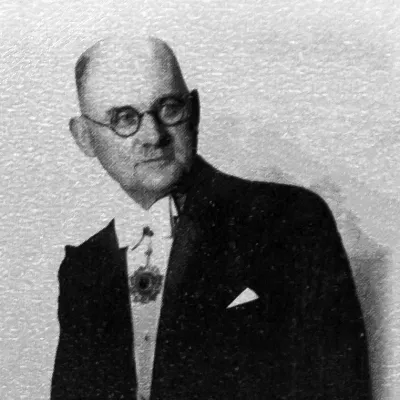
John Rabe
Human Design Chart
Biography
On 5 January 1950, Rabe died of a stroke. In 2005, Rabe's former residence in Nanking (as it then was called) was renovated and now accommodates the "John Rabe and International Safety Zone Memorial Hall", which opened in 2006. His war-time diaries were published in English as The Good German of Nanking (UK title) or The Good Man of Nanking (US title) (original German title: Der gute Deutsche von Nanking).
What does Manifesting Generator 2/4 mean for John Rabe?
Manifesting Generator 2/4 — Design at a Glance
John Rabe was revealed as a person with a hybrid energy configuration: He possessed the constant power of a Generator but also had the ability to quickly engage with the world. His design tended towards skipping steps and rapidly bringing things into life. This speediness was a double-edged sword. Often, he acted too quickly and skipped necessary intermediate steps, which later forced him to backtrack and fill in gaps. Such setbacks frequently led to frustration as they disturbed his inner satisfaction.
Furthermore, John Rabe had a tendency to pursue multiple projects simultaneously, driven by various impulses. If he did not wait for his internal signal – the clear “yes” from the Sacral Center – his creative enthusiasm quickly turned into overburdening himself. Therefore, his strategy was to react rather than initiate at first. Only when his inner self confirmed that something continued to bring him joy should he act. Under these conditions, he found deep satisfaction in doing things. Variety and a playful approach to his tasks were crucial; the compulsion to finish one thing strictly before another did not suit his nature. His success depended on maintaining this balance between quick implementation and internal resonance.
Emotional Authority
John Rabe exhibited an inner decision-making structure characterized by emotional wave movements. His inner authority was Emotional Authority, carried by the defined Emotional Center. In Human Design mechanics, this authority is prioritized: Once the Emotional Center is activated, it takes charge in decisions regardless of which other centers are also defined in his design.
This configuration meant for John Rabe that his perception was always colored by current mood swings; something could appear inspiring at one moment and negative the next. His immediate feeling only represented a provisional snapshot, not necessarily the final truth. Quick, spontaneous judgments from an emotional peak often proved misleading or disadvantageous.
The mechanics of his authority required patience and time. Instead of acting immediately, John Rabe had to let decisions mature ideally over several days. Only when initial emotional intensity subsided and clarity and calmness set in could he recognize his true inner direction. This process of “sleeping on it” was essential for gaining deep insights and making well-founded long-term life decisions. Through this delay, he gained the necessary distance to distinguish between transient excitement and lasting truth.
The 2/4 Profile — Hermit / Opportunist
John Rabe was revealed through Profile 2/4, which carried a constant tension between the need for solitude and the desire for community. His design suggested that he oscillated between these poles: Line 2 demanded withdrawal for internal clarification while Line 4 sought contact with familiar people. It was crucial for him to clearly communicate his needs – when he wanted company and when he needed to be left alone. During his “me-time,” he immersed himself in internal processes to gain peace and clarity. Only after satisfying this need did he emerge from his retreat to spend time with his favorite people. This phase allowed him to reflect on the knowledge of his network and develop new ideas from it. Line 2 brought selectivity and a natural momentum, which could also lead to isolation if impatience arose or focus was lost. Simultaneously, the fourth line of Gate 59 promoted deep friendships and non-sexual intimacy as a basis for connection. Through this configuration, John Rabe learned to consciously steer his energies: He used solitude for processing and exchanges with others for validation and sharing of insights. This rhythm of withdrawal and engagement helped him stay both internally stable and socially connected.
Single Definition — Defined & Open Centers
John Rabe's design combined mental intensity with physical endurance. His defined Head and Ajna centers created a constant internal pressure to question and form concepts. However, this mental flow was not directly action-oriented; it served to inspire others to think rather than implement solutions himself. The connection of this mental energy through his defined Throat Center allowed him to express his thoughts clearly and reliably when the right moment arrived.
At the same time, John Rabe had a defined Sacral center, making him a Generator. His strategy was not to initiate but to respond to questions or situations to access his vital energy. This combination of mental inspiration and sacral reactive power shaped his life path: he thought deeply, spoke clearly, and only acted with full force when prompted from the outside.
His open Heart center often made him feel that he did not naturally feel strong-willed. Instead of trusting inner authority, he tended to prove his worth by keeping promises – a route that led to frustration due to lacking constant energy for it. Additionally, his open Root center absorbed external stress and adrenaline from the environment. Rather than interpreting this pressure as his own and reacting hyperactively, it required him to distinguish between his own urging and external chaos to avoid exhaustion. This constellation described someone who shared mental clarity with others but protected his own actionability through patient waiting for the right reaction.
Channels for intuitive power, expressive strength and deep connection.
John Rabe's design was marked by a paradoxical tension: the ability to inspire others simply through presence and authentic living, paired with an intense, often stormy inner world. The Channel of Inspiration 1-8 connected his G Center with the Throat Center, allowing him to act as a living example. His impact did not come from explanations but from fully embodying his unique identity and thereby drawing attention. However, this required patience and protection against conditioning influences, as this channel did not offer automatic social adaptability.
Simultaneously, the Channel of Charisma 34-20 drove him with a powerful connection between Sacral and Throat Centers. Here, generative life force merged with the urge for immediate manifestation in the present moment. This energy enabled him to remain active over longer periods and achieve impressive feats if he waited for his inner sacral reaction. Without this guidance, however, the energy threatened to break out chaotically. The intuitive insight of the Brainwave Channel 57-20 supported this through spontaneous truths in the moment, while the Channel of Structuring 43-23 helped him translate complex mental breakthroughs into understandable concepts – provided he waited for the right timing.
In interpersonal relationships, the Channel of Union 59-6 served as a source of deep intimacy and emotional wave movement that needed time to find clarity. The Channel of Power 34-57 ensured his survival intelligence through constant vigilance and quick reactions to dangers. Mental confusion and the quest for meaning shaped him over the Channel of Abstraction 64-47, which transformed experiences into stories. Individual Gates like Gate 55 (emotional awakening), Gate 24 (mental renewal), and Gate 9 (detail work) rounded out this profile, determined by a mix of charismatic presence, intuitive sharpness, and the need for inner order.
Individual Circuitry — Circuit Signature
John Rabe was marked by a simple, coherent definition: all his defined centers formed a single, flowing energetic stream. This created in him a cohesive experience where thinking, feeling, and acting were not isolated but worked as an integrated whole.
This flow manifested through four circuits. The Knowledge Circuit connected Ajna, Throat, Identity, and Spleen Centers into one unit. Here, the flashes of creativity (Channel 20-57) merged with inspiring impulses (Channel 1-8) and structuring power (Channel 43-23). This allowed him to intuitively grasp new insights and express them structuredly. Parallel to this, the Meaning Circuit worked through Channel 64-47 between Head and Ajna Centers. It promoted the ability to recognize abstract patterns and interpret past experiences to draw logical conclusions for understanding.
Another aspect was the Protector Circuit, which connected Sacral with Solar Plexus Center via Channel 59-6. This gave him a primal, instinctive power for protection and preservation, driven by emotional waves and life energy. Complementing this, the Integration Circuit linked Throat, Sacral, and Spleen Centers. Through Channels 20-34 (Charisma) and 34-57 (Power), he could translate intuitive impulses into tangible, charismatic actions. This configuration fostered a direct, authentic presence where inner convictions were carried out immediately.
Right Angle Cross of the Sleeping Phoenix 4
John Rabe was marked by the right cross of the sleeping Phoenix 4. This configuration established a specific inner dynamics that manifested in his life path. The design connected a deep, almost mystical connection to one's essence with the ability to channel this energy purposefully. It was a rare structure aimed at translating spiritual or intuitive perceptions into tangible, graspable results. John Rabe did not merely flow with external circumstances but possessed an internal compass that helped him make moments of silence and waiting productive. The term 'sleeping Phoenix' points towards potential that is strengthened during quiet phases to emerge later with renewed vigor and clarity. For John Rabe, this meant he did not exhaust his energy through constant activity but rather charged it through deliberate pauses. This quality allowed him to maintain a calm aura in critical situations, stabilizing others around him. His design challenged him to trust the inner rhythm and not fight against the natural flow of things. The energy of this cross acted like a transformer: it absorbed raw, unshaped impulses and transformed them into structured actions. John Rabe utilized this ability to untangle complex situations and find solutions that were both practical and in harmony with his deepest values. His path was marked by this balance between passive absorption and active shaping, giving him a unique perspective on his tasks.
Saturn Return · Uranus Opposition · Chiron Return · 2nd Saturn Return — Life Cycles
John Rabes design was characterized by phases of structural consolidation where inner values were linked to external actions. In 1908, at the age of 26, he went to China. This marked his first Saturn return: a time when long-term life structures are solidified and professional directions set.
Later, a profound transformation phase occurred. The Chiron return around the age of 50 is in Human Design not a healing process of old wounds but an achievement cycle where personal meaning and incarnation cross should unfold – provided one follows their own strategy. In 1934, at the age of 52, John Rabe joined the NSDAP. This event fell into this phase of blooming and identity clarification, with political orientation appearing as part of a complex development stage.
The second Saturn return around the age of 56 brought further stabilization and deepening of established structures. In 1937, at the age of 55, he set up a protective zone for Chinese civilians. This step demonstrated the power of the second Saturn cycle: integrating earlier experiences into concrete, protective actions in public space. His design thus showed an evolution from initial structuring through a phase of identity clarification to mature and responsible implementation of his life mission.
Manifesting Generator · Emotional Authority — Synthesis
John Rabe lived a path marked by an internal tension between the drive for independent shaping and the need for connection. As a Manifesting Generator (MG) with defined sacral energy, his design pointed towards someone who could quickly set things in motion but was also dependent on the inner authority of the emotional center – a constant weighing between impulsive action and mature decision-making. The profile as a natural talent and networker amplified this dynamic: withdrawal into internal processes (Line 2) alternated with the need to nurture relationships and contribute to the community (Line 4).
A central paradox lay in his ability to generate inspiration and new perspectives through the defined head channel (Channel 1-8), while also being subject to emotional waves. This capacity to transform knowledge and initiate changes seemed to go hand-in-hand with phases of inner confusion and doubt – a tension that manifested during key moments, such as the start of a new career (26 years) or joining an organization (52 years), followed by later success in creating protection for others (55 years).
7 Defined Channels
Incarnation Cross - Right Angle Cross of the Sleeping Phoenix 4
Solar Return
The Solar Return shows the moment when the sun returns to its exact birth position - your personal solar year.
Life Cycles
Discover the life cycles with a detailed triple view (birth chart, cycle chart, composite).
Human Design Profile
- Strategy
- To respond - wait for something to respond to
- Authority
- Emotional Authority
- Profile
- 2/4 - Hermit / Opportunist
- Definition
- Single Definition
- Incarnation Cross
- Right Angle Cross of the Sleeping Phoenix 4
- Date of Birth
- 23.11.1882 06:30
- Place of Birth
- Hamburg, GER
Frequently Asked Questions
What is John Rabe's Human Design type?
What Profile did John Rabe have in Human Design?
What Authority did John Rabe have?
What incarnation cross did John Rabe have?
When was John Rabe born?
Discover your own Human Design
Are you also a Manifesting Generator? Find out in a personal reading how to unfold your multi-talents and direct your energy wisely.
More Personalities
Back to overviewAldair

Alizée

Angeli

Arletty

Artus

Balthus