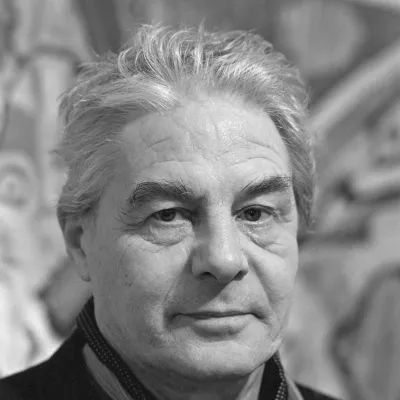
Photo: Wikimedia Commons
John Updike
Human Design Chart
Biography
Updike was born in a small town in Pennsylvania, which he later used as a model for the fictional towns in his books. He suffered from psoriasis and stammered as a child, so his parents, Wesley Russell and Linda Grace, encouraged him to write. His maternal grandparents lived with the family, and in 1945, they all moved to the farmhouse where his mother had been born. It was an isolated place, and he dreamed of escaping while immersing himself in books. He read nothing by "dead" authors, however, saying they depressed him. After graduating from high school as class president and co-valedictorian, he entered Harvard University on a scholarship. He chose the school primarily because it had the "Harvard Lampoon," and he began drawing and writing for the magazine. He graduated summa cum laude in 1954, and soon thereafter, sold his first short story, "Friends from Philadelphia," to "The New Yorker." That summer, he traveled to England on a Knox Fellowship and enrolled in the Ruskin School of Drawing and Fine Art at Oxford where he spent 1954-55.
On his return to the United States in 1955, he joined the staff of "The New Yorker" where for the next two years he wrote editorials, stories, poetry and criticism. In 1957, he became a full-time writer and moved to Ipswich, Massachusetts where he stayed for 17 years. His first book of poetry, "The Carpentered Hen and Other Tame Creatures," was published in 1958, and his first novel, "The Poorhouse Fair," was released in 1959. His "Rabbit" series was one of his most popular, and in 2000, he included a novella called "Rabbit Remembered" as part of "Licks of Love," a collection of short stories.
On 26 June 1953, Updike married Mary E.
John Updike as a Manifestor 6/2 in Human Design
Manifestor 6/2 — Design at a Glance
John Updike appeared as a pioneer and visionary whose design predisposed him to steer the world in new directions. His Human Design type was Manifestor, a configuration often compared to that of an emperor in ancient Rome: He had the great vision for the empire but did not lead the necessary wars himself; instead, he sent others out to conquer foreign lands on his behalf. This structure brought with it a specific challenge: Since his thinking often surpassed that of his environment, he was frequently misunderstood and polarized strongly. Some people loved his big dreams and followed him because of them; others rejected or even hated him precisely because of these visions. To find the right followers, it was crucial for him to inform others in good time and accurately about his plans. This formed the ideal strategy for his type. If John Updike followed this strategy and trusted his inner authority, he was rewarded with a feeling of inner peace. If he lived against his design, however, he likely felt an enduring, deep-seated anger within himself. His path was thus marked by the tension between his leading vision and the necessity to communicate it clearly in order to reduce resistance and gain support.
Ego Authority
John Updike's design established a rare inner authority: the authority of the ego. This configuration only appeared because his emotional center, sacral center, and spleen center were open while the ego center was defined. His truth did not lie in mental deliberations or physical impulses but rather in his will, which revealed itself through speech. He had to learn to listen to what came out spontaneously and unfiltered from him instead of questioning his mind, which always served the interests of others or his open centers.
What he pursued with enthusiasm gave him the necessary strength of will to achieve goals and keep promises. This consistent adherence to his own will could often appear selfish outwardly but was essential for him to remain authentic. His drive encompassed both a desire for material success and the urge to transcend limits and challenge himself in extraordinary ways, potentially leading others into new directions.
A central mechanism of his design was the need for pauses. Working continuously without breaks did not lead to the desired results but rather resulted in unhealthy exhaustion and illness. Only through temporary rest after achieved goals could he maintain his energy and fulfill his promises sustainably. His openness made him vulnerable to distractions, yet the clear orientation of his ego center provided the compass to focus on what truly mattered to him.
The 6/2 Profile — Role Model / Hermit
John Updike's design was characterized by a clear two-phase development. In his youth, the experimental side of the 6/2 line dominated: he sought truth through trial and error, withdrew after mistakes, and gathered diverse life experiences without rigid goals. This early phase was marked by the necessity to forge his own path and learn from failures.
After turning thirty, this dynamic fundamentally changed. The sixth line became active, initiating a period of intense reflection. John Updike mentally retreated into a metaphorical 'cave' to look back on his previous experiments with distance. This time served for healing and deep self-knowledge. The second line promoted independence through isolation; he protected his mental activity from external influences by withdrawing.
From this phase of seclusion emerged eventually a wise stance. John Updike appeared as someone who not only survived crises but used them as corrective mechanisms to find a higher form of justice and freedom from expectations. His wisdom was based on the appreciation of experience for its own sake, not merely as a means to an end. Others could benefit from his deep introspection brought about by his time of distance. Thus, his design showed the path from the impetuous experimentation of the young adult to the calm, introspective authority of the mature man who preserved and deepened his independence through purposeful moments of withdrawal.
Split Definition — Defined & Open Centers
John Updike's Human Design profile shows a tendency towards constant mental pressure to ask questions and form concepts. His defined Head and Ajna Centers created a perpetual inner impulse to think; he was always engaged in a mental process. This energy flowed through his defined Throat Center, which served as a pivot point to transform these thoughts into communication and action. Additionally, his defined G and Heart Centers shaped a firm self-identity and available willpower, allowing him to keep promises and follow his own path with clarity.
At the same time, John Updike was vulnerable to external influences through open centers. His open Sacral Center made him sensitive to the energy of others; he tended to overextend himself on "borrowed" energy and had difficulty setting boundaries around the availability of life force. The open Solar Plexus Center caused him to absorb and amplify emotions from his surroundings, leading to identifying foreign moods as his own or avoiding confrontations to not provoke emotional waves. His open Spleen Center carried a fundamental survival fear; he tended to cling to things that gave him a false sense of security rather than trusting spontaneous impulses. Finally, his open Root Center absorbed external stress, putting him into a cycle of taking on pressure and trying to release it through activity, even though this pressure did not align with his own design.
Channels for presence, clarity and selfless devotion.
John Updike's Human Design profile inclined him towards a deep, often isolated self-observation, coupled with the urge to capture sudden inner truths in language. This stance resulted from the connection between his G Center and Throat Center through Channel of Awakening 10-20. This channel linked Gate of Appearance (10) with Gate of Now (20), meaning that his survival and self-affirmation depended on showing himself authentically at every moment. He lived in a constant state of awakening, being seen by others while transforming his individual knowledge into proper action. His presence was a quiet authority; simply being himself inspired others to be themselves, often without him intending or knowing it.
Parallel to this, there was a mind that did not seek logical patterns but waited for spontaneous inspiration. Channel of Awareness 61-24 connected the Head Center with the Ajna Center through Gate of Secrets (61) and Gate of Rationalizing (24). His thinking was uncontrollable; it dealt with mutations and satori moments. The pressure to know the unknown transformed into rational answers as soon as inspiration from the "white noise" of Gate 61 produced a new thought. He had to surrender to this happy coincidence of inner truth and knew that knowledge could only come at his own pace.
Another imprint came from Channel of Initiation 51-25, which connected the Heart Center through Gate of Shock (51) and Gate of Self Spirit (25). Here competitive ego energy met universal love. His design challenged him to master individualization as an art. He often awakened competitiveness in others, but true initiation had to find him; it could not be sought. Through authentic living, he survived these mystical shocks and became an example for others who dared to leap into the unknown.
Additionally, Gates like Crisis 36, which releases emotional energy through cyclical movements, and Conflict 6, which enables growth, played roles. Gate 15 brought collective logic, while Gate 40 steered the balance between hard work and the expectation of rest as a reward. These configurations created a person who was captivated by the silence of himself but exercised a quiet, transformative effect on his environment through his mere existence and ability to withstand the shock of individualization.
Individual Circuitry — Circuit Signature
John Updike's Human Design profile indicates a tendency towards inner stability and individual identity. As someone with Split Definition, he had two energetically separate blocks that did not directly flow into each other but rather worked as parallel forces: One block connected the G Center, Throat Center, and Heart Center; the other linked Head Center and Ajna Center.
The Mental Circuit operated through the Channel of Awareness (24-61). This channel connects Updike's Head Center with his Ajna Center, fostering innovative flashes of insight. The energy of this circuit revolves around acquiring new knowledge and expressing unique identity.
In the Authority Circuit, he activated the Channel of Initiation (25-51). This channel links Identity Center with Heart Center. This configuration promotes resolute, courageous personalities with strong convictions. However, without a connection to Throat Center, these firm inner stances often could not be well expressed outwardly. The energy was individualistic and less oriented towards the outside world.
The Manifestation Circuit operated through the Channel of Awakening (20-10). This channel connects Throat Center with Identity Center. Here it is about directing power through proper behavior to make an impact in the present moment, ensuring personal survival by translating intuitive impulses into concrete expressions.
This combination of circuits shaped John Updike as someone who possessed innovative ideas (Head-Ajna) but filtered them through a strong yet often difficult-to-articulate inner identity (Heart-Identity) and direct, action-oriented expressions (Throat-Identity). The separate groups meant that intellectual inspiration (Head-Ajna) acted energetically independently of the emotional and identity-forming power (G-Heart-Throat).
Left Angle Cross of the Plane 1
John Updikes Human-Design legt eine Neigung zu einer tiefen, oft unausgesprochenen Verbindung zum Physischen und zur materiellen Realität fest. Diese Konfiguration, bekannt als das linke Kreuz der Ebene 1, prägt seine Grundhaltung: Er sucht nach dem Sinn des Lebens nicht in abstrakten Ideen oder spirituellen Höhenflügen, sondern im konkreten Erleben des Hier und Jetzt. Für ihn ist die Welt ein Ort, den es mit allen Sinnen zu erfassen gilt – durch Berührung, Geschmack, Geruch und das unmittelbare Erfahren von Freude oder Leid.
Diese Mechanik bedeutet, dass seine Energie darauf ausgerichtet war, die Schöpfung in ihrer physischen Form anzunehmen und zu genießen. Es ging ihm nicht darum, über das Leben nachzudenken, sondern es zu leben, so intensiv wie möglich. Seine Autorität, also sein innerer Kompass, sprach oft durch diese sinnliche Erfahrung. Wenn er Entscheidungen traf oder Handlungen einleitete, orientierte er sich daran, was sich in der materiellen Welt als wahr und befriedigend anfühlte.
Dieses Kreuz verleiht eine besondere Fähigkeit, die Schönheit im Alltäglichen zu erkennen und zu schätzen. John Updike zeigte sich als jemand, der den Wert des Lebens in seiner konkreten Existenz sah. Er war nicht interessiert an metaphysischen Spekulationen, sondern daran, wie man das Leben bestmöglich gestalten kann, indem man die Gaben der physischen Welt annimmt. Diese Haltung prägte seine gesamte Ausrichtung: ein tiefes Vertrauen in die materielle Schöpfung und der Wunsch, sie voll auszuschöpfen, ohne sich von ihr abzuwenden oder zu idealisieren. Sein Weg war geprägt durch diese bodenständige, sinnliche Annahme der Realität.
Saturn Return · Uranus Opposition · Chiron Return · 2nd Saturn Return — Life Cycles
John Updikes Human-Design zeichnet sich durch einen klaren Rhythmus der Reifung aus, in dem innere Struktur und äußere Anerkennung eng verknüpft waren. 1960, im Alter von 28 Jahren, erschien sein Roman „Rabbit, Run“ – ein Erfolg, der den ersten Saturn-Return markierte. Dieser Zyklus verdichtete jahrelange Vorarbeit zu einem tragfähigen Ergebnis, das seine kreative Substanz festigte.
Zehn Jahre später, 1971 mit 39 Jahren, veröffentlichte er „Rabbit Redux“. Dies fiel in die Uranus-Opposition, eine Phase der Umbrüche und neuen Perspektiven. Statt nur zu brechen, nutzte John Updike diese Energie zur Karriere-Neuorientierung; er passte sich den veränderten äußeren Bedingungen an, ohne seine innere Linie zu verlieren.
Der Höhepunkt dieser Entwicklung zeigte sich 1982 mit dem Chiron-Return. Mit 50 Jahren erhielt er für „Better Angels“ den Pulitzer-Preis. Dieser Erfüllungszyklus bestätigte nicht etwa eine Heilung alter Wunden, sondern die Blüte seines Inkarnationszwecks. Die langjährige Arbeit gemäß seiner Strategie gipfelte in dieser Anerkennung; Sinn und Zweck wurden erfahrbar. John Updikes Weg demonstrierte, wie strukturelle Zyklen – von der Verfestigung über den Wandel bis zur Erfüllung – eine kohärente Lebenslinie bilden können, wenn sie nicht als isolierte Ereignisse, sondern als Teile eines Ganzen erlebt werden.
Manifestor · Ego Authority — Synthesis
John Updike war ein Generator, dessen Leben von einem tiefgreifenden Drang nach Erkundung und dem Ausdruck individueller Wahrheit geprägt war. Das definierte Egozentrum (Autorität im Kopf-Zentrum) in Verbindung mit der offenen Emotionalität und dem Sakralzentrum deutet auf einen Menschen hin, der seine innere Stimme hörte – eine Stimme, die jedoch durch die Offenheit für äußere Einflüsse moduliert wurde. Dieser Prozess des inneren Abwägens und anschließenden spontanen Äußerns prägte seinen kreativen Output, der oft von einem scharfen Blick auf das menschliche Erleben und dessen Widersprüche zeugte. Die 6/2 Profil-Linie verstärkte diesen Zyklus aus Erfahrung sammeln, reflektieren und schließlich als Vorbild zu wirken, wobei die frühen Jahre durch Experimentierfreude und spätere Phasen durch eine tiefere Weisheit gekennzeichnet waren.
Ein zentrales Paradox in seinem Design lag in der Spannung zwischen dem manifestierenden Impuls (als Manifestor) und der Notwendigkeit, seine Entscheidungen aus dem Kopf-Zentrum heraus zu filtern. Er war dazu bestimmt, anzuregen und Veränderungen einzuleiten (Kanal des Erwachens), doch die Offenheit für äußere Einflüsse forderte ihn stets heraus, zwischen authentischem Ausdruck und den Erwartungen anderer zu unterscheiden. Dies führte zu einer inneren Dynamik aus kreativem Drang und dem Bedürfnis nach Selbstbestätigung, die sich in seinen Werken widerspiegelte und ihm sowohl Anerkennung als auch Missverständnisse einbrachte – insbesondere in Schlüsselmomenten seiner Karriere (belegte Ereignisse um 1960, 1971, 1982).
3 Defined Channels
Incarnation Cross - Left Angle Cross of the Plane 1
Solar Return
The Solar Return shows the moment when the sun returns to its exact birth position - your personal solar year.
Life Cycles
Discover the life cycles with a detailed triple view (birth chart, cycle chart, composite).
Human Design Profile
- Type
- Manifestor
- Strategy
- To inform others before acting
- Authority
- Ego Authority
- Profile
- 6/2 - Role Model / Hermit
- Definition
- Split Definition
- Incarnation Cross
- Left Angle Cross of the Plane 1
- Date of Birth
- 18.03.1932 15:45
- Place of Birth
- West Reading, PA, United States
Frequently Asked Questions
What was John Updike's Human Design type?
What profile did John Updike have?
What authority did John Updike have?
What incarnation cross did John Updike have?
When was John Updike born?
Discover your own Human Design
Are you also a Manifestor? Find out in a personal reading how to use your initiation power peacefully and dissolve resistance.
More Personalities
Back to overviewAlain-Fournier
Angeli
Christian-Jaque
Juninho

Kesha

Lucebert