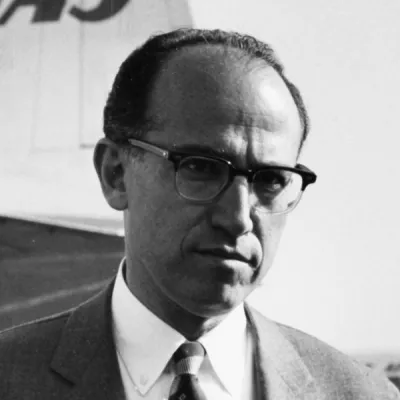
Jonas Salk
Human Design Chart
Biography
In 1947, Salk accepted a professorship at the University of Pittsburgh School of Medicine, where he undertook a project beginning in 1948 to determine the number of different types of poliovirus. For the next seven years, Salk devoted himself to developing a vaccine against polio.
Salk was immediately hailed as a "miracle worker" when the vaccine's success was first made public in April 1955, and chose to not patent the vaccine or seek any profit from it in order to maximize its global distribution. The National Foundation for Infantile Paralysis and the University of Pittsburgh looked into patenting the vaccine, but since Salk's techniques were not novel, their patent attorney said, "If there were any patentable novelty to be found in this phase it would lie within an extremely narrow scope and would be of doubtful value." An immediate rush to vaccinate began in the United States and around the world. Many countries began polio immunization campaigns using Salk's vaccine, including Canada, Sweden, Denmark, Norway, West Germany, the Netherlands, Switzerland, and Belgium. By 1959, the Salk vaccine had reached about 90 countries.
Human Design Analysis: Jonas Salk as Projector 3/5
Projector 3/5 — Design at a Glance
Jonas Salk's design featured a tendency towards focused perception. As a Projector, he did not have a constant, intrinsic source of life energy but worked in phases of high intensity, followed by necessary rest periods to avoid exhaustion. His undefined Sacral Center meant that he did not generate energy himself but rather absorbed and channeled it from his surroundings.
His aura acted like a bright flashlight, directing itself precisely at weaknesses in other people's systems or structures. Salk demonstrated the ability to immediately recognize errors or inefficient processes. However, directly addressing these deficiencies would have provoked resistance, as the other person would feel vulnerable. Instead, he was most effective through his own harmony and competence, which naturally drew others to him.
His strategy involved waiting for an honest invitation before taking on his role of imparting knowledge or leadership. Without this recognition from his environment, he risked frustration and a sense of bitterness. Living by this pattern, he was rewarded with success. His influence did not rely on constant action but on the precise identification of what was hidden in the dark and the provision of clarity when asked to do so.
Emotional Authority
Jonas Salk's inner authority lay in his defined Emotional Center. This configuration fundamentally determined his decision-making: He was subject to a natural wave of emotional ups and downs. His perception of the world was always colored by his current mood; what seemed inspiring in one moment could be felt as negative in the next. For his design, however, this immediate emotional reaction was only a snapshot, not yet the final truth. Quick, spontaneous decisions that arose directly from such a fleeting emotion carried the risk of having negative consequences.
The mechanics of his emotional authority required patience. The more time he took to let a decision mature, the deeper and more comprehensive he could understand the situation. This meant that he had to consciously hesitate and rethink decisions multiple times. By waiting and repeatedly "sleeping on" a question, the intense feelings gradually subsided. Only then did he gain the necessary emotional distance, leading to clarity and calm. This process was essential for long-term decisions that significantly influenced his life course. Only through this temporal distancing did he arrive at a well-founded, stable insight that went beyond the first, often misleading impression.
The 3/5 Profile — Martyr / Heretic
Jonas Salk's design laid a tendency towards experimental action based on practical experience. As a person with the Profile 3/5, the Experimenter and Hero, he initially believed little in predetermined truths. Instead, he sought to gain knowledge through his own experimentation. This Line 3 pushed him to take risks and learn through his own trials, including mistakes. The accumulated knowledge later served him to solve other people's problems, which activated the role of Line 5, the Hero.
His way of taking risks was shaped by Gate 28. Here, an adventurous spirit was tempered over time by reason and rational deliberation. He learned to be more selective with dangers and to clearly recognize personal goals. At the same time, Gate 31, which belongs to Line 5, was active. This led others to project leadership qualities onto him, even though he did not have a strong desire for power. The question of why he should lead at all often remained present. His attractiveness to others arose from the rich treasure of practical life experiences he presented. Failing in public could be painful, as the Hero role raised high expectations. His path involved learning from his own experiments and using these insights to lead the collective when called upon.
Split Definition — Defined & Open Centers
Jonas Salk's Human Design profile indicated a tendency towards constant mental pressure to question and understand. This energy came from his defined Head and Ajna Centers, creating a constant, specific mental awareness. He was not designed to force these thoughts directly into the world, as he lacked the direct energy to do so; instead, he inspired others through his concepts. Simultaneously, he had a defined Heart Center, which gave him a clear will and the need to determine his own life and keep promises. His inner authority lay in his defined Solar Plexus Center, meaning he did not make decisions immediately but waited for an emotional wave to gain clarity.
This stable inner core contrasted with his open Centers. His open Throat Center made him vulnerable to the pressure to demand attention or speak constantly to be heard. His open G Center meant that he did not carry a fixed identity or direction but rather took it from the environment; he tended to question who he was or what direction was correct. Additionally, his open Sacral Center made him receptive to the energy of others, potentially leading him to overwork rather than listen to his own energy flow. His open Spleen Center also absorbed fears of survival or health concerns from the environment, while his open Root Center amplified external stress. Salk's challenge was to resist these external pressures and trust his inner emotional clarity and willpower.
Channels for community, abstraction and mental clarity.
Jonas Salk's Human Design profile indicated a tendency towards deep mental reflection and the building of sustainable community structures. He was someone who filtered experiences through a kaleidoscope of possible connections to weave a coherent narrative. This attitude came from the Abstraction Channel 64-47, connecting the Head Center with the Ajna Center. This configuration generated an active, experience-based mind constantly seeking the meaning behind events. Clarity did not arise immediately but gradually condensed over time until an inspiring perspective emerged, which could then be shared.
Parallel to this, the Community Channel 37-40 shaped his social interactions. It connected the Solar Plexus Center with the Heart Center, conveying the tension between the need for belonging and the will to provide. For Jonas Salk, this meant that successful connections did not arise spontaneously but through careful, mutually beneficial agreements. He sought his place in the whole and understood that true loyalty rested on the principle of 'I do this for you if you do this for me.' Here, it was not about hierarchy but a horizontal structure where everyone contributed their part.
Additionally, specific Gates played roles in his design. Gate 28 brought the ability to hear and decide on risks in the here and now. Gate 27 added a caring, altruistic warmth to all activities, directed beyond the family to the clan. Gate 31 enabled the transfer of leadership to others, while Gate 41 propelled emotional evolution through crises and changes. Gate 55 contributed to emotional awareness and mood swings, and Gate 43 allowed spontaneous insights that he clearly communicated to others to find recognition. This combination created a profile that united intellectual depth with practical care and social integration.
Collective Circuitry — Circuit Signature
Jonas Salk's Human Design profile indicated a tendency towards abstract meaning-making and cooperative resource formation. Through the Meaning Maker Circuit, he connected the Head Center with the Ajna Center. This created a cyclical, visual way of thinking that reflected past experiences to recognize hidden connections and share these insights emotionally.
Parallel to this, the Ego Circuit operated through the channel between Heart and Solar Plexus Centers. This connection promoted a balance of giving and taking as well as mutual support. Since this circuit did not connect to the Sacral Center, there was no constant life force; instead, community resource formation required necessary pauses.
Jonas Salk had a Shared Definition. The defined Centers formed two separate groups: on one side, Head and Ajna, on the other, Heart and Solar Plexus. There was no direct energetic connection between these two groups. Thus, the abstract, meaning-making intelligence and the cooperative, resource-oriented power existed as parallel, independent forces. They did not act as a continuous flow but as separate areas, each maintaining its own dynamics – reflective understanding of the past and traditional togetherness – without directly influencing each other.
Right Angle Cross of the Unexpected 3
Jonas Salk's design indicated a tendency towards unpredictable turning points, often manifesting as sudden insights or unexpected challenges. This configuration, known as the right cross of the Unexpected 3, shaped his life through spontaneous changes that had profound impacts on his development. Such moments did not appear as random events but as part of a larger dynamic that prompted him to adapt flexibly to new situations.
The mechanics of this cross describe a life energy characterized by surprising reversals. It was not chaotic disruption but structured impulses that prompted Jonas Salk to question existing patterns and explore alternative paths. This ability to handle the unexpected was central to his personal and professional orientation.
Without specific events in the raw content, the description remains limited to this fundamental dynamic. Jonas Salk demonstrated the ability to adapt to sudden changes and gain new perspectives from them. This trait was not coincidental but a key component of his design, significantly influencing how he experienced and shaped the world.
Saturn Return · Uranus Opposition · Chiron Return · 2nd Saturn Return — Life Cycles
Jonas Salk's design indicated a tendency towards structured life phases where personal bonds and professional milestones were intricately intertwined. The first Saturn return often marked the crystallization of years of groundwork into tangible results. In 1939, at age 25, Salk married Donna Lindsay and earned his medical doctorate. This dual achievement of relationship and academic validation showed how his chart linked private stability with public recognition.
Later, the Uranus opposition acted as a catalyst for unexpected recognition. In 1955, at age 41, he received the Pennsylvania State Medal of Merit. This success did not come as a gradual accumulation but as a sudden confirmation of his previous work, typical of the disruptive yet affirming energy of this planetary phase.
The Chiron return, a cycle of fulfillment and bloom where the life purpose becomes palpable, culminated in 1962. At age 48, Salk received the Robert Koch Prize. This was not a moment of healing old wounds but the visible unfolding of his incarnation cross: his work was recognized as meaningful at the highest level.
The second Saturn return brought renewed structure and new bonds. In 1970, at age 56, Salk married Françoise Gilot. Again, the pattern was evident: a new life phase did not begin through rupture but through the establishment of a new, stable foundation that supported his further development. His life stations thus followed a clear rhythmic logic of anchoring, recognition, and fulfillment.
Projector · Emotional Authority — Synthesis
He was a projector, constantly inspired by the defined connection between Head and Ajna Centers (mental pressure) to recognize patterns and ask questions. This ability to see the potential and weaknesses in systems shaped his approach and led him to focus on areas where he could make a difference. His profile as an experimenter/hero and rescuer (3/5) suggests that he learned through experimentation and then made this knowledge available to others – a process enhanced by the emotional authority, which required a thorough engagement with his feelings and their maturation.
A central paradox lay in how he shared his insights. As a projector, he had the gift of uncovering flaws, yet his emotional center required careful consideration to avoid being perceived as intrusive. The recurring events that accompanied his cycles – both personal relationships and professional successes – showed that he continually oscillated between the need for connection and the desire for independent exploration, a dynamic balance that characterized his life approach.
2 Defined Channels
Incarnation Cross - Right Angle Cross of the Unexpected 3
Solar Return
The Solar Return shows the moment when the sun returns to its exact birth position - your personal solar year.
Life Cycles
Discover the life cycles with a detailed triple view (birth chart, cycle chart, composite).
Human Design Profile
- Type
- Projector
- Strategy
- Wait for the respectful invitation
- Authority
- Emotional Authority
- Profile
- 3/5 - Martyr / Heretic
- Definition
- Split Definition
- Incarnation Cross
- Right Angle Cross of the Unexpected 3
- Date of Birth
- 28.10.1914 07:30
- Place of Birth
- New York, United States
Frequently Asked Questions
What was Jonas Salk's Human Design type?
What Profile did Jonas Salk have?
What Authority did Jonas Salk have?
What incarnation cross did Jonas Salk have?
When was Jonas Salk born?
Discover your own Human Design
Are you also a Projector? Find out in a personal reading how to unfold your leadership qualities and recognize the right invitations.
More Personalities
Back to overviewSissy Spacek

Alain-Fournier
Anémone

Ann-Margret

Bourvil
Hergé