
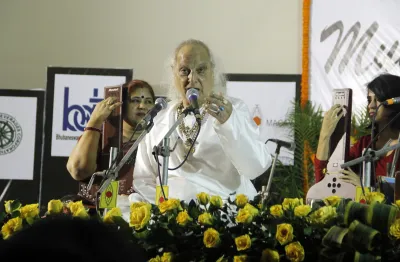
Jasraj
Human Design Chart
Biography
In 1962, Jasraj married Madhura, the daughter of film director V. Shantaram, who he had first met in 1955 during the filming of Jhanak Jhanak Payal Baje. After their marriage the couple lived in Kolkata for some time. They had a son, Shaarang Dev Pandit, and a daughter, Durga Jasraj, a television anchor and presenter.
Pandit Jasraj was in the USA when the country entered its COVID-19 pandemic lockdown. He died on 17 August 2020 at 5:15 am EST, due to cardiac arrest, at his home in New Jersey.
What does Projector 1/3 mean for Jasraj?
Projector 1/3 — Design at a Glance
Jasrajs design presented a dense, focused aura, comparable to a bright flashlight that immediately revealed system errors. This characteristic allowed him to precisely identify weaknesses in his environment and shed light on the dark spots. However, direct confrontation with these insights would often provoke resistance; instead, Jasraj was most effective through his own harmony. By setting an illuminating example himself, he attracted others who then sought his advice. His strategy involved waiting for a respectful invitation before sharing his knowledge.
As a projector, Jasraj did not have a defined Sacral Center, meaning that he lacked a constant source of intrinsic life energy. Instead, he experienced phases of high activity and rapid workability, which had to be followed by rest periods to prevent burnout. This cyclical energy requirement fundamentally differed from the demands of conventional work structures. When Jasraj lived in harmony with this rhythm and his strategy of waiting for invitations, he was rewarded with success. Deviations from it tended to lead to experiences of bitterness as an expression of his non-self. His design thus laid out a tendency towards strategic restraint and cyclical engagement to sustainably leverage his unique ability to detect errors.
No Inner Authority
Jasraj lacked inner authority, a rare configuration that fundamentally shaped his decision-making process. Instead of listening to a firm internal center, he gained orientation through exchanges with his environment. As a mental projector, he used dialogues to gather information from various perspectives. In these interactions, latent potentials in his open centers were activated, allowing him to view issues multi-layered and develop specific intelligence during conversations.
This process was complex and required time for evaluation. Jasraj withdrew to filter out the essential elements from the information chaos and structure them meaningfully. Only through this distance could he recognize what truly fit him and which thread it was worth following. His high resonance capability helped him identify the right environment and trustworthy conversation partners with whom he could exchange ideas.
The development of his sense for the right path was a long-term process. Over time, he learned to distinguish between relevant impulses and mere noise. This mechanism of gaining information through resonance and subsequent reflection formed his capital of success. Jasraj thus showed himself as someone who did not draw clarity from isolated introspection but rather from conscious interaction with others followed by orderly processing.
The 1/3 Profile — Investigator / Martyr
Jasrajs design pointed towards a cyclical process of theoretical study and practical application. As a person with Profile 1/3, the Researcher and Experimenter, he was someone who did not just collect knowledge but tested it through his own experience. The Line 1 in the first hexagram drove his need for fundamental understanding and securing resources. Here, it was about successfully approaching others while preserving individual uniqueness. Jasraj sought the right 'tribe' or partner, where mutual dependence and recognition of individual contributions were central. He avoided one-sided dependency as it could lead to identity loss out of fear of rejection.
However, Line 3 in the second hexagram required courage for experimentation. Jasraj had to learn that awareness alone was not enough; he needed support from his environment and assertiveness. This line dealt with adaptation and breaking through illusions. For him, errors were not defeats but necessary learning steps to recognize projections and realistically adapt. The tension between his desire for security through knowledge (Line 1) and the necessity of actively experimenting (Line 3) shaped his character. His judgments enjoyed the highest credibility as they were based on a synthesis of intensive research and personal experience.
Single Definition — Defined & Open Centers
Jasraj's Design creates a constant internal mental pressure: a mind that is always active, asking questions and forming concepts. This continuous inspiration stems from the defined connection between Head Center and Ajna Center. Jasraj has a fixed way of thinking, but it is not connected to personal energy for implementation; the brain is not the engine. Attempting to realize these thoughts directly often leads to frustration or concern due to the lack of power to act on them. Instead, Jasraj's aura influences others, particularly those with undefined Head Centers, by inspiring them to think. The challenge lies in not releasing this pressure inward as doubt or outward as hasty action but rather giving it purely as inspiration and waiting for the right timing from the environment to implement.
This stable mental process sharply contrasts with the situational nature of his open centers. Jasraj's Throat Center, G Center, Heart Center, Sacral Center, Solar Plexus Center, Spleen Center, and Root Center are all open. This means he does not have constant personal energy for communication, identity, willpower, vital endurance, emotional stability, spontaneous intuition, or stress management. Instead, he is susceptible to conditioning from the environment. His open G Center leads him to adopt identities and directions from others; when he questions who he is, he tends to seek borrowed roles. The open Heart Center makes him vulnerable to the pressure of proving his worth, often ending in promises he cannot keep. His open Sacral Center causes him to absorb and amplify foreign energy, leading to exhaustion if he ignores boundaries. The open Solar Plexus Center absorbs emotions from the environment, while the open Spleen Center takes on fears and the open Root Center stress from the surroundings. Jasraj's wisdom lies in not personalizing these open fields but using them as mirrors for others' reality, while employing his defined mind to bring clarity and inspiration into his environment without needing to act himself.
Channels for inspired inner truth.
Jasraj's thought process was acoustically and mutatively influenced; he did not process inspiration logically but rather through an inner truth that revealed itself in sudden moments of knowing. This resulted from Channel 61-24, which connects the Head Center with the Ajna Center. Through Gate 61, the Gate of Secrets, Jasraj received inspiration as acoustic interference or "white noise." His mind repeatedly processed these impulses until a mutation occurred in the Ajna Center, represented by Gate 24 of Rationalizing—a Satori moment when he simply knew. Jasraj could not control his thinking or use it for future goals; instead, he had to trust in fortunate happenstance that knowledge unfolds at its own pace. His task was to distinguish between misleading insights and genuine inspiration and pass on only the valuable aspects. To alleviate constant mental pressure, Jasraj sought silence, often through music which provided him relief. Additionally, other gates shaped his essence: Gate 19 connected him with resources, territory, and spiritual community, while Gate 33 required reflection and withdrawal to process experiences. Gate 44 brought awareness and transformation through relationship, and Gate 17 promoted logical teaching as well as the maintenance of human rights. Jasraj's design thus emerged as a synthesis of spontaneous mystical insight and the necessity to anchor this in a safe, reflective environment.
Individual Circuitry — Circuit Signature
Jasraj's design inclines towards innovative and creative flashes of insight. This energy stems from the Awareness Channel (24-61), which connects the Head Center with the Ajna Center. Through this direct link between the two thinking centers, Jasraj demonstrated the ability to translate spontaneous inspirations into clear concepts. The Knowledge Circuit, to which this channel belongs, generally focuses on one's unique path and acquiring new knowledge through transformation. In Jasraj’s case, it specifically involved the mentioned centers: the pulsating, acoustic format energy of this circuit reinforced his distinctive individuality. Although the complete circuit also encompasses emotional waves from the Solar Plexus Center and expression in the Throat Center, only Jasraj's Head and Ajna Centers were directly connected. This shaped his inner working style: new insights emerged through the synthesis of intuition (Head) and intellectual structuring (Ajna). This configuration supported him in recognizing deviations from the known—so-called mutations—and transforming them into innovative ideas. It was not a process of external emotional expression but an internal mental transformation that strengthened his individual identity and helped him navigate his specific path in dealing with new knowledge.
Right Angle Cross of the Four Ways 4
Jasraj's design showed a tendency towards strategic orientation that was expressed through the Right Cross of the Four Paths. This configuration created an internal framework for his individual development without prescribing specific mechanical details. It was an archetypal structure of the 'Right Path' serving as a guiding principle. Jasraj was marked by this alignment, with the focus on defining his life path generally. The design offered him a clear strategic basis that influenced his actions and decisions. The mechanics of this cross worked as an overarching order helping him find his place in life. It wasn't about isolated events or concrete deeds but rather a deeper structural orientation. Jasraj lived within these archetypal boundaries, which gave him stability and direction. The four paths symbolized different aspects of his existence that together formed a coherent whole. This structure allowed him to move strategically without being distracted by external circumstances. His path was defined through this inner logic helping him maintain clarity in complex situations. Thus, the Right Cross of the Four Paths significantly shaped how he designed and understood life. It was a constant companion providing orientation even when no specific details were mentioned in the raw content. Jasraj followed this internal compass needle that helped him tread his unique path.
Saturn Return · Uranus Opposition · Chiron Return · 2nd Saturn Return — Life Cycles
Jasraj's design was characterized by cycles of transformation and rebellion, profoundly shaping his life. The first Saturn Return marked a turning point towards structuring: In 1960 at age 30, he married the daughter of director V. Shantaram. This period condensed years of groundwork into solid relational foundations, typical for this cycle's stabilizing power.
Later, rebellious energy was evident through the Uranus Reversal. At age 42 in 1972, Jasraj initiated an annual classical music festival honoring his father. This act broke established patterns and created new structures driven by a need for change and individual expression. The opposition of Uranus promoted such impulsive yet creative actions challenging the status quo.
His life task involved integrating these transformative forces: structure through Saturn and innovation through Uranus. Jasraj lived this dynamic by entering personal relationships while also initiating cultural initiatives honoring his father. His design suggested he was particularly receptive to deep changes in both private and public spheres during these phases.
Projector · No Inner Authority — Synthesis
Jasraj led a life marked by a profound inner drive for understanding and the ability to recognize patterns (Channel 61/24). This mental clarity, fueled by the connection between Head Center and Ajna Center, guided him to perceive the world uniquely and share his insights. His Profile as Researcher/Experimentor (1/3) further strengthened this process through constant learning and experimentation in search of truth – knowledge he then shared with others. The openness of his lower centers made him receptive to environmental energies, helping him notice subtle changes and adapt to various contexts, though sometimes leading to internal unrest.
A central tension field in Jasraj's design lay between his need for understanding and the lack of a firm foundation for self-definition. He was a Projector without inner authority whose strength lay in recognizing others' potentials (Throat Center open), yet he relied on invitations to correctly apply his energy. This dynamic created a paradox: Jasraj possessed the ability to generate and convey profound knowledge, but without stable internal reference points, he had to orient himself constantly at the environment to find his place and purpose.
1 Defined Channel
Incarnation Cross - Right Angle Cross of the Four Ways 4
Solar Return
The Solar Return shows the moment when the sun returns to its exact birth position - your personal solar year.
Life Cycles
Discover the life cycles with a detailed triple view (birth chart, cycle chart, composite).
Human Design Profile
- Type
- Projector
- Strategy
- Wait for the respectful invitation
- Authority
- No inner authority - learn more
- Profile
- 1/3 - Investigator / Martyr
- Definition
- Single Definition
- Incarnation Cross
- Right Angle Cross of the Four Ways 4
- Date of Birth
- 28.01.1930 17:25
- Place of Birth
- Hisar, India
Frequently Asked Questions
What was Jasraj's Human Design type?
Which Profile did Jasraj have?
What Authority did Jasraj have?
What incarnation cross did Jasraj have?
When was Jasraj born?
Discover your own Human Design
Are you also a Projector? Find out in a personal reading how to unfold your leadership qualities and recognize the right invitations.
More Personalities
Back to overviewSissy Spacek

Aaliyah

Alain-Fournier

Alexia

Alizée

Anémone
