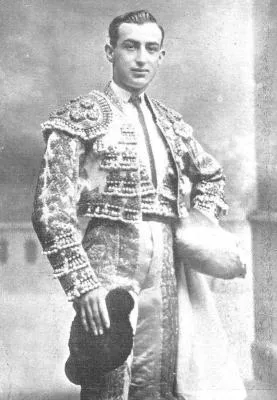
Jose Gomez Ortega
Human Design Chart
Biography
Ortega, commonly known as Joselito came from a family of bullfighters and was the youngest man ever to receive the title of matador (October 1912). He began his professional career at age 12 and celebrated his 16th birthday by killing six bulls. Joselito adopted Belmonte’s unorthodox style, in which the matador remains almost stationary during the bull’s charge, avoiding the animal’s horns by skillful manipulation of the cape. Together they became the heroes of the “Golden Age of bullfighting.”
Joselito was killed in the ringon 16 May 1920, at age 25 during a mano-a-mano (competitive bullfight) with his brother-in-law Ignacio Sánchez Mejías.
The Human Design of Jose Gomez Ortega: Manifestor 5/1
Manifestor 5/1 — Design at a Glance
Jose Gomez Ortega was a Manifestor, a type designed to be a pioneer and visionary, leading the world into a new future. His design was akin to that of an emperor in ancient Rome: he had the vision of a great empire but did not lead the necessary wars himself; instead, he sent others to conquer lands for him. This broad perspective often led to Jose Gomez Ortega being misunderstood and polarizing. Because he thought beyond many of his contemporaries, he was loved and followed by some for his dreams, while others disliked or even hated him because of these grand visions.
To ensure the right followers found him, it was crucial for Jose Gomez Ortega to inform others timely and accurately about his intentions. This was his ideal strategy. When he followed this strategy and trusted his inner authority, he was rewarded with a sense of inner peace. Living against his design, however, likely resulted in a persistent, deep-seated anger within him. His character was thus marked by the tension between the need to communicate his visions and the natural reaction of the environment, which either followed or rejected him.
Emotional Authority
Jose Gomez Ortega was someone who did not make decisions on the spot but took the time to find inner clarity. His design carried emotional authority, meaning his defined Emotional Center was the source of his inner guidance – regardless of which other centers were also defined. This configuration subjected him to a natural emotional wave, a permanent up and down of feelings. The world appeared to him always colored by his current mood; the same thing could inspire him in one moment and be negative in the next.
For Jose Gomez Ortega, however, the immediate feeling was only a snapshot, not a final judgment. Quick, spontaneous decisions made directly from such an emotional peak often proved problematic. Instead, his mechanics required patience and conscious waiting. By letting decisions rest overnight multiple times, he gained emotional distance. Over time, the intense feelings subsided, and only then did true clarity and calm set in. This process of 'polishing' and rechecking was essential for him, especially for long-term decisions that significantly influenced his life course. Only through this temporal distancing could he separate his deeper, more comprehensive understanding from the temporary mood fluctuations.
The 5/1 Profile — Heretic / Investigator
Jose Gomez Ortega's design was characterized by Profile 5/1, the configuration of the 'Hero' and 'Explorer'. He had a deep knowledge base that he used to offer concrete solutions to people's problems. This structure gave him almost magnetic appeal; others actively sought his insights, seeing him as an authority providing answers to complex questions.
This dynamic came from Line 5, representing strategic thinking and the ability to lead the way. Others projected an unconscious expectation that Jose Gomez Ortega would always point the right direction. Simultaneously, Line 1 anchored his need for intense, individual exploration. He loved the process of learning and diving into new challenges before sharing results.
The challenge lay in balancing these two poles. As others constantly sought advice, there was a risk that he would overextend his resources if he did not set clear boundaries. His design showed that he needed to learn to say 'No' at times to protect his energy. Only in this way could he maintain the beneficial tension between his private immersion in knowledge and public provision of solutions without burning out. His strength lay in cultivating deep understanding, like a master from the sciences, and applying it purposefully but thoughtfully to problem-solving for his environment.
Single Definition — Defined & Open Centers
Jose Gomez Ortega revealed himself through a consistent mental and emotional system that significantly shaped his way of thinking and feeling. His defined Ajna Center ensured a trustworthy, specific mental function; he processed data and creativity in a consistent manner and was difficult to influence by others. This mental structure flowed directly into his defined Throat Center, allowing him to express what his mind conceptualized. His voice served as a focal point to make these thoughts effective in the world as communication and action.
At the same time, Jose Gomez Ortega was marked by a defined Solar Plexus Center, which acted as his inner authority. He was designed to wait out the ups and downs of the emotional wave before making decisions. Emotional clarity emerged for him over time, not in the immediate moment. This combination of clear thinking, reliable expressiveness, and emotional depth created a stable inner core, but it required patience.
In contrast, his design revealed several areas of receptivity. His open Head Center made him vulnerable to mental pressure and the temptation to answer questions that were not his. He tended to engage with doubts and confusion that belonged to others, rather than trusting his emotional authority. His open G Center meant that he did not have a fixed identity or direction, but rather adopted these through the environment and relationships. This could lead him to seek a 'borrowed' identity or lose himself if he was not in the right place.
Additionally, his open Heart Center was not designed for consistent willpower, making him vulnerable to the pressure to prove himself to himself or others. His open Sacral Center lacked consistent generative energy; he absorbed the energy of others and risked overexertion and exhaustion, as he was not designed to respond to this energy or set boundaries. Finally, his open Root Center absorbed stress from the environment, leading to a feeling of pressure and restlessness that did not originate from him. These open centers challenged him to not identify with the conditioning of the environment but to trust his defined emotional and mental resources.
Channels for emotional openness and structured insight.
Jose Gomez Ortega revealed himself through an expression that strongly depended on his emotional state. His design shaped a tendency to use words and voice only when the inner mood invited it. This happened through the Openness Channel 22-12, connecting the Solar Plexus Center with the Throat Center. Here, the Gate of Openness (22) worked together with the Gate of Caution (12). This configuration meant that Jose Gomez Ortega was not constantly socially available, but waited for the right moment in his emotional wave. Only then could he articulate his passion and romance in a way that deeply touched and transformed others. Compulsion led to harshness; patience allowed him to act as a catalyst for new awareness.
Parallel to this, he possessed the ability to encapsulate complex insights into clear, efficient structures. The Channel of Structuring 23-43 connected his Ajna Center with the Throat Center. Through the Gate of Insight (43), he received spontaneous breakthroughs, which he processed and expressed through the Gate of Assimilation (23). This allowed him to explain innovative perspectives in a way that others could accept and understand. His thinking often worked ahead, but only through patient, clear communication did it find entry into the collective.
Additionally, Gates like Gate 1 (Uniqueness) and Gate 49 (Revolution) contributed to his individual, mutative power, while Gate 4 (Formulation) created logical clarity. Gate 2 (Receptivity) and Gate 31 (Transmission) supported his role as a receiver and transmitter of energy. Jose Gomez Ortega lived this mechanism by not forcing his uniqueness but waiting for the right timing to make his unique perspectives and emotional depths effective.
Individual Circuitry — Circuit Signature
Jose Gomez Ortega's design laid a tendency towards structured, emotionally colored knowledge transmission. He revealed himself as someone who not only sought new insights but carried them into the world through a clear, pulsating form of expression. This configuration stemmed from the Knowledge Circuit, which was his simple definition.
The energy flowed in a single, continuous stream between Ajna, Solar Plexus, and Throat Centers. This connected the mental process with emotional resonance and verbal expressiveness. Two specific channels shaped this flow. The Channel of Structuring (Gates 43 and 23) connected the Ajna with the Throat Center. It enabled the translation of complex thoughts into understandable, structured language. Simultaneously, the Channel of Openness (Gates 12 and 22) connected the Solar Plexus with the Throat Center. This channel promoted emotional openness and the ability to express knowledge intuitively and with inner truth.
Jose Gomez Ortega used this connection to formulate his unique identity. The pulsating energy of the Solar Plexus Center drove the expression, while the Ajna Center took over the mental shaping. The result was a communicative style that was both intellectually grounded and emotionally authentic. He conveyed knowledge based on his individual perspective and did so with a direct, acoustic presence. This mechanism described a natural way to initiate change through the expression of his transformed knowledge, without relying on external validation. The connection of these three centers created an integrated platform for creative creation and the exchange of new ideas.
Left Angle Cross of Defiance 1
Jose Gomez Ortega revealed himself through a design that placed him in a permanent state of probation. His chart bore the signature of the left challenge cross 1, a configuration that did not seek immediate confirmation or peaceful integration but rather the overcoming of resistance. This structure set a tendency to find oneself only at the friction point with reality; his path was not a smooth descent but an ascent through trials.
In Human Design, this cross marks a specific archetypal path. It describes an energy defined by the world's 'no' to form a clear 'yes' to one's own existence. The mechanics here demand not harmony but resilience. Jose Gomez Ortega lived in a system that challenged him to solidify his identity not through approval but through the overcoming of obstacles. Each resistance was not a sign of failure but the necessary catalyst for his development.
This design implied that his true potential could only unfold in the context of difficulties. He was programmed to gain clarity in crisis. The challenge was not a punishment but a structural necessity to harden his inner substance. Without this friction, his energy would have remained diffuse; through constant confrontation with the difficult, he found his precise alignment. His life thus followed the law of refinement through pressure, where the difficulty itself was the tool that shaped him.
Manifestor · Emotional Authority — Synthesis
Jose Gomez Ortega was a Manifestor whose life was marked by a deep inner tension between the urge to forge new paths and the necessity to gain emotional clarity. His profile as a Hero and Investigator (5/1) points to a natural aptitude for gathering knowledge and solving problems, always seeking new challenges. This curiosity and desire to share insights were reinforced by the defined Mental Center, which gave him a steady and trustworthy way of thinking.
At the same time, he lived with an emotional authority that exposed him to a wave of feelings that made quick decisions difficult. The open channel of Openness (22/12) intensified this emotional intensity by tying his ability to express himself to the tides of his inner world. This combination of visionary pioneering and emotional depth led to a paradox: he acted as an initiator and leader but needed time to achieve the emotional maturity for his decisions. The left challenge cross underscored this inner conflict by challenging him to prove his individuality through the overcoming of adversity.
2 Defined Channels
Incarnation Cross - Left Angle Cross of Defiance 1
Solar Return
The Solar Return shows the moment when the sun returns to its exact birth position - your personal solar year.
Life Cycles
Discover the life cycles with a detailed triple view (birth chart, cycle chart, composite).
Human Design Profile
- Type
- Manifestor
- Strategy
- To inform others before acting
- Authority
- Emotional Authority
- Profile
- 5/1 - Heretic / Investigator
- Definition
- Single Definition
- Incarnation Cross
- Left Angle Cross of Defiance 1
- Date of Birth
- 08.05.1895 11:00
- Place of Birth
- Sevilla, Spain
Frequently Asked Questions
Which Human Design type was Jose Gomez Ortega?
Which profile did Jose Gomez Ortega have in his Human Design?
What authority did Jose Gomez Ortega possess?
What incarnation cross did Jose Gomez Ortega have?
When was Jose Gomez Ortega born?
Discover your own Human Design
Are you also a Manifestor? Find out in a personal reading how to use your initiation power peacefully and dissolve resistance.
More Personalities
Back to overviewAldair

Cafu

Christian-Jaque

Joelinton

Kaká

Kesha