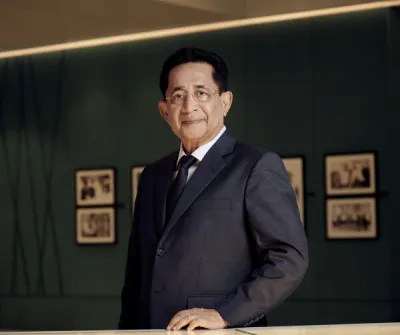
Joy Alukkas
Human Design Chart
Biography
His father, Varghese Alukkas "A. J. Varghese" of the Alukkas family started the jewellery business by setting up a store in Thrissur, Kerala, India. Later Varghese shared his business among his sons, Jos, Francis, Joy Alukkas and Anto Alukkas.
Joy Alukkas is concentrated in overseas business and started trading in gulf countries. Joy Alukkas' original name according to Malayali naming conventions was A. V. Joy.
In 2001, Alukkas founded Joy Alukkas Jewellery. The group is based in Thrissur, Kerala and Dubai.
In 2007, he opened a Gold & Diamond jewellery showroom, and a "Diamond Cave" in Chennai, India.
In 2012, Joyalukkas was authorized to sell Forevermark branded diamonds from De Beers.
Other businesses headed by Joy Alukkas include Mall of Joy, a shopping retail destination, Jolly Silks, a silk fashion label, Joyalukkas Exchange, a money exchange platform, and Joyalukkas Lifestyle Developers, a real estate company. Jolly Silks was named after his wife, Jolly Joy.
The Human Design of Joy Alukkas: Generator 4/6
Generator 4/6 — Design at a Glance
Joy Alukkas displayed a stance of endurance that was fueled not by self-initiative but exclusively through reactions to external impulses. Her design indicated that her high sacral energy only becomes effective when she responds to signals from life. As a Generator, Joy Alukkas possessed considerable strength – comparable to that of a workhorse – yet this power ignited only in harmony with her inner resonance. The central strategy was to wait until the Sacral Center gave a clear "yes" before taking action.
This mechanism served as protection against two specific pitfalls: wasting energy on activities without internal desire and suppressing the urge to continue working on heart projects. When Joy Alukkas reacted rather than initiated, it led to deeper fulfillment. Deviations from this pattern – such as constant initiating or ignoring the inner signal – resulted in frustration and energy loss. The materialization of her goals thus did not occur through pushing forward but through a disciplined response to life once internal confirmation was received.
Emotional Authority
Joy Alukkas demonstrated a decision-making dynamic that required time and emotional distance; spontaneous impulses proved misleading here. This stance stems from her emotional authority: The defined Solar Plexus Center carries this inner guidance. In Human Design mechanics, this rule is universal – once the Emotional Center is active, it functions as authority, independent of other definitions in the chart.
Joy Alukkas was subject to a wave dynamic of feelings, an ongoing up and down. The world appeared to her always colored by the current mood: A moment full of excitement could transform into deep skepticism in the next. However, this immediate impression was only a snapshot, not necessarily her deeper truth. Quick decisions made out of emotion risked negative consequences as they were based on fleeting states.
The mechanics show: The more time Joy Alukkas took, the deeper and more comprehensive she could see. This required patience and consciously "sleeping over" decisions. She should have hesitated and asked questions. Over time, intense feelings subsided, emotional distance gained strength, clarity emerged, and calmness set in. This process was particularly crucial for long-term, life-defining steps to ensure that the choice made rested on a stable inner truth, not on transient excitement or depression.
The 4/6 Profile — Opportunist / Role Model
Joy Alukkas is characterized by a fundamental disposition that exists in the tension between an intense desire for belonging and a later drive towards detached meaning-making. In her first thirty years, she acted as an experimental networker who actively sought out and utilized relationships and friendships to orient herself. This early period was marked by persistence and the ability to forge unexpected connections, though there was a risk of clinging to unsuitable contacts out of self-interest.
With the Saturn return, this dynamic fundamentally changed: The inner conflict between the heart seeking connection and the head asking for absolute security and wisdom became central. Joy Alukkas had to learn that actions and words must align to create trust. Without the assurance of sufficient support, she withdrew as her Line 6 did not accept leadership without this alignment. Her large heart configuration remained always cautious, opening only to those who proved trustworthy in order to avoid hurt. Later, she was expected to take on the role of a wise exemplar that emerges through cooperation with others while maintaining the necessary distance to clearly perceive the meaning of things. This constant balance between community needs and the necessity of retreat spaces for reflection shaped her entire development.
Split Definition — Defined & Open Centers
Joy Alukkas' Human Design foundation is characterized by a constant mental pressure and inspiration coupled with reliable vital energy. Her defined Head Center and Ajna Center created an ongoing internal questioning process; she was designed to develop concepts and inspire others to think, without needing to implement these ideas herself directly. This mental activity required patience, as attempting to relieve the pressure through immediate action often led to frustration. Instead, her energy worked most effectively when she waited for life's questions to be answered by her defined Sacral Center with a clear yes or no response. This sacral authority ensured sustained vitality provided she responded rather than initiated.
Her emotional depth was marked by a defined Solar Plexus Center acting as an inner authority. Here, truth reveals itself over time. Joy Alukkas was designed to wait out the waves of her emotions until reaching emotional clarity before making decisions. Complementing this was a defined Spleen Center that gave her spontaneous intuitive security in the present moment – a protective instinct for health and well-being that issued immediate warning signals.
At the same time, her Throat, G, Heart, and Root Centers were open. These mirror centers made her susceptible to external conditioning: the pressure for attention (Throat), the search for identity and direction (G), the need to prove worth (Heart) or the absorption of stress from the environment (Root). Her design challenged her to be aware of these external influences and instead trust in her inner strategy – waiting and responding – as well as her authorities, to avoid energy depletion and self-doubt.
Channels for logic, intimacy and caring values.
Joy Alukkas exhibits a fundamental attitude of logical skepticism: a mind that filters patterns and asks questions to provide useful answers for the collective. This impulse stems from Channel Logic 63-4, which uses doubt as an essential tool to distinguish between constant and fleeting patterns; pressure arises here only with unresolved questions. Simultaneously, there was intense emotional energy in relationships seeking intimacy through merging. The Pairing Channel 59-6 combines sexual with emotional power, where clarity emerges after waiting for the emotional wave – a mechanism that requires patience to avoid confusion. Additionally, there was a strong instinct for care and responsibility within the tribal context. The Preservation Channel 27-50 ensures community survival through selfless interest (Gate 27) and traditional values (Gate 50); provision occurs only upon request and after an inner, sacral reaction to prevent exploitation. Further nuances were provided by prioritized gates like Gate 28 with its focus on here-and-now risks and Gate 41 as a driver of evolutionary development through emotional crises. This configuration describes someone who logically examines, emotionally connects intensely, and responsibly cares – always aligned with their inner authority rather than external pressure.
Tribal Circuitry — Circuit Signature
Joy Alukkas' design sets a tendency towards strategic clarity paired with a deep instinctive drive to protect the near. Her Head Center and Ajna Center are connected through Channel Logic, describing a capacity for focused rational analysis. This energy aims to structure logical insights free from emotional conditioning and make them useful for the future – a pure, emotionless ratio. Parallel to this, in the Guardian Circuit, three interconnected centers: Sacral, Solar Plexus, and Spleen were active. Here, life force, emotional waves, and instinctive perception converged. This generated an ancient need for family and genetic preservation through care, nutrition, and defense. Themes of pairing and nurturing were central here. As Joy Alukkas had a Shared Definition, these two systems – the cognitive strategy in Head-Ajna area and the emotional protection system in Sacral-Solar Plexus-Spleen – existed as separate parallel forces. They were not directly connected but formed independent focal points: on one hand sharing rational structures for societal improvement, on the other the timeless sensual task of familial preservation and protection.
Right Angle Cross of the Unexpected 3
Joy Alukkas revealed herself through a design that integrated unpredictability as a central component of her life dynamics. Her chart indicated a structure where spontaneous turns and surprising developments did not appear as disruptions but rather as natural elements of the personal flow. This aligned with the mechanics of the right cross of the Unexpected 3, which describes life less as a linear plan than as a sequence of unexpected events. This configuration suggested that Joy Alukkas was not dependent on foreseeing every step; instead, her design worked most effectively when she embraced the unplanned. The underlying dynamics called for an attitude of acceptance towards the surprising rather than resisting or controlling it. Through this integration of chance and spontaneity, a specific rhythm emerged for Joy Alukkas in which the unexpected did not appear threatening but served as a driving force for personal development. Her design thus signaled an inner readiness to accept life’s flow as it came – with all its sudden direction changes and unforeseen moments. This structure supported her in moving through situations outside of any control, and from there drawing new impulses for her further path.
Saturn Return · Uranus Opposition · Chiron Return · 2nd Saturn Return — Life Cycles
Joy Alukkas was marked by strategic, long-term career steps that gained maturity at cyclical turning points. At the age of 51 during his Chiron Return – a fulfillment cycle that leads to the realization of one’s incarnation purpose when lived strategically – he opened a showroom for gold and diamond jewelry as well as a “Diamond Cave” in Chennai in 2007. This step marked not just expansion but the concrete realization of his deepest life intention within a business context.
His second Saturn Return, which begins at age 56 and often serves to solidify structures, brought another decisive turning point in 2012: Joyalukkas received permission to distribute trademark-protected Forevermark diamonds from De Beers. These two events underscore how internal developmental steps translated into external, sustainable successes for him. The Chiron Return functioned as the peak of his personal mission, while the second Saturn Return provided institutional security and access to exclusive resources. His career thus followed not random impulses but a clear inner logic where each phase built upon the previous one leading to greater stability and depth.
Generator · Emotional Authority — Synthesis
Joy Alukkas’ design reveals a central thread of reactive engagement fueled by strong sacral authority (Design) and emotional wave patterns (Authority). He is not destined to initiate, but rather to react to impulses – a principle reinforced by the definition in the Sacral and Solar Plexus Centers. This combination generates an energy that is powerful yet conditional: it unfolds only in response to external stimuli and requires time to gain emotional clarity. The undefined Heart, Root, and G Centers further show openness to influences that enable him to perceive others’ energies and adapt – as long as he follows his strategy and listens to his inner authority. Prioritizing Gates like 28 (Player) and 31 (Leadership) indicates a capacity to recognize opportunities and draw others along with his energy.
A central paradox in Joy Alukkas’ chart lies in the tension between the need for validation and the inherent instability of his identity. The open G Center suggests that he strongly adapts to his environment, while the defined Sacral Center harbors deep inner strength that is only activated through reaction. This dynamic can lead to an internal conflict: the desire to find a firm place in the world versus the natural ability to remain flexible and open to new experiences. The connection between logic (Channel 63-4) and sacral energy indicates that he possesses clear thinking but this is bound by the availability of his life force.
3 Defined Channels
Incarnation Cross - Right Angle Cross of the Unexpected 3
Solar Return
The Solar Return shows the moment when the sun returns to its exact birth position - your personal solar year.
Life Cycles
Discover the life cycles with a detailed triple view (birth chart, cycle chart, composite).
Human Design Profile
- Type
- Generator
- Strategy
- To respond - wait for something to respond to
- Authority
- Emotional Authority
- Profile
- 4/6 - Opportunist / Role Model
- Definition
- Split Definition
- Incarnation Cross
- Right Angle Cross of the Unexpected 3
- Date of Birth
- 29.10.1956 02:00
- Place of Birth
- Trichur, India
Frequently Asked Questions
What is Joy Alukkas' Human Design type?
Which Profile does Joy Alukkas have in Human Design?
What Authority does Joy Alukkas possess in his design?
Which incarnation cross is assigned to Joy Alukkas?
When was Joy Alukkas born?
Discover your own Human Design
Are you also a Generator? Find out in a personal reading how to use your sacral energy correctly and discover deep satisfaction.
More Personalities
Back to overviewAaliyah

Alexia

Angèle

Anne-Marie

Arcángel

Arno