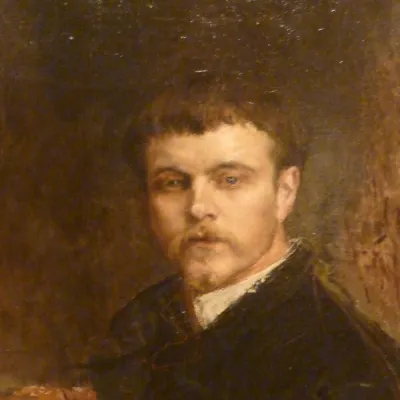
Jules Bastien
Human Design Chart
Biography
His en plein air depictions of peasant life in the countryside were highly influential on many international artists, including George Clausen in England and Tom Roberts in Australia. He also won renown for his history paintings, among the most famous being Joan of Arc, now held at the Metropolitan Museum of Art in
New York.
What does Manifesting Generator 2/4 mean for Jules Bastien?
Manifesting Generator 2/4 — Design at a Glance
Jules Bastien revealed himself as someone who possessed a rare combination of constant energy and lightning-fast implementation power. His design as an Manifesting Generator combined the powerful endurance of a Generator with the direct impact of a Manifestor. This configuration allowed him to skip steps and achieve results faster than conventional methods would permit.
The challenge, however, lay in this speed. Often Jules Bastien acted so quickly that important intermediate steps were missed, which inevitably led to having to return later and make up for them. This reworking of processes was the primary source of his frustration. Additionally, his system tended to respond simultaneously to numerous impulses, causing multiple projects to run in parallel. Without internal confirmation, this creative drive quickly turned into overwhelm and anger at himself.
The key to his satisfaction lay in strictly waiting for external stimuli before acting. Only when his sacral center – the source of his constant energy – gave a clear "yes" did he apply his strength. Regular checks to see if current activities still fulfilled him were essential. When this strategy was followed, a state of deep happiness emerged. In this mode, multitasking was not a problem but a source of fun and lively variety. The work no longer felt like a duty but rather like free play in which his natural speed came into full effect without overwhelming or frustrating him.
Emotional Authority
Jules Bastien showed a decision-making approach based on patience and navigating through emotional waves. Spontaneous reactions were often misleading for his design; his inner truth did not lie in the first impulsive response but rather in the subsequent state of calmness. This resulted from his emotional authority, which was defined by his colored Solar Plexus Center. In Human Design mechanics: If this center is colored, it always takes on the role of internal authority – regardless of all other definitions in the chart. Jules Bastien was subject to a constant emotional wave, an up and down of his feelings that continually colored his perception of the world. What appeared inspiring at one moment could become negative in the next. These moods were merely snapshots, not final truths. Quick decisions made from this heat risked negative consequences. His design required him to take time and let decisions "sleep" multiple times over. Only when intense feelings subsided and emotional distance was gained did clarity emerge. This process of waiting until calmness prevailed was essential for Jules Bastien, especially in long-term life-changing decisions that significantly influenced his life path. He learned to allow himself to be patient and to thoroughly examine questions to ensure that his actions stemmed from a deep, comprehensive understanding of his emotional nature rather than fleeting excitement or depression.
The 2/4 Profile — Hermit / Opportunist
Jules Bastien revealed himself through a pronounced cyclical dynamic between the urgent need for isolated reflection and the deep desire for familiar community. His design as Profile 2/4, the natural talent and networker, established that he constantly oscillated between two poles: Line 2 of the Hermit and Line 4 of the Community. This meant not only changing states but also an essential life task to send clear signals outward – whether he needed space or sought company. Only through this transparent communication could Jules Bastien effectively process the knowledge gathered in his network. In phases of withdrawal, he immersed himself in internal processes to find peace and clarity. This solitude was productive: it served the transformation of impressions into brilliant ideas. The Sun at Gate 44 on Line 2 underscored a specific management approach. Instead of focusing solely on goals, Jules Bastien directed his attention to people and integrated even "lower" forces to achieve qualitative quality rather than mere quantitative success. On the other side, Gate 33 on Line 4 acted, which demanded transpersonal depth and the necessary withdrawal for regeneration. Without this reflective pause, burnout threatened in this configuration; with it, withdrawal became a place of resurrection and meaning-making. Thus, his success in life arose from conscious oscillation: first engagement in the network, then protection of one's own energy through withdrawal, followed by renewed clear orientation towards favourite people.
Single Definition — Defined & Open Centers
Jules Bastien revealed himself through a stable, defined foundation from the Sacral, Solar Plexus, and G Centers. His vital energy source lay in Reacting: He waited for questions or invitations to respond with a clear "Yes" or "No" from his gut. Initiatives without this confirmation typically led him to frustration and exhaustion, as his sacral power was only available for correctly taken on commitments. This energy was filtered through his emotional authority in the Solar Plexus Center; he needed time for his feelings' waves to subside before gaining clarity and taking action. Impulsive decisions based on emotional highs or lows were avoided in favor of a deeper, time-matured truth.
His defined G Center gave him a firm inner direction and self-love. He intuitively knew where his place was without having to control it. This reliable identity flowed into his also defined Throat Center, which served as a pivot point to translate this inner truth, along with the answers from the Sacral and emotions, into the world. His communication was thus authentic and directly expressed from his essence.
In contrast, Head, Ajna, Heart, Spleen, and Root Centers were open. This made him a mirror for his environment: He had no constant mental inspiration or logical structuring but rather a flexible mind that took in ideas from context. Without a defined Heart Center, he was not geared towards proving willpower or keeping promises; the pressure to prove himself often led him into spirals of failure. His open Spleen Center made him sensitive to health and well-being but tended to make spontaneous decisions out of fear of survival issues or enter unhealthy relationships. Additionally, his open Root Center absorbed others' stress, making him vulnerable to external pressure and hyperactivity if he did not recognize this foreign adrenaline rush as such and let it go.
Channels for self-love, intimacy and logical leadership.
Jules Bastien revealed a fundamental attitude that understood intimacy as the slow build-up of trust. This stemmed from the Partnership Channel 59-6, which linked sexual energy (Gate 59) with the emotional wave (Gate 6). This configuration required patience: Jules Bastien had to wait for emotional clarity before deep bonds could form. An immediate intrusion into others' auras was possible, but without this temporal distance there was a risk that his intensity might be falsely perceived as flirting. The true fruitfulness of this energy only became apparent when friendship preceded intimacy.
Parallel to this, Jules Bastien possessed the ability for collective leadership, yet under a specific condition. The Alpha Channel 7-31 connected logical roles (Gate 7) with the voice of the leader (Gate 31). This energy did not manifest through claims of authority but rather as influential guidance for the future. Jules Bastien could show the way, but he was not permitted to impose it on the community. His leadership role only became effective when the "pack" or majority explicitly invited him to do so. Without this invitation, his potential remained in the realm of influence rather than transforming into actual power.
On a personal level, Jules Bastien promoted self-love and belief in individual convictions. The Exploration Channel 34-10 (Personality) linked inner strength (Gate 34) with the behaviour of oneself (Gate 10). This energy encouraged him to live authentically and through this example, gave others confidence in their own uniqueness. It did not come across as intrusive but rather as a quiet demonstration of how one can honour themselves. Together, these channels formed a design based on resonance, invitation, and patient development, rather than immediate imposition or superficial interaction.
Individual Circuitry — Circuit Signature
Jules Bastien revealed himself as someone who combined a well-established individuality with strategic thinking and instinctive protective tendencies. His design was marked by a simple definition, meaning that all his defined centers – Solar Plexus, Sacral, Identity, and Throat – were energetically directly connected to each other. This created a coherent flow without internal breaks or isolated energy pockets.
The Projector circuit linked his Sacral with his Identity Center through the Exploration Channel (10-34). This connection promoted a pulsating, creative life force that was deeply rooted in his personal identity. It strengthened his self-esteem and enabled him to live out his own individuality courageously, even if these inner convictions were not always easy to verbalize.
Parallel to this, the Reflector circuit connected his Throat with his Identity Center (Channel 7-31). Here a dispassionate ratio came into play: Jules Bastien used logic and strategy to structure insights and project them into the future. This helped him communicate complex connections clearly and find rational solutions for societal or personal questions.
Finally, the Manifestor circuit linked his Sacral with his Solar Plexus Center (Channel 6-59). This connection brought primal instincts into play, particularly the urge towards pairing and emotional protection of family. The wave-like emotions of the Solar Plexus were grounded by the stable life force of the Sacral, resulting in a strong focus on preservation, care, and the continuation of his own genetics. Overall, this resulted in a character profile that united inner centering with clear-mindedness and deep protective instincts.
Right Angle Cross of the Four Ways 3
Jules Bastien was marked by the Right Cross of the Four Paths 3, a configuration often associated with a profound search for inner truth and spiritual integrity. This design element points to a life path where external circumstances frequently served as catalysts for internal transformation. Jules Bastien did not primarily express himself through loud declarations but rather through a quiet, persistent alignment with what is essential.
The mechanics of this cross describe a process of purification and understanding, in which challenges were understood not as obstacles but as necessary steps toward clarifying one's identity. It was less about overcoming material goals than it was about establishing an authentic connection to one's inner self. Jules Bastien lived this dynamic by questioning the meaning of existence and seeking answers not in dogma but through personal experience.
Without specific biographical events in the raw content, the description remains on this archetypal level: Jules Bastien embodied a tendency to reach deeper self-awareness through life events. His design suggested that he sought paths leading to unity between action and being, with an unwavering focus on inner correctness regardless of external validation. This attitude shaped his way of interacting with the world – reflective, grounded, and mindful of lasting impact.
Saturn Return — Life Cycles
Jules Bastien's design showed a tendency to solidify one's position in the world through confrontational self-assessment. This was evident in 1876, at age 28, when he again entered the competition for the Prix de Rome – unsuccessfully. For his Human Design, this was not just a failure but a typical moment of the first Saturn return. This cycle marks the transition from youth to adult responsibility and forces confrontation with one's own limits as well as ambitions. Illusions about one's abilities or external recognition must break here to stand on solid ground. The defeat in the competition served as a catalytic event for this necessary clarity. Rather than losing himself in disappointment, his configuration prompted him to acknowledge the reality of his capabilities without filters. This phase of self-assessment was essential to base future steps not on wishful thinking but on actual substance. The experience taught Jules Bastien that true stability only arises when one is ready to endure hard trials and align ambitions with the real world rather than lose oneself in idealistic notions.
Manifesting Generator · Emotional Authority — Synthesis
Jules Bastien lived a life marked by an inner dynamic between creative energy and the need for authentic expression. His design as a Manifestor Generator with emotional authority points to someone who both had the ability to quickly initiate things and the necessity of filtering decisions through a process of emotional maturation. This combination, reinforced by his defined G Center and connections in his circuitry, pointed to a strong inner direction that was always dependent on the ability to communicate authentically and identify with one's values. The recurring emphasis on reaction rather than initiation, paired with the need for alone time and community (Profile 2/4), suggests he lived in a constant exchange between individual withdrawal and social interaction – a rhythm that allowed him to recharge energy and refine his creative vision.
A central paradox in Jules Bastien's design lies in the tension field between his quick, initiating energy as a Manifestor Generator and the emotional process of his authority. He possessed the ability to set things in motion, yet true satisfaction came only through waiting for emotional clarity. This tension may have manifested in an internal conflict between impulsivity and reflection, between the desire for immediate implementation and the necessity of thorough decision-making. The openness of his centers suggests he was a mirror for others' emotions and fears, making him vulnerable to external influences but also strengthening his ability to form deep connections and maintain authentic relationships.
3 Defined Channels
Incarnation Cross - Right Angle Cross of the Four Ways 3
Solar Return
The Solar Return shows the moment when the sun returns to its exact birth position - your personal solar year.
Life Cycles
Discover the life cycles with a detailed triple view (birth chart, cycle chart, composite).
Human Design Profile
- Strategy
- To respond - wait for something to respond to
- Authority
- Emotional Authority
- Profile
- 2/4 - Hermit / Opportunist
- Definition
- Single Definition
- Incarnation Cross
- Right Angle Cross of the Four Ways 3
- Date of Birth
- 01.11.1848 01:00
- Place of Birth
- Damvillers, France
Frequently Asked Questions
What was Jules Bastien's Human Design type?
What profile did Jules Bastien have in Human Design?
What authority did Jules Bastien have?
What incarnation cross did Jules Bastien have?
When was Jules Bastien born?
Discover your own Human Design
Are you also a Manifesting Generator? Find out in a personal reading how to unfold your multi-talents and direct your energy wisely.
More Personalities
Back to overviewAldair

Alizée

Angeli

Arletty

Artus

Baekhyun