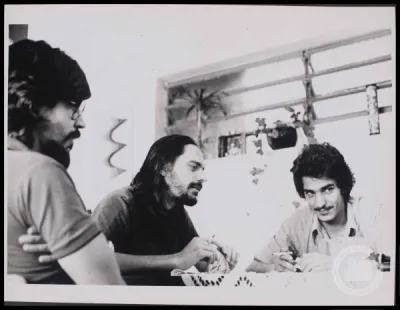
Photo: Wikimedia Commons
Keith Richards
Human Design Chart
Biography
He was known as the wildest Stone. When charged with heroin traffic in Toronto, 1977, he escaped a heavy jail sentence by agreeing to a free concert for the blind and rehab center. At that time he was living with German actress Anita Pallenberg and their two kids. He split with Jagger in 1986 and did a solo album "Talk is Cheap."
Finally, in 1977, Richards turned his life around with rehab. He lives the life of a rich gypsy, traveling with beautiful fiancé Patti Hansen and a goodly supply of bourbon. Like the other Stones, he has homes here and there, in his case, a house in Jamaica, an apartment in Paris, a country estate in CT. and a country home in England.
On 5 May 2006, the guitarist successfully underwent surgery in Auckland, New Zealand to relieve a blood clot that had formed on his brain. Richards had been complaining of headaches after he had sustained what was thought to be a mild concussion in an accident a week and a half prior while vacationing in Fiji. Reports about the nature of the accident conflicted but most commonly attribute his injuries to a fall from a palm tree or a jet-ski accident. Again in the news for outrageous antics, in spring 2007 he said that he had snorted his dad's ashes along with cocaine but later said he really never mixed his dad's ashes in with his cocaine snort. His dad died in 2002.
Keith Richards — Manifesting Generator with Profile 3/6
Manifesting Generator 3/6 — Design at a Glance
Keith Richards revealed himself as someone who possessed hybrid energy: the constant power of a Generator paired with the lightning-fast assertiveness of a Manifestor. His design inclined him to draw things extremely quickly into his life, often bypassing usual intermediate steps. However, this speed was a double-edged sword. Acting too quickly caused him to skip necessary phases, leading to the need to return later and fill in these gaps – a source of frustration, as his non-self theme lay precisely in exhausting himself through haste.
At the same time, he tended to pursue multiple projects simultaneously, driven by various impulses. Without the inner consent of his authority and sacral center, this creative drive could quickly turn into overburdening. The key to his satisfaction lay in not initiating himself but reacting to life. Only when his sacral center gave a clear “yes” could he effectively utilize his energy. In this state, he fell into a “play mode,” where variety and parallel work were no burden but the source of his deep satisfaction and creative power.
Emotional Authority
Keith Richards revealed himself as someone who did not make decisions in the first impulse but let them go through a process of emotional maturation. His design carried Emotional Authority, meaning his defined Solar Plexus Center provided the inner compass for all significant life decisions. This holds true regardless of which other centers are defined in his graph; the emotional wave always takes precedence.
This configuration generates a permanent up and down of feelings. The world is always colored by the current mood: a moment of excitement can turn into deep disappointment in the next. Since the feeling in the moment is just a snapshot and not necessarily the truth, spontaneous decisions based on emotion would be risky and could have negative consequences.
Instead, his mechanics required patience. Keith Richards let decisions mature, slept on them multiple times, and took his time until the intense feelings subsided. Only then did he gain emotional distance, and clarity and calmness set in. This process was particularly important for long-term decisions that profoundly shaped his life path. By waiting for this inner calm, he secured a solid foundation for his actions rather than reacting to fleeting moods.
The 3/6 Profile — Martyr / Role Model
Keith Richards revealed himself through the Profile 3/6, the experimenter and role model, marked by a dynamic development line. In the first half of his life, Line 3 dominated: a constant process of trial and error. Here, it was less about ultimate truths and more about testing idea connections and adapting to emotional waves. Experience taught that ideas are transient; only through practical experimentation and the admission of mistakes could a correct direction crystallize.
Only after the return of Saturn, around age 30, did Line 6 kick in. This shift marked the transition from pure experimentation to reflection. Richards withdrew to organize the accumulated experiences and gain a broader perspective. The playful energy of Line 3 now received the wise guidance of Line 6, which seeks reason and peace.
This configuration carried an internal tension: the feeling of being torn between the need for playful space and the necessity of deep contemplation. Line 6 aimed to control his own emotional nature and set conditions ensuring that emerging bonds – particularly concerning the next generation – are anchored in a sustainable world. Only in later years, around age 50, could this synthesis fully unfold, making Richards through the combination of charm and acquired wisdom a role model for others.
Single Definition — Defined & Open Centers
Keith Richards revealed through his design as someone who possesses a consistent, reliable voice. His defined Throat Center ensured that his communication and actions were not arbitrary but stemmed from a clear inner source. This manifested as a natural ability to translate messages from the entire system into the world without losing credibility.
This expressive strength was reinforced by two additional defined centers: the G Center and the Sacral Center. The defined G Center endowed him with a firm self-identity and a clear sense of direction. He knew who he was and where he belonged, allowing him to show others new paths without being dependent on their expectations. Simultaneously, his defined Sacral Center generated a massive, constant vital energy. This power source was available to him for work and activities he enjoyed, enabling him to act in response to life rather than impulsively initiate. The combination of clear identity, reliable voice, and generative energy created a foundation for enduring creation.
At the same time, Keith Richards was vulnerable to external influences through several open centers. His open Head Center meant he did not experience a constant mental pressure to process ideas. Instead, he tended to absorb inspirations and questions from the environment, which sometimes pulled him into a mental monologue of doubts and confusion that did not originate from himself. Similarly, his open Ajna Center made him flexible for new concepts but also conditioned him to adopt thoughts and opinions of others rather than trust his own, firm intellectual truth.
His open Heart Center lacked a consistent willpower in terms of competition or the need to prove his worth by keeping promises. This led him to avoid getting stuck in spirals of self-doubt and the attempt to prove something to others. Instead, he learned not to validate his worth through external achievements. Additionally, his open Root Center absorbed stress and adrenalized pressure from the environment. Rather than using this pressure as his own drive, he had to learn to recognize and let go of it to avoid falling into a cycle of hyperactivity and exhaustion. These opennesses made him receptive to the energies of others but also required a conscious distancing to not lose the clarity and energy given by the defined centers.
Channels for connection, leadership, reflection, endurance and change.
Keith Richards revealed himself as someone who exuded a deep, often physically felt intensity that shaped relationships and creative processes alike. This quality stems from the Channel of Union 59-6, which connects sacral sexuality with the emotional wave of pleasure and pain. Here, intimacy is a powerful, fruitful connection that requires patience: true closeness only arises through waiting for emotional clarity, rather than superficial friction.
Parallel to this, a logical, collective leadership energy emerged, based not on command but on trust and recognized patterns. The Channel of the Alpha Animal 7-31 links the role of self with leadership. Keith Richards sought his own sphere of influence, his 'pack', and directed attention to essential qualities that keep a community on track. His authority was more of an influential position than absolute rule; it only worked when invited by the majority.
This leadership role was complemented by a reflective stance. The Channel of the Lost Son 13-33 connects listening with withdrawal. He gathered life stories and secrets to later withdraw and sort out deeper truths. This wisdom from experience served to show others that the meaning of life often only becomes clear at the end of the cycle.
His persistence was supported by the Channel of Discovery 29-46, which links sacral endurance with the determination of self. Here, it was about letting go of expectations and fully immersing oneself in the experience to be in the right place at the right time. Success did not come through control but through clear commitment and trust in the process.
Finally, the Channel of Transience 35-36 drove him to constantly seek new, emotional experiences. This channel resists restrictive patterns and seeks change, often by creating crises to set things in motion. Keith Richards learned that feelings are transient and used this insight to seize the moment and inspire others to embrace correct, new adventures.
Collective Circuitry — Circuit Signature
Keith Richards revealed himself as someone whose inner compass was marked by a clear, coherent structure. His definition connected the Solar Plexus, Sacral, Identity, and Throat Centers into a single, flowing stream. This unity created a coherent aura where emotional waves, life energy, self-worth, and expression seamlessly intertwined.
This flow manifested concretely in three circuits. The Understanding Circuit connected his Throat and Identity Centers through the Channel 'The Alpha Animal'. This promoted the ability to share logical, rational insights free from conditioning and to strategically keep the future in sight.
Parallel to this, the Finding Meaning Circuit, which in Keith Richards linked the Throat, Solar Plexus, Identity, and Sacral Centers, reflected past experiences and emotions through the Channels 'The Lost Son', 'Transience', and 'Discovery'. These cyclical waves served to learn from the past and share these insights emotionally filled with the collective.
The Protector Circuit closed over the Channel 'Union', which connected the Sacral with the Solar Plexus Center. This connection emphasized primordial energies of protection, care, and preservation of one's genetics. It underscored themes of nourishment and defense of the family, with the emotional wave of the Solar Plexus directly flowing into the life force of the Sacral Center.
Together, these connections formed a design that oscillated between the cool logic of the future and the emotional depth of the past, always carried by a strong, protective life energy. Keith Richards' chart revealed a person who could both strategically think and deeply feel to authentically express these experiences.
Right Angle Cross of Eden 4
Keith Richards' design has a specific energetic alignment expressed through the right cross of Eden 4. This configuration suggests a tendency towards a deep, often unconscious connection to collective patterns and archetypal forces. It was not a conscious choice but a fundamental imprint that shaped his experience of reality and belonging.
The right cross of Eden 4 describes an energy that oscillates between individual existence and the greater whole. It is about experiencing boundaries, what is 'inside' and 'outside', and how this separation is overcome or accepted. For Keith Richards, this meant an internal dynamic that inclined him to grapple with themes of trust, loyalty, and deep, sometimes painful, bonds to groups or ideals. This energy often works subtly but persistently; it shapes the way he perceives relationships and communities less through rational analysis than through an intuitive, almost bodily sense of what is authentic and what is not. It is an energy of integration that aims to bring seemingly contradictory forces – the individual and the collective – into a coherent whole, even if this process is often accompanied by internal tensions.
Saturn Return · Uranus Opposition · Chiron Return · 2nd Saturn Return — Life Cycles
Keith Richards' design shows a structure where external milestones often mirror inner maturation processes. In 1971, at the age of 28, he released the album *Sticky Fingers*. This marks the first Saturn return, a cycle in Human Design mechanics that describes the condensation of long-term work into a tangible, publicly visible result. The energy of this point served to solidify his personal identity through concrete creative power.
Another turning point occurred in 1985 when Richards was 42 and performed at the Live Aid concert with Bob Dylan and Ron Wood. Here, the Uranus opposition became active. This configuration often signals a sudden opening or a redefinition of the relationship to the outside world, often accompanied by the urge to break old bonds or act in new contexts. The shared stage served as a catalyst for this expansive, often unpredictable energy.
In 1992, at 49 years old, Richards released *Main Offender* and went on tour again. This falls into the Chiron return, a fulfillment cycle in which the individual's incarnation cross unfolds. If the strategy is observed, the meaning of the design becomes experiential here; it is not a healing but a blooming of the true life task. The focus was on confirming his own path.
Finally, in 1998, at 55 years old, the second Saturn return was evident. The shift of the European concert series after a fall from a ladder in his library underscores the gravity of this cycle. The second Saturn return demands a final confrontation with responsibility and structure. The physical crisis served here as a compelling reminder of the need to stabilize one's life course sustainably before further steps are taken.
Manifesting Generator · Emotional Authority — Synthesis
A central red thread in this design is the dynamic between quick reaction and deep emotional processing. The Manifesting Generator energy (Design View) with sacral availability (Design View) points to the ability to seize opportunities immediately and push things forward quickly. This is, however, countered by emotional authority (Authority) that requires time and the experience of an emotional wave to gain clarity. The profile as an experimenter/role model (Profile Role) emphasizes this tendency to collect experiences and only later, through reflection, develop patterns and wisdom – a life marked by experimentation and subsequent integration. The defined Throat Center (Centers) enables the communication of these transformed experiences.
The central paradox lies in the tension between the urge for immediate action and the necessity of emotional maturity. The quick, sacral energy (Design View) stands in contrast to the emotional wave (Authority) that requires slowing down and waiting. This discrepancy is illustrated in life through phases of action and withdrawal (Cross, Cycles), where events both require quick career steps (Cycles) and crises that need time for processing (Cycles). It is a pattern of quick action followed by the necessity to emotionally digest and integrate the consequences.
5 Defined Channels
Incarnation Cross - Right Angle Cross of Eden 4
Solar Return
The Solar Return shows the moment when the sun returns to its exact birth position - your personal solar year.
Life Cycles
Discover the life cycles with a detailed triple view (birth chart, cycle chart, composite).
Human Design Profile
- Strategy
- To respond - wait for something to respond to
- Authority
- Emotional Authority
- Profile
- 3/6 - Martyr / Role Model
- Definition
- Single Definition
- Incarnation Cross
- Right Angle Cross of Eden 4
- Date of Birth
- 18.12.1943 06:00
- Place of Birth
- Dartford, UK
Frequently Asked Questions
What is Keith Richards' Human Design type?
What Profile does Keith Richards have in Human Design?
What Authority guides Keith Richards?
What is Keith Richards' incarnation cross?
When was Keith Richards born?
Discover your own Human Design
Are you also a Manifesting Generator? Find out in a personal reading how to unfold your multi-talents and direct your energy wisely.
More Personalities
Back to overviewAaliyah

Aldair
Alexia

Alizée

Angèle

Angeli