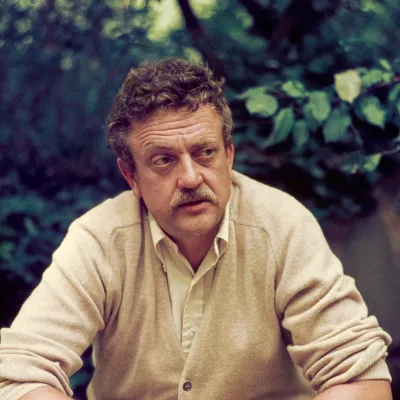
Kurt Vonnegut
Human Design Chart
Biography
Vonnegut served in the Army during WWII and was captured by the Nazis in 1945. He survived imprisonment under the Third Reich and when the war was over was able to write short stories for the "slicks" and science-fiction magazine.
On 30 January 2000 he was rushed to the ER after suffering smoke inhalation while trying to put out a fire at his New York brownstone with the help of a neighbor. He was in serious but stable condition. When released from the hospital, he decided on a change of venue, moving to Northampton, Massachusetts where he taught at Smith College in the fall, 2000. His daughter and son-in-law, both artists, lived there with their three children.
The novelist died in New York City on 11 April 2007 of brain injuries suffered when he fell several weeks earlier in his Manhattan home. He was 84 years old.
The Human Design of Kurt Vonnegut: Manifesting Generator 6/2
Manifesting Generator 6/2 — Design at a Glance
Kurt Vonnegut's Human Design configuration created a hybrid energy structure: He had the constant power of a Generator, yet was also capable of acting with the speed of a Manifestor. This setup meant he could skip steps and pull things into his life quickly. However, this speed carried risks. Often, he acted too hastily, neglected necessary intermediate steps, and found himself having to backtrack to fill in gaps. This often led to frustration, the specific non-self theme of his type. Additionally, he tended to pursue multiple projects simultaneously, driven by different impulses. Without clear internal consent, this creative drive quickly turned into overburdening.
The strategy for his design was not to initiate himself but to react to life. Only when his sacral center – the source of his energy – gave a clear “yes,” should he act. For ongoing projects, it was important to regularly check if this internal resonance persisted. If so, Kurt Vonnegut found deep satisfaction in his work. Parallelism then became not an obstacle but a source of his strength. He needed variety and a playful mode to maintain his energy. The compulsion to complete one thing before starting another stood in opposition to his nature; rather, he flourished in the dynamic interaction of various tasks as long as they were internally reinforced.
Emotional Authority
Kurt Vonnegut's Human Design configuration set a tendency towards emotional wave movement that significantly shaped his decision-making process. He was someone who always perceived the world through the filter of his current mood; what seemed totally exciting at one moment could turn completely negative in the next. These fluctuations were not instability but an expression of a specific inner authority: the defined Emotional Center.
In Human Design mechanics, this center always carries the inner authority regardless of which other centers are also defined. This means Kurt Vonnegut was subject to an emotional wave that showed itself in constant ups and downs of his feelings. His feeling at any given moment was merely a snapshot, a first impression that did not necessarily represent his truth yet. Quick, spontaneous decisions based on such emotions often had negative consequences.
The mechanics required him to have patience and to sleep over decisions multiple times to gain clarity. The more time he took, the deeper and more comprehensive he could see something. Over time, intense feelings subsided, he gained emotional distance, and calmness set in. Only then was he through the process. This mechanism was particularly important for long-term decisions that could have a significant impact on his life course. Through pondering and questioning, he found his true answer beyond the transient emotional coloring.
The 6/2 Profile — Role Model / Hermit
Kurt Vonnegut's Human Design showed a two-phase development: early experimentation followed by later distanced wisdom. In his youth, he acted like a natural talent (Line 3), learning through trial and error. This period was about accumulating many personal life experiences, with retreating after mistakes as the driving principle.
After the age of thirty, Line 6 activated. Vonnegut metaphorically retreated into a “cave” to look back on his earlier experiments from a distance. This phase of intense reflection was also a time of healing and deep self-awareness. From this isolation emerged a wise person whose life wisdom attracted others. They sought him out to partake in his introspective abilities.
This dynamic rooted in Gate 1 (Line 6), which promoted objectivity in dealing with creativity. It allowed him to assess the value of creative work and distinguish true innovation from fashion trends. Wisdom arose here through the realization that new ideas needed time to prove their authentic worth. Simultaneously, Gate 4 (Line 2) worked to foster tolerance and acceptance of limits within oneself and others. Vonnegut learned that misunderstandings often stemmed from poor timing rather than lack of intelligence. This helped him clarify feelings and forgive despite deliberations. The combination of creative objectivity and patient acceptance shaped his journey from experimental youth to reflective authority.
Triple Split Definition — Defined & Open Centers
Kurt Vonnegut's Human Design profile indicated a tendency towards constant mental pressure and deep emotional processing. He was someone who asked questions and formed concepts without the immediate need or desire to turn them into actions. This attitude stemmed from his defined Head Center and Ajna Center: They generated a continuous stream of inspiration and conceptual thinking, but lacked their own energy for direct implementation. Attempting to relieve this mental pressure through hasty action would have frustrated him; instead, his mental activity served to inspire others to think or wait for the right moment to share ideas.
His defined Throat Center allowed him to reliably express these thoughts and concepts, while his defined G Center provided a firm inner direction and self-love. He knew who he was and where he was going without needing to force others to follow this path with him. His energy source lay in the defined Sacral Center: As a Generator, he possessed vital energy that became available only through reacting to external requests. Initiatives from his mind led to resistance and exhaustion; satisfaction came only from activities that his Sacral Center responded to with a clear
Channels for logic, leadership, principles and determination.
Kurt Vonnegut's Human Design profile indicated a tendency towards skeptical analysis and collective influence. His mind constantly sought out consistent patterns to logically categorize questions. The Logic Channel 63-4 connected Head Center with Ajna Center; doubt was essential here, as an answer was only valid if it functioned reliably upon verification. This created an active mind that checked data before making predictions to serve the collective.
At the same time, there was a need for recognized leadership. The Alpha Channel 7-31 connected G Center with Throat Center; this wasn't about sole rule but logical guidance based on verified trends. Kurt Vonnegut sought his own
Collective Circuitry — Circuit Signature
Kurt Vonnegut's Human Design profile indicated a tendency towards analytical clarity paired with deep emotional processing of past experiences. These separate forces worked in parallel, as his Triple Definition did not establish a continuous connection between all centers.
The Understanding Circuit connected two independent segments for him: the Head and Ajna Centers along with Throat and Identity Centers. This promoted an ability to logically structure strategic future visions that were communicated free from emotional coloring. The energy was visual and focused on rational sharing.
Simultaneously, the Meaning Circuit worked separately. Here it linked the Identity Center with the Sacral Center. This configuration generated cyclical emotional waves aimed at giving meaning to the past and sharing these insights based on experiential values. Unlike the cool logic of the first circuit, this was about felt, wave-like processes.
Additionally, the Ego Circuit presented through the connection between Solar Plexus and Root Centers. This supported cooperative dynamics within a group or family based on balanced giving and taking. Since there was no direct link to the Sacral Center in this circuit, rest phases were necessary to regenerate resources for the collective.
Kurt Vonnegut thus combined rational future visions with emotional past reflection, where these areas remained energetically separate but complemented each other through cooperative support within a social context.
Left Angle Cross of Defiance 2
Kurt Vonnegut's Human Design profile indicated a tendency towards internal conflict, manifesting as an ongoing struggle between the desire for personal freedom and societal responsibility. This structure, the left challenge cross two, described a life path where he often felt his personal goals were hindered by external expectations or moral obligations. It was not a passive victim role but rather an active tension: He had to learn to stand in this gap and use it as a source of strength instead of being worn down by it. The mechanics of this cross suggested that his greatest challenge lay in not abandoning his identity while simultaneously bearing the burden of the world or his environment. This shaped a stance of skeptical observation, deeply embedded in human connection yet always feeling the need to distance himself to preserve his integrity. The resulting energy was often arduous but also created the depth and authenticity characteristic of his specific experience. He lived in constant balance between 'I' and 'We', with the design demanding he endure this tension without resolving it through flight or total surrender.
Saturn Return · Uranus Opposition · Chiron Return · 2nd Saturn Return — Life Cycles
Kurt Vonnegut's Human Design profile indicated a tendency towards profound structural breaks, manifesting as creative reorientations throughout his life phases. This dynamic was triggered by planetary cycles that transformed inner tension into outer action.
In 1952, at the age of 30, he published 'Player Piano'. This marked his first Saturn Return, a time when years of groundwork often condenses into a solid result and personal identity is strengthened. For his design, this was the moment when his professional foundation became concrete.
Seven years later in 1959 at age 37, came 'The Sirens of Titan'. This period fell on the Uranus Opposition, a phase of radical upheaval and liberation from old patterns. The publication signaled a departure from the familiar towards new, experimental forms driven by an inner compulsion for change.
The deepest break occurred in 1971 with his divorce from Jane Cox at age 49. This was his Chiron Return, a fulfillment cycle where one's incarnation cross unfolds. Instead of being purely painful, this moment acted as a catalytic point for the final unfolding of his life purpose. The crisis served not to heal old wounds but to clarify his personal path. Through these cycles, his design showed: structure is redefined through breaks to fulfill inner purpose.
Manifesting Generator · Emotional Authority — Synthesis
He was a Generator with a unique dynamic due to the connection between sacral energy and a manifesting component. This combination propelled him to quickly realize ideas (Manifestor), yet the defined Head Center (Logic) demanded constant questioning and verification (Channel 63/4). This process led to a deep need for understanding and an unceasing search for patterns that were consistent. The experience showed he often overlooked important steps, only to return later and reassess them – a cycle of swift action followed by thorough reflection.
A central paradox lay in the tension between his need for quick implementation and the emotional wave pattern of his authority. He lived the profile of role model, initially learning through experimentation and experience (6/2 line), before withdrawing to gain wisdom. Intense reflection during withdrawal gates stood in contrast to the urge to push things forward quickly; a dance between the desire for distance and the ability to inspire others through insight (Understanding Circuit). Crisis events like separation (Chiron Return) seemed to reinforce this cycle.
4 Defined Channels
Incarnation Cross - Left Angle Cross of Defiance 2
Solar Return
The Solar Return shows the moment when the sun returns to its exact birth position - your personal solar year.
Life Cycles
Discover the life cycles with a detailed triple view (birth chart, cycle chart, composite).
Human Design Profile
- Strategy
- To respond - wait for something to respond to
- Authority
- Emotional Authority
- Profile
- 6/2 - Role Model / Hermit
- Definition
- Triple Split
- Incarnation Cross
- Left Angle Cross of Defiance 2
- Date of Birth
- 11.11.1922 00:25
- Place of Birth
- Indianapolis, IN, United States
Frequently Asked Questions
What was Kurt Vonnegut's Human Design type?
What Profile did Kurt Vonnegut have in Human Design?
Which Authority guided Kurt Vonnegut's decisions?
What incarnation cross did Kurt Vonnegut have?
When was Kurt Vonnegut born?
Discover your own Human Design
Are you also a Manifesting Generator? Find out in a personal reading how to unfold your multi-talents and direct your energy wisely.
More Personalities
Back to overviewAlain-Fournier

Aldair

Alizée

Angeli

Arletty

Artus