
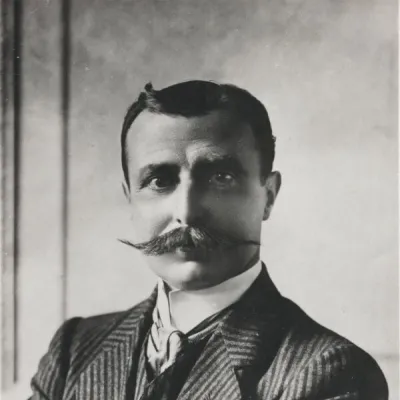
Louis Blériot
Human Design Chart
Biography
What does Generator 1/4 mean for Louis Blériot?
Generator 1/4 — Design at a Glance
Louis Blériot had a tremendous amount of sacral endurance and energy potential. His design laid the foundation for immense work capacity, comparable to that of a strong workhorse that only operated efficiently when responding to external impulses rather than initiating on its own. This Generator mechanics determined his life approach: The energy was primarily released when he responded to signals from his environment and followed his inner "yes."
His strategy involved waiting for a stimulus to come before reacting to it. This was the key to preserving his strength and materializing his heart projects. Deviations from this principle inevitably led to two specific pitfalls. Either he wasted energy on tasks that did not interest him, making him vulnerable to burnout, or he was prevented from working on what truly interested him, even though he still had the energy.
When Louis Blériot acted in accordance with this design by reacting instinctively to life impulses, it rewarded him with a deep sense of fulfillment and satisfaction. If, however, he lived against this nature, for example, by constantly initiating without an external trigger, he encountered persistent frustration and a lack of energy. His strength did not lie in planning or pushing forward but rather in the powerful response to life when called upon.
Sacral Authority
Louis Bleriot's Design sets a tendency to make decisions not through intellectual analysis but based on an immediate physical resonance. As a Generator, his strategy was the reaction: he waited for external stimuli rather than initiating himself. This approach greatly simplified his decision-making process since his strategy and inner authority were identical.
His sacral authority served as the primary instance. It manifested in a gut feeling or surge of energy upon receiving an external trigger. Louis Bleriot learned to pay attention to specific bodily sounds – grunts, hums, groans, or an affirming "mm-hm". When this resonance occurred, he felt vital and alive. Such a state signaled access to seemingly inexhaustible energy. He then tackled his tasks with great enthusiasm and immersed himself in his activities without the need for purposefulness. This allowed him to move through life with joy and satisfaction.
Additionally, his activated Spleen Center acted as a supportive instance to his sacral authority. This configuration gave him the ability to respond quickly and spontaneously to stimuli. He had an immediate connection to his physical well-being and instinctive perception. Louis Bleriot could reliably use these inner signals to make decisions. The combination of sacral confirmation and spleen-induced speed characterized his way of impulsively yet energetically responding to the world.
The 1/4 Profile — Investigator / Opportunist
Louis Blériot's Design inclines towards deep, isolated research that was initially shared only within protected circles. As a 1/4 Profile (Researcher/Networker), he combined the analytical drive of Line 1 with the social urge of Line 4. Line 1 propelled him to study and overcome obstacles through mental analysis in order to gain security. This dynamic also created a latent fear of exposure: his need for thorough expertise clashed with the fear of appearing inadequate before loved ones.
This dynamic required a trusting environment. Only there could Louis Blériot contribute his acquired knowledge without heartache or rejection. Line 4 enabled him to build authority by sharing insights within a close trust network. This protected base allowed him, through deep understanding and networking skills, to become an acknowledged authority in matters of the heart. His path was marked by the necessity to first research alone and selectively test before connecting his findings with those emotionally close to him. This shielded him from hostile forces and secured the success of his efforts through targeted exchanges rather than diffuse public work.
Single Definition — Defined & Open Centers
Louis Bleriot's Design establishes a tendency towards inner confidence and constant endurance. His defined G Center grants him a firm sense of self-identity and clarity about his life direction, without the need for control. This internal security allows him to provide guidance to others while his defined Sacral Motor provides a reliable source of vital energy. He does not act through initiative but rather reacts: his strength ignites only when life asks or delivers. An immediate "yes" from the gut signals available energy; a "no" protects against exhaustion. This is supported by his defined Root Center, which generates a steady survival drive and propels him forward during stressful phases.
In contrast, Head, Ajna, Throat, Heart, Solar Plexus, and Spleen remain open. These centers reflect situational environmental pressure without Louis Bleriot personalizing them. His open Head and Ajna Centers make him flexible for other people's inspirations but also tend to get stuck in non-personal mental questions or seek answers he cannot provide. His open Heart Center is not geared towards willpower or competition; it avoids the need to prove his worth through promises. Instead, he remains open to the emotions of his environment (more open Solar Plexus) without identifying them as his own and reflects them more like a barometer. Similarly, his open Spleen Center makes him sensitive to environmental intuition and health signals but warns against making spontaneous decisions out of fear or false feelings of security. By waiting for the correct reaction from his defined centers, he uses his energy efficiently and remains untouched by the conditioning streams of his open fields.
Channels for steady rhythms and the process of growing.
Louis Bleriot's Design established a natural and logical life flow characterized by firm habits and intuitive timing. This stability came from the Rhythm Channel 5-15, connecting the Sacral Center with the G Center. Gate 5 held fast to rituals while Gate 15 used love for extremes to integrate variety into his life flow. This created a magnetic, impersonal attraction that drew others into his energy field and connected them on an equal footing without being distracted by emotional waves or intellectual arrogance.
Parallel to this, Channel Maturity 42-53 propelled a cyclical process of experiencing new ventures. By linking the Root Center with the Sacral Center, Louis Bleriot initiated new projects, completed them fully, and reflected afterwards to gain wisdom. Gate 53 marked the beginning, while Gate 42 signified growth; this cycle was not goal-oriented but served to collect experiential knowledge for future generations. A premature interruption would have required repetition; completing the full cycle ensured the depth and integrity of his insights.
These calm channels stood in contrast to Personality Sun at Gate 39, which brought an aggressive, selective energy with mutation, provocation, and adrenaline. This readiness for battle served to preserve individual integrity, supported by Gate 38, which built resistance against harmful forces. The challenge lay in channeling this explosive energy through the stabilizing flow of Rhythm and the disciplined structure of Maturity. Provocation here did not act as a conflict issue but rather as a catalyst for necessary changes that were integrated within the safe harbor of completed cycles. Thus, a balance was struck between mutating dynamics and cyclical constancy.
Collective Circuitry — Circuit Signature
Louis Bleriot's Design establishes a tendency to connect rational strategies for the future with emotional reflections from the past. Both aspects culminate in a common goal: sharing insights with the collective. His simple definition links the Sacral Center directly to the Identity and Root Centers, creating a continuous flow of these energies.
The Understanding Circuit operates through Channel Rhythm (Gates 15/5). It connects Bleriot's Identity Center with his Sacral Center, promoting a focused, logical approach aimed at developing structured solutions for future challenges and communicating them clearly. This energy is strategic and visually oriented, free from emotional conditioning.
Parallel to this, the Meaning Circuit functions through Channel Maturity (Gates 42/53). This connects the Sacral Center with the Root Center. Here, it's about cyclical, wave-like emotional experiences and searching for meaning in past events. This energy is less logical, based on felt insights shared for collective learning from the past.
Although both circuits use different formats – focused versus cyclical – they unite at the Sacral Center as a common source. Louis Bleriot embodies the tension between cool logic and emotional meaning seeking, with sharing these dual experiences being central.
Right Angle Cross of Tension 2
Louis Blériot's Human Design shows a tendency towards internal tension that manifested as a driving force for his actions. This configuration stems from the right cross of tension 2, a specific energetic structure in the Human-Design system. It describes not just passive experience of pressure but an active, often unconscious search for friction and challenges. For Louis Blériot, this internal tension was an integral part of his identity; it functioned as a compass guiding him towards situations that disrupted stability or required new solutions.
The mechanics of this cross acted like an inner motor that perceived rest often as stagnation and instead sought resistance to generate energy. It wasn't destructive conflict but the necessity to create clarity and forward movement through confrontation with external or internal obstacles. This dynamic quality shaped Louis Blériot's way of perceiving his environment: he reacted particularly to elements generating tension, using this as raw material for personal growth and action. Energy flowed where resistance stood, establishing a pattern that did not avoid challenges but viewed them as necessary nourishment for development. This structure significantly determined how Louis Blériot received impulses and translated them into concrete steps – always driven by the deeply rooted dynamism of using tension rather than avoiding it.
Saturn Return · Uranus Opposition · Chiron Return · 2nd Saturn Return — Life Cycles
Louis Blériot's design showed a tendency towards structural maturity followed by disruptive new beginnings. This dynamic was made tangible through two key phases in his life: the first Saturn return and the Uranus opposition.
In 1901, at age 29, he married Alicia. This marked his first Saturn return, a cycle often condensing years of groundwork into stable results. For his design, this was a moment of consolidation and anchoring in a relationship that offered stability.
Another pattern emerged in 1914 when, at the age of 42, he founded a new company after World War I. This coincided with the Uranus opposition, an aspect often requiring sudden changes and breaking old structures. Founding a new company post-war was an expression of this disruptive energy: a fresh start that did not arise from gradual development but from the necessity of a radical cut.
These two events illustrate the mechanics of his design: cycles of consolidation (Saturn) alternated with phases of upheaval (Uranus). Louis Blériot lived this sequence not as contradiction, but as rhythmic process. Marriage anchored him; founding a company severed old ties to make way for new structures. His design required embracing both the depth of anchoring and the sharpness of cutting – each at its right time.
Generator · Sacral Authority — Synthesis
Louis Blériot was a Generator whose life was marked by the necessity to respond to the sacral center and release energy through action. This fundamental principle of acting in response to external stimuli runs like a red thread through his entire being. The definition in the root center strengthened this impulse, creating constant physical readiness for forward movement – an unstoppable drive that propelled him to accept challenges and overcome obstacles. By connecting the sacral with the G-center, a deep sense of direction and inner compass emerged, helping him find his way in the world. The open design of many centers points to high sensitivity to external influences, yet this openness enabled him to learn from experiences and adapt.
A central paradox in Blériot's design lies in the interplay between the defined G-center – suggesting a clear sense of direction – and the open centers, particularly the solar plexus and spleen. While the G-center suggests a firm identity and goal, openness points to vulnerability to external emotions and fears. Thus, he was simultaneously guided by a strong inner drive while constantly receiving signals from his environment. This tension between self-determination and adaptability shaped his decisions and led him to what he achieved.
2 Defined Channels
Incarnation Cross - Right Angle Cross of Tension 2
Solar Return
The Solar Return shows the moment when the sun returns to its exact birth position - your personal solar year.
Life Cycles
Discover the life cycles with a detailed triple view (birth chart, cycle chart, composite).
Human Design Profile
- Type
- Generator
- Strategy
- To respond - wait for something to respond to
- Authority
- Sacral Authority
- Profile
- 1/4 - Investigator / Opportunist
- Definition
- Single Definition
- Incarnation Cross
- Right Angle Cross of Tension 2
- Date of Birth
- 01.07.1872 23:50
- Place of Birth
- Cambrai, France
Frequently Asked Questions
What was Louis Blériot's Human Design type?
What Profile did Louis Blériot have?
Which Authority guided Louis Blériot?
What incarnation cross did Louis Blériot have?
When was Louis Blériot born?
Discover your own Human Design
Are you also a Generator? Find out in a personal reading how to use your sacral energy correctly and discover deep satisfaction.
More Personalities
Back to overviewAaliyah

Alexia

Angèle

Anne-Marie

Arcángel

Arno
