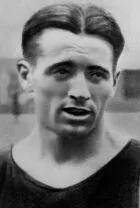
Luigi Beccali
Human Design Chart
Biography
He was the first Italian to win a European Championship title in athletics.
Luigi Beccali, an Italian champion in 1500 m from 1928 to 1931, became a national hero overnight when he won the Olympic 1500 m gold at Los Angeles.
In 1933, Beccali ran three world records.
He died on 29 August 1990 in Daytona Beach, US.
Luigi Beccali — Manifesting Generator with Profile 2/4
Manifesting Generator 2/4 — Design at a Glance
Luigi Beccalis Design shows a tendency towards hybrid dynamics: He combined the constant power of a Generator with the lightning-fast execution power of a Manifestor. As a Manifesting Generator, he had a defined Sacral Center that provided him with steady energy, yet unlike a pure Generator, he could skip steps through his Motor Channels and quickly pull things into his life. However, this speed carried specific risks: Beccali was prone to overlooking important intermediate steps, which forced him to backtrack and fill in gaps—a process that quickly frustrated him, touching on the non-self theme of his configuration. Additionally, his design tended to pursue multiple projects simultaneously as he responded to various impulses. Without constant validation from his inner authority, this creative drive could easily turn negative. His strategy was not to initiate but to react to life's impulses and then act only when his Sacral Center signaled a clear "yes." Regularly reviewing his projects after receiving this confirmation was essential for him. If he maintained this discipline, Beccali reached a state of deeper satisfaction. For him, linear progression was restrictive; instead, his energy flourished in the "play mode," where variety and parallel work were not distractions but sources of fulfillment. His effectiveness therefore depended less on the number of completed tasks than on whether he remained in this rhythmic, playful flow rather than struggling against his own speed.
Emotional Authority
Luigi Beccalis design points to a tendency towards delayed decision-making; he appeared as someone who needed patience to gain clarity. His inner authority carried the defined Emotional Center. This meant that his perception was marked by constant emotional waves – an ongoing up and down of his feelings. In one moment, he could be excited about something, in the next view it negatively. However, his feeling in the moment was only a snapshot, not necessarily the truth. Quick, spontaneous decisions based on emotion were risky for him and could have negative consequences.
The mechanics of his emotional authority required that he let decisions ripen. The more time he took, the deeper and more comprehensive his understanding became. This demanded patience and repeatedly sleeping on a decision. He should take his time properly. Over time, intense feelings subsided, he gained emotional distance, and calmness set in. Then he was through the process. This need for temporal distancing served to avoid emotional distortions. Since the Emotional Center was activated, this authority always applied, regardless of what else was defined in his chart. Only a Reflector could not have such authority; Luigi Beccali followed this rhythm. Long-term decisions that influenced his life course required this process particularly strongly.
The 2/4 Profile — Hermit / Opportunist
Luigi Beccali showed a pronounced tension between the deep desire for withdrawal and the simultaneous urge towards community. His design suggested that he constantly oscillated between these two poles: Line 2, which promotes hermitage and internal reflection, and Line 4, which seeks out networks and exchange with familiar people. For him, it was crucial to create a safe environment where he could clearly communicate these needs – when he needed company and when he wanted to be left alone.
During his "Me-Time," Beccali immersed himself in inner processes to gain clarity. This phase of isolation served to develop ideas and build expertise, while he learned to delegate responsibility and focus on skillfulness rather than constant self-justification. Once this internal need was satisfied, Line 4 came into play. Then he left his "cave" to meet up with his favorite people. Here, he used direct experiences and simple solutions to reflect on the accumulated knowledge of his network and gain new insights. This conscious shift – withdrawal for inner order, then community for integration – defined his way of developing brilliant ideas through the connection of introspection and social exchange.
Single Definition — Defined & Open Centers
Luigi Beccali revealed himself as someone with a massive, defined energy foundation and a clear inner compass. His design indicated a tendency towards constant expressiveness, guided by emotional depth. The defined throat served as a pivot point for communication; it transmuted information from the body into reliable messages. Since the throat was connected to sacral and G energies, he spoke from his vital strength and personal identity. The defined G Center endowed him with a fixed sense of self-worth and direction in life without being dependent on others.
This stable foundation contrasted with open centers like Head, Ajna, Heart, and Spleen. Here lay the challenge: Not to follow mental pressure or the desire for proof of his worth but to trust the sacral response instead. The open head center tended to get stuck in doubts and confusion when trying to find answers that were not its own. Instead of succumbing to mental stress, he had to remain an observer of his thoughts. An open Ajna Center meant that concepts and opinions were not his personal truth; he could take on many ideas without having to adhere to them.
The open heart center lacked consistent willpower for initiatives. There was no energy to keep promises or prove his worth through competition. Instead, the strategy of waiting was essential: Not initiating but waiting until life asked so that the defined sacral center could respond. The sacral energy provided enormous vital force available only with a confirming response. An open spleen center made him vulnerable to survival fears and spontaneous decisions from uncertainty. He learned not to act impulsively but to observe his fears without being led by them. By waiting for the emotional wave in the solar plexus, he achieved clarity before acting. Thus, he used his energy efficiently rather than wasting it through mental or emotional impulses.
Channels for inspiration, rhythm, emotional depth and drive.
Luigi Beccali's design indicated a tendency towards powerful, generative life force that drove new directions and innovations. This energy flowed through Channel of Inspiration 1-8 connecting the G Center with the Throat Center via Gate 1 of Self-expression and Gate 8 of Contribution. Here, internal innovation was not only kept internally but carried outward as an inspiring example. By living his unique identity, Luigi Beccali drew attention to himself and potentially changed others' perspectives by inspiring new directions in them. This was not explained through words but achieved through exemplary presence.
Additionally, Channel of Openness 22-12 between Solar Plexus and Throat Center as well as Channel of Recognition 30-41 between Root and Solar Plexus were at work. The former expressed emotional volatility and passion regulated by the caution of Gate 12. The latter generated a drive for new experiences driven by restlessness and emotional intensity. Further gates like 29 (Yes), 53 (Freedom) and 62 (Logic) rounded out his profile, providing persistence, the start of new cycles and the ability to recognize patterns.
Individual Circuitry — Circuit Signature
Luigi Beccali's design indicated a tendency towards synthesis of innovative expression and emotional reflection. As someone with simple definition, all his defined centers – Throat, Solar Plexus, Identity, Sacral and Root – flowed in one continuous energetic system. This created an integrated experience where creativity and feelings did not act separately but directly influenced each other.
The Knowledge Circuit shaped his way of expression. Through the channels Inspiration (1-8), Openness (22-12) and The Beat (2-14), it connected Luigi Beccali's Throat Center with Solar Plexus, Identity and Sacral center. This connection allowed him to directly translate new ideas and individual impulses into speech or action driven by a pulsing creative energy.
Parallel to this, the Meaning Circuit was at work. The channel Recognition (30-41) connected his Solar Plexus Center with Root Center. This generated a cyclical emotional wave tending to reflect on past experiences and give them meaning. Here, the energy was less focused on future innovation than understanding what had already happened.
The interface of these two circuits lay in the Solar Plexus Center. There, the impulsive, creative waves of the Knowledge Circuit met the reflective, history-oriented emotions of the Meaning Circuit. Luigi Beccali thus revealed himself as someone who not only expressed his unique ideas from the moment but filtered them through the lens of emotional depth and historical significance. His expression was therefore both innovative and marked by a deep, wave-like emotionality that connected past and present.
Right Angle Cross of Contagion 4
Luigi Beccali's design carried the signature of the right infection cross 4. This configuration established a specific energetic alignment, which remains unspecified in the given data. The right infection cross 4 is identified as a structural component of his Human Design chart, yet there are no details about its impact on character traits, behavior, or energy flow. Therefore, it's not possible to derive a detailed description of his lifestyle, typical reactions, or inner dynamics from this element alone. Mentioning the cross marks merely an architectural feature in his design without specifying any human experiences or challenges associated with it. Luigi Beccali lived with this configuration, whose concrete manifestation in everyday life is not explained by the raw content provided. The analysis thus focuses solely on identifying the presence of this element in his chart without further interpretations about its function or significance for his personal experience. It remains a neutral naming of a design component, whose deeper mechanical implications are not elaborated.
Saturn Return · Uranus Opposition · Chiron Return · 2nd Saturn Return — Life Cycles
Luigi Beccali's design indicated a tendency towards structured self-assertion that intensified at age 27. He was someone who strengthened inner clarity through external validation, reflecting the first Saturn return cycle, where years of groundwork often culminate in a sustainable outcome and the individual's identity is seriously scrutinized.
In 1934, Luigi Beccali won the gold medal at the European Championships in Turin. This success was no coincidence but rather the concrete expression of this developmental phase. The first Saturn return typically marks a trial by fire where the individual learns to channel their strength sustainably and set boundaries. For Luigi Beccali, it meant he had found the necessary structures to fully exploit his potential at the highest level. The gold medal thus symbolized the successful integration of his inner dynamics into a stable, recognized form. This moment confirmed the effectiveness of his design: through discipline and focus, he managed to translate his energy into measurable, excellent results. It was the point where his potential not only showed but anchored itself as real achievement in life.
Manifesting Generator · Emotional Authority — Synthesis
Luigi Beccali lived a life marked by the dynamic tension between inner strength and external expression. As an Manifesting Generator with defined Throat Center and G Center, he had a constant energy source and a clear sense of self-identity. This combination allowed him to react quickly to impulses while simultaneously radiating strong self-confidence – a skill evident in his pursuit of performance and recognition. The connection between Sacral and G Centers gave him the endurance to pursue his visions, while the defined Throat Channel enabled him to communicate these authentically and inspire others.
A central paradox in his design lay in the interplay between the need for solitude (Line 2) and the desire for community (Line 4). This tension necessitated connecting phases of reflection with moments of exchange. Emotional authority challenged him not to rush decisions but to wait out the full range of his feelings – a process contrasting with the quick reaction time of a Manifesting Generator, requiring conscious self-regulation.
4 Defined Channels
Incarnation Cross - Right Angle Cross of Contagion 4
Solar Return
The Solar Return shows the moment when the sun returns to its exact birth position - your personal solar year.
Life Cycles
Discover the life cycles with a detailed triple view (birth chart, cycle chart, composite).
Human Design Profile
- Strategy
- To respond - wait for something to respond to
- Authority
- Emotional Authority
- Profile
- 2/4 - Hermit / Opportunist
- Definition
- Single Definition
- Incarnation Cross
- Right Angle Cross of Contagion 4
- Date of Birth
- 19.11.1907 02:00
- Place of Birth
- Milano, Italy
Frequently Asked Questions
What was Luigi Beccali's Human Design type?
What profile did Luigi Beccali have?
What authority did Luigi Beccali have?
What incarnation cross did Luigi Beccali have?
When was Luigi Beccali born?
Discover your own Human Design
Are you also a Manifesting Generator? Find out in a personal reading how to unfold your multi-talents and direct your energy wisely.
More Personalities
Back to overviewAldair

Alizée

Angeli

Arletty

Artus

Balthus