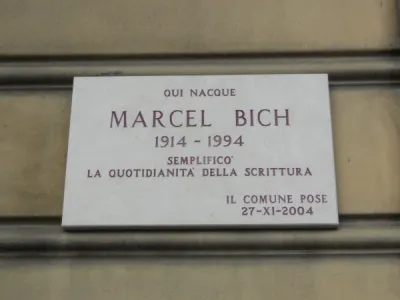
Marcel Bich
Human Design Chart
Biography
Born an aristocrat, the Baron Marcel Bich began a fountain-pen company in 1950 with a partner, Edouard Buffard. He decided to improve on the method of fabrication of a ball-point pen (invented by Hungarian Laslo Biro) and soon introduced this revolutionary product on the market. Later on that same year, he met Pierre Guichenné, president of an advertising firm. Guichenne convinced Bich to drop the ‘’h’’ in his name and use Bic as a universal trademark. The results of the 1951-1952 advertising campaign organized by Guichenné were phenomenal with Bic selling over 200,000 pens each day!
In 1954 Bic branches were created in Italy and Brazil; in 1957 the company bought Biro Swan Ltd in England and in 1958 took control of the Waterman Pen Company in the U.S. An important breakthrough came on 3 September 1965, when the students in France were authorized to use the pen. Several take-overs were orchestrated in the following years, one of the last major one being the Sheaffer Group in 1997.
A passionate sailor, Bich participated in four America Cup events. He made a third marriage on 26 June 1956 and fathered 11 children. He died on 30 May 1994 at age 79 in Paris.
Marcel Bich — Generator with Profile 4/6
Generator 4/6 — Design at a Glance
Marcel Bich's design indicated a tendency towards great endurance, which was not unfolded through constant initiation of actions. Instead, his nature showed him as someone who primarily released his strength by reacting to external impulses. As a Generator, he possessed a lot of sacral energy, comparable to a workhorse that is strong and steady—provided it finds nourishment for its task. This energy became effective when he responded to signals from the environment, acting "from the gut" rather than taking the first step himself.
The successful use of this dynamic led him to deep fulfillment and satisfaction. Conversely, frustration or energy depletion threatened if he violated this principle: either by doing things that did not resonate internally, or by being prevented from pursuing his heart projects while still full of power. His design thus required waiting for an internal "yes" before taking action. Reacting rather than initiating was the key to maintaining his high endurance and preventing burnout. If he followed this strategy, nothing could stop him; if he did not live according to this pattern, he encountered persistent frustration. His energy served to materialize things in life, but only when activated by a response to a life signal.
Emotional Authority
Marcel Bich's inner authority lay in his defined Solar Plexus Center, fundamentally shaping his decision-making process. He was subject to an emotional wave that manifested as a constant up and down of his feelings. The world appeared colored by his current mood: at one moment he would be totally enthusiastic about something, only to see the same thing completely negatively the next. His feeling in the moment, however, was merely a snapshot, a first impression that did not necessarily represent his truth yet. Therefore, quick and spontaneous decisions based on emotion could have very negative consequences.
The more time Marcel Bich took to let a decision mature, the deeper and more comprehensively he could understand something. This required patience and reconsidering an issue multiple times. He should take his time and ask himself repeatedly. Over time, intense feelings subsided, he gained emotional distance, clarity emerged, and calmness set in. Only then had he gone through the process. This mechanism was particularly relevant for long-term decisions with significant influence on his life course. Since the Solar Plexus Center was defined, this emotional authority always took the lead in orientation, regardless of other defined centers in his chart.
The 4/6 Profile — Opportunist / Role Model
Marcel Bich showed himself to be someone whose life was marked by a clear developmental trajectory: in the first three decades, an experimental and relationship-focused approach dominated. His design indicated a tendency to be motivated by social interaction and recognition – Line 4 of Profile 4/6 sought belonging and success within the community network. Criticism or rejection were not seen as personal defeats but rather as necessary impulses for improvement.
After his thirtieth year, his focus shifted fundamentally. Line 6 became active, placing him in the tension between the heart (the desire for connection) and the head (the necessity of detached reflection). Marcel Bich developed from pure experimentation into the role of a wise role model and mentor. His generosity was filtered through a realistic protective mechanism: he learned to give trust without being exploited. This process fostered altruism and care, which were based on fairness and a clear measure of awareness. In his later years, those around him expected this authority from him – not as a detached observer but as a cooperative partner who helped others find their own paths through his experiences. The initial search for validation thus transformed into a trustworthy, altruistic stance that balanced emotional engagement with rational distance.
Triple Split Definition — Defined & Open Centers
Marcel Bich's design showed a tendency towards constant inner drive and mental intensity. His chart revealed someone with an inexhaustible supply of vital energy, coupled with a persistent pressure to ask questions and find answers. This configuration described a structure without situational dependency on the environment for core functions; all motors and consciousness centers were defined.
The defined Head-Ajna channel created constant mental pressure towards inspiration and questioning. This did not mean he always knew the solution but that his mind constantly sought understanding. Simultaneously, the defined Heart Center provided consistent willpower and ego strength, enabling him to keep promises and use his resources self-determinedly. The defined Sacral Center offered an inexhaustible source of vital energy for work and expression, yet based on reaction – he needed the right timing to make his power effective.
Emotional clarity dictated his defined Solar Plexus Center as inner authority; he was inclined to wait out emotional waves before deciding. His defined Spleen Center provided spontaneous intuition in the present moment, while the defined Root Center delivered physical pressure to move forward and transform stress into constructive energy.
In contrast, his open centers shaped specific vulnerabilities. The open G Center meant that he did not have a fixed identity but rather acquired it through interaction with the environment; he tended to question whether he was in the right place to find the correct direction. The open Throat Center led him to be unable to communicate consistently and had to wait for invitations to gain attention instead of forcing it by constant talking. This openness protected him from being forced into false roles or inappropriate expressions as long as he followed his inner authority.
Channels for community, synthesis, care and abstract comprehension.
Marcel Bich showed himself as someone who held social structures together through emotional bonding and mutual care. His energy served not isolated thinking but the creation of stable communities where loyalty and trust formed the foundation. He sought the place where he was needed to take responsibility for others – an attitude described as 'enlightened self-interest': Only those who properly care for themselves can sustainably nourish others.
This orientation resulted from the synthesis of several channels. The Synthesis Channel 19-49 connected the Root Center with the Solar Plexus through the Gates of Claims and Principles. This channel acted as an emotional glue, determining who belonged to the group and who did not. It created a foundation of love, honor, and obedience, where loyalty was exchanged for coverage of basic needs. Marcel Bich was programmed to find fairness and balance between feasibility and community welfare.
This was complemented by the Preservation Channel 27-50, which connected the Sacral Center with the Spleen Center. Through the Gates of Care and Values, his aura automatically attracted trust. People sought him out for support – whether in raising children or caring for the elderly. This channel required clear boundaries: help was only provided when requested and his own energy was available.
The framework here was set by the Community Channel 37-40, which linked the Solar Plexus Center with the Heart Center. The Gates of Friendship and Solitude ensured that agreements were carefully reviewed before being closed. Marcel Bich waited for the right invitation into an organization or relationship to find his place in the whole. His decisions were strongly dependent on the quality of these interpersonal contracts based on reciprocity and long-term stability.
Tribal Circuitry — Circuit Signature
Marcel Bich's design showed a tendency towards cyclical, wave-like engagement paired with the need for clear pauses for regeneration. This structure emerged from his Triple Definition: three separate, not directly connected energy groups existed parallel within him.
The first group included Heart, Solar Plexus, and Root Centers, linked by the Ego Circuit. Here, Channel 37-40 (Community) promoted a give-and-take relationship – 'today I give, tomorrow you give'. As there was no connection to the Sacral Center, constant life force was lacking; energy flow followed a ratchet movement. This required traditional, conservative support in the collective and forced necessary rest phases between active phases of resource creation. Channel 49-19 (Synthesis) in this group supported information integration for these cooperative purposes.
The second isolated group connected Sacral and Spleen Centers via the Archer Circuit. Here, Channel 27-50 (Preservation) provided instinctive care and conservation, separate from the rest of the system.
The third group consisted of Head and Ajna Centers, linked by the Sense-Finding Circuit. Channel 64-47 (Abstraction) directed energy towards understanding past experiences and sharing emotional insights with others. This abstract processing stood in no direct flow to the other two groups. Marcel Bich's mechanics thus showed three independent functioning ways: cooperative, pause-needing action in the stem area, instinctive conservation, as well as reflective abstraction – each independently acting.
Right Angle Cross of the Unexpected 2
Marcel Bich's energetic signature was marked by the right cross of the Unexpected. This defined a life dynamic that did not develop linearly or predictably, but rather distinguished itself through spontaneous turns and unexpected opportunities. His path unfolded as a sequence of surprises and unforeseen events. The central challenge lay in not interpreting this unpredictability as an obstruction, but rather accepting it as an essential part of his own journey. It was about trusting that the unexpected would pave the way. This configuration described an existence characterized by flexibility and reaction to the new, rather than through rigid planning. Marcel Bich found himself in a structure that integrated surprises. The right cross of the Unexpected suggested that his life was marked by moments lying outside any control. The mechanics of this design emphasized the necessity of accepting the flow of events instead of opposing it. It was a dynamic that utilized unpredictability as a driving force. Marcel Bich lived in a reality where the unexpected did not exist as an exception but as a rule. This energetic alignment shaped his way of acting and reacting, suggesting openness to sudden changes. His design challenged him to let go of control and give space to surprises, since these formed the core of his development.
Saturn Return · Uranus Opposition · Chiron Return · 2nd Saturn Return — Life Cycles
Marcel Bich's life followed a clear rhythm of anchoring and realignment driven by Saturn return cycles. These phases marked critical turning points for identity and responsibility, structuring his life path.
The first Saturn Return around age 31 presented itself as a moment of foundation laying. In 1945, Marcel Bich founded the company BIC in Paris. This event solidified his professional identity sustainably and created a stable basis for future actions, typical of the consolidating power of this first cycle.
The second Saturn Return around age 56 brought instead a phase of testing and challenge. In 1970, Marcel Bich initiated an attempt with the yacht France I in the America's Cup. This was not just a success but a complex process that tested his leadership role and required new responsibilities.
These two cycles show how Saturn return times for Marcel Bich served not only as biological markers but as active shapers of his life structure. The first cycle strengthened the foundation through founding, while the second demanded adaptation and resilience in a new, challenging dimension. His biography illustrates the mechanical function of these cycles: they compel confrontation with one's positioning in the world and redefine which burdens must be carried. Marcel Bich responded to these impulses through concrete enterprises that sharpened his identity as an entrepreneur and visionary, even if the path there was marked by crises.
Generator · Emotional Authority — Synthesis
Marcel Bich was a Generator whose life was marked by deep, sacral energy – a constant urge to react to life's impulses through action. This responsiveness combined with emotional authority compelled him not to make decisions in the present moment but to let them ripen within the waves of his feelings. His profile as a networker and role model suggests that he initially experimented much before taking on the role of a wise mentor – a development shaped by the interplay of community feeling (Line 4) and the need for inner reflection (Line 6). The defined root base created constant pressure to move forward and secure resources, while the connection to the Solar Plexus fostered deep sensitivity towards others' needs.
A central paradox in Marcel Bich's design lies in the tension between a desire for community and the search for individual direction. The defined Ego Circuit emphasized cooperation and the joint creation of resources, while the open G Center made him vulnerable to seeking identity and meaning in relationships with others. This dynamic likely led him to redefine himself repeatedly by taking on the energy of others and reflecting it through his work and engagement – a constant shift between the need for belonging and discovering one's own path.
4 Defined Channels
Incarnation Cross - Right Angle Cross of the Unexpected 2
Solar Return
The Solar Return shows the moment when the sun returns to its exact birth position - your personal solar year.
Life Cycles
Discover the life cycles with a detailed triple view (birth chart, cycle chart, composite).
Human Design Profile
- Type
- Generator
- Strategy
- To respond - wait for something to respond to
- Authority
- Emotional Authority
- Profile
- 4/6 - Opportunist / Role Model
- Definition
- Triple Split
- Incarnation Cross
- Right Angle Cross of the Unexpected 2
- Date of Birth
- 29.07.1914 12:30
- Place of Birth
- Turin, Italy
Frequently Asked Questions
What was Marcel Bich's Human Design type?
Which Profile did Marcel Bich have?
What was Marcel Bich's Authority?
Which incarnation cross was active for Marcel Bich?
When was Marcel Bich born?
Discover your own Human Design
Are you also a Generator? Find out in a personal reading how to use your sacral energy correctly and discover deep satisfaction.
More Personalities
Back to overviewAaliyah

Alexia

Angèle

Anne-Marie

Arcángel

Arno