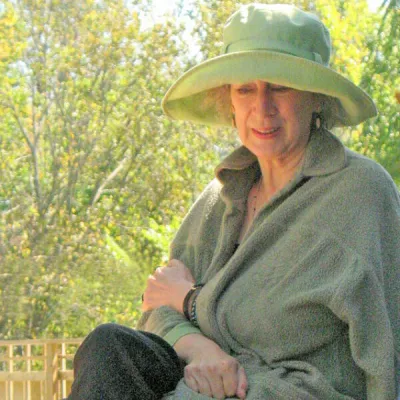
Margaret Atwood
Human Design Chart
Biography
The Human Design of Margaret Atwood: Reflector 2/4
Reflector 2/4 — Design at a Glance
Margaret Atwood's design established a foundational structure without constant personal energies. As a Reflector, she did not have defined centers, meaning her internal state was not shaped by stable personal impulses but rather dynamically oriented towards her environment. She acted as a mirror of humanity and perceived the energy of her surroundings, including seasons and celestial constellations, particularly intensively. This configuration required a specific approach to decision-making: The strategy involved waiting for at least one lunar cycle before taking important steps. Through this alignment with natural rhythms, she automatically found suitable environments and people. If Margaret Atwood lived according to this design, she could observe the world free from attachment and was rewarded with feelings of joyful surprise. A life against this principle would have led to deep, persistent disappointment both regarding herself and the state of the world. Her mechanics thus did not describe a fixed character core but rather a highly sensitive resonance capability that could only unfold its full positive effect through patience and cycle orientation.
No Inner Authority
Margaret Atwood showed herself as someone whose decision-making did not stem from an inner physical authority, but arose through dialogic exchange and energetic resonance in her open centers. As a mental projector, she lacked defined centers below the Throat Center, meaning that her responses to situations were not pre-programmed but only crystallized in contact with others. This exchange activated dormant potentials and allowed her to view and express issues from multiple perspectives. Her high resonance capability helped her find the right people and environments for this necessary dialogue.
However, evaluating this complex information flow required withdrawal and time. Margaret Atwood needed alone time to recognize the red thread, separate what was essential from what wasn't, and structure meaningfulness. This filtering process was crucial for developing her specific intelligence. Over time, she learned what belonged to her and which information could be meaningfully organized. Her success capital lay precisely in this ability: to filter out the core issue from a mass of impressions and clearly organize it. The necessity of exchange to activate potentials always stood in balance with the duty of solitary reflection to gain clarity.
The 2/4 Profile — Hermit / Opportunist
Margaret Atwood's design tended towards a constant alternation between seclusion and network work. She showed herself as someone who sought inner clarity through withdrawal, then brought this into trusted circles. This pattern stems from Profile 2/4, the 'Natural Talent / Networker'. Here exists a fundamental tension: Line 2 demands solitude to deepen expert knowledge and take responsibility, while Line 4 drives the need for community and direct experience with known people.
For Margaret Atwood, it was crucial to set clear boundaries. She had to communicate when she sought company and when she wanted to remain undisturbed in her 'cave'. Only when the need of Line 2 for peace was satisfied could she open up again. During this phase of withdrawal, she reflected on the knowledge from her network, evaluated it, and developed new ideas from it. Line 4 supported this through a pragmatic focus on experiences and direct actions without unnecessary complications.
This alternation shaped her work style: first intense, isolated engagement with the topic, followed by exchange in the community. Without structured communication about availability, the potential of the profile would have been at risk due to frustration if it was unclear when someone could be called upon or whether one could withdraw. Margaret Atwood used this dynamic to process her internal knowledge and then make it effective in her trusted environment.
No Definition — Defined & Open Centers
Margaret Atwood's design was characterized by complete openness in all nine centers, resulting in extreme sensitivity to the environment. Without defined energy sources, her system acted as a mirror: The open Head and Ajna Centers absorbed mental inspirations as well as doubts, causing her to easily fall into foreign thought patterns. Instead of seeking consistent answers, she tended to question whether she was drawing the right conclusions or sought external confirmation for her intellectual processes.
This resonance mechanism extended to the open G Center, which did not offer a fixed identity. Margaret Atwood adapted to people and places to sense what was correct rather than dictating a rigid direction. The open Heart Center lacked consistent willpower; she tended to want to prove her worth through performance or make promises that overextended her energy in order to gain acceptance.
In the emotional realm, the open Solar Plexus Center acted as a barometer for others' moods. She picked up on and amplified the fluctuations and feelings of others, which could lead her to personalize emotional waves that were not hers. The open Sacral and Spleen Centers caused fluctuating vitality limits; she absorbed the generative energy of her environment, leading to exhaustion if she did not pause, and made risky spontaneous decisions in health or survival areas. Finally, the open Root Center took on external stress, which she could misinterpret as her own drive rather than letting it go. The challenge always lay in distinguishing taken-in material from inner authority.
Channels & Gates
Margaret Atwood's design indicated a tendency towards skilled, pulsating handling of power. She was someone who accumulated and preserved strength with grace and self-control rather than openly displaying it. This attitude stems from Gate 14 (Line 2), which carries individual process energy: It’s about preserving the “Great” through restraint and the right timing mechanism.
This energy drives the Sphinx Cross, initiating a fundamental direction-finding process. Crucial here is that this mutation does not occur in isolation; it requires the influence of Gate 2 to be completed. Margaret Atwood thus acted as an initiator of changes that rely on resonance and exchange to fully unfold their effects.
Parallel to this, other gates shaped her profile. Gate 8 emphasized the need to advocate for group goals individually. It was about attracting attention through the expression of one’s uniqueness and acting as a creative role model – a contribution that needs support to become a mutation.
In the emotional realm, Gate 30 was at work. It represented the recognition of feelings and control over inner fire. Here there was a longing for positive experiences, coupled with learning from illusions: The realization that absolute freedom is often an illusion and that limitations must be accepted as fate.
Gate 29 rounded out the picture as the Yes-Saying Gate in the Sacral Center. It underscored the importance of persistence in the face of challenges (“depth beyond depth”). The reward for correct action was inevitable, provided Margaret Atwood said “yes” only when it was true – false agreement would otherwise have led to personal difficulties. Together, these gates formed a configuration of persistent, graceful power unfolding.
Circuit Signature
Margaret Atwood's Design showed no defined circuits. This means that in this specific area of Human-Design mechanics, there was no continuous energy flow or a fixed connection between different centers. Without these closed circuits, the typical dynamics were missing that arise when energy circulates across multiple channels and thus forms a characteristic pattern.
Instead of a connected circuitry, her configuration here consisted of isolated or unconnected elements. The absence of this definition implies that no specific behavior or particular energetic orientation can be derived from this aspect. There was no fixed channel transporting information, impulses, or power from one point to another, thereby creating a recurring experience.
This lack of defined circuits shows up as a neutral area in the chart. It allows for no statements about preferred ways of acting or internal tensions that would arise through such connections. Margaret Atwood did not have the structural basis in this area for an automatic energy flow between the involved centers. The mechanics of these circuits were inactive in her, so no characteristic expression emerged from them. This is a gap in the energetic network that cannot be evaluated as either positive or negative but simply exists as non-existent. No power was channeled through these specific paths; instead, this part of the design remained open and undefined by fixed patterns.
Right Angle Cross of Contagion 4
Margaret Atwood's Human Design reveals a tendency towards an archetypal role as a carrier or recipient of influences. Her chart shows the dynamics of the right infection cross, which deals with processes of transmission and reception. This describes not a medical condition but an energetic structure: Margaret Atwood was predisposed to take in ideas, moods, or cultural currents, process them, and potentially pass them on further.
The tension lies between what is taken in from outside and what is internally transformed and carried outwards. She did not primarily act as the origin of a new, isolated idea but rather as a channel through which existing influences could flow, condense, and exert their influence in a new form. This configuration shaped her way of perception: highly sensitive to what circulates in her environment, whether intellectually or emotionally.
The right infection cross (Cross 4) emphasizes the role of the carrier. Margaret Atwood embodied this transmission dynamic – not passively but actively involved in its continuation. Her design underscores that her strength lay in integrating what was taken in and passing it on so that it resonates with others or has an effect. It is about the quality of connection between source and recipient, where Margaret Atwood herself formed the crucial mediation point.
Saturn Return · Uranus Opposition · Chiron Return · 2nd Saturn Return — Life Cycles
Margaret Atwood's creative rhythm showed a clear cyclical structure correlated with recurring astrological transits. In 1969, at age 30, she published her novel 'The Edible Woman'. This marked her first Saturn return, a time when years of groundwork often condenses into a tangible result and inner maturity manifests outwardly.
Development continued: in 1977 (age 38), the Uranus opposition brought the story collection 'Dancing Girls and Other Stories'. This transit often brings sudden insights or a break with the past, visible in her publication activity.
Another peak was in 1987 (age 48) during her Chiron return. Here she published 'In Search of the Rattlesnake Plantain' and other stories. The Chiron return is an achievement cycle where one's incarnation cross unfolds and purpose becomes experiential – not healing old wounds but a blossoming of intent.
Finally, in 1996 (age 57), her second Saturn return brought the novels 'Alias Grace' and 'Power Politics', again condensing experience into concrete work. This sequence demonstrates how Margaret Atwood's design used specific transits to structure creative phases and manifest her creations at regular intervals – or more precisely, make them effective.
Reflector · No Inner Authority — Synthesis
Margaret Atwood's design reveals a central continuity in perceiving and reflecting on her environment. As an undefined reflector without defined centers, she perceives the energy of others and nature particularly strongly (Design View). This openness, combined with a mental profile (Profile Role), allows her to gather information from diverse sources and mirror it in her works. The undefined Sacral, Root, and Solar Plexus centers enhance this ability by taking in and processing other's energies – a process that is intense but not sustained by inner, constant energy (Centers). Repeated documented events in the career area (Cycles) suggest that this reflective process manifests itself in creative work.
A central paradox lies in the tension between her capacity for deep empathy and the lack of internal, defined authority (Authority). She is a mirror reflecting the world but without a fixed inner compass. The prioritization of Gates 8, 29, 14, and 30 in the cross (Channels/Gates) points to a process of individual contribution that requires persistence to handle power and recognize one's own feelings. These gates imply a dynamic engagement with external influences and an internal need for authenticity – a constant navigation between adaptation and self-assertion.
Incarnation Cross - Right Angle Cross of Contagion 4
Solar Return
The Solar Return shows the moment when the sun returns to its exact birth position - your personal solar year.
Life Cycles
Discover the life cycles with a detailed triple view (birth chart, cycle chart, composite).
Human Design Profile
- Type
- Reflector
- Strategy
- Wait a lunar cycle (approx. 28 days)
- Authority
- No inner authority - learn more
- Profile
- 2/4 - Hermit / Opportunist
- Definition
- No Definition
- Incarnation Cross
- Right Angle Cross of Contagion 4
- Date of Birth
- 18.11.1939 17:00
- Place of Birth
- Ottawa, Canada
Frequently Asked Questions
What is Margaret Atwood's Human Design type?
What Profiles does Margaret Atwood have?
What Authority does Margaret Atwood have?
What incarnation cross is assigned to Margaret Atwood?
When was Margaret Atwood born?
Discover your own Human Design
Are you also a Reflector? Find out in a personal reading how to find the right environment and understand your unique mirror effect.
More Personalities
Back to overviewAlain-Fournier

Angeli
Baekhyun

Jihyo

Juninho

Martial