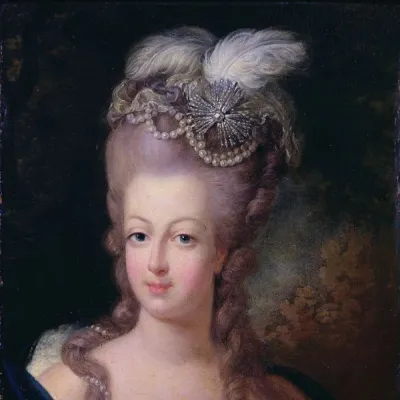
Marie Antoinette
Human Design Chart
Biography
Human Design Analysis: Marie Antoinette as Manifesting Generator 3/5
Manifesting Generator 3/5 — Design at a Glance
Marie Antoinette's Design featured a tendency towards hybrid dynamics: She had the constant, sacral energy of a Generator combined with the ability of a Manifestor to skip steps and produce quick results. This configuration created a tension between the need to respond to impulses and the inclination for rapid, parallel action.
Her Human-Design as a manifesting generator meant that while she needed the same basic strategy as generators—waiting and responding to life's impulses—she also possessed the potential to accelerate processes. However, this speed carried specific risks. If important steps were overlooked, it often led to the necessity of backtracking and catching up, which caused frustration, in line with the non-self theme of this type. Additionally, her design tended to pursue multiple projects simultaneously, driven by various impulses.
Without constant verification of inner consent, this creativity could quickly turn into overextension. Therefore, her strategy required that she check at each new undertaking whether her sacral center still gave a clear "yes." Only under these conditions—through variety and playful engagement with her many interests—could Marie Antoinette draw deep satisfaction from her work. Her design thus did not promote linear focus but rather multi-layered reactive activity, which was only successful when she maintained the play mode and did not act against her inner authority.
Sacral Authority
Marie Antoinette had a decision-making process that did not take place in her Head Center but was rooted deeply within her body. As a Generator, her strategy and inner authority were identical: she responded to life rather than initiating it. Her sacral authority served as the primary filter for all actions. She waited for external stimuli before waiting for a physical resonance – an internal "Hmm" or surge of energy signaled approval, while nausea indicated warning. This mechanism greatly simplified her process by providing clear physiological signals.
Her design also featured supportive Instinct-Authority through her activated Spleen Center, giving her the ability to react quickly and spontaneously and to have immediate access to instinctive perceptions of her well-being. She could reliably orient herself with these physical impulses. When her sacral energy resonated with something, she felt vital and acted with great enthusiasm, fully immersed in the activity without obsessive purposefulness. This configuration shaped a lifestyle carried by joy and contentment as long as she listened to her inner voice and did not swim against the current of her natural energy.
The 3/5 Profile — Martyr / Heretic
Marie Antoinette's design set a dynamic of personal experimentation and public failure or success. As an Experimenter-Hero (Profile 3/5), she showed herself to be someone who initially accepted nothing at face value, but rather had to try everything out for herself. She learned from her experiments and failures, then used this practical knowledge to solve problems for others. This attitude made her attractive to those who wanted to learn from her experiences, yet the role of the hero was painful when she publicly failed.
Line 3 (Gate 44) drove the necessity of adaptation and bond-testing through direct experience. She was vulnerable to illusions and projections but needed Root support and assertiveness to recognize her ego. Awareness alone was not enough; she required the backing of a community. At the same time, Line 5 called for private reflection and timing. In times of crisis, she offered practical solutions, yet she had to hide her intentions until her reflection was complete. Premature sharing of these thoughts led to confusion. The tension between the pressure for public adaptation with the risk of failure and the need for secrecy shaped her experience. She had to learn to choose the right timing for revealing herself carefully so as not to destabilize others by involving them too early in her processes.
Split Definition — Defined & Open Centers
Marie Antoinette's design established a constant, mechanical presence: persistent mental pressure for inspiration and concept formation, reliable communication, and immense vital energy through reaction. Her defined Head and Ajna centers generated a permanent internal stimulus to question and form concepts. This mental process was her natural way of thinking, even though it lacked a direct source of energy. The connection to the defined Throat center allowed her to clearly express these thoughts. Her power source lay in the defined Sacral center; she possessed enormous vitality that could only be activated through correct reactions to external stimuli. This was complemented by the defined Spleen center, which created spontaneous intuition and awareness of health and well-being in the present moment.
In contrast to this internal structure stood four open centers: G, Heart, Solar Plexus, and Root. The open G center meant that identity and direction were not fixed but initiated by place and relationship; she tended to reflect her environment rather than impose a rigid personality. In the open Heart center, there was no constant energy for willpower and promises; the need to prove personal worth was a conditioned trap, not an inner truth. The open Solar Plexus center absorbed emotions from the surroundings without personalizing them; she acted as a barometer for emotional climate rather than having stable moods of her own. Finally, the open Root center took on external stress but did not carry it as a personal burden. This openness required a stance of waiting: identity was found through the right place, willpower did not need to be proven, emotions were observed rather than lived, and external pressure was recognized without being driven by it.
Channels for intuitive power, charisma, clarity and awareness.
Marie Antoinette's design carried an insatiable drive for immediate, charismatic action. This impulse came from Channel of Charisma 34-20, which channeled raw physiological energy from the Sacral center directly into the Throat center. This connection created a speed of implementation that made it difficult for her to sit still; her generative power met manifestation before rational considerations could intervene. Without inner guidance, this energy could become obsessive or misdirected, driven by its own momentum like an unguided rocket.
Her self-reinforcement was central: Her energy served her own satisfaction and vitality, not the draining by others. This led to natural self-absorption; she was often busy reacting correctly to stimuli and thus did not always make herself available to others. This unavailability was not a lack of interest but a mechanical necessity to maintain her charismatic presence.
Additionally, Channel of Power 34-57 linked intuitive insight from the Spleen with sacral life force. This created a strong survival instinct and awareness of threats in her environment. Her intuition reacted spontaneously to vibrations from people or places, free from time constraints through thinking or emotions. This defensive intelligence kept her acoustically alert and physically fit but prioritized her own well-being over others' needs.
Channel of Awareness 61-24 shaped her mental landscape with sudden insights (Satori). Her mind did not seek logical patterns or predictions but waited for inspiration that appeared in a moment of silence. This transformative knowledge broke old cycles and offered new perspectives, yet required patience as knowledge only emerged at its own pace.
Further Gates like 44 (Awareness), 19 (Resources), and 33 (Reflection) supported this dynamic through cellular memory and the need for secure territory. Marie Antoinette's design suggested that her strength lay in authentic reactions to the present moment, while forced adaptations or ignoring her inner guidance led to chaos and exhaustion.
Individual Circuitry — Circuit Signature
Marie Antoinette's design contained two separate energetic poles: one area of cognitive intuition and another of emotional expression and survival power. This separation shaped her experiential world as parallel, non-directly connected streams.
In the Knowledge Circuit, she linked Head with Ajna center. This generated intuitive flashes but lacked direct access to her emotional or physical expressive capacity. Parallel to this, in the same circuit, Throat and Spleen centers worked separately. Here expression occurred, guided by the intuitive wisdom of the Spleen center – a process of individual confirmation through spontaneous perception.
The second pole lay in integration. Here energy flowed directly between Sacral, Spleen, and Throat centers. This connection secured her survival: The reactive power from the Sacral center (Gate 34) was guided by the intuitive knowledge of the Spleen center (Gate 57) and culminated in immediate expression or action in the present moment (Gate 20, Throat center). This gave her a natural presence and the ability to respond immediately to life impulses.
As her definition was divided, these systems existed side by side. Cognitive impulses from Head and Ajna did not directly exchange with the powerful, reactive dynamics of Sacral, Spleen, and Throat. Marie Antoinette therefore had to learn to integrate these different sources – intuitive thinking on one hand and physical, emotional action capacity on the other – as separate but equally valid aspects of her identity without falsely experiencing them as a single continuous flow.
Right Angle Cross of the Four Ways 3
Marie Antoinette's Human Design shows the signature of the right cross of the four paths 3. This configuration establishes a specific energetic alignment characterized by a deep connection to the material world and physical realities. In Human-Design, this cross represents the path of incarnation; it describes a nature programmed to bring ideas and visions into tangible forms.
Marie Antoinette thus appeared as someone whose life was strongly influenced by interaction with the Physical. The mechanics of this design require no abstract detachment but rather a direct encounter with the substance of life. It's about the ability to make the invisible visible and manageable. For Marie Antoinette, this meant that her energy was directed towards creating or maintaining structures that exist in the material realm.
This aspect of her chart explains a certain heaviness or grounding in her presence, regardless of external circumstances. She did not live solely in the spiritual but her design demanded she engage with concrete realities. The right cross of the four paths 3 often endows a person with the potential to act as a stabilizing force by bringing chaos into form. Marie Antoinette was predisposed through this mechanism to bridge the gap between the spiritual and material, focusing clearly on realization in the here and now. Her life energy thus naturally flowed into areas requiring physical presence.
Saturn Return — Life Cycles
Marie Antoinette's design indicated a profound inner maturation process marking the transition from youthful innocence to conscious, independent responsibility. This concrete process was evident in 1783 when she turned 28 years old and had herself painted in a simple linen dress. For her Human Design, this was a typical moment of the first Saturn Return: during this phase, years of groundwork and inner development often solidified into a tangible result. The choice of simple clothing signaled not just a fashion decision but an expression of newly found self-determination and clarity about her role. The first Saturn Return functions in Human-Design as the first major maturation threshold where the individual learns to take responsibility for their life, not out of compulsion but from growing awareness. Marie Antoinette used this time to redefine her identity beyond external expectations. The mechanics of this cycle support the integration of earlier experiences and foster a more stable foundation for future decisions. Through this conscious shaping of her image, she demonstrated how the Saturn Return can contribute to carrying inner values outward and thus establishing a more authentic presence in life.
Manifesting Generator · Sacral Authority — Synthesis
Marie Antoinette's life was marked by an internal dynamic between action and reaction. As a Manifesting Generator, she possessed the ability to quickly initiate things, yet her design required her to first react to external impulses before becoming active. This combination of initiating energy and sacral response created a personality that was both powerful and adaptable – a pattern evident in her constant shift between social engagement and the need for privacy. The connection between Head and Ajna Centers intensified this internal pressure to constantly think and understand, while the defined Throat allowed her to clearly express her thoughts once the Sacral agreed. Her profile as an experimenter and hero suggests that she learned through personal experiences and was eager to share this knowledge.
The central paradox in Marie Antoinette's design lies in the tension between her ability for quick manifestation and the necessity of reacting to life. She was destined to initiate things, but her sacral center required confirmation before action could take place. This may have led to an internal conflict, a constant weighing between the desire for activity and the wisdom of waiting. The open definition in several centers pointed to high sensitivity to other people's energies, influencing her decisions but also creating feelings of vulnerability.
4 Defined Channels
Incarnation Cross - Right Angle Cross of the Four Ways 3
Solar Return
The Solar Return shows the moment when the sun returns to its exact birth position - your personal solar year.
Life Cycles
Discover the life cycles with a detailed triple view (birth chart, cycle chart, composite).
Human Design Profile
- Strategy
- To respond - wait for something to respond to
- Authority
- Sacral Authority
- Profile
- 3/5 - Martyr / Heretic
- Definition
- Split Definition
- Incarnation Cross
- Right Angle Cross of the Four Ways 3
- Date of Birth
- 02.11.1755 19:30
- Place of Birth
- Wien, Austria
Frequently Asked Questions
What Human Design type was Marie Antoinette?
Which Profile did Marie Antoinette have?
What Authority guided Marie Antoinette's decisions?
What incarnation cross did Marie Antoinette have?
When was Marie Antoinette born?
Discover your own Human Design
Are you also a Manifesting Generator? Find out in a personal reading how to unfold your multi-talents and direct your energy wisely.
More Personalities
Back to overviewAldair

Alizée

Angeli
Arletty
Artus

Balthus