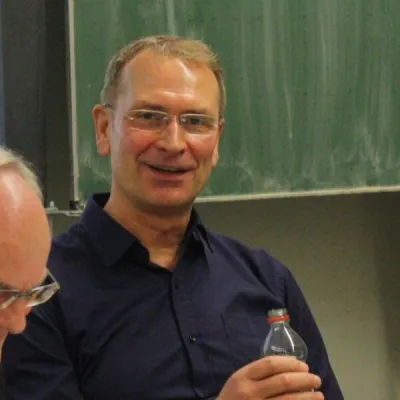
Matthias Behr
Human Design Chart
Biography
He won a gold medal and three silvers at three Olympic Games.
On 19 July 1982, Matthias Behr, and foil fencing in general, became widely known outside of those interested in the sport when, at the world championship in Rome, Behr's blade broke and struck incumbent world champion Vladimir Smirnov in the eye, leading to Smirnov's death nine days later.
Forty years later, amidst the Russian invasion of Ukraine, Behr called Smirnov's former wife in Ukraine, and gave her son-in-law and two grandchildren refuge during the war.
Human Design Analysis: Matthias Behr as Generator 2/4
Generator 2/4 — Design at a Glance
Matthias Behr's design indicated a tendency towards great endurance, which was activated not through constant initiating but by responding to external impulses. As a Generator, he had abundant sacral energy – comparable to that of a workhorse – making him strong and resilient as long as this energy was available for appropriate tasks. This energy primarily released itself when his gut feeling gave a clear "yes."
Two stumbling blocks shaped his dynamics: either he burned out on things he actually didn't want to do, leading to frustration and burnout, or he was held back from heart projects even though he still had plenty of power left. His successful strategy involved waiting for life signals and then acting only when the sacral center prompted him to move forward.
If Matthias Behr lived by this principle of reacting rather than initiating, his design rewarded him with a deep sense of satisfaction and fulfillment. Deviations from it – such as constantly pushing against inner resistance – resulted in ongoing frustration or energy depletion. His path to effectiveness thus did not lie in controlling the start but in consciously responding to what spoke to him externally and was internally affirmed.
Emotional Authority
Matthias Behr showed an internal decision structure that required time as a central element of clarity. His design indicated that spontaneous reactions were unreliable and often clouded by temporary mood swings. This resulted from his emotional authority, carried by the defined Solar Plexus Center. In Human Design mechanics, this authority always takes precedence over all other defined centers, regardless of further configurations in the chart.
Matthias Behr was subject to a natural emotional wave, a permanent up and down of his feelings. The world appeared to him always colored by his current mood: At one moment he could feel totally excited about something, in the next he saw the same thing negatively. His immediate feeling, however, was only a snapshot, not necessarily his deeper truth. Quick decisions made from this emotional heat therefore risked negative consequences.
The mechanics of his authority required patience. By Matthias Behr letting decisions "sleep" multiple times, intense feelings subsided. Over time, he gained emotional distance, which led to calmness and true clarity. This process was particularly crucial for long-term life decisions, as only then could the true inner truth be distinguished from momentary mood swings.
The 2/4 Profile — Hermit / Opportunist
Matthias Behr's Human Design shows a tendency towards a rhythmic alternation between deep withdrawal and social connection. He appeared as someone who constantly oscillated between two fundamental needs: the urge for solitude (Line 2) and the desire to spend time with chosen people (Line 4). For him, it was essential to create a safe environment where he could clearly communicate when company was welcome and when silence was necessary.
During his alone times, Matthias Behr immersed himself in internal processes to find peace and clarity. Once this need was satisfied, the network desire of Line 4 came back into focus again. This cycle allowed him to reflect on and evaluate knowledge from his social environment during phases of isolation, leading to brilliant ideas.
However, this dynamic also carried risks. Strong interference with his withdrawal could trigger extreme reactions from Line 2, which were justified but often followed by regret. In contrast, Line 4 emphasized analysis and strategic patience in seeking alliance partners. Aggressive resistance hindered the necessary trust. Matthias Behr's challenge was to integrate these seemingly contradictory forces—the protective hardness of the hermit and the analytical openness of the networker—into a functional life rhythm without extreme reactions undermining trust in his relationships.
Triple Split Definition — Defined & Open Centers
Matthias Behr's Human Design profile indicates a tendency towards constant, independent presence: Thinking, Communication, Identity, Energy, Emotion, and Stress Management are stabilized by defined centers (Ajna, Throat, G, Sacral, Solar Plexus, Root). This creates a consistent mental function and clear expression. The defined Throat allows him to articulate his thoughts and emotions reliably, while the defined G Center provides a firm sense of self-identity and inner direction. His vital energy from the Sacral Center is available as a constant power source that responds to questions. The emotional depth of the Solar Plexus serves as an authority requiring patience to gain clarity. The defined Root pressure drives him forward and helps in dealing with stress.
In contrast, Head, Heart (Ego), and Spleen Centers are open. These open centers reflect their environment situationally and require protection from conditioning. The open Head Center makes Matthias Behr susceptible to external mental pressure and the temptation to solve others' questions or be influenced by others' doubts. He tends to seek inspiration to escape inner confusion rather than trusting his internal authority. The open Heart Center lacks consistent willpower; he is vulnerable to the pressure of having to prove himself or make promises he cannot keep, which can lead to a cycle of self-doubt. The open Spleen Center allows him to perceive sensitive feelings of well-being or illness in his environment. There is a risk of clinging to unhealthy situations just for the feeling of security from others or making spontaneous decisions that are regretted later. The challenge lies in not misinterpreting these open areas as their own authority but using them as mirrors for inspiration, expressions of will, and intuition from the environment without being conditioned by it.
Channels for clarity, rhythm and emotional release.
Matthias Behr's design points towards a constant generative energy for creating new directions. This power comes from Channel Beat 14-2, which connects material resource availability (Gate 14) with higher knowledge and identity (Gate 2). As a 'Key Holder', he has essential means to translate mutative impulses into material reality not through active direction but by living authentically and trusting his own Sacral reaction.
This generative foundation contrasts with the mental structuring through Channel of Structuration 23-43 (Personality), which links insight with assimilation, clearly expressing innovative perspectives only after internal processing. Additionally, Juxta-Channel of Emotional Release 39-55 connects emotional provocation with the mind, generating a pulsating wave of passion and melancholy.
By openly reacting to life, Matthias Behr mechanically strengthens others in their direction finding. His presence enables people to initiate their own identity or be taken by new paths without him having to direct them. The combination of generative life force and the ability to influence through example shapes his role as an initiator of mutation in social fields.
Individual Circuitry — Circuit Signature
Matthias Behr's design indicates a tendency towards situational, active creative transformation. As a Triple Defined individual, he is not consistently present in this energy but reacts to external inspiration or internal emotional conditions. This shows up as the potential ability to express unique identity, which however is not a constant trait but a reactive possibility.
The Knowledge Circuit shapes this dynamic through three separate segments. First, it connects Ajna with Throat Center (Channel 43-23), enabling structuring and clear communication. Second, it links Identity to Sacral Center (Channel 2-14), creating a rhythmic, pulsating beat for individuality. Third, it ties Solar Plexus to Root Center (Channel 55-39), releasing emotional waves and anchoring them acoustically in the present.
These center groups are energetically isolated from each other in Matthias Behr; there is no direct flow between them. Instead, they exist as parallel adjacent forces: structural clarity, rhythmic identity, and emotional intensity. The energy is pulsing and acoustic but only effective under specific conditions for structuring or emotional expression. Thus, Matthias Behr carries the capacity for innovation and mutation, activated by inspiration (Channel 1-8 in the general context of the circuit) or inner resonance, not as a constant state but as situational responses to the environment.
Right Angle Cross of Tension 1
Matthias Behrs Human-Design legte eine Tendenz zu einer abstrakten, architektonischen Spannungsstruktur fest. Es handelte sich um ein reines Strukturelement ohne energetische Aktivierung; kein Kanal war aktiviert und kein Zentrum definiert. Dies prägte ihn als jemanden, der im Hintergrund wirkte, nicht durch direkte Kraftausübung, sondern durch die Schaffung eines stabilen Rahmens. Die Mechanik dieser Konfiguration zeigt, dass es hier nicht um dynamischen Fluss oder emotionale Beteiligung ging, sondern um eine statische, aber essentielle Ordnungsfunktion. Matthias Behr zeigte sich als jemand, der diese Spannung trug, ohne sie in konkrete Handlungen umzusetzen. Es war ein Hintergrundkontext, der die Form gab, ohne selbst Inhalt zu liefern. Diese Struktur wirkte wie das unsichtbare Gerüst eines Gebäudes: nicht sichtbar im Alltag, aber notwendig für den Zusammenhalt des Ganzen. Ohne definierten Zentren blieb er von spezifischen energetischen Drängen frei, was ihm eine gewisse Neutralität verlieh. Die Spannung 1 bildete dabei einen Punkt der potenziellen Anspannung, der jedoch nicht aufgelöst wurde, sondern als konstante Größe vorhanden war. Dies bedeutete für Matthias Behr, dass er stets in einem Zustand der latenten Bereitschaft stand, ohne dass dieser Zustand zwangsläufig zu Aktion führte. Seine Präsenz war eher strukturell als energetisch; er bot Stabilität durch seine bloße Existenz innerhalb dieses Systems. Diese Konfiguration beschrieb eine Lebensaufgabe, die weniger mit dem Tun als mit dem Sein in einer bestimmten Form verbunden war. Matthias Behr verkörperte damit die Idee der reinen Struktur, die anderen ermöglichte, sich darin zu bewegen und zu orientieren, ohne dass er selbst aktiv lenkte oder steuerte.
Saturn Return · Uranus Opposition · Chiron Return · 2nd Saturn Return — Life Cycles
Matthias Behrs Human-Design legte eine Tendenz zu einer ersten großen Strukturierungsphase fest, die mit einer Konfrontation mit Tod und Verlust einherging. Diese Dynamik zeigte sich konkret 1982: Im Alter von 27 Jahren erlebte er den todbringenden Unfall von Wladimir Smirnow während der Weltmeisterschaften in Rom. Für sein Design war dies kein isoliertes Trauma, sondern ein markanter Punkt des ersten Saturn-Returns. Dieser Zyklus fungiert als erste ernsthafte Begegnung mit der Endlichkeit und zwingt zur innerlichen Ordnung. Die Erfahrung eines solchen plötzlichen Verlusts im Umfeld wirkte wie ein Katalysator, der jahrelange Vorarbeit auf eine neue, tragfähige Basis stellen musste. Es ging nicht um Heilung im emotionalen Sinne, sondern um die Notwendigkeit, Strukturen zu schaffen, die auch unter dem Druck von Krisen und der Konfrontation mit der Vergänglichkeit standhalten können. Matthias Behr zeigte sich in dieser Phase als jemand, der durch den Schock des Verlusts gezwungen war, seine eigenen Grenzen und Prioritäten neu zu definieren. Der Unfall Smirnows wurde zum Wendepunkt, an dem sich die abstrakte Mechanik des Saturn-Returns – die Forderung nach Reife und Struktur – in einer schmerzhaften, aber notwendigen Weise im Leben auswirkte. Dies prägte die weitere Entwicklung hin zu einer tieferen, wenn auch schwereren, innerlichen Stabilität.
Generator · Emotional Authority — Synthesis
Matthias Behrs Human-Design offenbart einen zentralen roten Faden der dynamischen Selbstentdeckung und des transformativen Ausdrucks. Die starke sakrale Definition, gekoppelt mit emotionaler Autorität und dem Kanal des Beats (14-2), deutet auf eine tiefe Energiequelle hin, die jedoch erst durch Reaktion auf äußere Impulse aktiviert wird. Diese Reaktionsfähigkeit wird durch das definierte Ajna-Zentrum verstärkt, welches Wissen filtert und formuliert, um es über das Throat-Zentrum auszudrücken – ein Prozess, der durch den Kanal der Strukturierung (43-23) eine klare Form erhält. Das Profil als Naturtalent/Netzwerker unterstreicht die Notwendigkeit, zwischen Phasen des Rückzugs zur inneren Reflexion und dem Austausch mit einer ausgewählten Gemeinschaft zu wechseln, um kreative Energie zu bündeln und neue Perspektiven zu entwickeln.
Ein zentrales Paradox in Matthias Behrs Design liegt im Spannungsfeld zwischen der tief verwurzelten, emotional gefärbten Individualität (G Center, Solar Plexus) und dem Bedürfnis nach Verbindung und Anerkennung durch andere (definierte Zentren mit Verbindungen zum Throat-Zentrum). Während das Design auf eine klare innere Autorität hinweist, die unabhängig von äußeren Einflüssen ist, sucht es gleichzeitig Bestätigung und Austausch im Netzwerk der Beziehungen. Diese Spannung manifestiert sich in der Fähigkeit, innovative Ideen zu generieren und auszudrücken, während gleichzeitig ein sensibles Abstimmen auf die Bedürfnisse anderer stattfindet – eine Balance zwischen Selbstverwirklichung und sozialer Interaktion.
3 Defined Channels
Incarnation Cross - Right Angle Cross of Tension 1
Solar Return
The Solar Return shows the moment when the sun returns to its exact birth position - your personal solar year.
Life Cycles
Discover the life cycles with a detailed triple view (birth chart, cycle chart, composite).
Human Design Profile
- Type
- Generator
- Strategy
- To respond - wait for something to respond to
- Authority
- Emotional Authority
- Profile
- 2/4 - Hermit / Opportunist
- Definition
- Triple Split
- Incarnation Cross
- Right Angle Cross of Tension 1
- Date of Birth
- 01.04.1955 18:30
- Place of Birth
- Tauberbischofsheim, Germany
Frequently Asked Questions
What is Matthias Behr's Human Design type?
What Profile does Matthias Behr have in Human Design?
What authority does Matthias Behr possess?
Which incarnation cross is active for Matthias Behr?
When was Matthias Behr born?
Discover your own Human Design
Are you also a Generator? Find out in a personal reading how to use your sacral energy correctly and discover deep satisfaction.
More Personalities
Back to overviewAaliyah

Aldair

Alexia

Angèle

Anne-Marie

Arcángel